What happened here
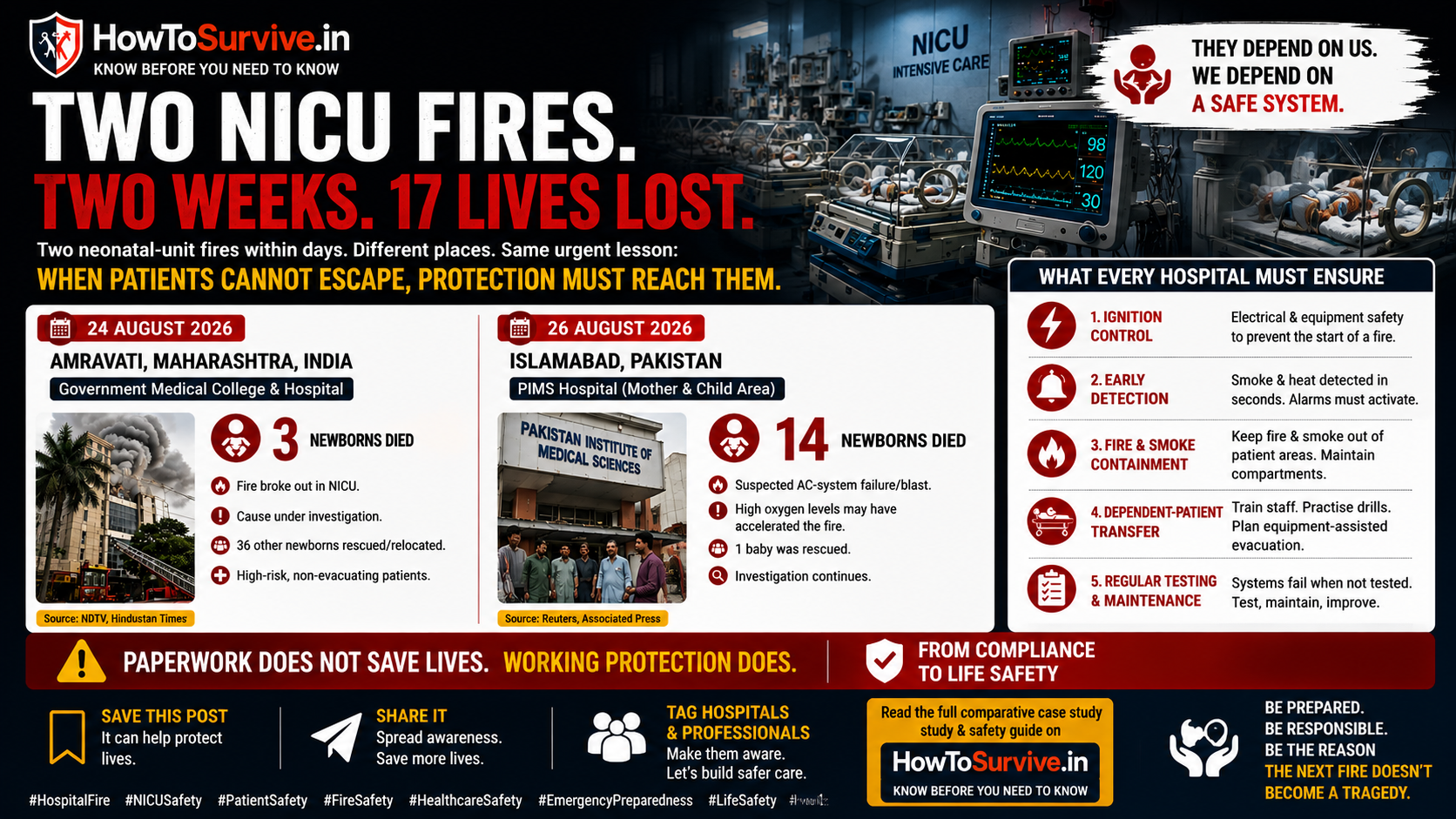
A comparative hospital-fire record examining reported neonatal deaths. Because the original post combines two incidents and casualty claims, each number must remain separated and source-dated.
Two Neonatal-Unit Fires, 17 Newborn Lives Lost: Critical-Care Fire Safety Cannot Depend on Self-Evacuation
HowToSurvive.in | Know Before You Need to Know
DATE & LOCATION
INCIDENT 1 — INDIA
24 August 2026, approximately 3:30 AM
Special Newborn Care / Neonatal Intensive Care Unit, District Women’s Hospital, Amravati, Maharashtra, India.
Three newborns died. Reporting says 36 other newborns were rescued/relocated.
INCIDENT 2 — PAKISTAN
26 August 2026, approximately 6:45 AM
Nursery, Mother and Child Health facility, Pakistan Institute of Medical Sciences — PIMS, Islamabad, Pakistan.
Fourteen newborns died. At least 15 newborns were reportedly inside the nursery and one survived/rescued.
Combined impact
17 newborn deaths in two hospital fires within roughly three days.
This comparison is being made for systemic learning, not to suggest the incidents shared the same cause.
WHAT HAPPENED
AMRAVATI
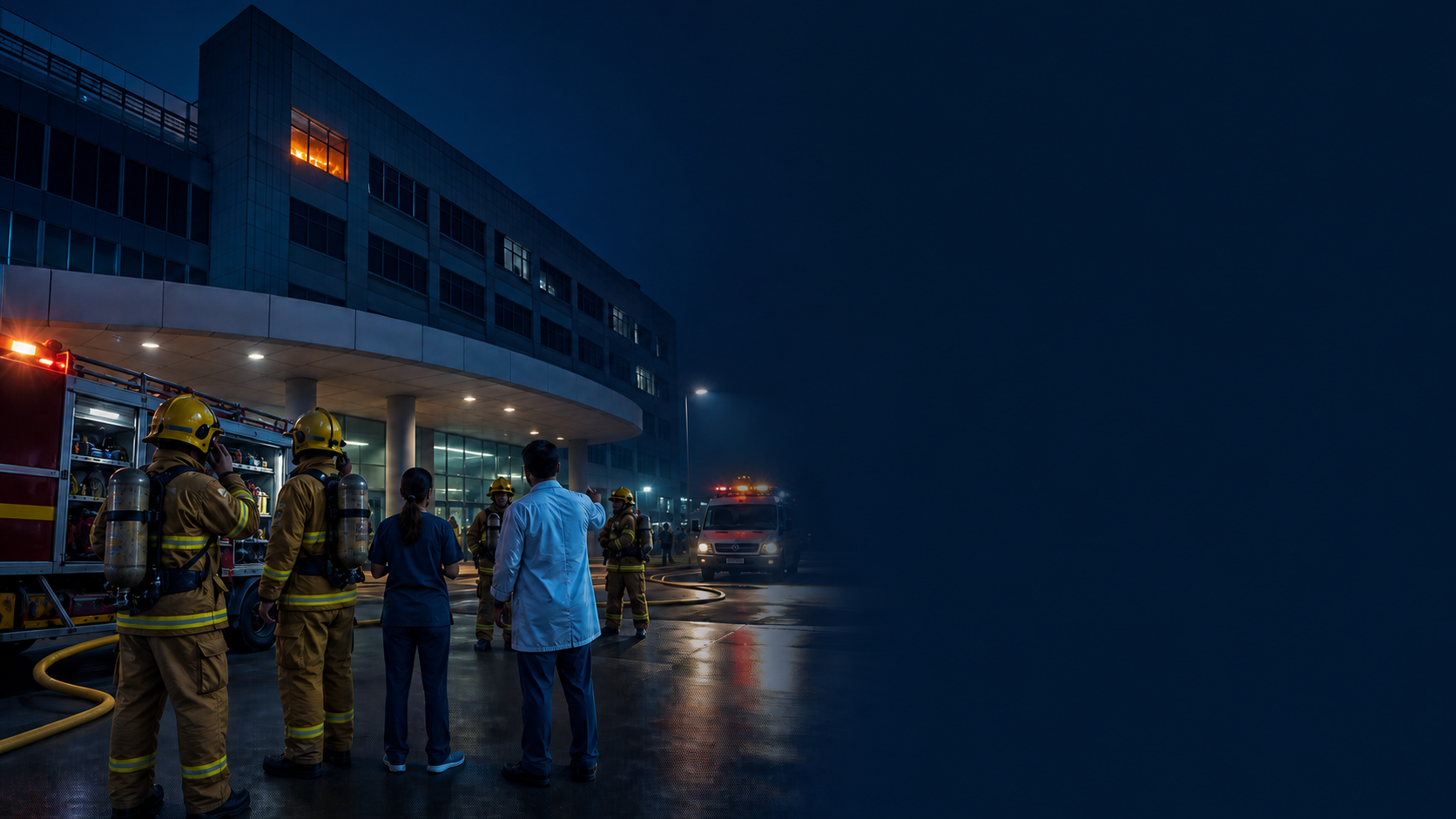
A fire broke out in the neonatal/SNCU area of the District Women’s Hospital during the early hours of 24 August.
Hospital staff began evacuating babies from the affected unit.
Three newborns died, while reporting says another 36 newborns were rescued or relocated because of the fire and smoke conditions.
Reports have referred to a ventilator-related explosion or an electrical short circuit, but authorities ordered an investigation.
Therefore, HowToSurvive.in does not treat either mechanism as the final established cause.
ISLAMABAD
Two days later, another fire broke out in the nursery on the third floor of PIMS’s Mother and Child facility in Islamabad.
Fourteen newborns died.
One baby survived/rescued.
The fire was largely confined to the nursery, but rescuers reportedly had to reach parts of the affected area through windows.
Early official accounts pointed toward an air-conditioning system/compressor or electrical fault. Reuters reported the health minister saying that elevated oxygen conditions contributed to rapid fire spread.
Investigators examining the site on 27 August were still considering the precise initiating source, with AP reporting preliminary possibilities including an air-conditioning unit or nebulizer.
Again:
Suspected origin ≠ final forensic cause.
INCIDENT SNAPSHOT
| AMRAVATI | ISLAMABAD | |
|---|---|---|
| Date | 24 Aug 2026 | 26 Aug 2026 |
| Facility | District Women’s Hospital | PIMS |
| Area | SNCU/NICU | Newborn nursery |
| Time | ~3:30 AM | ~6:45 AM |
| Deaths | 3 newborns | 14 newborns |
| Other babies | 36 rescued/relocated reported | 1 rescued/survived reported |
| Suspected origin | Conflicting early reports around ventilator/electrical failure | AC/compressor/electrical equipment under investigation |
| Investigation | Ordered | Multiple inquiries underway |
| Major challenge | Dependent neonatal patients | Dependent neonatal patients |
COMBINED
17 NEWBORN LIVES LOST
But the number should not become the entire story.
The important question is what hospitals everywhere can learn before the next emergency.
TIMELINE
24 AUGUST — AMRAVATI
~3:30 AM
Fire breaks out in the neonatal/SNCU area.
↓
Staff respond and babies are evacuated.
↓
Three newborns die.
↓
Other newborns are moved/rescued.
↓
Authorities order investigation.
↓
Maharashtra government announces compensation and directs wider safety action.
↓
26–27 August
Maharashtra orders broader fire, electrical, building/structural and medical-equipment safety audits across hospitals and requires designated fire-safety nodal responsibility.
26 AUGUST — ISLAMABAD
~6:45 AM
Fire reported in PIMS newborn nursery.
↓
Fire spreads rapidly within the affected area.
↓
Emergency response mobilised.
↓
Rescuers access the affected area, including through windows.
↓
Fourteen newborn deaths confirmed.
↓
One baby survives/is rescued.
↓
Prime Minister orders investigation.
↓
Health secretary removed/suspended from the role following the tragedy.
↓
27 August
Investigators inspect the nursery.
A special committee is tasked with urgent recommendations and a fuller report.
CONFIRMED FACTS VS PRELIMINARY CLAIMS
CONFIRMED — AMRAVATI
✓ Fire occurred in the newborn critical-care area.
✓ Three newborns died.
✓ Other babies were evacuated/rescued.
✓ Government investigation was ordered.
✓ Maharashtra subsequently ordered wider hospital-safety audits.
PRELIMINARY / UNDER INVESTIGATION
⚠ Whether the initiating event was specifically a ventilator explosion.
⚠ Whether an electrical short circuit initiated the fire.
⚠ Exact sequence of equipment and fire-system performance.
CONFIRMED — ISLAMABAD
✓ Fire occurred in the hospital nursery.
✓ Fourteen newborns died.
✓ One newborn survived/rescued.
✓ The affected nursery was on the third floor.
✓ Investigations have been ordered.
PRELIMINARY / REPORTED
⚠ Exact electrical/equipment initiating source.
⚠ Whether an AC compressor, wiring fault, nebulizer or another component was the primary source.
⚠ Witness allegations concerning exits and staffing.
Those allegations must be investigated rather than repeated as established facts.
WHAT WENT WRONG?
We should not create one forensic explanation for two unrelated fires.
The causes remain subject to investigation.
But both incidents expose the same fundamental vulnerability:
NEWBORNS ARE COMPLETELY DEPENDENT OCCUPANTS.
A healthy adult may:
hear an alarm → recognise danger → disconnect themselves → find an exit → walk downstairs → reach safety.
A newborn in critical care cannot perform any of those actions.
Some may also depend on:
- oxygen,
- ventilatory support,
- incubators,
- monitoring,
- intravenous therapy,
- thermal support.
That means hospital life safety cannot be designed around:
“ALARM → EVERYONE LEAVES.”
The system has to protect patients while trained people organise their movement to safety.
WHY IT BECAME DANGEROUS
A. FIRE + OXYGEN-ENRICHED CONDITIONS
Oxygen itself does not burn.
But increased oxygen concentration can make combustible materials ignite more readily and burn more intensely.
Reuters reported that Pakistan’s health minister said high oxygen levels in the PIMS nursery accelerated the fire.
That makes oxygen management particularly important in critical-care environments.
B. SMOKE
In many fires, smoke becomes the immediate life threat.
Smoke can:
reduce visibility → impair breathing → create confusion → obstruct evacuation → expose highly vulnerable patients.
A neonatal patient has essentially no ability to protect themselves from it.
C. ELECTRICAL LOAD
Critical-care rooms contain substantial electrically powered equipment.
Potential hazards include:
- monitors,
- ventilators,
- incubators,
- infusion equipment,
- air-conditioning,
- sockets,
- cables,
- extension arrangements,
- electrical panels.
That makes electrical inspection and preventive maintenance part of fire prevention, not merely maintenance housekeeping.
D. DEPENDENT EVACUATION
Moving a newborn from critical care is not equivalent to walking an adult through an exit.
Staff may have to preserve:
airway + oxygen + temperature + monitoring + medical support
while simultaneously escaping a fire environment.
Seconds therefore matter.
WHAT COULD HAVE PREVENTED OR REDUCED LOSS?
No responsible analysis can claim one measure would definitely have prevented these deaths.
Hospital safety requires layers.
PREVENT
- electrical preventive maintenance;
- medical-equipment inspection;
- safe oxygen management;
- appropriate wiring and circuit protection;
- controlled combustible loading;
- safe air-conditioning/electrical equipment;
- housekeeping.
DETECT
- reliable automatic fire detection;
- appropriate alarm coverage;
- staff notification;
- continuously functional systems.
CONTAIN
- fire/smoke compartmentation;
- protected doors;
- penetration sealing;
- smoke management;
- controlled spread between patient areas.
SUPPRESS
- appropriate first-aid firefighting equipment;
- functioning fire-protection systems;
- trained staff response where safe.
TRANSFER
- neonatal evacuation procedures;
- defined safe receiving areas;
- adequate staff;
- portable medical support;
- practised horizontal evacuation where appropriate.
VERIFY
Perhaps the most overlooked step:
TEST WHETHER THE SYSTEM ACTUALLY WORKS.
Not:
“Is there an alarm?”
But:
“Does the alarm operate?”
Not:
“Is there an emergency exit?”
But:
“Can it actually be used?”
Not:
“Was an audit completed?”
But:
“Were defects corrected and re-tested?”
SURVIVAL GUIDE
IF YOU ARE A PARENT OR ATTENDANT IN A HOSPITAL
If you discover fire or smoke:
1. RAISE THE ALARM
Immediately alert hospital staff and emergency responders.
2. DO NOT DELAY REPORTING
Do not assume someone else has already called.
3. FOLLOW STAFF EVACUATION DIRECTIONS
Critical-care evacuation requires coordination.
4. KEEP CORRIDORS CLEAR
Do not crowd around the affected ward.
5. CLOSE DOORS WHERE SAFE
Doors can help slow smoke and fire movement.
6. DO NOT USE LIFTS UNLESS SPECIFICALLY AUTHORISED FOR FIRE EVACUATION
Use the hospital’s designated emergency procedure.
7. MOVE AWAY FROM SMOKE
Do not enter a smoke-filled neonatal or ICU area attempting an unprotected rescue.
8. GIVE RESPONDERS INFORMATION
Tell firefighters/staff:
where patients remain → how many → what medical support they require.
WHAT NOT TO DO
❌ DON’T RUN INTO A SMOKE-FILLED NICU
An unprotected rescuer can become another casualty.
❌ DON’T BLOCK CORRIDORS
Firefighters and medical teams need immediate access.
❌ DON’T MOVE CRITICAL EQUIPMENT RANDOMLY
Patient transfer must preserve essential life support wherever possible.
❌ DON’T OPEN EVERY DOOR
Opening doors can alter smoke/fire movement.
❌ DON’T USE LIFTS AUTOMATICALLY
Follow the hospital’s emergency procedure.
❌ DON’T RETURN FOR BELONGINGS
Life first.
❌ DON’T ASSUME “THE HOSPITAL WILL HANDLE IT”
Parents and attendants should still know:
nearest exit + alarm location + emergency number + assembly/safe area.
VISUAL / DATA BOX
WHEN THE PATIENT CANNOT ESCAPE, THE SYSTEM MUST.
THE CRITICAL-CARE FIRE-SAFETY CHAIN
PREVENT
Electrical + equipment + oxygen safety
↓
DETECT
Find fire while it is still small
↓
CONTAIN
Keep smoke and fire away from patients
↓
SUPPRESS
Control escalation
↓
TRANSFER
Move dependent patients safely
↓
VERIFY
TEST. MAINTAIN. DRILL. RE-TEST.
One broken link can change the outcome.
OFFICIAL RESPONSE + SYSTEMIC LESSON
INDIA
Following the Amravati deaths, Maharashtra ordered immediate hospital audits covering fire safety, electrical systems, building/structural safety and medical equipment.
Hospitals are also being required to identify fire-safety nodal responsibility, with institutional leadership accountable for safety lapses.
That is an important response.
But an audit only protects life when the process continues:
AUDIT → DEFECT → RESPONSIBILITY → RECTIFICATION → RE-TEST → CLOSURE
A report sitting in a file cannot stop a fire.
PAKISTAN
Prime Minister Shehbaz Sharif ordered an investigation after the PIMS tragedy.
Investigators visited the nursery on 27 August. AP reports that a special committee has been asked for urgent recommendations within 48 hours and a fuller report within five days.
The investigation should establish not merely what ignited, but how every protection layer performed.
THE SYSTEMIC LESSON
These fires occurred in different countries.
They involved different buildings.
They may ultimately have completely different initiating causes.
But they share one unavoidable principle:
THE LESS ABLE A PATIENT IS TO ESCAPE, THE MORE RELIABLE THE BUILDING’S PROTECTION MUST BE.
Hospitals should therefore ask more than:
“Are we compliant?”
They should ask:
- Will we detect the fire early?
- Will smoke remain contained?
- Will emergency power perform?
- Are electrical and medical systems maintained?
- Are exits genuinely usable?
- Can staff move dependent patients?
- Has that movement actually been practised?
- Were previous audit defects closed?
- Can firefighters reach the affected area quickly?
- Does every shift know exactly what to do?
Because critical-care fire safety is not primarily about paperwork.
It is about buying enough safe time to keep patients alive.
- Conditions exceed normal control
- Occupants or witnesses identify danger
- People move or require assisted evacuation
- Public services control the incident
- Authorities examine cause, compliance and corrective action
Why consequences escalated
- Occupancy must match the approved use
- Detection and two usable escape routes are essential
- High-risk fuel, smoke, water or blast exposure requires separation
- Vulnerable occupants need planned assistance
- Reported cause and liability must follow evidence
Failures and risk multipliers
- Using unapproved or incompatible space
- Allowing one route to become a single point of failure
- Delaying alarm or evacuation
- Ignoring prior complaints or inspection findings
- Publishing unverified casualty or cause claims
People closest to the evidence
““Safety principle””
A building or industrial system must remain survivable after one foreseeable failure.
Actions that reduce risk
- Verify lawful occupancy
- Check detection and two exits
- Control fuel, water and structural hazards
- Plan assistance and accountability
- Practise evacuation
- Call the appropriate emergency service
Leave a comment