
Quick answers
Do fire extinguishers have an expiry date?
Not all of them. Whether one is still fit for use depends on its type, build, charge and condition, and on regular inspection, maintenance, refilling and pressure testing. A disposable unit must be replaced after use or when its maker says so.
Is a green gauge enough to show an extinguisher works?
No. The gauge shows only the pressure. Also check that the pin and seal are in place, and look for rust, dents, leaks or a damaged hose.
Can I refill or pressure-test an extinguisher myself?
No. You can check access, the gauge, the seal and visible damage, but opening, refilling, internal maintenance and hydrostatic testing must be done by competent service staff with the right parts and equipment.
What should I do after an extinguisher has been used?
Report it and send it for refilling or replacement before anyone relies on it again, even after a short burst. A disposable unit must be replaced.
Fire extinguishers do wear out, and the Indian standard IS 2190 sets a life counted from the date of manufacture, explained below, although many units carry no expiry label. Whether an extinguisher is still fit to use depends on its type, its condition and whether it has been inspected, refilled and tested on time. It is your first line of defence against a small fire, so it has to work on the day you need it.
What decides how long an extinguisher lasts
- The type of extinguisher
- Whether it is disposable or rechargeable
- How well it has been maintained
- When it was made
- What the manufacturer recommends
The rules in India
In India, follow IS 2190:2024, the Bureau of Indian Standards code of practice for selecting, installing, maintaining and testing portable and mobile extinguishers, along with the maker’s instructions. The 2024 revision sets quarterly and yearly inspections, and says that maintenance, refilling and testing must be done by a competent person: someone with the training, experience, tools, parts and maker’s information the job needs.
You will find many websites quoting 6-year and 12-year intervals. Those come from the United States. Do not copy them into an Indian maintenance plan. A disposable (non-rechargeable) extinguisher must be replaced after any use, or when its maker says so.
How to tell if your extinguisher needs attention
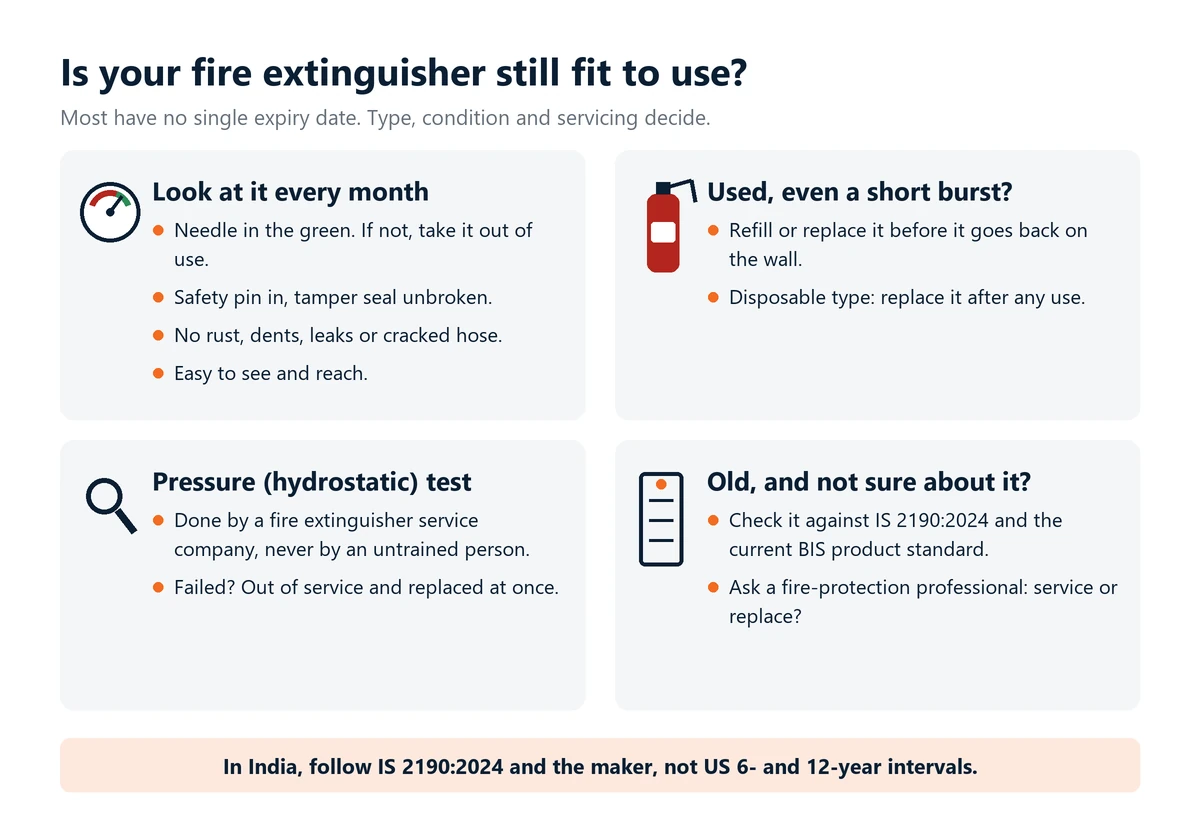
Some extinguishers carry an expiry or replacement date from the maker, but many do not, which makes it hard to know when to replace them. That is why you should look at each one once a month. Check for these:
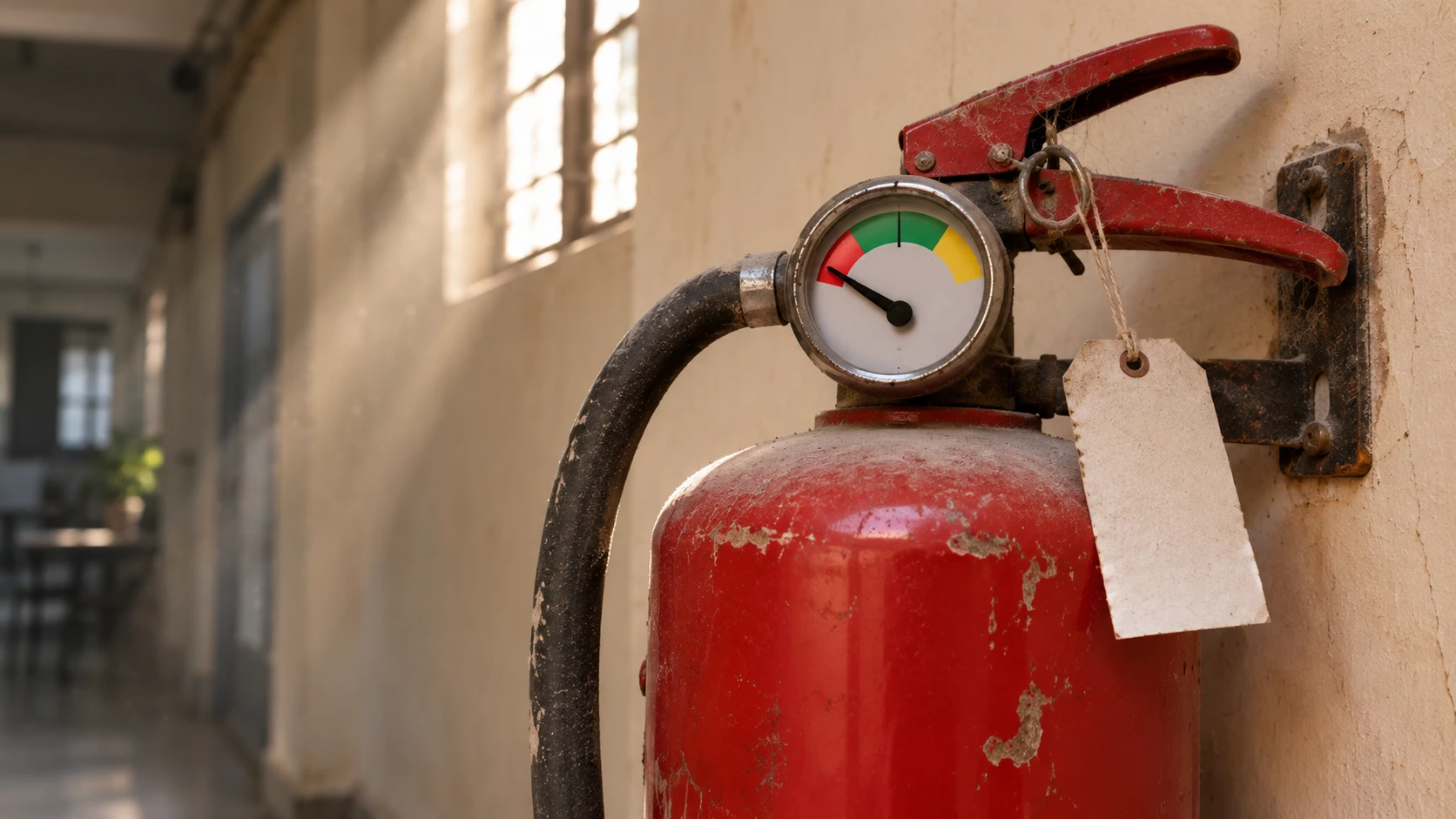
- Pressure. Many extinguishers have a pressure gauge. If the needle has moved out of the green zone, take the extinguisher out of use and have it serviced or replaced by a competent person. An extinguisher that has lost pressure will not work. A green needle on its own does not prove that everything else is fine, though.
- Pin and seal. The safety pin should be in place and the tamper seal unbroken.
- Damage. Rust, corrosion, dents, leaks, a cracked hose or broken parts mean it may not work properly and may need replacing.
- Access. It should be easy to see and reach, not hidden behind cartons or furniture.
Pressure testing
A fire extinguisher service company can carry out a hydrostatic test, which checks whether the cylinder can still safely hold pressure. If it fails, the extinguisher must be taken out of service and replaced at once. This test needs proper equipment and must never be tried by an untrained person.
How often the test is due depends on the type of extinguisher. As one example, the oil-industry standard OISD-STD-142, updated in February 2026, sets a hydrostatic test once in five years for DCP extinguishers. That schedule is written for oil-industry sites, so check what applies to your premises.
After it has been used
Even a short burst counts. Once an extinguisher has been used, it must be refilled or replaced before it goes back on the wall.
Older extinguishers
As rules change and technology improves, some types of extinguisher are no longer needed. Check older units against IS 2190:2024 and the current BIS product standard for that type. If you have an old extinguisher and are not sure about it, ask a fire-protection professional whether it can still be serviced or should be replaced.
When it is time to replace one, our fire extinguisher chooser helps you pick the right type for the place where it will hang.
Is there a fixed life for an extinguisher? What the earlier IS 2190 said
Yes, the previous edition of the Indian code did set one. IS 2190:2010 counted the life of an extinguisher from its date of manufacture: 10 years for water, foam, powder and clean agent types, and 15 years for carbon dioxide (Annex F). It added that an extinguisher which fails its pressure test must be rejected at once, even before those years are up. BIS replaced that edition with IS 2190:2024, whose full text we could not open, so treat the figures below as the older benchmark and ask your service agency which clause of the current edition applies to your units.
The 2010 text also fixed how often the body must be pressure tested with water (Annex E). Every extinguisher in a premises had to be covered, and at least one third of the units were to be tested each year, so the whole set was done in rotation.
- Every 3 years: water, foam, dry powder and clean agent extinguishers.
- Every 5 years: carbon dioxide extinguishers, tested whenever the cylinder goes for recharging.
Separate from the pressure test was a discharge (operational) test, also done in a yearly rotation (Annex D). Stored-pressure water and foam units came up once in two years, BC and ABC powder units once in three years, and carbon dioxide, clean agent and trolley-mounted powder units once in five years. In a corrosive place such as a chemical works or a coastal site, the standard said it was desirable to test at half those intervals.
What to do with an extinguisher that is retired
The 2010 code said a rejected extinguisher should be cut across the body and made unusable before disposal, so that nobody refills and reuses it, and the date and method of disposal should go into the extinguisher register (clause 14). It also said that while a unit is out for service or recharging, it should be replaced by one of the same class and at least equal rating, and never by a unit taken from another facility (clause 15.1.1). A recharge is checked by weighing, so the gross mass matches the figure on the label (clause 15.1.3).
A short routine you can follow
- Read the manufacture date on each label and write it in a register, with the date you will review the unit.
- Ask the agency for the date of the last pressure test and the next one, and note both.
- If the label is unreadable or the date is missing, treat the unit as unknown and ask the agency to assess or replace it.
- Keep a replacement of the same class ready before an old unit leaves for service.
- Do not keep or resell a rejected extinguisher. Ask the agency to make it unusable and give you a record.
The older text is public, and you can read it in the 2010 edition of IS 2190 on the Public.Resource.Org archive. Use it to understand the thinking, but follow the current edition and the maker’s label for your own units.
Check yours today
Walk round your home, shop or office and look at every extinguisher. Is it easy to reach? Is the pin in, the seal intact and the needle in the green? When was it last serviced? If any answer worries you, call your service provider this week, and keep other protection in place while a unit is away for service.
What needs attention
- The gauge shows only one thing; a green needle does not prove the extinguishing agent, valve, hose or cylinder is fine
- A disposable or non-rechargeable unit must be replaced after use or when the maker says so
- A rechargeable unit still needs proper refilling, maintenance and testing by a competent person
- A hydrostatic test checks the cylinder under controlled water pressure and can be dangerous without proper facilities
- Corrosion, dents, exposure to fire, damaged threads or a leak can mean a unit must come out of service before its due date
- Service records should stay with the extinguisher for its whole life
- An extinguisher is first-aid equipment for small fires; it does not replace alarms, evacuation or fixed fire protection
Controls that reduce risk
- Create an extinguisher register with serial number, type, location and due dates
- Check that each unit is visible, accessible and appropriate for the hazard
- Look for a missing pin or seal, gauge outside its operating range, corrosion, dents, leakage or damaged hose
- Read the manufacture, maintenance and hydrostatic-test markings rather than guessing from appearance
- Tag and isolate suspect units so nobody relies on them
- Book service only with a competent provider using correct parts, agent and test equipment
- Place equivalent protection while a unit is removed
- Teach staff that an extinguisher is optional only for a tiny fire with a clear exit; evacuation comes first
Common unsafe practices
- Copying a 6-year or 12-year US interval into an Indian maintenance plan without checking IS 2190:2024
- Looking only at a green gauge and ignoring corrosion, damage, blocked hoses or missing seals
- Rehanging an extinguisher after a brief discharge without servicing it
- Letting an untrained person open, refill or pressure-test a cylinder
- Painting over labels, service records or cylinder markings
- Mixing incompatible agents, parts or recharge materials
- Leaving an area without equivalent protection while units are away for service
- Discarding a pressurised cylinder in ordinary waste or deliberately discharging it without safe arrangements


Leave a comment