
What happened here
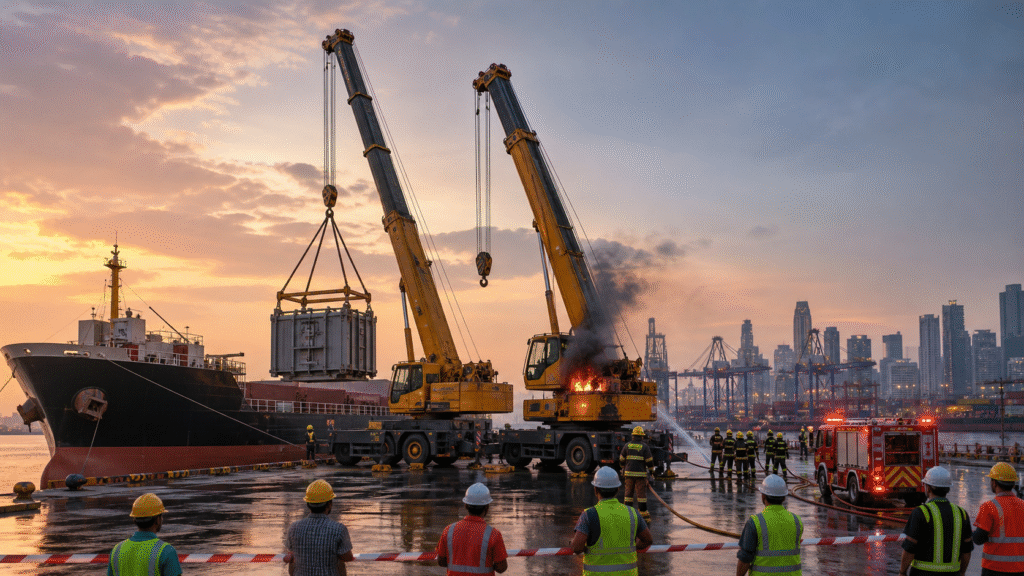
During a two-crane lift of project cargo reported at about 140 tonnes from the Barbados-flagged vessel Vienna, the operation became unstable. One mobile crane overturned or shifted into the vessel and caught fire; two operators were injured. Mumbai Port ordered a safety investigation and coordinated surveys and recovery planning.
Quick answers
What happened in the Mumbai Port crane fire?
On 30 August 2026, during a two-crane lift of about 140 tonnes of cargo from the vessel Vienna at Mumbai Port, the lift became unstable. One crane's boom struck the vessel and caught fire, two crane operators were injured, and the port fire brigade put out the fire.
What caused the Mumbai Port crane accident?
Police accounts said a lifting strap reportedly slipped or the load became imbalanced, shifting weight onto the second crane. This sequence is preliminary; Mumbai Port ordered a safety investigation and no final engineering finding was public.
Why is a tandem lift with two cranes risky?
A tandem lift behaves as one connected system. Load share is not automatically equal, and if one sling or crane stops carrying its share, force can transfer to the other crane within seconds and destabilise it.
What to do if a crane load tilts or rigging slips during a lift?
Give or obey the stop signal and leave the fall and overturn zone. Never try to steady a heavy load by hand. If fire starts, raise the alarm and call 112 or 101 from safety, and keep away from tyres and pressurised systems.
Mumbai Port Crane Fire: Safety Lessons from a 140-Tonne Tandem Lift Failure
HowToSurvive.in | Know Before You Need to Know
📅 Date & Location
– Incident: 30 August 2026, approximately 7:30 PM
– Reporting date: 31 August 2026
– Location: BPS port area, Mumbai Port, Maharashtra, India
– Operation: Unloading a reported 140-metric-tonne cargo from the Barbados-flagged vessel Vienna using two mobile cranes
– Outcome: Two crane operators injured; crane fire extinguished by Mumbai Port fire brigade
🕯️ What Happened?
During a two-crane cargo-unloading operation, one lifting strap reportedly slipped after the lift became imbalanced. Published police accounts said the load then shifted suddenly onto the second crane.
The transferred force reportedly lifted or destabilised the second crane. Its telescopic boom struck the vessel, and the impact/friction was followed by a crane fire. Mumbai Port fire-brigade personnel responded and extinguished the flames.
Both crane operators were injured and taken to St George Hospital. Yellow Gate Police initiated an inquiry into the precise sequence and cause.
The reported account is preliminary. It should not be treated as a complete engineering finding about rigging design, crane capacity, ground support, coordination, equipment condition or human performance.
📊 Incident Snapshot
| Item | Reported information |
|---|---|
| Time | About 7:30 PM, 30 August 2026 |
| Cargo | Approximately 140 metric tonnes |
| Lift method | Tandem lift using two cranes |
| Vessel | Vienna, Barbados flag |
| Reported initiating problem | Strap/load imbalance during unloading |
| Escalation | Load transfer, crane instability/boom contact and fire |
| Injured | Two crane operators |
| Fire response | Mumbai Port fire brigade |
| Investigation | Police inquiry initiated |
⏱️ Reported Timeline
Before 7:30 PM — Two cranes were positioned to unload a heavy cargo unit from the vessel.
During the lift — A lifting strap reportedly slipped or lost its intended load share.
Seconds later — Weight transferred towards the second crane, changing forces far more quickly than a normal controlled lift.
Escalation — The second crane became unstable or lifted, its telescopic boom contacted the vessel, and fire followed.
Emergency response — Port firefighters extinguished the blaze. The two operators were transported to hospital.
Afterward — Police opened an inquiry into the exact cause and sequence.
✅ Confirmed Facts vs ⚠️ Preliminary Claims
Supported across multiple reports
– Two cranes were involved in handling one approximately 140-tonne cargo.
– A crane caught fire during the unloading operation.
– Two operators were injured and hospitalised.
– Mumbai Port fire brigade extinguished the fire.
– Authorities began an inquiry.
Preliminary and requiring technical investigation
– Why the strap slipped or load became imbalanced.
– The actual load share carried by each crane at every stage.
– Crane configuration, radius, boom angle and rated capacity at the moment of failure.
– Condition, certification and compatibility of slings, straps and lifting points.
– Whether the lift plan anticipated sudden load transfer.
– Ground-bearing capacity, outrigger reactions and communication performance.
– The exact ignition mechanism following contact.
🔍 What Made This Lift High-Risk?
1. One load depended on two machines
In a tandem lift, each crane’s load changes as the cargo rotates, slews, rises or shifts. A failure at one connection can transfer force rapidly to the other crane.
2. Load share is not automatically equal
Two cranes do not necessarily carry 50% each. Centre of gravity, hook geometry, sling length, crane movement and load orientation determine the real distribution.
3. Stored energy changed suddenly
A slipping strap or uncontrolled movement can create shock loading. Dynamic forces may exceed those predicted for a slow, stable lift.
4. Crane-to-vessel proximity
Booms, cargo and rigging operate close to the ship. Loss of control can produce collision, structural damage, sparks, hydraulic release or fire.
5. Operators were exposed inside the equipment
Crane cabins are close to mechanical, hydraulic and electrical systems. An equipment fire can restrict escape and expose the operator to heat and smoke.
🧯 Prevention and Loss-Reduction Layers
PLAN THE LIFT
– Classify multi-crane work as a complex/critical lift.
– Use a competent lift planner and one authorised lift director.
– Calculate centre of gravity, load share and worst-case transfer for every stage.
– Confirm crane capacity at the actual radius and configuration—not nominal maximum capacity.
– Define stop criteria for imbalance, unexpected movement, communication loss or weather change.
VERIFY RIGGING
– Confirm weight, lifting points and rigging arrangement.
– Inspect and certify slings, straps, shackles, hooks and spreader beams.
– Protect soft slings from sharp edges and abrasion.
– Conduct a controlled trial lift only as allowed by the engineered plan.
CONTROL BOTH CRANES
– Use one agreed communication method and one signal authority.
– Synchronise hoisting, slewing and lowering speeds.
– Monitor each crane’s actual load continuously where suitable systems are available.
– Stop immediately if load share departs from the planned envelope.
PROTECT PEOPLE
– Establish an exclusion zone covering the load, crane overturning and boom-fall areas.
– Keep all non-essential personnel away.
– Maintain unobstructed operator escape and emergency-service access.
PREPARE FOR FIRE
– Inspect hydraulic and fuel systems.
– Provide suitable extinguishing capability and rapid isolation.
– Brief operators on shutdown and escape procedures.
– Coordinate port fire response before exceptional lifts.
🛡️ How Workers and Bystanders Should Respond
– Never enter the area beneath or beside a suspended load.
– If a lift tilts, rigging slips or a crane moves unexpectedly, obey the stop signal and move away from the fall/overturn zone.
– Do not attempt to steady a massive load by hand.
– If fire starts, raise the alarm and call 112/101 under the site procedure.
– Operators should use emergency shutdown and escape procedures only if safe.
– Do not approach a burning crane: tyres, hydraulic accumulators, fuel and pressurised components may fail violently.
– Give responders the cargo manifest and identify hazardous materials immediately.
📢 Systemic Lesson
A tandem lift is not two ordinary lifts happening together. It is one interconnected system in which a change at one crane can overload or destabilise the other within seconds.
The plan must therefore answer the hardest question before lifting begins:
What happens if one crane or one rigging leg suddenly stops carrying its planned share?
💡 What Organisations Can Do Today
– Audit all planned multi-crane lifts.
– Name one competent lift director with stop-work authority.
– Verify certified cargo weight and centre of gravity.
– Include sudden load-transfer scenarios in the engineered plan.
– Test communication and emergency shutdown before lifting.
– Share investigation findings across ports, contractors and crane operators.
🔚 Closing Line
When two cranes share one load, they also share every mistake. Engineering, communication and stop-work authority must move together.
More on Mumbai: see our Mumbai fire and emergency safety guide for fire brigade numbers, every fire station and the local risks to know.
- Two shore-based mobile cranes were arranged for project-cargo handling alongside M/V Vienna at BPS Berth.
- Reporting based on police accounts said a sling or lifting strap lost its intended position or the lift became imbalanced. The load share changed abruptly.
- One crane became unstable and its telescopic boom contacted the vessel. Fire followed. The exact ignition sequence remains subject to investigation.
- Mumbai Port firefighters extinguished the fire. Two crane operators were taken to St George Hospital.
- Police and port authorities investigated. Mumbai Port said vessel, P&I, insurer, operations/maintenance and other representatives were engaged in surveys, assessment and safe crane removal.
Why consequences escalated
- The publicly supported facts are the two-crane operation, approximately 140-tonne cargo, crane instability/overturning, vessel contact, fire and two injured operators. These facts do not by themselves prove the precise rigging failure or allocate responsibility.
- A tandem lift behaves as one connected system. Load share is determined by centre of gravity, hook geometry, crane position and motion; it is not automatically equal and can change rapidly. A loss of support at one point can transfer force to the other crane within seconds.
- The port's later statement establishes a formal safety investigation and multi-party survey process. That is more reliable than treating the first police description as a completed engineering finding.
- Fire became a secondary emergency after the lifting failure. Fuel, hydraulic systems, tyres and pressurised components can make an overturned or damaged crane unsafe to approach even after visible flames reduce.
- The strongest prevention question is whether the written critical-lift plan modelled an abnormal load-transfer scenario and defined the safe response before lifting began. The public record reviewed does not answer that question.
Failures and risk multipliers
- Assuming each crane will carry half the load through the complete movement.
- Relying on an approximate cargo weight or unverified centre of gravity.
- Treating sling movement as a small rigging issue instead of a possible system-wide load transfer.
- Checking capacity only at pickup rather than at every radius and stage.
- Continuing after imbalance, unexpected crane movement or loss of communication.
- Entering the overturn or fire zone before the crane and stored-energy hazards are controlled.
- Reporting a preliminary sequence as the final investigation conclusion.
Actions that reduce risk
- Require an engineered critical-lift plan for the exact load, cranes, configurations, rigging and complete path.
- Verify cargo weight, centre of gravity, lifting points and below-the-hook equipment.
- Calculate expected and credible worst-case load share for each stage.
- Assess outrigger reactions, ground support, nearby vessel geometry and crane-to-crane interaction.
- Appoint one lift director and rehearse radio, signals and emergency stop.
- Set an exclusion zone for load swing, overturn and falling-object hazards.
- Conduct a controlled trial lift and stop if balance or instrumentation differs from the plan.
- Pre-plan shutdown, safe landing, fire response and hazardous-cargo information for responders.
- Preserve rigging, data logs, crane configuration and scene evidence for investigation.
Leave a comment