

Quick answers
What is a clean agent fire suppression system?
It releases an electrically non-conductive gaseous agent, such as a halocarbon or an inert-gas blend, into a defined space after fire detection. It is designed for a particular hazard and enclosure, not as a universal substitute for sprinklers, compartmentation or evacuation.
Is carbon dioxide fire suppression safe for occupied rooms?
No. Carbon dioxide is not an occupant-safe shortcut; its extinguishing concentration can incapacitate or kill within seconds and may collect in pits and adjacent low areas.
Does a clean agent system leave no damage after a fire?
Little agent residue can reduce cleanup, but it does not mean no fire, smoke, soot, corrosive decomposition products or downtime. Non-conductivity protects energised assets from the agent, not from heat or combustion damage.
What to do when a gas suppression pre-discharge alarm sounds?
Leave the protected room immediately, warn others, close the door if safe and call 112 from outside. Never enter a discharged enclosure even if the air looks clear, and wait for trained responders to ventilate, test and release the space.
What a clean-agent system is
A clean-agent system releases an electrically non-conductive gaseous agent into a defined space after fire detection. It is normally designed for a particular hazard and enclosure, not as a universal substitute for sprinklers, compartmentation or evacuation. The agent may be a halocarbon or an inert-gas blend. Carbon dioxide is another gaseous suppressant, but it must not be described as generally safe for occupied spaces: the US Environmental Protection Agency warns that its total-flooding design concentrations can be lethal.
The useful advantages—and their limits
Correctly designed gaseous systems can reach spaces around equipment and leave little agent residue. This can reduce cleanup compared with some other extinguishing methods. It does not guarantee undamaged electronics or uninterrupted operations: fire, smoke, soot, corrosive decomposition products and the agent discharge itself can still affect people or equipment. No agent should be called environmentally safe without naming the chemistry and checking current exposure and climate information.
Design around the actual room
A competent fire-protection designer should verify the current contents, room volume, openings, leakage paths, pressure relief, hold time, detection logic, alarm interfaces and discharge sequence. People need a clear pre-discharge warning, a usable escape route and training. The correct design concentration and occupant-exposure limits depend on the particular agent. Inert-gas systems reduce oxygen, while halocarbon systems have agent-specific exposure and decomposition considerations.
Inspection and changes
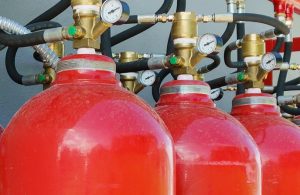
Keep the as-built design, agent data, cylinders, nozzles and test records together. Review the system whenever partitions, cable penetrations, ventilation, equipment layout or occupancy change. Use a competent service provider to test alarms, shutdowns, time delay and any approved abort or lockout feature without an unintended discharge. Confirm that replacement agent and cylinder service remain available; environmental and supply conditions can change.
What occupants should do
On a fire or pre-discharge alarm, leave the protected area promptly, warn others and call 112 from a safe place in India. Do not stay behind to protect equipment or enter a discharged enclosure to investigate or rescue property. Tell responders if anyone is missing, and wait for trained personnel to test and release the space. This is a guide to questions and precautions, not a system design or permission to service a pressurised installation.
Sources: US EPA, substitutes for total-flooding agents; US EPA, carbon-dioxide life-safety risks; Government of India, 112. Reviewed 29 September 2026.
What needs attention
- No residue can reduce cleanup but does not mean no fire, smoke, corrosive decomposition products or downtime
- Electrical non-conductivity protects energised assets from the agent, not from heat, soot or combustion damage
- Inert gases extinguish by reducing oxygen and require concentration and egress assessment
- Halocarbon systems rely on exposure limits and minimum design concentrations specific to the agent
- CO2 extinguishing concentration can incapacitate or kill within seconds and may collect in pits and adjacent low areas
- Door fans or other enclosure-integrity methods are important because leakage can prevent hold time
- Agent availability, refill logistics and environmental policy must be included in lifecycle planning
Controls that reduce risk
- Confirm the protected hazard still matches the original design basis
- Identify the exact agent chemistry, quantity, listing and current refill source
- Review safety data, design concentration and occupant-exposure provisions
- Test detection, pre-discharge alarms, time delay, shutdowns, abort or lockout and monitoring under an approved procedure
- Inspect room boundaries and seal undocumented penetrations after engineering review
- Verify pressure-relief venting and cylinder restraint
- Post clear entry and discharge warnings and train every affected worker
- Create a transition plan for agents facing supply or HFC policy changes
Common unsafe practices
- Calling carbon dioxide safe for occupied spaces
- Assuming every zero-ozone-depletion agent is also low climate impact
- Selecting an agent by brand name without checking chemistry, listing, supply and regulatory direction
- Installing suppression without early detection and pre-discharge warning
- Ignoring pressure relief, room leakage, cable penetrations or ventilation shutdown
- Allowing staff to enter after discharge because the gas is invisible and leaves no residue
- Testing release circuits without lockout, permit and coordinated safeguards
- Failing to protect the room while cylinders are discharged, removed or awaiting refill

Leave a comment