
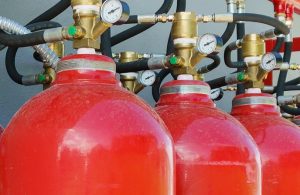
Quick answers
Is FM-200 the same as HFC-227ea?
Yes. FM-200 is a trade name for HFC-227ea, a gas that puts out fire mainly by absorbing heat and leaves no residue.
Is a CO2 flooding system safe in a room where people work?
No. The concentration needed to put out a fire is lethal, so people must be kept out, with alarms, a delay before release and supervised lockout during maintenance.
Which is better for a server room, FM-200 or CO2?
If people work in the room, an agent approved for occupied rooms such as FM-200 is usually the safer choice. CO2 suits normally empty spaces. The final choice must follow IS 15493:2021 and your fire authority's approval.
Does FM-200 harm the environment?
It does not damage the ozone layer, but the US EPA lists its global-warming potential at 3,220. India's HFC phase-down under the Kigali Amendment starts with a freeze in 2028, so plan for refills and replacement.
If your company is putting a gas flooding system into a server room, an electrical panel room or a record room, the contractor will usually offer two options: FM-200 or CO2. Both replaced the old Halon systems, both are gases, and both leave no powder or water behind. But they are not interchangeable. One of them can be designed for rooms where people work. The other can kill anyone who is inside when it goes off.

What FM-200 is
FM-200 is a trade name for a gas called HFC-227ea. It puts out a fire mainly by soaking up heat. It acts fast, does not conduct electricity, leaves no residue and does not harm the ozone layer. It can be used on fires in ordinary solids such as paper and plastics, on flammable liquids, and around live electrical equipment. Because nothing has to be cleaned up afterwards, the room can get back to work quickly.
FM-200 can be designed for rooms where people are normally present, but only within approved concentration and exposure limits, with alarms and a clear way out. It is not “harmless”. When it meets flame or very hot surfaces it can form hydrogen fluoride and other harmful breakdown products, especially if the discharge or the extinguishing is slow.
You will usually find FM-200 in:
- data centres, server rooms and computer rooms
- telecom exchanges and control rooms
- military installations
- museums, art galleries and archive or record rooms
- pharmaceutical units and medical facilities
What a CO2 system is
A carbon dioxide (CO2) system floods the room with gas and brings the oxygen level down until the fire cannot keep burning. It also acts fast, does not conduct electricity and leaves no residue. It suits flammable liquids, electrical equipment and surface fires in solids.
The catch is people. The US Environmental Protection Agency (EPA) says the minimum CO2 concentration used to flood a room is 34%, and that level is lethal. A person caught inside can pass out before they have time to find the door. So CO2 flooding is meant for spaces where people are kept out, or are safely out before the gas is released.
CO2 systems are common in:
- power plants and turbine enclosures
- metal production and processing
- printing presses
- automobile plants
- electronics and computer manufacturing
- research facilities and storage areas
FM-200 and CO2 side by side
| FM-200 (HFC-227ea) | CO2 | |
|---|---|---|
| How it works | Mainly absorbs heat | Mainly cuts oxygen |
| Rooms where people work | Possible within approved limits | People must be kept out |
| Residue | None from the agent | None from the agent |
| Ozone-depletion potential | 0 | 0 |
| Global-warming potential (100 years) | 3,220 (US EPA) | 1 (reference value) |
| Main safety worry | Harmful breakdown products in a fire | Lethal at extinguishing levels |
How to choose
Will people be in the room?
This is the first question, not the price. If the space is occupied most of the time, FM-200 or another agent approved for occupied rooms is usually the safer choice. CO2 should not be used where people work. If the area is normally empty, such as a cable cellar or a machine enclosure, CO2 may suit it, but you still need lockout during maintenance, a pre-discharge alarm, a delay long enough to get out and controlled re-entry.
How much space do you have?
CO2 systems often need more cylinders than FM-200 for the same room, so they take up more floor space. That is not always true, though. The number of cylinders depends on the room volume, the concentration needed, the storage pressure and the pipe runs, and it has to be calculated for your room.
What will it cost, now and later?
Prices differ, so get quotations based on proper design calculations, not a rough cylinder count. Think about the future too. India ratified the Kigali Amendment in September 2021, and its schedule for cutting HFCs starts with a freeze in 2028 and reductions from 2032. A system you install today may run for twenty years, so ask your contractor about refilling, agent recovery and what you would switch to later.
The Indian rules
In India, gas flooding systems are designed under BIS IS 15493:2021 for gaseous fire-extinguishing systems, along with the standard for the specific agent and the approval of your local fire authority. US rules such as EPA’s SNAP list and OSHA regulations are useful background, but they are US practice and do not decide what is allowed here.
If the gas alarm sounds
Leave the room at once when the pre-discharge alarm goes off. Do not stay to save a server or collect your bag. Never go into a room after a CO2 discharge, not even to pull someone out, unless you are a trained rescuer with breathing apparatus. Call 112 and tell them which gas, which room and whether anyone is missing.
What needs attention
- No harm to the ozone layer does not mean no harm to the climate: the US EPA lists HFC-227ea at a global-warming potential of 3,220
- India ratified the Kigali Amendment in September 2021; its HFC schedule starts with a freeze in 2028 and reductions from 2032, so plan for future supply and recovery of HFC-227ea
- The US EPA says the minimum CO2 room-flooding concentration of 34 percent is lethal
- An EPA review found 62 CO2-system incidents with 119 deaths and 152 injuries, though it warned the records were incomplete and dominated by marine and maintenance events
- Maintenance work on or near CO2 systems was the biggest single cause of accidental injury or death in that EPA review
- Saying FM-200 is "safe for occupied rooms" is only half the story; it depends on concentration, exposure time, escape routes, alarms, breakdown products and the limits in the standard
- Calling CO2 "environment-friendly" misses the point; its climate impact is low, but it can kill people in the room
- HFC-227ea hitting flame or hot surfaces can form harmful breakdown products such as hydrogen fluoride, especially if extinguishing is slow
- Cylinder space and installed cost are not fixed; room volume, concentration, storage pressure, reserve supply, pipe runs and local supply all need calculating
- Neither gas system replaces required sprinklers or stops a battery or deep-seated fire from flaring up again
Controls that reduce risk
- Read the system nameplate and confirm whether the gas is HFC-227ea or CO2, not just the brand name
- Check the design concentration, room volume, number of cylinders and the latest room-integrity test
- Mark where people normally sit, where maintenance staff go and any low areas where gas can collect
- For CO2, check supervised lockout, pre-discharge alarms, escape delay, warning signs, rescue arrangements and air testing before re-entry
- For HFC-227ea, record the gas quantity, any leaks, how it will be recovered, refill availability and a plan for the HFC phase-down
- Test detection, manual release, abort switch where approved, alarms, AC shutdown, dampers, doors and remote signals
- Check pressure-relief vents and any new holes, raised floors or false ceilings that let gas escape
- Brief every contractor before they work on protected equipment or near the release hardware
- Keep the gas safety data sheet, pipe drawings, cause-and-effect chart and emergency contacts at the control point
- Get an engineer's approval before switching to a lower-GWP gas or changing the room
Common unsafe practices
- Choosing CO2 for a room where people work because it is cheap and leaves no residue
- Calling FM-200 harmless because it can be used where people work
- Thinking zero ozone harm means low climate impact
- Ignoring India's Kigali phase-down when buying a system meant to last for decades
- Comparing cylinder counts without proper design calculations
- Using the same detectors, release delay and abort setup for every kind of hazard
- Leaving a CO2 system live during maintenance without supervised lockout
- Relying on smell, feeling short of breath or a handheld alarm as the main warning to get out
- Skipping the room-integrity and pressure-relief checks
- Opening doors or switching on ventilation before the fire brigade has checked for re-ignition and harmful gases
- Assuming no residue means no contamination or corrosion after a fire
- Changing the gas, cylinders or nozzles without a full redesign and approval
Leave a comment