

Quick answers
How should I place diyas and candles safely during festivals?
On a steady holder or plate that will not burn, at least 30 cm away from curtains, garlands, paper and clothes, and out of passages where a child or pet could knock them over. Never leave a diya, candle or agarbatti burning in an empty room.
Is it safe to run many decorative light strings from one adaptor?
No. Too many light strings on one multi-plug adaptor, or a damaged extension cord, can overheat. Check your lights, throw away damaged ones and follow the maker's limit on joining strings.
What should I do if a firework does not go off?
Do not relight it and do not go near it for a while, because it can still burst. A community display run by professionals is the safest choice, and always follow current local rules.
What should I do if clothes catch fire or someone gets a burn?
Stop, drop and roll to put out burning clothes. Cool the burn under cool, clean running water for 20 minutes. Even 10 minutes helps if that's all you can manage. No ice, toothpaste, oil or butter. Cover the burn loosely with cling film or a clean cloth and call 108 if it is large, deep, on the face or hands, or if smoke was breathed in.
Diwali, Durga Puja, Christmas, Eid, a wedding in the family: in India the festive season brings more lights, more diyas, more cooking and more guests than any other time of the year. Put together, they raise the chance of a fire. A few simple habits keep the celebration safe.

Lights and decorations
- Check every string of lights before you put it up. Throw away any with cracked wires, loose bulbs or burn marks.
- Do not run many light strings from one multi-plug adaptor, and do not use a damaged extension cord. Follow the maker’s limit on how many strings can be joined.
- Do not push wires under rugs or doors, or hide them behind cloth and paper decorations, where heat and damage go unnoticed.
- Choose flame-resistant decorations where you can, and keep paper and cloth décor away from lamps and heaters.
- Switch off decorative lights before you go to bed or leave the house.
Diyas, candles and agarbatti
An open flame needs space. Place diyas and candles on a steady surface that will not burn, such as a metal plate or a stone ledge, at least 30 cm (12 inches) away from curtains, garlands, rangoli paper and clothes, as US fire safety guidance advises. Keep them out of passages where people walk and where a child or pet could knock them over. Put them out before you sleep or go out. Never leave a diya, candle or agarbatti burning in an empty room.
Loose synthetic clothing, such as a nylon dupatta or a flowing saree pallu, catches fire easily. Be careful near the puja thali, the stove and crackers.
US figures show how common candle fires are. The NFPA estimated an average of 7,610 home candle fires a year in the US from 2014 to 2018, about 21 a day. India does not publish a comparable number.
Festival cooking
Festival cooking keeps the stove busy for hours, often with a kadhai of hot oil for puris, pakoras and sweets. In the US, cooking is the leading cause of home fires; the US Fire Administration estimated 167,800 residential cooking fires in 2023. The same risk sits in every Indian kitchen.
- Stay in the kitchen while frying. If you must step away, turn off the gas.
- Keep a lid next to the kadhai. If the oil catches fire, turn off the gas if you can reach the knob safely and slide the lid on from the side. Never pour water on burning oil.
- Keep towels, packets and decorations away from the stove.
- Do not cook when you are very tired or have been drinking.
- Check the LPG hose and regulator before the season starts.
Fireworks
The Petroleum and Explosives Safety Organisation (PESO) advises a community display rather than every family handling crackers on its own. That is the safest choice. Where fireworks are allowed:
- check the current local rules on timing and type before you buy;
- buy only from licensed shops, and store crackers away from the puja flame, the kitchen, the stairs and exits;
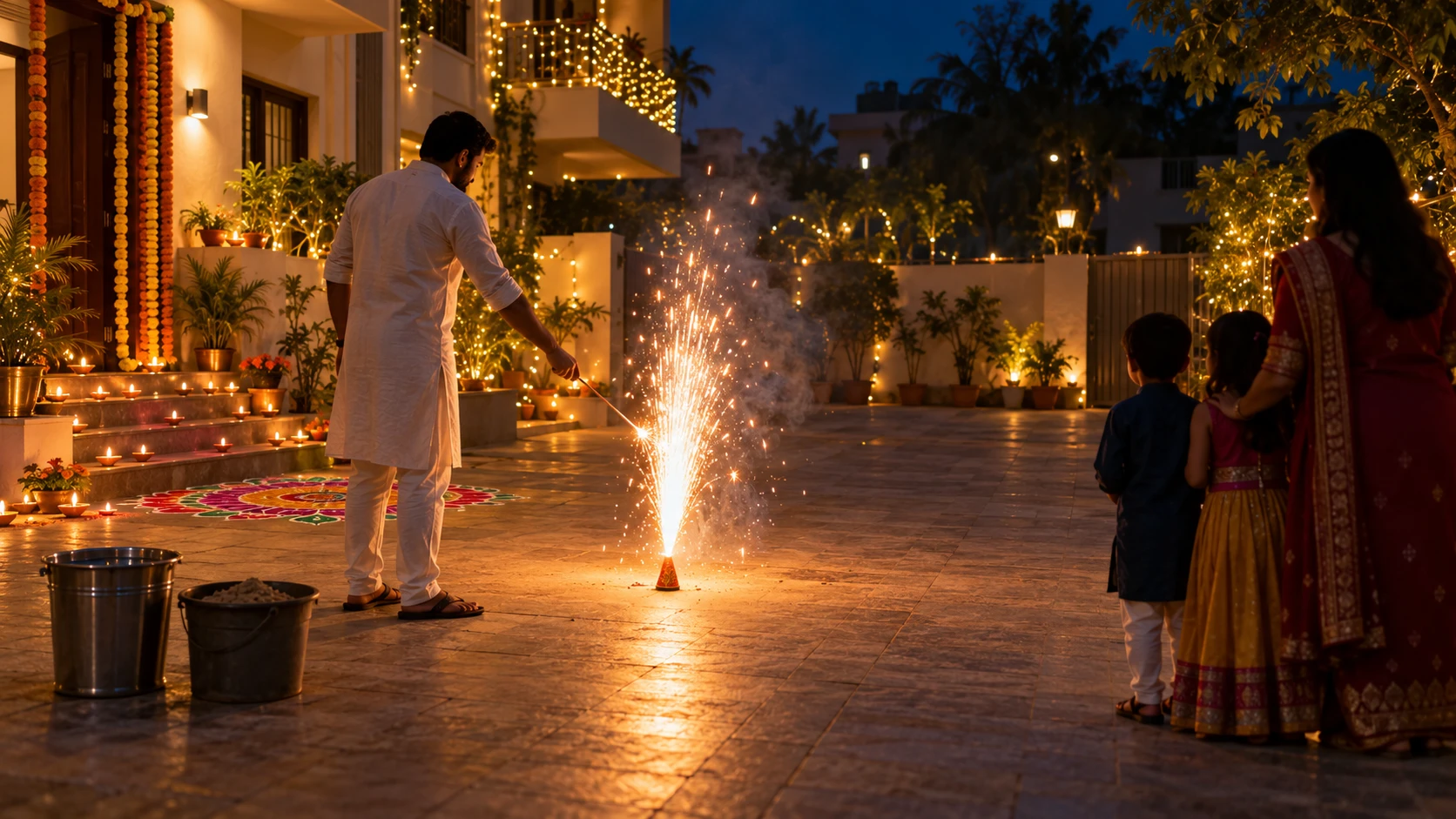
- light them in an open space, never indoors, in narrow lanes or near parked vehicles, buildings or dry grass;
- have one sober adult in charge of the children;
- keep a bucket of water nearby and drop used sparklers and crackers into it;
- never relight a cracker that did not go off, and stay away from it for a while. It can still burst.
Guests and exits
With a house full of guests, footwear, gift boxes and extra chairs pile up at the door and in the stairwell. Keep the main door, the balcony, the corridor and the stairs clear. Test your smoke alarm before the guests arrive and tell them how to get out if there is a fire. Put 101, 112 and your full address where everyone can see them.
If someone gets burnt
If clothes catch fire, stop, drop to the ground and roll. Cool the burn under cool, clean running water for 20 minutes. Even 10 minutes helps if that’s all you can manage. No ice, toothpaste, oil or butter. Do not put any cream on it either. Cover it loosely with clean cling film or a clean cloth and get medical help. Call 108 for an ambulance if the burn is large or deep, if it is on the face, hands or private parts, or if the person breathed in smoke.
Before the next festival, walk from your puja room to the front door and move every carton, shoe rack and decoration that is in the way.
What needs attention
- Temporary festival lights can overload weak connections and hide damaged wires among the decorations
- A diya or candle needs space from curtains, garlands, paper and clothes, and must be kept off paths where it can be knocked over
- Leaving cooking unattended starts more home fires than the dramatic fireworks videos suggest
- Guests, stored gifts and packaging can block an exit that is usually clear
- Sparklers and used fireworks stay hot enough to burn skin or set rubbish alight
- A firework that fails can still go off later and must not be approached or relit straight away
- Two Hindi news videos show real 2025 Diwali fires but do not give national totals
Controls that reduce risk
- Walk every escape route and remove cartons, footwear, decorations and furniture
- Test smoke alarms and put 101, 112 and your full address where guests can see them
- Throw away damaged light strings and follow the maker's limit on connecting them
- Use steady, non-flammable holders for diyas and candles, away from cloth and breeze
- Keep a lid beside the kadhai and never leave hot oil alone
- Put one sober adult in charge of children and of any fireworks that are allowed
- Keep water ready outdoors and keep unused crackers well away from any flame
- Plan help and a way out for elderly people, children, guests with disabilities and pets
Common unsafe practices
- Running many light strings from one multi-plug adaptor or using damaged extension cords
- Taping wires under rugs, doors or decorations that can burn
- Leaving diyas, candles, agarbatti or cooking unattended
- Wearing loose synthetic clothes near a flame, hot oil or fireworks
- Storing fireworks near the puja flame, the kitchen, the stairs or an exit
- Lighting fireworks indoors, in containers, in your hand or near buildings and vehicles
- Relighting a failed firework or going near it straight away
- Using water on burning cooking oil or on live electrical equipment
- Putting ice, toothpaste, butter, oil or cream on a fresh burn
Leave a comment