
Quick answers
What is an electrical cabinet fire suppression system?
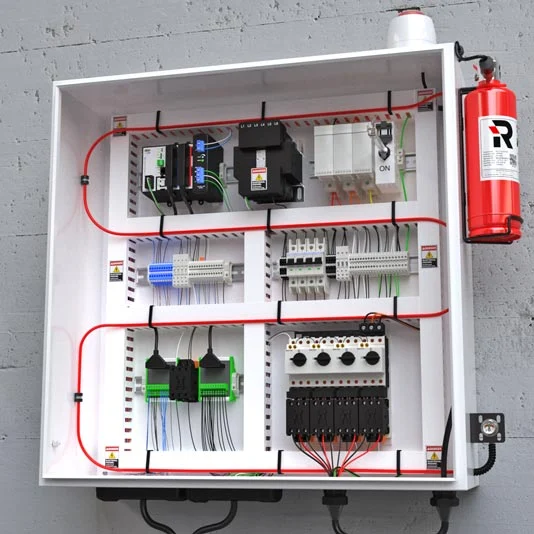
A small unit fitted to an electrical cabinet, panel or enclosure. It detects a fire inside and releases an extinguishing agent at the source, to limit damage and downtime.
How does it detect a fire?
Through smoke detectors, heat sensors or a linear heat detection tube or cable that watches the cabinet all the time and triggers the system when it senses fire.
Which agents are used to suppress fires in electrical cabinets?
FM-200 and CO2 are common because they leave no residue on electronics. CO2 is lethal to people at extinguishing levels, so a room system needs a lockout and a pre-discharge alarm, and nobody should be inside when it goes off.
Where are these systems used?
Data centres, telecom facilities, factories, commercial buildings and power distribution centres use them to protect servers, switches, control panels and distribution equipment.
Does a suppression system replace electrical maintenance?
No. Loose joints and overloading still start the fire. Thermal scans, tight connections and a clear panel room come first.
Panel fires usually start where nobody can see them: a loose lug, an overheated breaker or a failing part inside a closed steel box. By the time smoke comes out from around the door, the damage inside is already done. An electrical cabinet fire suppression system is built to catch that fire inside the box and put it out at the source.
What the system is
It is a small, self-contained unit fitted to an electrical cabinet, panel or enclosure. It watches for fire inside the cabinet and, when it finds one, releases an extinguishing agent straight into it. The aim is to protect costly equipment and avoid a long shutdown.
How it works
- Detection. Smoke detectors, heat sensors or a linear heat detection tube or cable run through the cabinet and keep watch all the time. When they sense a fire, they trigger the system.
- The agent. It is chosen to suit the fire risk and how sensitive the equipment is. The common ones are the clean agent FM-200 (HFC-227ea) and carbon dioxide (CO2). Both leave no residue on electronics.
- Discharge. The agent is released directly into the cabinet. It smothers the fire quickly and stops it spreading to the next panel.
A warning about CO2
CO2 is not a harmless clean agent. At the concentration needed to put out a fire, it is lethal and can kill within seconds. In-cabinet systems release it inside the enclosure, but a leak, or a room-flooding system, can fill a small panel room.
Never let CO2 discharge into a room with people in it. Any room system needs a lockout valve for maintenance and a pre-discharge alarm with a time delay, so that everyone is out first. In India, CO2 systems, including in-cabinet ones, are covered by IS 15528.
Why fit one
- Speed. The fire is tackled inside the cabinet, where it starts, before it can spread.
- Less damage. Clean agents leave little or nothing behind, so there is less harm to electronics and less cleaning afterwards.
- A safer workplace. Catching the fire early cuts the risk of injuries, property loss and work coming to a halt.
- Compliance. It can help you meet fire-safety rules and standards.
Where they are used
- Data centres, for servers and network equipment.
- Telecom facilities, for switches, routers and the other equipment that keeps calls and data running.
- Factories, for control panels and machinery on production lines.
- Commercial buildings, such as offices and shops with large electrical installations.
- Power distribution centres, to keep the supply running.
Before you buy one
A suppression unit is not a substitute for good wiring. Get a thermal scan of your main panels and fix hot joints first. Then, for panels you cannot afford to lose, ask a qualified supplier which agent and size suits your cabinet, and tell them whether people work in that room. Seal unused cable entries so the agent stays inside, wire the alarm to a place where someone will hear it, and get the unit serviced on the maker’s schedule.
This week, go and stand near your main panel. If you smell hot plastic, see discoloured lugs or find cartons stacked in front of it, sort that out first.

What needs attention
- Panel and cabinet fires usually start from loose connections, overheating or failed components inside a closed box
- A small system inside the cabinet can detect the fire with a linear heat tube or sensor and discharge right at the source
- Clean agents such as FM-200 leave little residue on electronics; CO2 also works but is dangerous to people in a closed room
- Water and ordinary building sprinklers do not reach inside a closed cabinet in time
- Detection only helps if someone gets the alarm and the power can be isolated quickly
Controls that reduce risk
- Get a thermal scan of your main panels and tighten or replace hot joints
- For critical panels, ask a qualified supplier about an in-cabinet detection and suppression unit
- Seal unused cable entries so the agent stays inside the cabinet
- Wire the system's alarm to a place where someone will see or hear it
- Keep a CO2 extinguisher near the panel room and train staff to isolate power first
- Service the unit on the maker's schedule and keep the record
Common unsafe practices
- Treating CO2 as a harmless clean agent and using it where people work in a small room
- Leaving cabinet doors open or cable holes unsealed, so the agent escapes
- Overloading panels and ignoring hot smells, discoloured lugs or tripping breakers
- Using a water extinguisher on a live panel
- Never checking the cylinder pressure or detection tube after installation

Leave a comment