
What happened here
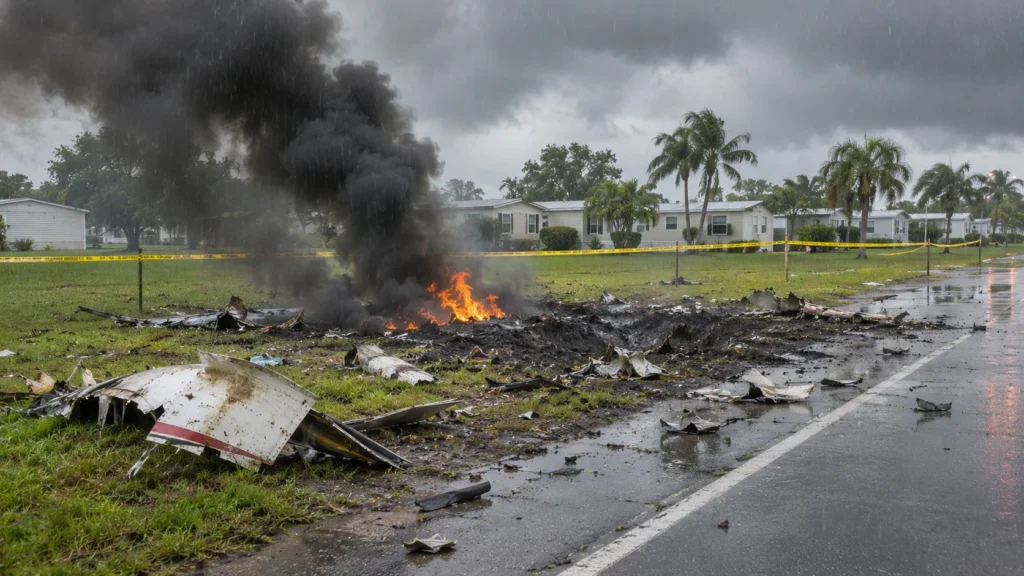
On Sunday, 1 November 2026, a Learjet 60 on a flight from Austin, Texas, to North Eleuthera, Bahamas, dived almost vertically into the ground near Military Trail and 10th Avenue North in Greenacres, Palm Beach County, Florida, during a day of thunderstorms and heavy rain. All nine aboard (two pilots and seven passengers, including a family with two young children) died. One person driving nearby had a leg injury. The crew reported light clear ice and moderate turbulence at 35,000 ft, asked to climb, then declared an emergency and reported an overspeed condition. The NTSB said on 2 November that there is early evidence of break-up before impact and that it is trying to establish the weather at altitude and whether the horizontal stabiliser came off. Hundreds of people from a nearby mobile home community were displaced. The cause is not determined.
Quick answers
What happened at Greenacres on 1 November 2026?
A Learjet 60 flying from Austin to the Bahamas dived into the ground beside a road in Greenacres, Palm Beach County, Florida, at about 12.51 pm local time, killing all nine aboard.
How many people died?
All nine people on board. One driver nearby had a leg injury, described as minor by The Guardian.
What caused the Learjet crash?
The cause is not determined. The NTSB says weather, including reported icing and turbulence, is a major focus and that there are early signs the aircraft broke up before impact.
What did the crew say before the crash?
They reported light clear ice and moderate turbulence at 35,000 ft, asked to climb, then declared a mayday and said they were in an overspeed condition and descending fast.
How fast did the jet fall?
The pilot said 10,000 and then 20,000 feet a minute on the radio; flight-tracking data shows more than 32,000 feet a minute at one point. These are not recorder values.
Who investigates a crash like this?
In the US, the National Transportation Safety Board leads, with the maker, the regulator and the operator taking part. A preliminary report usually comes in weeks and the final report often takes a year or more.
What should I do if I see a plane crash?
Call emergency services (911 in the US, 112 in India), keep well back, do not touch wreckage and do not film or drive towards the site.
Is there any link with India?
None reported. We include it as a major world aviation accident with lessons for travellers and for communities near airports.
What happened
On Sunday, 1 November 2026, a Bombardier Learjet 60 on its way from Austin, Texas, to North Eleuthera in the Bahamas dived out of the sky and hit the ground next to a road in Greenacres, Palm Beach County, Florida, about 11 km southwest of West Palm Beach. All nine people on board died: two pilots and seven passengers, among them a family with two young children. Passers-by and dashcams recorded the final plunge, which was close to vertical, and a large fireball and crater followed near a mobile home park. The US National Transportation Safety Board (NTSB) said on Monday, 2 November, that it has early indications the aircraft began to break up before it hit the ground. Checked on 3 November 2026; the cause has not been determined.
Rain pounded south Florida that day, with thunderstorms, a flood watch and gusty winds; Miami airport was briefly shut. The jet was cruising east at 35,000 ft when the crew told air traffic control they had light, clear ice they could manage and moderate turbulence, with an outside temperature of minus 47 degrees Celsius. They then reported picking up precipitation and asked to climb to 37,000 ft, which was approved. Less than 30 seconds later came a descent call and a mayday. At about 12.48 pm local time the crew said they were in an overspeed condition and descending; the recording also has the words “we’re going to crash into the ground”. The crash was logged at about 12.51 pm.
What the reports say and where they differ
- Deaths: all nine aboard, confirmed by officials. One person driving near the site had a leg injury, which an NTSB investigator called leg wounds and The Guardian called minor. The Florida governor said on Sunday he did not believe anyone on the ground had been hurt.
- How fast it fell: the pilot said on the radio they were descending at 10,000 and then 20,000 feet a minute. Flight-tracking data from Flightradar24, quoted by Bloomberg and The Guardian, shows the rate went above 32,000 feet a minute. These are not the same measure, and the official figures will come from the flight recorders.
- People moved out: The Guardian and local reports say about 600 residents of a nearby mobile home community were displaced; Bloomberg says about 400; the county said a shelter was set up for residents of almost 80 mobile homes. We say several hundred, as reported.
- Break-up: the NTSB says the aircraft started breaking up before impact and debris could be spread over a wide area. Whether the tail’s horizontal stabiliser came off is not yet determined; the NTSB member said they are still working on that.
- Cause: none has been named. Weather, including icing and turbulence at altitude, is a major focus, and the NTSB has said it still has to work out what the weather was at 35,000 ft. An outside expert quoted by AP called the radio description red flags; that is an opinion, not a finding. Posts online guessing about the crew’s age or background are speculation and are not part of any finding.
What is not known
- Why the aircraft went into a steep, fast dive, and what broke first.
- What the weather, ice and turbulence were at altitude, and whether storm cells on the route could have been avoided.
- Whether a cockpit voice recorder or other recorder will be recovered. The NTSB said the plane was originally fitted with one and that it hopes to recover it; the crater makes this hard.
- How long the NTSB team will need on the road, and when nearby residents can go home.
How an air accident investigation works
The NTSB leads, with the aircraft maker, the engine makers, the regulator and the operator taking part as parties. The team usually spends several days at the site, maps where each piece fell, collects recorders, radar, air-traffic audio and weather data, and examines the wreckage. A preliminary report normally follows within weeks, and the final probable-cause report often takes a year or more. Early statements, like those on Monday, are working notes and can change. For readers in India, our report on the Joshimath helicopter crash in Uttarakhand shows how the same questions arise after a smaller crash, and our guide on pilgrimage helicopter flights covers what to check before you fly.
What this teaches
Most flights are very safe, and a crash like this is rare. Still, it shows three things any traveller or flight crew can understand. First, severe weather at cruising height can be very different from what you see on the ground, which is why pilots are trained to keep clear of thunderstorm cells and why forecasts and weather radar matter. Icing and strong turbulence can strike together. Second, a loss of control at speed can end in minutes, so crews rely on training, checklists and the discipline to turn away early. Third, a crash is not only about those on board: it lands in a neighbourhood. Seeing the crash site, the displacement of hundreds of families and the injury to one driver reminds us that emergency plans must cover the ground as well as the air.
What to do if you are near a crash site
These are general safety points, not findings about Greenacres.
- Call emergency services first. In the US that is 911; in India, 112 (see our guide to emergency numbers in India). Give the exact location, say that an aircraft has crashed and report fire or injured people.
- Keep well back. Wreckage can burn again, fuel and batteries can ignite, and hot metal and sharp fragments may be spread over a wide area. Stay upwind and keep distance until the fire service says it is safe.
- Do not touch or take away wreckage. Items are evidence for the investigation, and some may be dangerous. Do not pick up pieces as souvenirs.
- Keep roads clear. Do not drive towards the scene or stop to film. Crowding delays fire engines and ambulances and puts you at risk. Our guide for what to do at a road accident explains how to help safely.
- If you live nearby, follow evacuation instructions, take medicines and documents if you can, and stay out of the cordon until officials say you may return. Smoke from burning aircraft and fuel can irritate the lungs.
- If you fly often, check weather before you travel, follow crew instructions and keep seat belts fastened when told, as turbulence can be sudden. Our guide on lightning and thunderstorm safety explains what storms do on the ground.
- Cruising east at 35,000 ft, the crew tells air traffic control of light clear ice and moderate turbulence, then of precipitation, and asks to climb to 37,000 ft
- A descent is announced, followed by a mayday call
- The crew reports an overspeed condition and a descent of more than 20,000 ft a minute; flight-tracking data later shows more than 32,000 ft a minute at one point
- The jet hits the ground beside a road in Greenacres and burns; roads are closed and about 600 people are moved from a nearby mobile home community
- The NTSB briefs the media: early evidence of break-up before impact, weather a major focus, recorder search, several days of work on scene
- Investigators are still recovering wreckage from the crater; no cause has been announced; displaced residents have no return date from the county
Why consequences escalated
- A Learjet 60 crashed beside a road in Greenacres, Florida, on 1 November 2026; all nine aboard were killed and one person on the ground had a leg injury.
- The NTSB has early indications that the jet began breaking up before impact.
- The crew reported ice and turbulence at 35,000 ft, then declared an emergency and an overspeed condition.
- Weather is a major focus; the weather at altitude is still to be established.
- The cause is not determined and a preliminary report is awaited.
Failures and risk multipliers
- No finding of fault has been made and none is stated here.
- What caused the dive and the break-up is not known.
- Whether the crew could have avoided the storm cells on the route is not established.
- Social media speculation about the crew is not evidence and is not part of any investigation finding.
- The wide debris field and nearby homes show why crash planning has to cover the ground as well as the air.
Actions that reduce risk
- After a crash call emergency services, keep well back and do not touch or take away wreckage.
- Do not drive towards the scene or stop to film; keep roads clear for responders.
- If you live nearby, follow evacuation instructions and stay out of the cordon until officials allow return.
- If you fly, follow crew instructions and keep your seat belt fastened when turbulence is possible.
- For readers in India, call 112 (or 101 and 108) in an emergency.





Leave a comment