
A small device needs a clear plan
A power bank is easy to carry and easy to overlook. Before putting one in a bag or connecting it at a desk, know its model, condition and charging instructions. This guide is for everyday portable chargers; it is not a repair manual or a rulebook for carrying batteries on aircraft.
Identify what you own
Keep the model and serial details, purchase record and manufacturer’s support contact where you can retrieve them without handling a failing device. Check product-specific safety notices against the exact model. A warning concerning one model does not prove every device sold under the brand is affected.
For Indian purchases, use the Bureau of Indian Standards information on the applicable registration scheme and product category. An overseas regulator’s description of its own market is not a statement about Indian requirements. Packaging claims alone should not end your checks.
Make charging deliberate
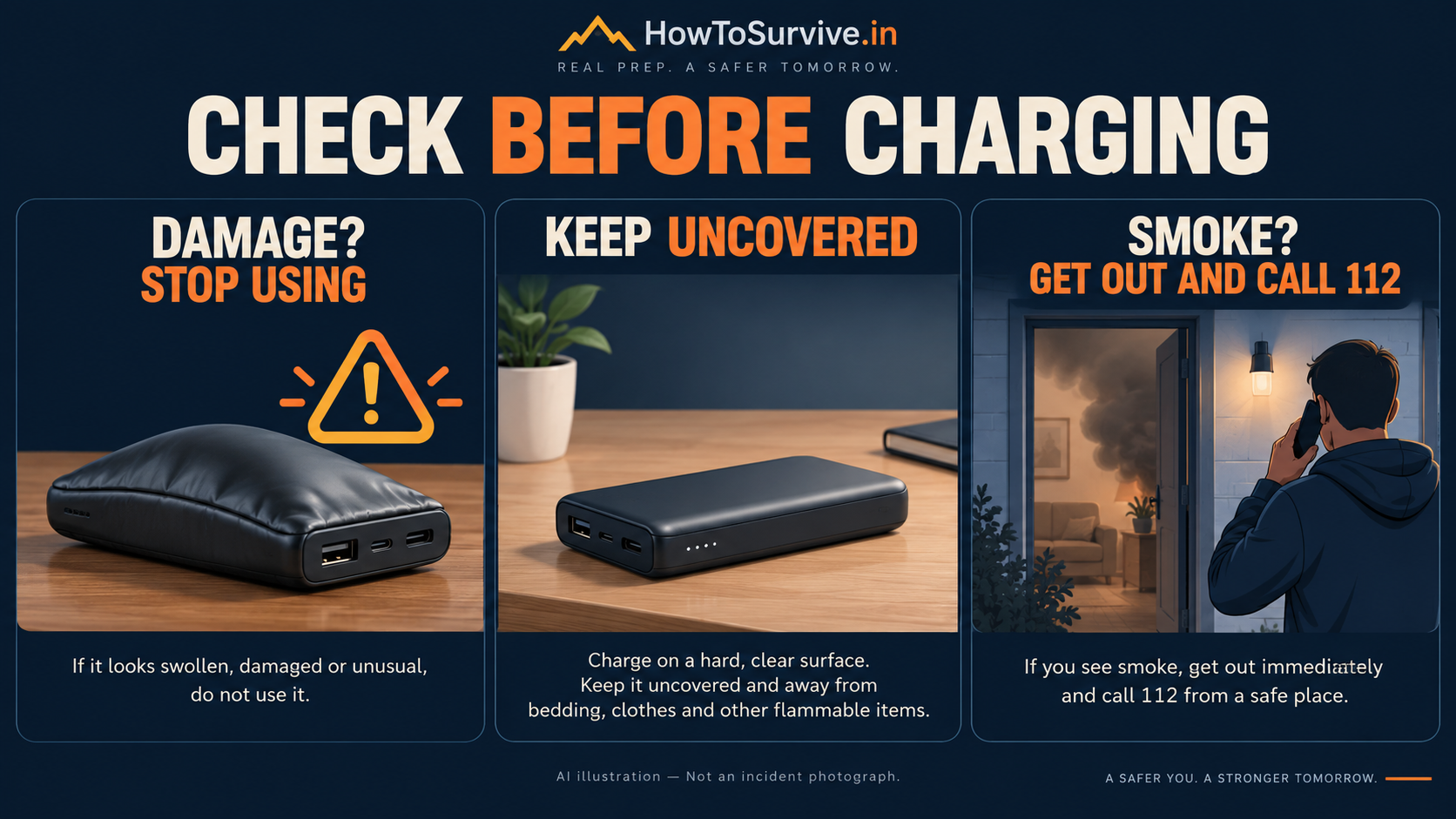
Use the manufacturer’s specified charging arrangement, with an intact cable and an uncovered location. The Electrical Safety First power-bank guide stresses suitable products, ventilation and avoiding prolonged charging. Establish a routine in which someone can notice a problem and disconnect normally when charging is complete.
The Australian regulator’s power-bank guidance advises against storage in a parked vehicle and charging on bedding or other combustible materials. Its physical safety advice is useful here; its emergency telephone number and regulatory statements are Australian. In India, call 112 for an emergency.
Stop using a suspect device
London Fire Brigade advises stopping charging and contacting the manufacturer or a competent technician when a battery swells. Do not open the casing, puncture it or try to flatten it. If disconnection would bring you near heat, smoke or a dangerous device, prioritise withdrawal and emergency assistance.
Differentiate an ordinary product query from an active emergency. A stable concern can be referred to the manufacturer; smoke or fire means people need to leave and alert emergency services. Do not spend that time collecting serial numbers, filming the device or looking for a place to carry it.
After the immediate concern
Do not put a damaged power bank back into shared circulation. Mark its status in a household or office record so another person does not reconnect it. Ask the manufacturer and an appropriate authorised collection service how that particular damaged device should be handled. Confirm acceptance before transport; a normal battery collection point may not accept a damaged unit.
Limits of the advice
This is a planning guide, not evidence that all power banks fail or that a visual check guarantees safety. It does not estimate an Indian incident rate. The video section uses an official fire-service explanation of a different lithium-battery device and labels that distinction. Product-specific instructions and local emergency directions take priority.
What needs attention
- A useful safety routine begins with identity. Without the model number, a household or office cannot reliably match a notice to the device it owns. Store purchase and model information beforehand; gathering evidence beside a smoking device is the wrong priority.
- The charging environment matters as well as the product. A device that is covered or left where no one notices a problem undermines early recognition. Use the manufacturer’s instructions to decide the compatible charger and operating conditions, rather than treating every USB connection as interchangeable.
- A defect report needs a clear handover. If one person stops using a shared device but returns it to the common charging drawer, the next user may assume it is available. An explicit out-of-use record is an editorial organisational recommendation, not a guarantee that storage itself is safe.
- Smoke changes the decision. Product troubleshooting and warranty questions can wait; people should withdraw, warn others and contact emergency services. The official learning video demonstrates escalation in a different device and should not be used to calculate the behaviour of every power bank.
Controls that reduce risk
- Owner: save the model, purchase record and manufacturer contact before a problem occurs. If you see a recall or warning, compare the complete model details and region rather than relying on a similar-looking picture.
- Household or office organiser: decide where routine charging happens and who checks completion. Keep the arrangement consistent with the manufacturer’s instructions and avoid covering devices.
- User: stop using visibly damaged or swelling equipment. Do not open the casing or attempt cell replacement as an improvised fix. Obtain guidance suited to the actual device and its condition.
- During an emergency: get people away from smoke or fire and call 112 from safety. Do not move a smoking device through occupied rooms or carry it to another person.
- After a fault: record that the item is out of use. Contact the manufacturer and an authorised service or collection provider about safe next steps, telling them if it is damaged or recalled before you travel with it.
Common unsafe practices
- Do not assume a working charging light proves the battery is undamaged.
- Do not use an overseas product-rule statement as Indian legal guidance.
- Do not treat a different model’s recall as proof that your unit is included or excluded.
- Do not continue charging a swelling device to see whether it recovers.
- Do not puncture, squeeze or dismantle a battery pack.
- Do not approach smoke to retrieve paperwork or make a close-up video.
- Do not put a damaged unit back into a shared-use drawer without a clear handover and suitable handling advice.
 ↗
↗
Leave a comment