
Quick answers
How should tenants report an electrical fault in a building?
Give each report a reference and date, note the location and equipment, describe the observed symptom, name the responsible manager and record when they acknowledged it.
Should I guess the cause of an electrical fault when reporting it?
No. Record what was observed, such as a burning smell near an appliance, and leave diagnosis to a professional. Do not reproduce a fault, remove a cover or go close to unsafe equipment for a photograph.
When can an electrical fault report be marked as closed?
Keep the professional's assessment, work record and the responsible person's confirmation with the report. A group-chat message is not a completed repair, and the entry stays open if a promised assessment has not happened.
What to do if an electrical fault becomes a fire or immediate danger?
Immediate danger takes priority over the log. Move away from danger, contact 112 in India and leave electrical work to a qualified professional.
A fault report needs an owner
A message saying “the appliance seems wrong” can disappear in a group chat. This guide proposes a simple written handover so the person receiving the report knows what needs a response. It is an editorial record-keeping tool, not an electrical inspection checklist or a legal compliance certificate.
Delhi Fire Service warns against overloaded electrical circuits and concealed damaged cords, and advises professional electrical checks for damage. Official Delhi Fire Service guidance. The practical role of a resident is to report an observable concern safely, not diagnose a component.
Record the observation, not a guessed cause
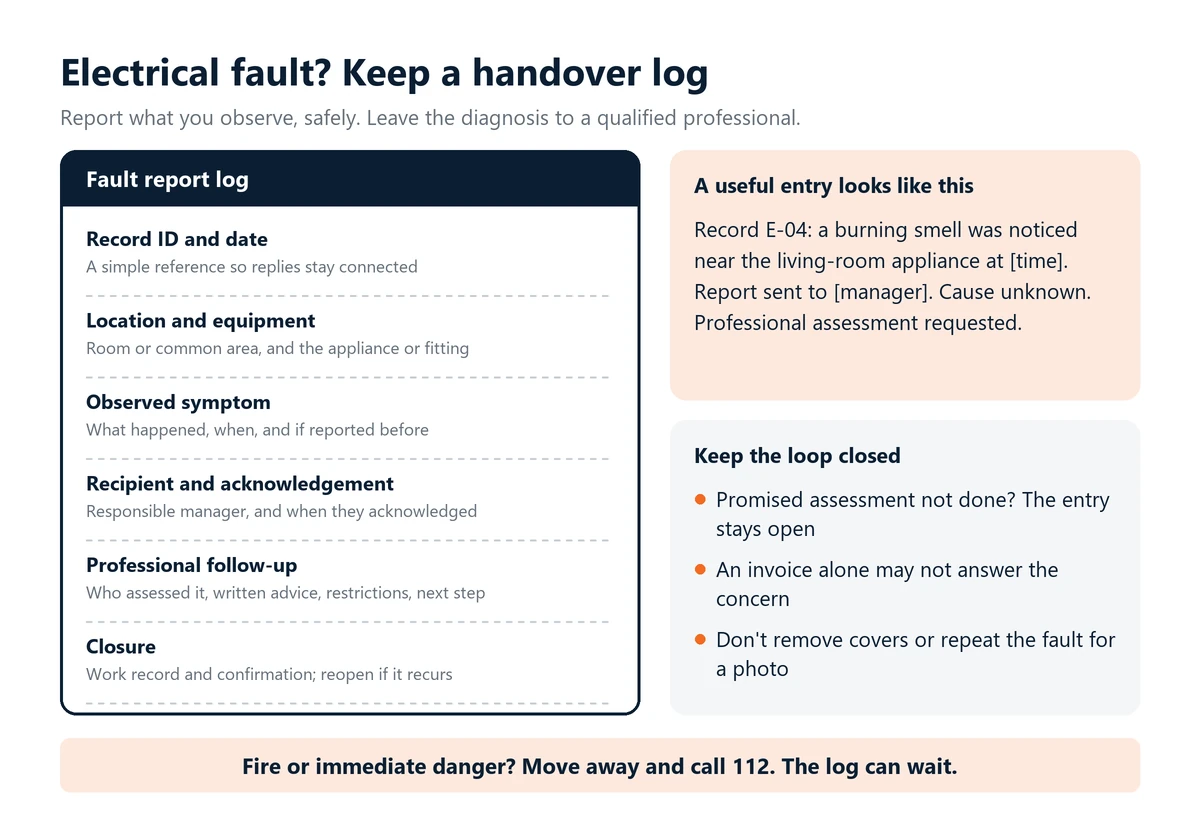
- Record ID and date: choose a simple reference so replies stay connected.
- Location and equipment: identify the room or common area and the appliance or fitting.
- Observed symptom: write what happened, when, and whether it has been reported before.
- Recipient and acknowledgement: name the responsible manager and record when they acknowledged it.
- Professional follow-up: record who assessed it, their written advice, any usage restriction and the next action.
- Closure: keep the work record and the responsible person’s confirmation; reopen the entry if the symptom recurs.
A safe example of a useful entry
“Record E-04: a burning smell was noticed near the living-room appliance at [time]. Report sent to [manager]. Cause unknown. Professional assessment requested.” This description is more useful than an unsupported diagnosis. Do not reproduce a fault, remove a cover or go close to unsafe equipment to improve a photograph.
What a handover should settle
Before closing the entry, ask what was assessed, what work was completed and what operating advice applies. Keep the response with the original report. If a promised assessment has not happened, the entry remains open. An invoice alone may not answer the original concern; ask for the relevant written explanation rather than guessing.
What the NBC 2026 electrical chapter says an owner should ask
A log shows that a report was received and answered. It does not say whether the wiring itself is in good order. For that, the National Building Code of India 2026, Part F, is a useful reference, and our chapter summary gives the questions to put to a building’s electrician or fire officer.
Our NBC 2026 chapter on electrical rooms and wiring notes that leakage current from ageing insulation is a possible cause of fire. It names residual-current devices of 300 mA on the main board to guard against leakage-current fires, and 30 mA devices to protect people in wet areas. It advises residents to press the test button of their residual-current device and to call an electrician if it does not trip, and to follow the maker’s instruction on how often to test it. The chapter does not give a test frequency itself.
It also suggests that an owner ask the fire officer when the wiring, the earthing and the leakage-current device were last tested, and by whom. A warm panel, a burning smell or a loose terminal is a reason to call an electrician, not to wait for the next entry in the log.
Where this fits with the log
Put the answer to those questions in the same file as the fault entries. A closed entry that says the professional assessed it and the work is done is more useful when it sits beside the last recorded test date of the earthing and the leakage-current device.
- Date and name of whoever last tested the wiring, earthing and leakage-current device.
- Result of the residual-current device test button check, and the date.
- Any warm panel, smell or loose terminal reported since, with the entry number.
- What the local fire officer or licensed electrician said about the building.
NBC 2026 is voluntary until a state or local authority adopts it, and the fire officer decides what applies to a real building. Electricity safety rules made by the Central Electricity Authority also apply to installations in India, so check their current text with your electrician. This section gives no repair or testing procedure.
When the log must wait
An active fire or immediate danger is an emergency, not a paperwork task. Move away from danger and contact 112 in India; MHA identifies 112 as the unified emergency number. Leave electrical work to a qualified professional. This guide gives no live-work, isolation, repair or re-energisation procedure.
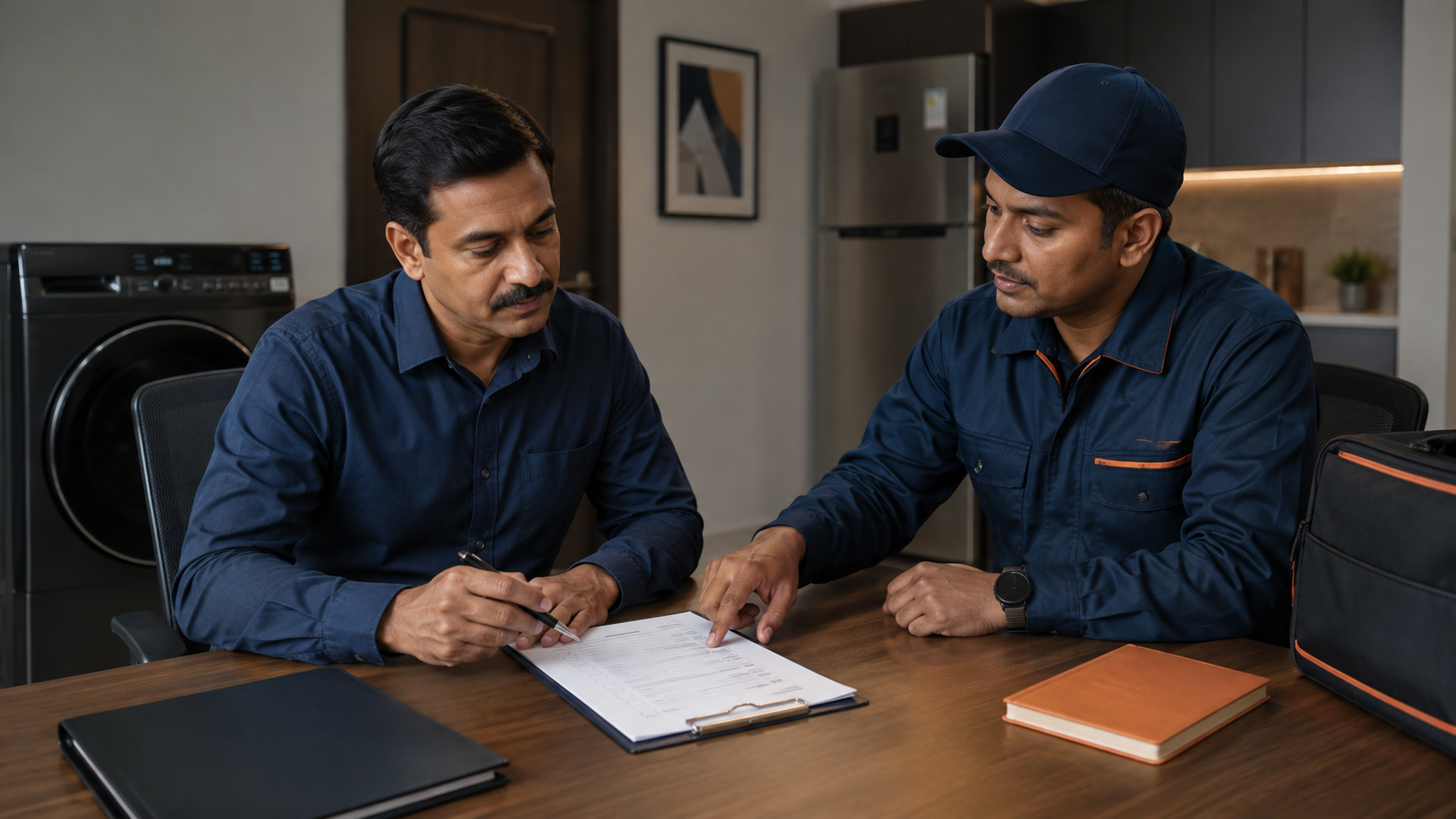
The supplied images are AI-generated illustrations of fictional maintenance discussions. They do not document a real repair or certify that an appliance is safe.
What needs attention
- An observation and a technical diagnosis should be recorded separately.
- A named recipient and closure record make follow-up easier to track; no quantified risk reduction is claimed.
Controls that reduce risk
- Give each report a reference and date.
- Describe the observed symptom without reproducing it.
- Record the responsible recipient and acknowledgement.
- Keep professional advice and any usage restrictions with the report.
Common unsafe practices
- Treating a group-chat message as a completed repair.
- Guessing an ignition cause.
- Opening equipment or reproducing a dangerous symptom for evidence.

Leave a comment