
What happened here
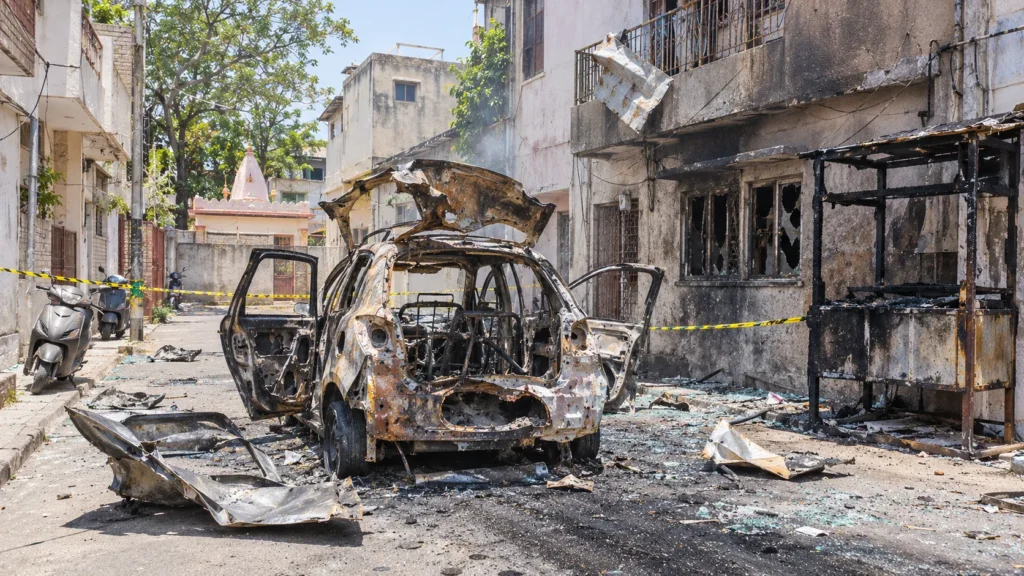
In the early hours of Thursday, 5 November 2026, a parked Honda City caught fire on a residential lane in Ramwadi, in Vadodara's Navayard area. A crowd gathered to watch. Before the fire brigade reached the spot, the car's CNG cylinder exploded, tearing the car apart. Pieces of metal were reported up to about 200 metres away and at third-floor level, window glass in nearby houses broke and a small roadside stall burnt. Five people were reported injured, including a woman whose hand was pierced by a metal piece and a person hit in the leg; an early English report said two were hurt, and others said three to four or more than five. Firefighters controlled the blaze with water, and police and residents took the injured to hospital. Police have begun an inquiry. A resident says the car had a CNG kit fitted about 15 days earlier; no official cause or cylinder test record has been reported.
Quick answers
What happened in Ramwadi, Vadodara on 5 November 2026?
A parked Honda City caught fire on a lane in Ramwadi, Navayard, in the early hours, and its CNG cylinder burst before the fire brigade arrived. Five people were reported injured; no deaths were reported.
How many people were injured?
Five, according to the most detailed reports; the earliest English report said two and others said three to four or more than five. A woman's hand was pierced by metal and another person was hit in the leg.
Why did the CNG cylinder explode?
No official cause has been announced. A CNG cylinder can burst when fire heats it; reports have not said whether the kit was approved, when the cylinder was tested or whether its safety valve worked.
How far did the debris fly?
One detailed report says pieces of the car's body were found about 200 metres away and at third-floor level, across three rows of houses.
Was the car's CNG kit new?
A resident quoted in one report says it was fitted about 15 days earlier. This is not an official record, and where it was fitted is not known.
What should I do if a CNG car catches fire?
Move away and keep others away, go behind a wall or into a building, do not film or stand close, call 101 or 112 and say it is a CNG car. In this case pieces flew about 200 metres.
How often must a CNG cylinder be tested?
Indraprastha Gas Limited advises a hydro-test after every three years and says the cylinder valve and master shut-off valve should be known to the owner.
Is there a city safety guide for Vadodara?
Yes: Vadodara fire stations and safety guide on howtosurvive.in/city-safety/vadodara/.
What happened in the early hours of 5 November 2026
A parked Honda City caught fire on a residential lane in Ramwadi, in the Navayard area of Vadodara, Gujarat, in the early hours of Thursday, 5 November 2026. Reports put the time between shortly after midnight and about 2.15 am; one resident quoted in one report says he went indoors at about 1.30 am and the blast came soon after, and another says he heard a first small explosion at about 2 to 2.15 am. The fire grew quickly. A crowd gathered to watch, and the car’s CNG cylinder then blew up before the fire brigade reached the spot. The blast tore the car apart and threw pieces of metal across the neighbourhood.
Five people were reported injured. One report says the burn and metal-fragment injuries were among people who had come out to look at the fire. A piece of metal went through a woman’s hand, and another person was hit in the leg. Nobody is reported dead. We have not named anyone.
What the reports describe
- The car: a Honda City, parked on the lane for what a resident quoted in one report called a short while, with a CNG kit that, according to the same resident, had been fitted about 15 days earlier. Where and by whom it was fitted is not known to the residents quoted, and no official has confirmed the date.
- The crowd: several reports say people had gathered to see the burning car when the cylinder burst. A resident who was hurt said she stood at her doorway because she feared for her son, who was near the car. Another resident said he rang the owner of a car parked behind it, asking him to move it, when the blast came.
- The blast: reports describe a very loud explosion that shook the area, broke window glass in nearby houses and burnt a small roadside stall. Pieces of the car’s body were reported up to about 200 metres away, on a third-floor level, and across three rows of houses. One person was hit near a nearby temple.
- The response: the fire brigade (a TP-13 team is named in one report), ambulances and police reached the spot. One report says the cylinder burst before the fire team arrived. Firefighters controlled the fire with water and the injured were taken to hospital by police and residents. Police sealed off the lane and began an inquiry; one report says forensic experts will examine the car.
Where the reports differ, and what we do not know
- How many were hurt: one early English report says two (including a woman); others say three to four, five, or more than five. We use five, which is the number two detailed reports with injured names gave, and say reports vary.
- Time: from shortly after midnight to about 2.15 am. We say the early hours of 5 November.
- Place: most reports say Ramwadi (also written Navi Ramwadi), Navayard. One says the lane is behind the Fatehganj police station. The map point is approximate.
- Why the car caught fire and why the cylinder burst: no official cause has been announced. One report mentions a gas leak or fault in the CNG system as an initial guess. Whether the kit was approved, when the cylinder was last tested and whether its safety valve worked are not reported.
- Not reported: the condition of the injured after the first hours, any police case against the owner, the owner’s statement, and compensation. The latest reports we found are from the afternoon and evening of 5 November.
What this case teaches
The most important lesson is plain: a burning car with a gas cylinder is not a spectacle. A CNG cylinder holds gas at very high pressure. When fire heats it, it can burst with little warning and throw hard fragments a long way. In Ramwadi the people who were hurt were mostly those who had come out to see the fire or to save a vehicle, in a lane that was only a few steps wide. Pieces were reported 200 metres away. A distance of ‘a few steps back’ is far too little.
The second lesson is about the kit. Indraprastha Gas Limited advises that a CNG cylinder be hydro-tested every three years, that an LPG or any other cylinder never replace a CNG cylinder, that the cylinder valve and master shut-off valve be known to the owner, and that the cylinder be emptied before any welding or heat within 1.5 metres of it. A kit that is badly fitted, a cylinder that is out of date for testing, or a leak that goes unnoticed can all turn a small fire into a blast. Our guide to car fire safety in India, including CNG cars explains the checks in more detail. We could not confirm from the reports whether any of these was the cause here.
Third, parking. A residential lane with children playing is a poor place to leave a car with a freshly fitted gas kit. A resident said the owner had been asked not to park there; that is a neighbour’s account and the owner’s side has not been reported.
For other gas-cylinder blasts and bystander injuries on our site, see the RR Nagar cylinder blast, the Dhar car fire and the Hapur furniture shop fire near a CNG station. Our guide Balloon gas cylinders at fairs and crowds explains why crowds near a gas cylinder are dangerous.
What drivers, residents and bystanders can do
- If a car is on fire: keep away and keep others away. Do not stand and watch, do not film from nearby and do not try to move the car or the vehicles beside it. Move yourself and your family behind a wall or into a building, away from the car’s boot and sides. In this case pieces flew about 200 metres, so go as far back as you safely can. We found no official Indian figure for a safe distance in a CNG car fire, so treat the reported 200 metres as the lesson.
- Call first: dial 101 for the fire brigade or 112, say it is a CNG car, and give the lane and a landmark. Tell neighbours to move away from windows and doorways facing the car.
- Driver, before a fire: if the car is a CNG conversion, use only an approved kit fitted by an approved retrofitter, make sure the fitment is recorded on the RC, and keep the hydro-test certificate. Test the cylinder every three years. Know where the cylinder valve and master shut-off valve are.
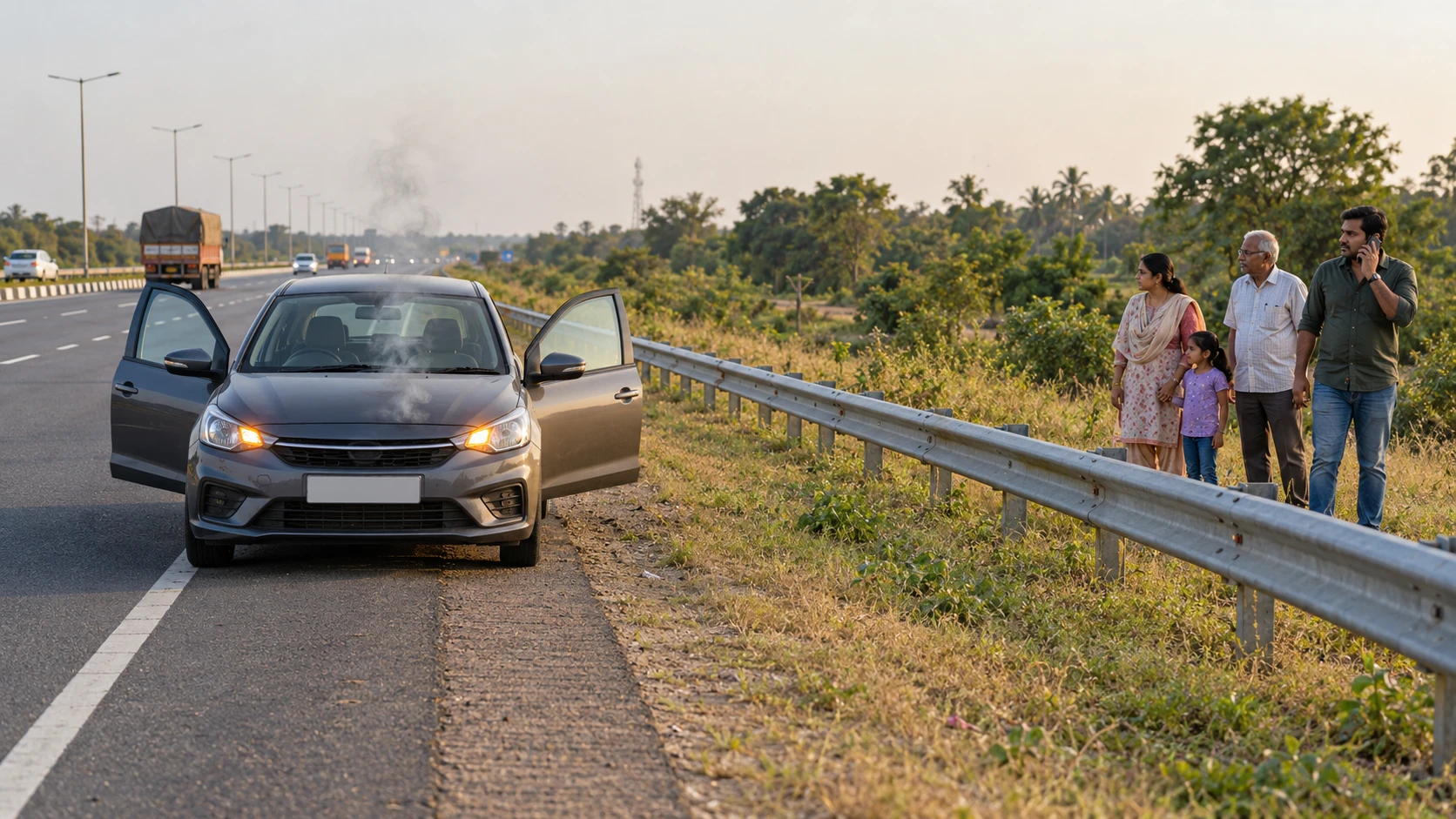
- Warning signs: a smell like cooking gas, a hiss from the boot, a hot smell or smoke. Stop, switch off the engine, get everyone out, move away and call 101 or 112.
- Parking: after a new kit has been fitted or if the car smells of gas, park in the open away from houses, children and crowded lanes. Do not leave it in a narrow residential lane.
- Everyone: Emergency numbers in India and How to call 112, 101 or 108 explain which number to call and what to say, and the first five minutes of an emergency lists safe bystander actions.
Vadodara has a city safety guide with fire station and emergency numbers: Vadodara fire stations and safety guide.
- A parked Honda City catches fire in a lane in Ramwadi, Navayard, Vadodara; residents see the fire and a crowd gathers; one resident rings neighbours to move vehicles
- The CNG cylinder explodes before the fire team arrives, tearing the car apart; metal is thrown about 200 m; at least five people are hurt
- Fire brigade, ambulances and police arrive; the fire is controlled with water; the injured are taken to hospital; police begin an inquiry
- Reports, a CCTV clip and TV videos appear; counts of the injured vary between two and more than five
Why consequences escalated
- A parked Honda City caught fire in a residential lane in Ramwadi, Navayard, Vadodara, in the early hours of 5 November 2026 and its CNG cylinder exploded before the fire brigade reached the spot.
- Five people are reported injured, mostly neighbours and onlookers; no death is reported.
- Metal fragments were reported about 200 m away; window glass in nearby houses broke and a roadside stall burnt.
- A resident says the CNG kit had been fitted about 15 days earlier; no official cause, kit approval or cylinder test record has been reported.
- Police have begun an inquiry; no official statement of cause or any police case was found.
Failures and risk multipliers
- No official finding exists. What the reports raise as questions:
- A crowd stood near a burning car that carried a CNG cylinder, and several of those hurt were onlookers or neighbours trying to move vehicles.
- The car was parked in a narrow residential lane where, a resident says, children play, soon after a new gas kit was fitted.
- Whether the kit was approved, whether the cylinder was tested and whether its safety valve worked has not been reported.
- The fire team had not arrived when the cylinder burst, so the first minutes were left to residents.
- These are reports and questions, not findings of fault.
Actions that reduce risk
- If a car is on fire: keep away, keep others away, do not watch or film from nearby, do not try to move the car or those next to it, and go behind a wall or into a building.
- Call 101 or 112 and say it is a CNG car, with the lane and a landmark.
- CNG owners: use an approved kit fitted by an approved retrofitter, keep the fitment recorded on the RC, hydro-test the cylinder every three years and know the cylinder valve and master shut-off valve.
- Do not park a car that smells of gas, or one with a newly fitted kit, in a crowded residential lane.


Leave a comment