
Quick answers
Do I have to give mouth-to-mouth when doing CPR on an adult?
No. If you are not trained, or not willing to give breaths, hands-only CPR for an adult is far better than doing nothing. Trained rescuers should add rescue breaths, and children and drowning victims need them.
How do I give hands-only CPR to an adult?
Check that the person does not respond and is not breathing normally, call 108 or 112, put your locked hands on the centre of the chest and push hard and fast, 100 to 120 times a minute. Keep going until the ambulance crew takes over.
Does CPR restart the heart straight away?
No. CPR keeps blood and oxygen reaching the brain until medical help or a defibrillator arrives.
Where can I learn CPR properly?
Take a hands-on course with the Indian Red Cross Society, St John Ambulance or a nearby hospital, and practise on a training manikin. Do not rely on viral videos.
In films, someone gets two pushes on the chest and one breath, coughs, and sits up. Real CPR is nothing like that, and believing the film version is one reason so many people in a crowd just stand and watch.
CPR means pushing on the chest hard and fast, without stopping. It does not restart the heart. It keeps blood and oxygen moving to the brain until an ambulance crew or a defibrillator (AED) can take over. Think of it as buying time.
Survival figures (latest published)
| Where | Survived to leave hospital | Got CPR from a bystander | Source |
|---|---|---|---|
| USA, all cardiac arrests outside hospital (2024) | 10.5% | 41.7% | CARES 2024 Annual Report |
| USA, arrests in public places (2024) | 21.1% (8.9% at home) | Not given | CARES 2024 Annual Report |
| Europe, average across countries | 7.5% (3.1% to 35% by country) | Not given | ERC Guidelines 2025 |
| India, one hospital in South India (2019 to 2020) | 1.4% | 9.8% | Bhat et al., Indian Heart Journal 2021 |
India has no national cardiac arrest registry, so the India row comes from a single-hospital study of 205 patients and is not a national rate. (Sources: CARES 2024 Annual Report; ERC Guidelines 2025; Bhat et al., Indian Heart Journal 2021.)
In that South Indian study, fewer than 1 in 10 people who collapsed outside hospital got CPR from someone nearby (9.8%).
Common CPR myths and the facts
| Myth | Fact |
|---|---|
| “CPR restarts the heart straight away.” | No. It keeps blood flowing until an ambulance crew or an AED takes over. |
| “You must always give mouth-to-mouth.” | No. If you are not trained, or not willing to give breaths, hands-only CPR for an adult is far better than doing nothing. Trained rescuers should give breaths too, and children and drowning victims need rescue breaths. |
| “You can hurt the person by pressing too hard.” | Ribs sometimes crack during CPR, and they heal. A heart that gets no help does not. Push hard. |
| “Only doctors or nurses can do CPR.” | No. Anyone who has learnt it can do it safely. |
| “Check the pulse before you start.” | No. Every second counts. If the person does not respond and is not breathing normally, start pushing on the chest at once. |
Hands-only CPR for an adult, step by step
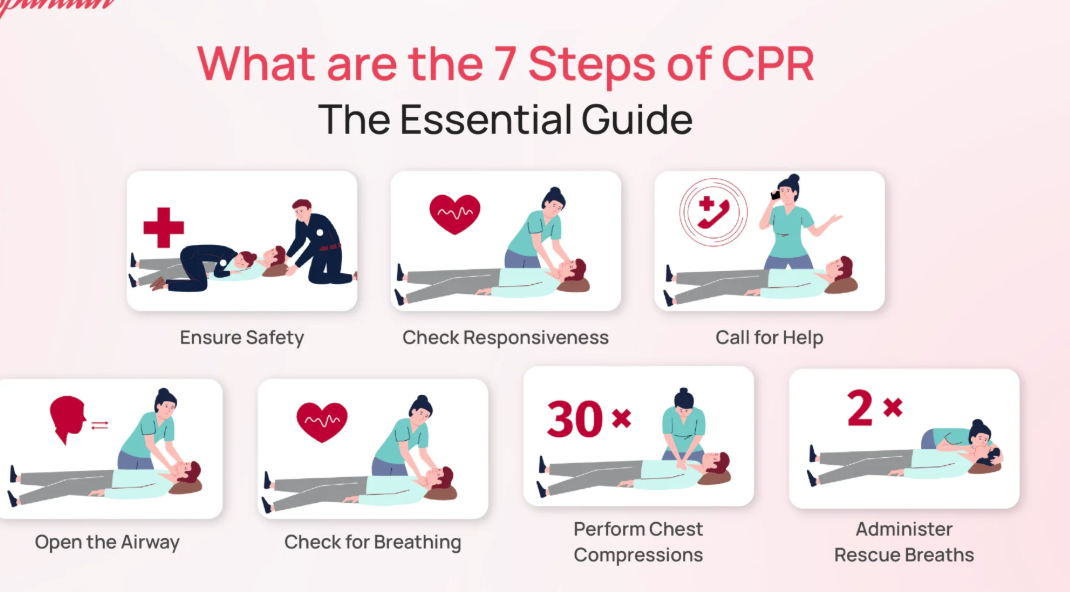
- Check. Tap the shoulders and shout, “Are you okay?” Look for normal breathing for no more than 10 seconds.
- Call. Dial 108 or 112 straight away, or tell someone nearby to call. Put the phone on speaker.
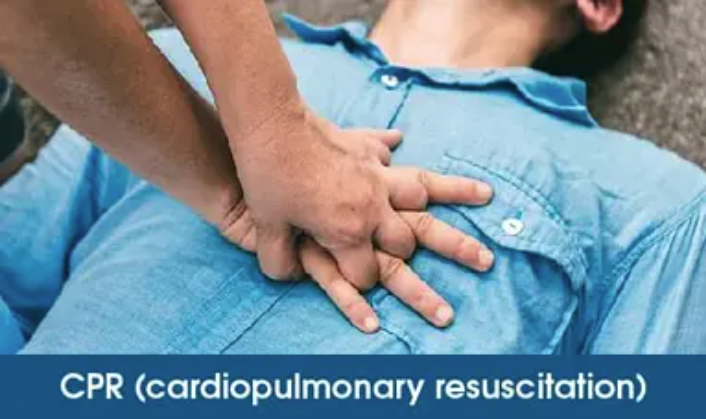
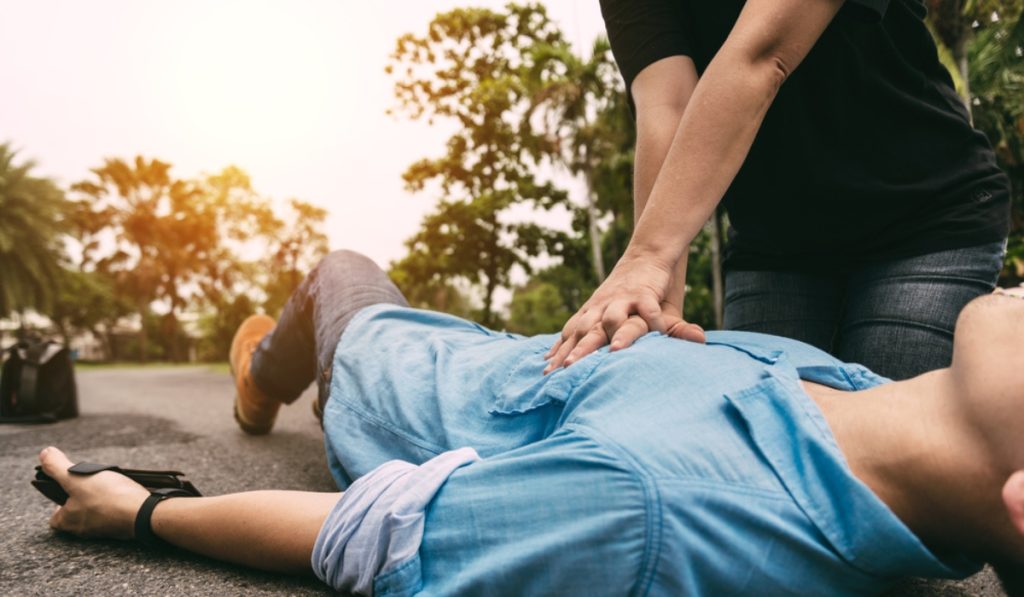
- Place your hands. Put the heel of one hand in the centre of the chest, the other hand on top, fingers locked together.
- Push fast. 100 to 120 pushes a minute, about the beat of the old song “Stayin’ Alive”.
- Push deep. About 5 cm (2 inches) in an adult, but not more than 6 cm. Let the chest come fully back up after each push.
- Keep going until the ambulance crew or a doctor takes over. If someone brings an AED, switch it on and follow its voice prompts.
Each minute of delay before a defibrillator shock lowers the chance of survival by about 10% (ERC 2025). CPR buys time until the AED arrives.
An everyday example: a collapse on a metro platform
This is an illustrative example, not a real case.
- A commuter collapses on a platform.
- A crowd gathers, but nobody starts CPR.
- By the time the ambulance arrives, many minutes have gone by without a single push on the chest.
- Every one of those minutes without CPR or a defibrillator shock lowered his chance of survival.
What was missing on that platform was not knowledge. It was one person confident enough to kneel down and start.
Where to learn CPR
Indian Red Cross Society branches, St John Ambulance and many hospitals run short hands-on CPR courses. Practise on a training manikin, not just by watching videos, because your hands need to learn the depth and the speed. Then ask your school, office or society to organise a session for everyone.
The bigger lesson
CPR should be as common a skill as riding a two-wheeler. In a country of 140 crore people, ordinary citizens could become the largest group of first responders in the world, if each of us knows what to do in the first two minutes.
What to do this week
- Book a hands-on CPR course for yourself and one family member.
- Ask your office, school or society to host a training session.
- Learn from trusted medical sources and proper trainers, not viral CPR videos.
References
- American Heart Association, Highlights of the 2025 AHA Guidelines for CPR and ECC
- European Resuscitation Council, The ERC Guidelines 2025 on Resuscitation for Everyone
- Resuscitation Council UK, Adult Basic Life Support Guidelines 2025
- CARES (Cardiac Arrest Registry to Enhance Survival), 2024 Annual Report
- Bhat R et al., Study of pre-hospital care of out of hospital cardiac arrest victims and their outcome in a tertiary care hospital in India, Indian Heart Journal, 2021
- NCRB, Accidental Deaths & Suicides in India 2024, Tables 1.7 and 1.8
The difference between life and death can be a pair of hands that know what to do. Let them be yours.
What needs attention
- CPR does not restart the heart; it keeps blood and oxygen reaching the brain until help comes
- In one South Indian hospital study, fewer than 1 in 10 people who collapsed outside hospital got bystander CPR
- Each minute before a defibrillator shock lowers the chance of survival by about 10%
- For an adult, hands-only CPR is far better than doing nothing
- India has no national cardiac arrest registry, so there is no national survival rate
Controls that reduce risk
- Book a hands-on CPR course with the Red Cross, St John Ambulance or a nearby hospital
- Ask your office, school or society to host a CPR session
- Find out whether your office, mall or metro station has an AED, and where it is kept
- Practise the rhythm of 100 to 120 pushes a minute
- Teach older children the basic steps
Common unsafe practices
- Searching for a pulse instead of starting compressions
- Pressing too gently for fear of breaking ribs
- Stopping compressions before the ambulance crew takes over
- Not calling 108 or 112 straight away
- Learning CPR from viral videos instead of a proper course
- Standing in the crowd and waiting for someone else to start
Leave a comment