
Quick answers
What should I do if someone suddenly collapses near me?
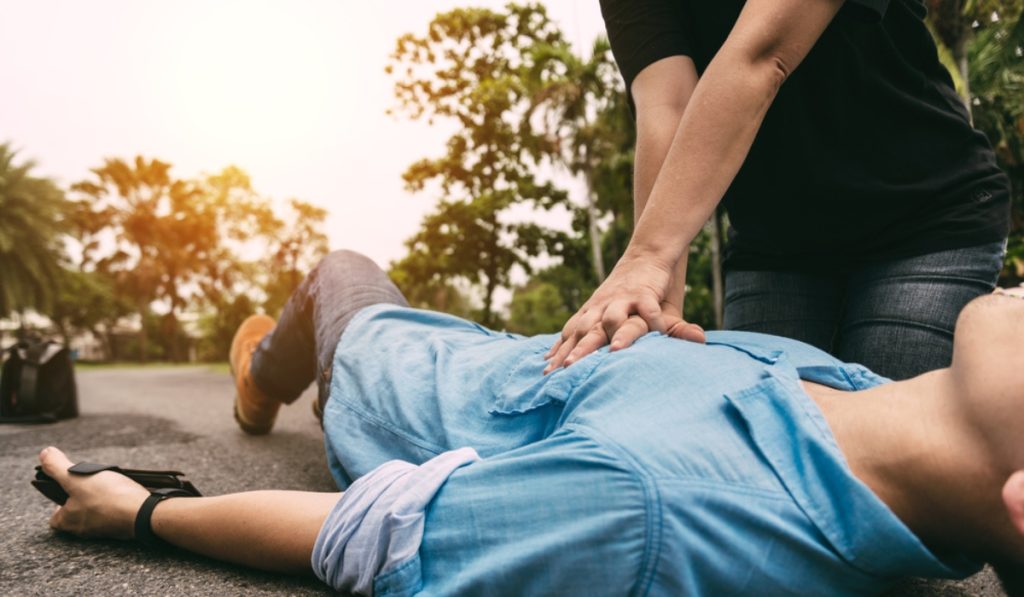
Tap the person and shout to check for a response, call 108 or 112, and begin chest compressions by pushing hard and fast in the centre of the chest until professional help arrives.
What is hands-only CPR?
Hands-only CPR means pushing hard and fast in the centre of the chest to keep blood and oxygen flowing until professional help arrives. It needs no medical equipment, only two hands and the courage to act.
Why does bystander CPR matter so much in a cardiac arrest?
When the heart stops pumping, the brain is starved of oxygen within minutes and an ambulance may take longer than that to arrive. The person nearby is often the only one who can keep blood flowing in that gap.
How can workplaces and schools improve CPR readiness?
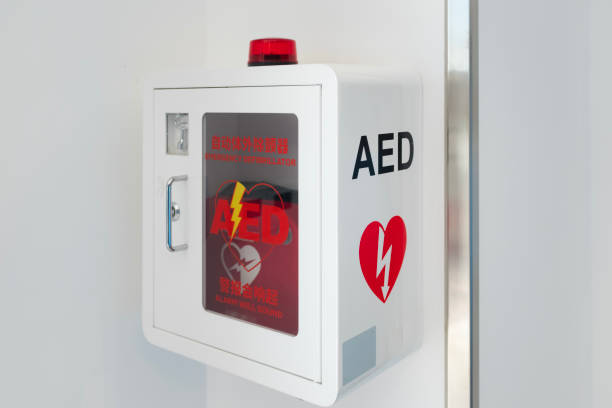
They can host CPR workshops, train staff and students in hands-only CPR, and keep an AED available. When an AED is present, it should be used promptly and its voice prompts followed.
What is the difference between a heart attack and a cardiac arrest?
In a heart attack, blood flow to part of the heart is blocked and the person is usually awake with chest pain. In a cardiac arrest, the heart stops pumping and the person collapses and stops breathing normally. Call 108 or 112 for both, and start CPR for a cardiac arrest.
Do heart attacks only happen to older people?
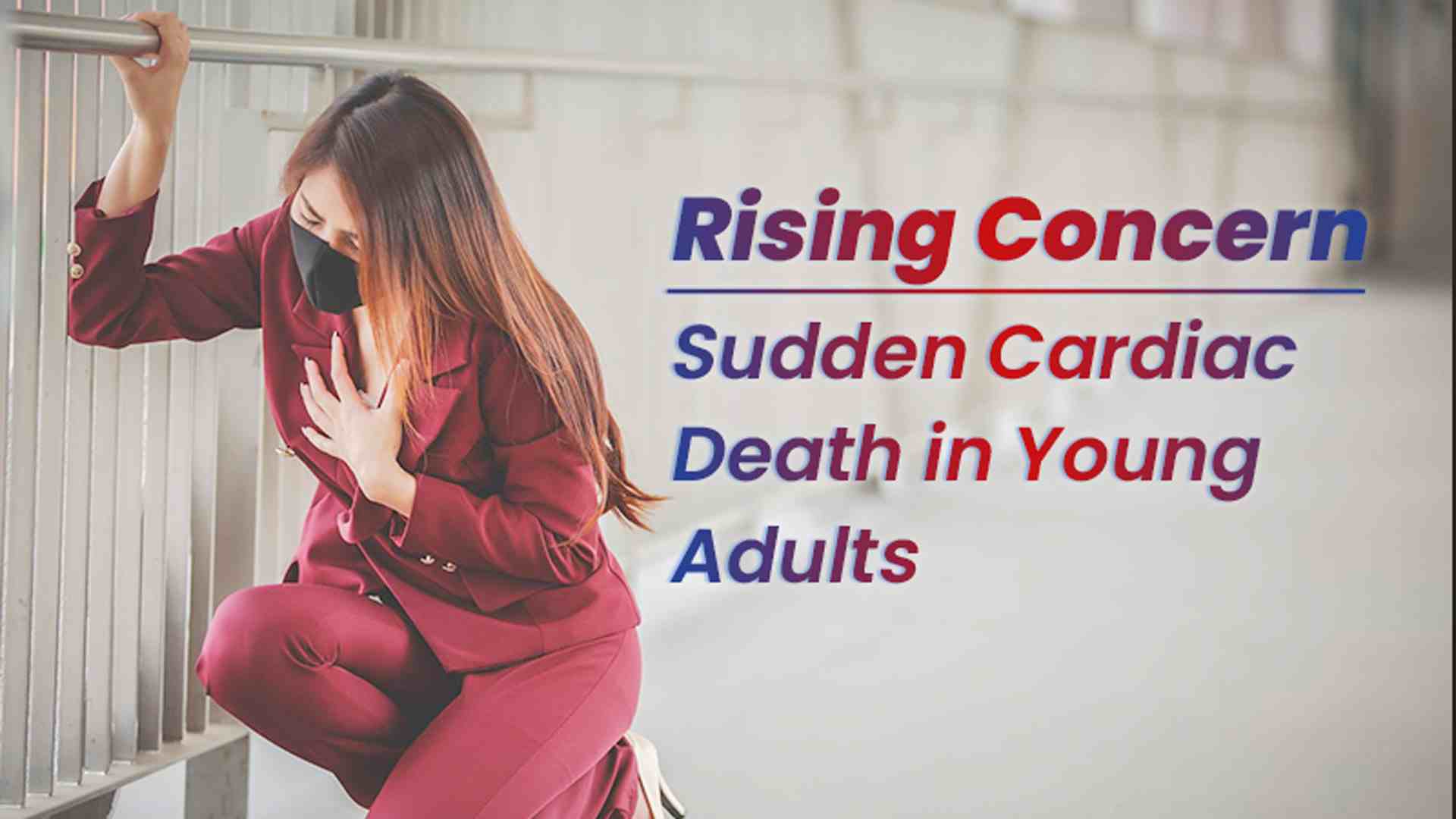
No. NCRB recorded 38,599 sudden deaths from heart attacks in India in 2024, and 15,574 of them were people aged 18 to 44.
Can I drive to hospital if I have chest pain?
No. Call 108 or 112 and rest while you wait. If you collapse at the wheel, you put yourself and others at risk.
When someone goes into cardiac arrest, the heart stops pumping blood within seconds. Brain damage can begin within four to six minutes. India publishes no national average ambulance response time, and in traffic or in a village, help can take much longer than that.
So in those first minutes, the only person who can save a life is the one standing next to them. Very often, that is you.
Yet bystander CPR is rare in India. In a study of 205 cardiac arrests outside hospital at a South Indian hospital (2019 to 2020), only 9.8% of patients had received CPR from a bystander. In the US, the figure was 41.7% in 2024.
Why it matters
A cardiac arrest can strike anyone, anywhere: at home, in the gym, at the office, in a mall or at a temple. CPR from a bystander and early use of an AED (automatic external defibrillator) can make survival two to four times more likely.
In the US in 2024, 13.0% of people who got CPR from a bystander survived to leave hospital, against 7.6% of those who did not.
India has no national count of cardiac arrests. Police records alone show 38,599 sudden deaths from heart attacks in 2024 (NCRB), and many more cardiac arrests never reach those records. Some of these people could have been saved if someone nearby had known what to do.
Heart attack or cardiac arrest?
People use the two words for the same thing, but they are not the same. In a heart attack, blood flow to part of the heart muscle is suddenly blocked. The person is usually awake, often with chest pain. In a cardiac arrest, the heart suddenly stops pumping. The person collapses, does not respond and is not breathing normally. A heart attack can lead to a cardiac arrest.
Someone who is awake with crushing chest pain, pain spreading to the arm, jaw or neck, breathlessness, sweating or nausea needs 108 or 112 straight away. Keep them sitting and resting, and do not let them drive themselves to hospital. If they collapse and stop breathing normally, start CPR.
Do not assume this only happens to older people. Of the 38,599 sudden deaths from heart attacks NCRB recorded in 2024, 15,574 were people aged 18 to 44.
What is bystander CPR?
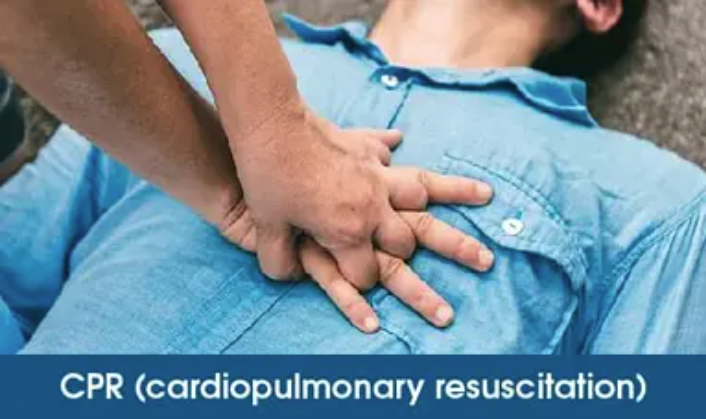
CPR (cardiopulmonary resuscitation) keeps blood and oxygen moving to the brain until trained help arrives. You do not need any equipment, only your two hands and the courage to start.
Hands-only CPR: put the heel of one hand in the centre of the chest, the other hand on top, and push hard and fast, 100 to 120 times a minute. That is about two pushes every second. Let the chest come back up after each push.
CPR and survival around the world
| Where | Survived to leave hospital | Got CPR from a bystander | Source |
|---|---|---|---|
| USA, all cardiac arrests outside hospital (2024) | 10.5% | 41.7% | CARES 2024 Annual Report |
| USA, arrests in public places (2024) | 21.1% (8.9% at home) | Not given | CARES 2024 Annual Report |
| Europe, average across countries | 7.5% (3.1% to 35% by country) | Not given | ERC Guidelines 2025 |
| India, one hospital in South India (2019 to 2020) | 1.4% | 9.8% | Bhat et al., Indian Heart Journal 2021 |
India has no national cardiac arrest registry, so the India row comes from a single-hospital study of 205 patients and is not a national rate.
Every minute of delay before a defibrillator shock lowers the chance of survival by about 10%. CPR in the meantime keeps blood flowing and buys time.
Two situations, two endings
These are illustrations of what commonly happens, not reports of real events.
At a metro station. A young man collapses on the platform. A fellow passenger who learnt CPR at a workshop starts chest compressions at once. Someone calls 112, and another person runs for the station’s AED. This is how a collapse becomes a survival story.
In an office. A colleague collapses during a meeting. Nobody knows CPR, so everyone waits for the ambulance. Every minute of that wait without CPR lowers his chance of survival. The chance to help was there; the knowledge was not.
Starting young. The European Resuscitation Council recommends teaching CPR to children early in life, so that more people are ready to help when someone collapses. Indian schools can do the same.
Key facts
- About 7 in 10 cardiac arrests outside hospital happen at home (71.3% in the US in 2024). The first person on the scene is usually a family member.
- Immediate CPR can double or triple the chance of survival.
- CPR plus an AED: in the US in 2024, 37.6% survived when a bystander saw the collapse, the heart rhythm could be shocked, and a bystander gave CPR or used an AED.
- Each minute of delay before a defibrillator shock lowers the chance of survival by about 10%.
- In one South Indian hospital study, only 1.4% of people brought in after a cardiac arrest outside hospital survived to go home.
If someone collapses near you
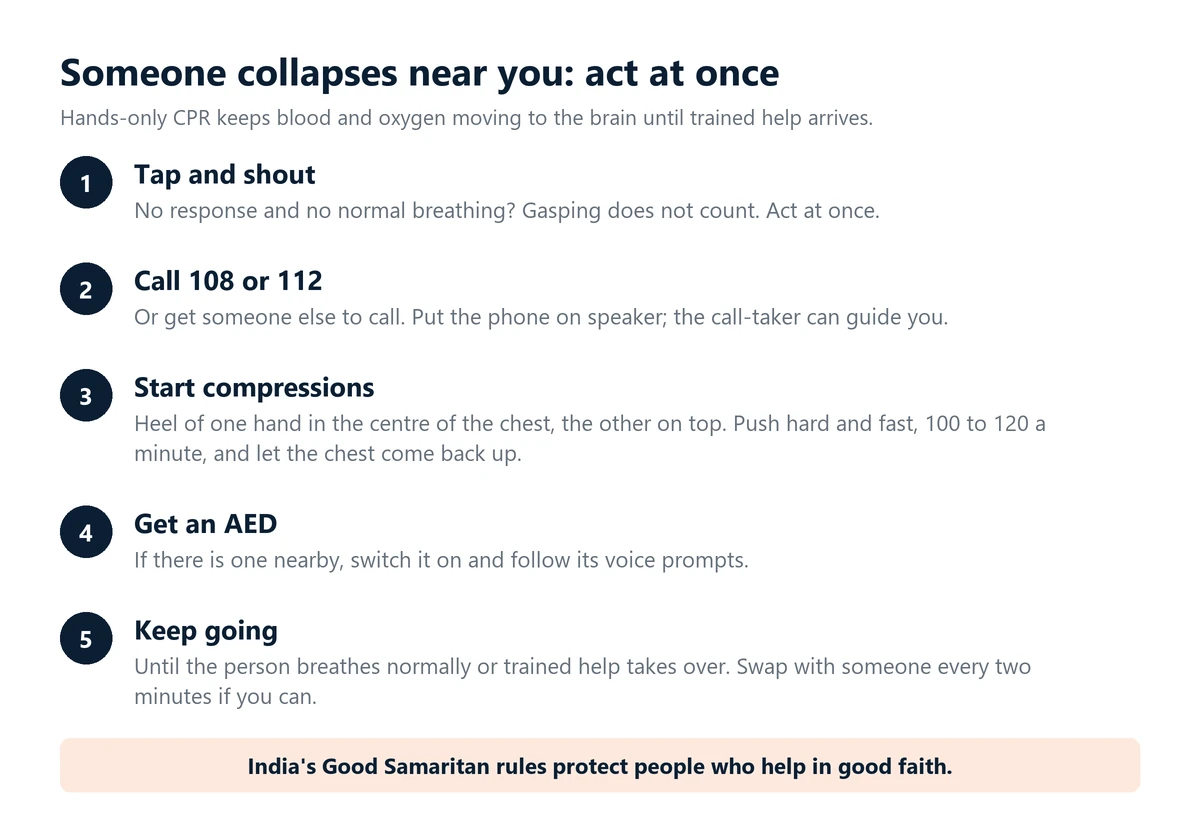
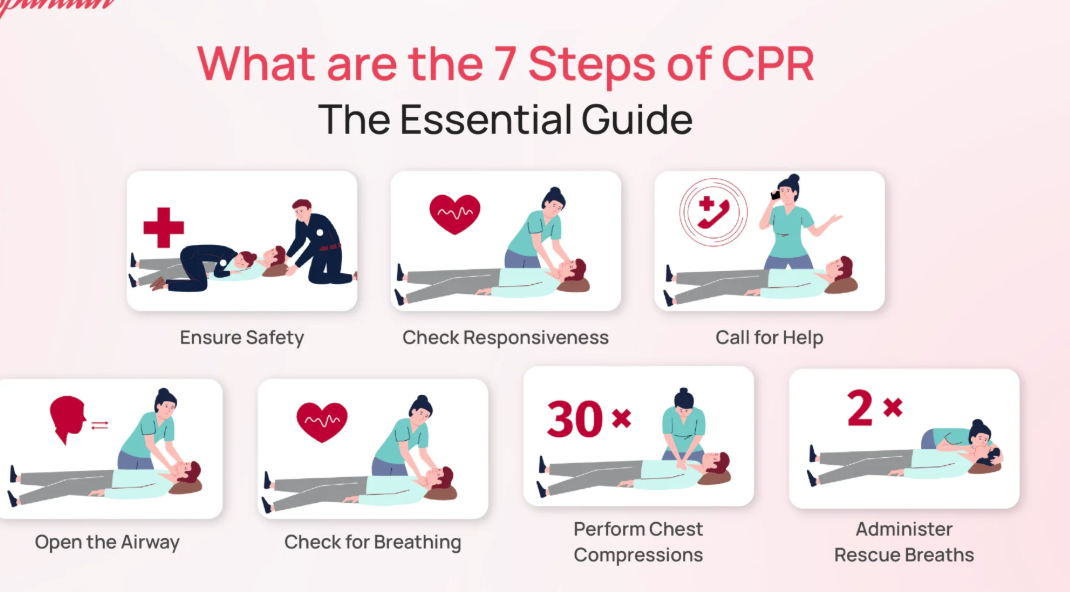
- Tap and shout. If there is no response and no normal breathing (gasping does not count), act at once.
- Call 108 or 112, or get someone else to call. Put the phone on speaker; the call-taker can guide you.
- Start compressions. Push hard and fast in the centre of the chest and do not stop.
- Get an AED if there is one nearby, switch it on and follow its voice prompts.
- Keep going until the person breathes normally or trained help takes over. Swap with someone every two minutes if you can.
Do not be afraid of legal trouble. India’s Good Samaritan rules protect people who help in an emergency in good faith.
What you can do this month
- Learn hands-only CPR. A short hands-on session is enough to start.
- Ask your workplace, school, gym or housing society to host a CPR workshop.
- Find out whether there is an AED in your building and where it is kept.
- Share a reliable CPR video with your family group, and practise the hand position on a cushion together.
What needs to change
- CPR training in every school, college and large workplace.
- AEDs in malls, metro and railway stations, airports and other busy places.
- Police, teachers and transport staff trained as first responders.
- CPR drills included in disaster preparedness programmes.
- A national cardiac arrest registry, so we know how many people we lose and save.
References
- American Heart Association: Highlights of the 2025 Guidelines for CPR and ECC
- European Resuscitation Council: ERC Guidelines 2025, resuscitation for everyone
- Resuscitation Council UK: Adult Basic Life Support Guidelines 2025
- CARES (Cardiac Arrest Registry to Enhance Survival): 2024 Annual Report
- Bhat R et al., pre-hospital care of out-of-hospital cardiac arrest victims in a tertiary care hospital in India, Indian Heart Journal, 2021
- NCRB: Accidental Deaths & Suicides in India 2024, Tables 1.7 and 1.8
Seven in ten cardiac arrests happen at home, so the life you save is most likely to be someone you love. Learn CPR, and teach it to the people you live with.
What needs attention
- Bystander CPR is rare in India; under 1 in 10 victims got it in the one study cited
- Bystander CPR and an early AED can make survival two to four times more likely
- Most cardiac arrests outside hospital happen at home
- Every minute without a shock cuts survival by about 10%
- India has no national cardiac arrest registry
- Heart-attack deaths are not only an older person's problem: 15,574 of the 38,599 recorded in 2024 were aged 18 to 44
- CPR training for children builds a generation ready to help
Controls that reduce risk
- Learn hands-only CPR in a hands-on session
- Organise a CPR workshop at your workplace, school or society
- Ask for an AED in your building and make sure people know where it is
- Teach older children and family members the steps
- Save 108 and 112 on every family phone
Common unsafe practices
- Confusing a heart attack with a cardiac arrest
- Waiting for the ambulance instead of starting CPR
- Mistaking gasping for normal breathing
- Stopping compressions to check repeatedly
- Not knowing where the nearest AED is
- Fearing legal trouble for helping
- Crowding around or filming instead of acting
- Sprinkling water or giving a drink to an unconscious person
- Driving yourself to hospital with heart attack symptoms
Leave a comment