
Quick answers
What should I do in a mall or cinema to be ready for a fire?
Note the exit signs when you enter. Before the movie starts, look for the exits so you know your way out.
How do I escape if smoke fills a mall or cinema hall?
Crawl low and cover your mouth with cloth, do not use lifts, and do not rush or push. Look for side exits rather than only the main gates.
What safety violations should visitors report in malls and theatres?
Report locked or hidden emergency exits, covered or painted sprinklers, and blocked exits to the management or the authorities.
What is the main lesson of the Uphaar Cinema fire?
People were trapped amid locked exit doors, no working emergency lights and smoke build-up. Exits must stay open and lit, and fire safety must be enforced, not just approved on paper.
The Uphaar Cinema fire in Delhi on 13 June 1997 killed 59 people and injured more than 100. The victims died of suffocation, not burns.
In 2024, NCRB recorded 249 deaths in fires in commercial buildings across India.
(Sources: Uphaar court record as reported by The Quint; NCRB, Accidental Deaths & Suicides in India 2024.)
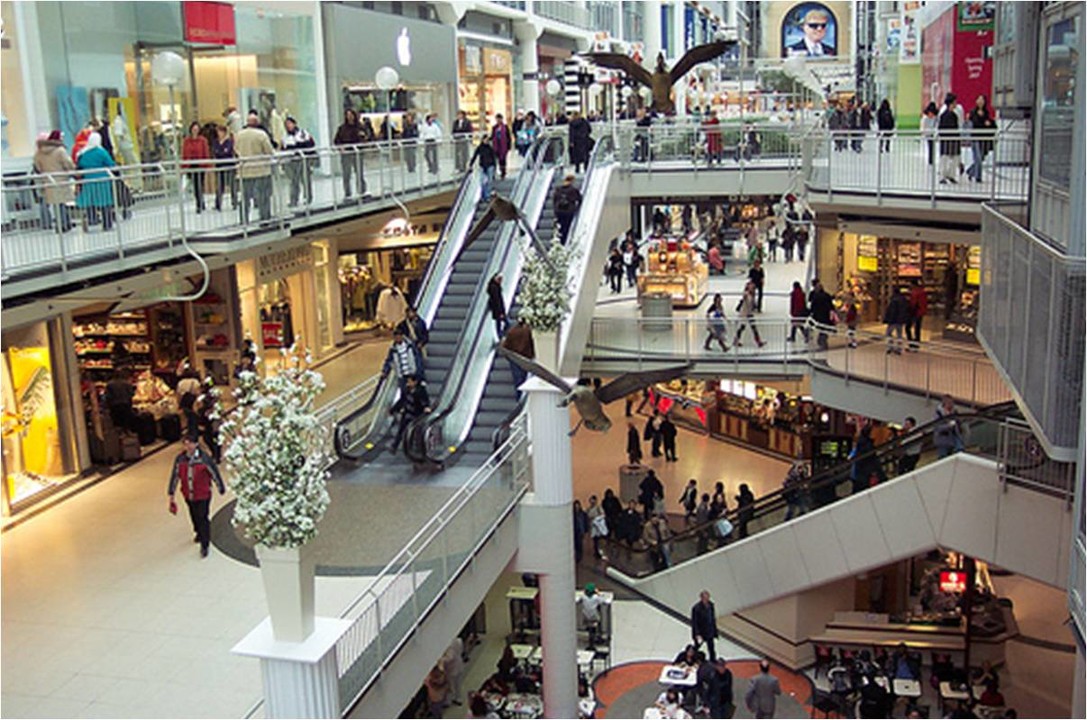
Almost three decades after Uphaar, our cinemas and malls look very different. They are brighter, bigger and full of glass and food courts. But the questions that mattered in 1997 still matter today. Is the exit door open? Does the alarm work? Can people get out before the smoke reaches them? Too often, false ceilings hide overloaded wiring, fire exits stay locked to “prevent theft” and alarms get switched off after one false alarm too many.
Looking back: Uphaar Cinema, Delhi (1997)
- What happened: a Delhi Vidyut Board transformer in the cinema building caught fire during a screening of the film Border on 13 June 1997.
- Deaths: 59 people died of suffocation, and more than 100 were injured.
- Why people died: the court found that illegal structural changes, extra seats and a closed fire exit led to the deaths.
- What followed: a long legal fight led by the Association of Victims of Uphaar Tragedy (AVUT). The owners were convicted, and in 2017 the Supreme Court sentenced Gopal Ansal to one year in prison.
Fires in commercial buildings (NCRB, 2024)
| Place of fire | Fire accidents | Injured | Deaths |
|---|---|---|---|
| Commercial buildings | 277 | 19 | 249 |
| All places | 5,971 | 330 | 5,888 |
(Source: NCRB, Accidental Deaths & Suicides in India 2024, Table 1.12.)
- NCRB does not separate malls or cinemas from other commercial buildings, so there is no official national count of mall and cinema fires since Uphaar.
- As at Uphaar, it is smoke, not flame, that kills most people trapped in closed buildings.
Violations we keep seeing
- Emergency exits locked or hidden behind advertisement panels and stalls.
- Sprinkler heads covered or painted over during renovation.
- No smoke extraction in basements, parking levels and food courts.
- LPG cylinders stored carelessly in food court kitchens.
- Security staff who do not know the evacuation plan, so nobody guides the crowd.
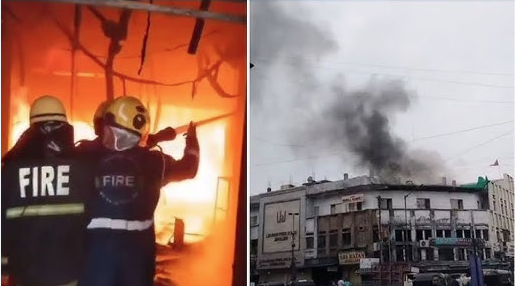
Case study: Swapnalok Complex, Secunderabad (2023)
- What happened: a fire broke out in the Swapnalok commercial complex in Secunderabad on the evening of 16 March 2023. Fire officials suspected a short circuit.
- Impact: six people died, and about 18 people were rescued from the building.
- Lesson: old commercial complexes with offices packed into every floor need the same attention as new malls. Wiring, exits and smoke control must be checked, not assumed.
What a safe mall or cinema should have
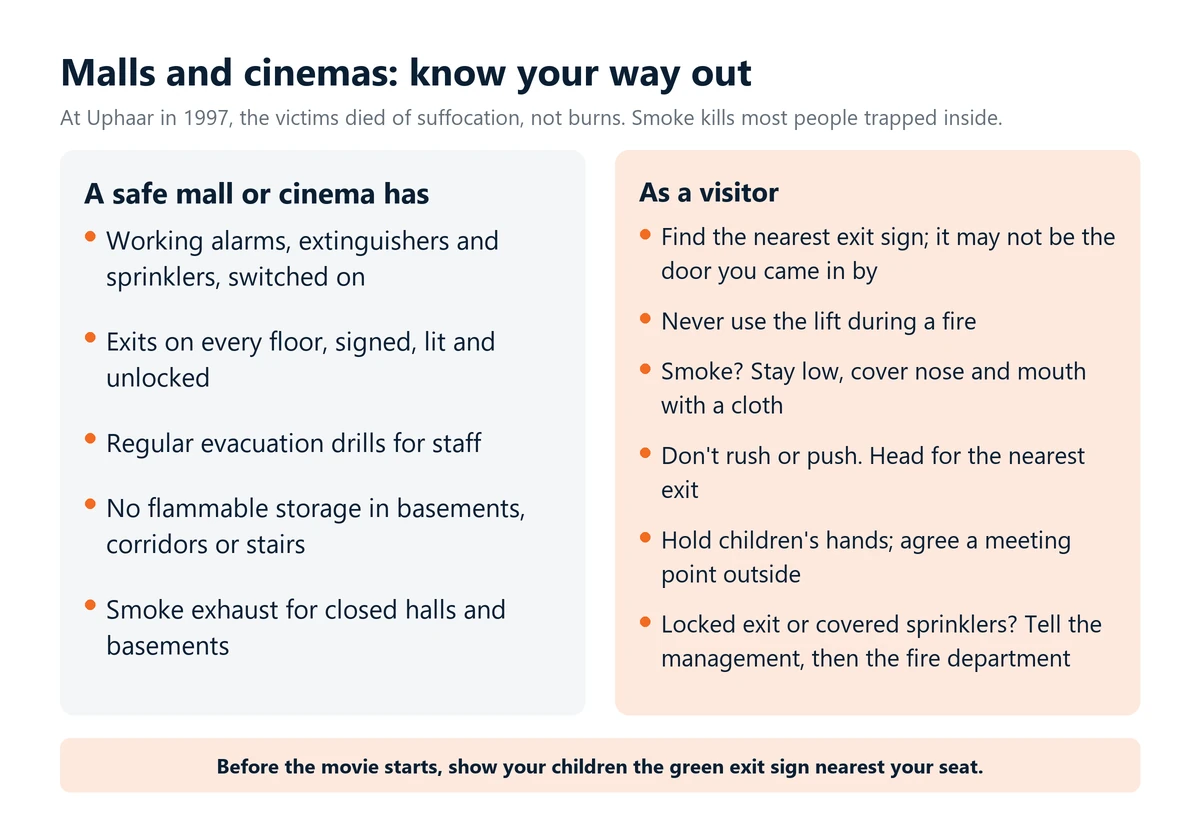
- Working fire alarms, extinguishers and sprinklers, maintained and switched on.
- Emergency exits on every floor, clearly signed, lit and unlocked whenever the building is open.
- Regular evacuation drills for staff, and clear instructions for visitors.
- No flammable storage in basements, corridors or staircases.
- A fire control room in large complexes, with staff who know how to use it.
- Smoke exhaust systems for closed halls, multiplexes and basements.
(Fire and life safety requirements for these buildings are set out in the National Building Code of India 2016, Part 4, as adopted by state Fire Acts and local bye-laws.)
Safety tips for visitors
- When you walk into a mall or take your seat in a cinema, look for the nearest exit sign. It may not be the door you came in by.
- Never use the lift during a fire.
- If smoke fills the air, stay low and cover your nose and mouth with a cloth.
- Do not rush or push. Head for the nearest exit, not only the main gate where everyone else is going.
- Hold children’s hands, and agree a meeting point outside if the family gets separated.
- If you see a locked exit, covered sprinklers or blocked stairs, tell the management, and if nothing is done, complain to the fire department.
What should change
- Fire NOC renewals should be linked to real inspections, with records the public can see.
- Alarm and smoke control systems in public buildings should be monitored, so a switched-off system is noticed.
- Owners and managers should face criminal accountability for locked exits and false compliance, as the Uphaar case showed they can.
- Safety ratings for public venues should be published and visible to visitors.
Before the movie starts
When the lights go down and the ads begin, take ten seconds. Find the green exit sign nearest your seat and show it to your children. It is the cheapest safety habit there is.
References
- NCRB, Accidental Deaths & Suicides in India 2024, Table 1.12 (ncrb.gov.in)
- Bureau of Indian Standards, National Building Code of India 2016, Part 4, Fire and Life Safety
- Uphaar case judgments, as summarised by The Quint
What needs attention
- At Uphaar, smoke and a closed exit killed 59 people, not the flames
- The court held illegal structural changes and extra seats responsible
- India has no official count of mall and cinema fires since Uphaar
- Locked exits, covered sprinklers and untrained security staff are still common
- Older commercial complexes, like Swapnalok, are as dangerous as new malls if wiring and exits are neglected
Controls that reduce risk
- Keep every exit unlocked, lit and signed while the building is open
- Maintain alarms, sprinklers and smoke exhaust and keep them switched on
- Train security and housekeeping staff to guide an evacuation
- Hold regular evacuation drills
- Store LPG and flammables away from public areas
- Report locked exits and covered sprinklers to the fire department
Common unsafe practices
- Locking emergency exits to prevent theft
- Hiding exits behind advertisement panels or stalls
- Painting over or covering sprinkler heads
- Switching off alarms after false alarms
- Storing LPG and other flammables in basements and corridors
- Visitors using the lift or rushing only for the main gate
Leave a comment