
Quick answers
What is a Fire NOC?
A Fire NOC is a No Objection Certificate that buildings above a certain height or occupancy must have. It is meant to confirm that alarms, hydrants, sprinklers, detectors and exits are in place.
Does a Fire NOC mean a building is safe?
Not always. NOCs can be issued without proper inspection, and systems may be disabled after inspection day, so look for working exits, extinguishers, alarms and hydrants yourself.
How can I check fire safety before booking a school, hospital or hall?
Ask for a valid Fire NOC copy and also check that exits are open, extinguishers are serviced, alarms are visible and hydrants are charged.
What can housing societies do about Fire NOCs?
Residents can push their RWA to renew the Fire NOC and display it publicly, and report locked exits, capped sprinklers or missing hydrants to the authorities.
Who issues and enforces Fire NOCs in India?
The state or city fire service. Fire services are a State subject, and the Ministry of Home Affairs has said enforcement of building fire rules lies with the States and UTs. Ask your local fire service about a particular building.
Who is responsible for keeping fire systems working after the NOC?
The building owner or occupier, and in a housing society the managing committee. Name one person to look after the extinguishers, alarms, pumps and sprinklers, get them serviced on schedule and keep a log of faults and repairs.
How do I complain about a blocked exit or suspected bribery in a Fire NOC?
Write to the management with a photo and date first, then report unsafe conditions to your local fire service. Take suspected bribery to your state anti-corruption bureau with whatever evidence you have. Specific, dated complaints are the ones that get acted on.
Many buildings in India, depending on their height and what they are used for, need a Fire NOC (No Objection Certificate) from the fire department before they can open. On paper, the NOC tells you the building has passed a fire safety check. In real life, a certificate on the wall does not put out a fire. Only working systems and people who know what to do can save lives.
Three fires, one pattern
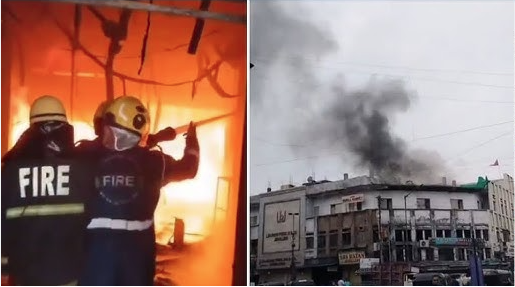
- Surat, Takshashila Arcade (May 2019): 22 students died at a coaching class held in a makeshift dome on the terrace. The only way up was a wooden staircase, and it burnt. The building had no fire safety equipment, and two fire officers were later suspended.
- Delhi, Anaj Mandi (December 2019): 43 people died in a building used as an illegal factory. Most were labourers sleeping inside, and most were killed by smoke. The Delhi Fire Service said the place had no fire clearance.
- Rajkot, TRP Game Zone (May 2024): 27 people died, children among them. The game zone ran without a fire NOC, and more than 2,000 litres of petrol was reportedly stored on the premises while welding work went on.
After each fire, we heard the same lines. The authorities said they would investigate. The owners said they had permission. And families buried their children. When a building can run for months or years without clearance, and nobody notices until people die, the NOC system has failed at its basic job.
How a Fire NOC is meant to work
Fire safety rules for buildings come from the National Building Code of India 2016 (Part 4, Fire and Life Safety) and from each state’s Fire Act and rules. In broad terms:
- The building must have the exits, alarms, extinguishers, hydrants, sprinklers and detectors that its height and use call for.
- The fire department inspects the building before giving the NOC.
- The NOC has to be renewed at the interval the state sets, with fresh inspection.
Fire services are a State subject in India. In a Lok Sabha answer of 10 February 2026, the Ministry of Home Affairs said enforcement of building fire rules lies with the States and UTs, and that the Centre does not keep data on buildings audited for fire safety. The Centre does fund the States: a Scheme for Expansion and Modernisation of Fire Services, launched on 4 July 2023, has a central outlay of ₹5,000 crore for new fire stations, training and equipment. So when you want to know about a particular building’s NOC, the people to ask are your state or city fire service, not Delhi.
Where it goes wrong
- Buildings open, or keep running, without ever applying for an NOC, as the Rajkot game zone did.
- Equipment works on inspection day and is then switched off, locked away or left without service.
- Exits get locked or blocked with stock once the inspector has gone.
- A building’s use changes, say from shops to a factory or a coaching class, without fresh approval.
- Most of us never ask to see the NOC, or check whether it is still valid.
A valid NOC with a locked exit is no protection at all.
What you can check yourself
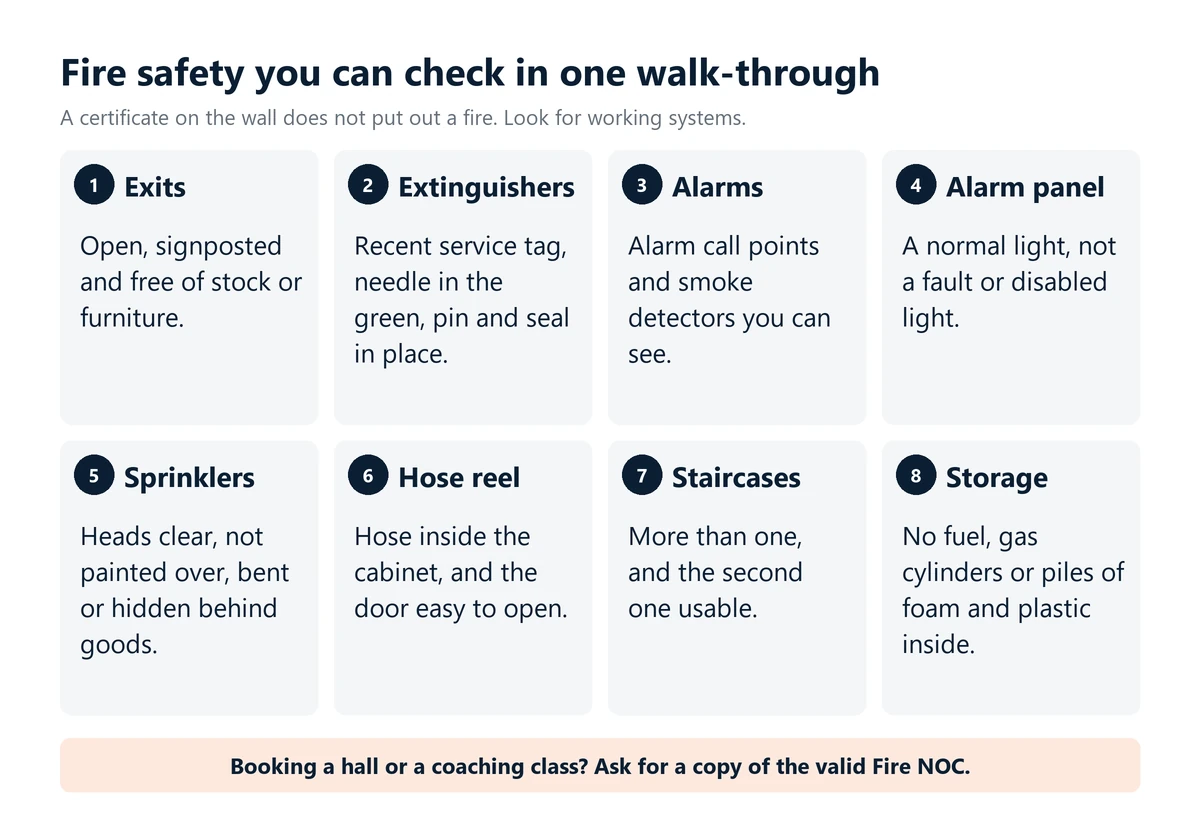
You do not need to be an engineer. When you walk into a school, hospital, coaching class, banquet hall or game zone, look for these:
- Are the exits open, signposted and free of stock or furniture?
- Do the extinguishers have a recent service tag, with the pressure gauge needle in the green and the safety pin and seal in place?
- Can you see alarm call points and smoke detectors?
- If you can see the fire alarm panel, is it showing a normal light, or a fault or “disabled” light?
- Are the sprinkler heads clear, or painted over, bent or hidden behind stacked goods?
- Is the hose reel or hydrant cabinet there, with the hose inside and the door easy to open?
- Is there more than one staircase, and is the second one usable?
- Is anything dangerous stored inside, like fuel, gas cylinders or piles of foam and plastic?
Before you book a hall or admit your child to a school or coaching class, ask for a copy of the valid Fire NOC. A good management will show it without fuss.
What housing societies can do
- Ask the committee whether the building needs a Fire NOC, and when it is due for renewal.
- Display the NOC and the renewal date in the lobby.
- Get the fire pump, hydrants and alarms serviced, and keep the service records.
- Keep staircases and refuge areas free of junk, two-wheelers and storage.
What needs to change
- Fire NOCs should be public and searchable online, so anyone can check a building before walking in.
- Surprise inspections should be routine, not just a check when the file is due.
- Officials who sign off unsafe buildings should be held accountable.
- Places that run without a valid fire clearance should be shut until they comply.
Speak up
If you see locked exits, capped sprinklers or missing hydrants, it does not matter what certificate hangs on the wall. Tell the management, complain to the local fire department, and share your evidence with us at HowToSurvive.in.
A complaint gets fixed when it is specific and on record. A few habits help:
- Put it in writing. Send it to the manager or society secretary with a photo and the date, and keep a copy.
- Ask for evidence, not promises. When was the fire pump last tested? When was the alarm panel serviced? When was the last drill?
- Be specific. A blocked exit, an expired service tag or a failed pump test can be checked and fixed. A general allegation cannot.
- Use the right channel. Report unsafe conditions to your local fire service. If you suspect bribery in an NOC, take it to your state’s anti-corruption bureau with whatever evidence you have.
- Do not accuse without proof. A suspicion is not a finding, and a loose accusation is easy to ignore.
In an emergency, call 101 for the fire brigade or 112 for all emergencies.
Fire does not read certificates. Next time you are in a hall, a class or a mall with your family, take one minute to find two ways out.
What needs attention
- In all three fires covered here, the building was running without proper fire clearance
- Most of the Anaj Mandi victims were killed by smoke while asleep, not by flames
- At Takshashila, the only way up to the class was a wooden staircase, and it burnt
- At Rajkot, fuel was stored on site while welding work went on
- A certificate cannot keep an exit unlocked or an alarm working; only daily upkeep can
- Citizens rarely ask to see a Fire NOC, so unsafe places face little pressure
- Common failures are simple: an empty extinguisher, a closed sprinkler valve, an alarm panel switched off because of false alarms
- When nobody is named as responsible for upkeep, nobody does it
Controls that reduce risk
- Ask for a valid Fire NOC before booking a hall or choosing a school or coaching class
- Get your society to display its Fire NOC and renewal date in the lobby
- Have the society's fire pump, hydrants and alarms serviced, and keep the records
- Clear staircases and refuge areas of junk and parked vehicles
- Report locked exits or missing equipment to the local fire department
- Push for NOCs to be published online so anyone can check
- Name one person responsible for the building's fire systems and keep a log of every fault and repair date
- Fix the cause of false alarms instead of switching the alarm panel off
- Put complaints in writing with a photo and date; report suspected bribery to the state anti-corruption bureau with evidence
Common unsafe practices
- Assuming a building is safe because it is busy or well known
- Never asking to see the Fire NOC or its renewal date
- Ignoring locked or blocked exits
- Letting a building change its use without fresh fire approval
- Storing fuel, tyres or plastic near work that makes sparks
- Keeping alarms and pumps for show and never servicing them
- Closing a sprinkler or hydrant valve for repairs and not reopening it
- Disconnecting an alarm panel instead of fixing false alarms
- Making loose accusations without dates, photos or other evidence





Leave a comment