
Quick answers
How does a fire sprinkler work?
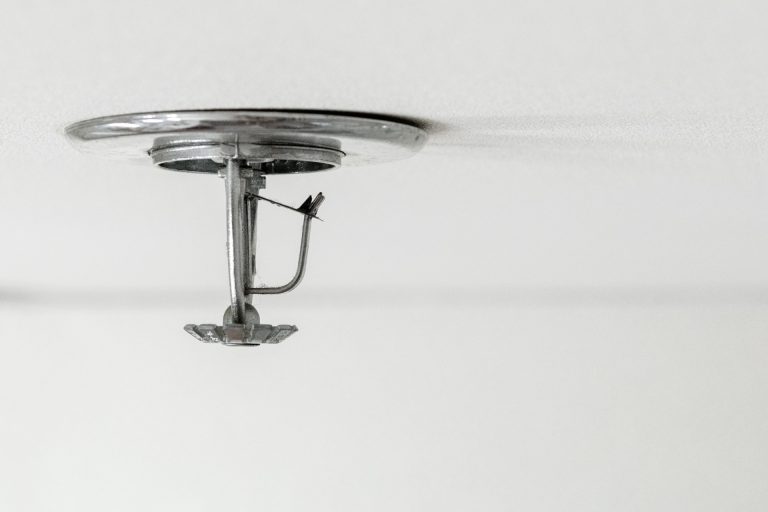
Each sprinkler head has a glass bulb or metal link that breaks when the heat at that spot gets high enough. Only that head opens and sprays water on the fire. Smoke or a pressed alarm button does not set off every head.
Can I close the sprinkler valve to stop water damage during a fire?
No. Never close the valve or stop the fire pump to save furniture or stock. A switched-off system can let a small fire grow into a big one. Treat flowing sprinklers as a real fire and get out.
Is it all right to paint sprinkler heads or hang things from the pipes?
No. Paint can stop a head from opening, and things hung from pipes or kept in the way can block the spray. Keep heads clean and the space below them clear.
Do sprinklers replace fire alarms and exits?
No. Sprinklers work alongside alarms, fire-rated walls and doors, smoke control, exits and the fire brigade. They cannot make up for locked exits, open fire doors or missing alarms.
Of all the fire protection you can put in a building, sprinklers do the most on their own. They start working the moment a fire gets hot enough, whether the building is full or empty, day or night, long before the fire brigade can reach you. For a hospital, a hotel, a mall, a godown or a tall residential tower, few safety investments give you more.

What sprinklers do
A sprinkler system has two jobs. It protects the people inside, and it protects the building and what is in it.
Protecting people
A sprinkler sprays water on a fire while it is still small. The water cools the burning material, wets whatever is next to it and slows the fire down. Less heat and less smoke means more time for people to get out, and safer conditions for the firefighters who have to go in.
Protecting property
Because the fire is tackled early, the damage stays small. A wet room can be dried out. A burnt-out floor cannot be saved.
What the numbers say
India has no national data on how sprinklers perform, so the best evidence we have comes from the US. NFPA’s latest report, published in October 2026, covers fires reported to US fire departments from 2020 to 2024. It found that:
- where sprinklers were present, the civilian death rate per fire was 90% lower than in buildings with no automatic extinguishing system;
- in homes with sprinklers, the average property loss per fire was 58% lower;
- the fire stayed in the object or room where it started in 93% of fires in sprinklered buildings, against 68% where there was no system;
- sprinklers operated in 90% of fires big enough to set them off, and controlled the fire in 97% of the cases where they operated;
- the most common reason a sprinkler system failed was that someone had shut it off before the fire.
NFPA’s earlier edition, covering 2017 to 2021, gave similar results, and those are the figures in the data panel on this page. These are American numbers, not Indian ones. Still, water on a small fire does the same job in an Indian building as it does in an American one.
They don’t all go off at once
In films, one cigarette sets off every sprinkler in the building. Ordinary sprinklers do not work like that. Each head has its own heat-sensitive glass bulb or metal link, and it opens only when the heat right at that head is high enough. Smoke alone will not open it, and pressing the fire alarm will not make every head spray. Usually only the one or two heads above the fire open. In NFPA’s 2020 to 2024 data, just one sprinkler operated in 76% of the fires where sprinklers operated, and five or fewer in 97%.
The exception is a deluge system, used for special hazards such as transformer yards. Its nozzles are open, so all of them discharge together once a detection system opens the main valve.
Why sprinklers fail
The sprinkler head is only the last link in a chain. Behind it you need the right design for the hazard, enough water at the right pressure, open valves, a working pump and nothing in the way of the spray. Break any one link and the protection is gone. These are the usual culprits we see:
- a control valve closed to stop a leak or during renovation, and never opened again;
- heads painted over during whitewashing, or wires, banners and bags hung from sprinkler pipes;
- false ceilings, ducts or partitions added below the sprinklers;
- storage piled higher, or changed from cartons to plastics, foam or lithium-ion batteries, without anyone checking the design again;
- a fire pump left on manual, or a tank that looks full but cannot deliver the flow the system needs.
In India, sprinkler systems are designed and installed under BIS IS 15105:2021 and the National Building Code of India 2016, as your local fire authority requires. Sprinklers support alarms, fire-rated walls and doors, smoke control and protected exits. They do not replace any of them.
If the sprinklers go off
Treat it as a real fire. Get out by the nearest safe exit and call 101 or 112. Never close the sprinkler valve or stop the pump to save furniture or stock from water damage. A sprinkler that is shut off can let a small fire become a big one.
If you manage a building, go and find the main sprinkler control valve this week. Check that it is open and either locked or monitored, and that the fire pump panel shows “Auto”.
What needs attention
- Older versions of this page said sprinklers cut deaths and property loss by a half to two-thirds; that mixed different datasets, so the figures now name the country, years and measure
- NFPA's October 2026 report covers fires reported to US fire departments from 2020 to 2024; it is good evidence of how sprinklers perform but it is not an Indian survey
- In that data, sprinklers operated in 90 percent of fires big enough to set them off and controlled the fire in 97 percent of those; the 2017 to 2021 edition gave 92 and 97 percent
- The most common reason sprinklers did not work was that someone had shut the system off before the fire, so who controls the valves really matters
- One sprinkler operated in 76 percent of fires where sprinklers operated, and five or fewer in 97 percent (2020 to 2024)
- Sprinklers come in different types, such as standard spray, residential, quick-response and ESFR, and each is listed for particular uses
- Deluge systems are the exception to the one-head-at-a-time rule, because all their open nozzles spray once the valve opens
- Water damage is a fair worry, but a switched-off system can let a fire grow until the fire brigade has to pour in far more water
Controls that reduce risk
- Find the main sprinkler control valve and confirm it is open, locked or monitored as designed
- Check that the fire pump and its automatic controls show normal status
- Review the latest main-drain, alarm, pump, flow and water-supply test records
- Look for painted, rusted, leaking, dirty, damaged or missing sprinklers
- Remove storage and decorations that break the required clearance or block the spray
- Compare the current use and stored goods with the approved hydraulic design
- Require a permit, temporary precautions, notice to the right people and a restoration test for every shutdown
- Keep spare sprinklers and the correct spanner where the adopted standard requires them
- Train security and maintenance staff never to close a valve just to stop an alarm
- Send every change to the ceiling, racks, partitions, machinery, processes or water supply to a competent designer
Common unsafe practices
- Believing that smoke, a pressed alarm button or one opened head makes every sprinkler spray
- Closing a control valve to stop a leak or keep out renovation dust, without a proper shutdown procedure
- Painting heads, hanging things from pipes or putting cupboards and signboards in the way of the spray
- Switching from cartons to exposed plastics, aerosols, lithium-ion batteries or higher stacks without a design check
- Assuming that water in the tank means enough flow and pressure at the far end of the system
- Adding false ceilings, ducts, lights or partitions under sprinklers without moving or adding heads
- Using ordinary plumbing fittings or unlisted heads as replacements
- Forgetting to protect wet pipes from freezing in hill areas where it gets that cold
- Treating a once-a-year pump start as proof that the whole system works
- Expecting sprinklers to make up for locked exits, wedged-open fire doors or missing alarms
Leave a comment