
Quick answers
What share of road accidents in India happen near schools?
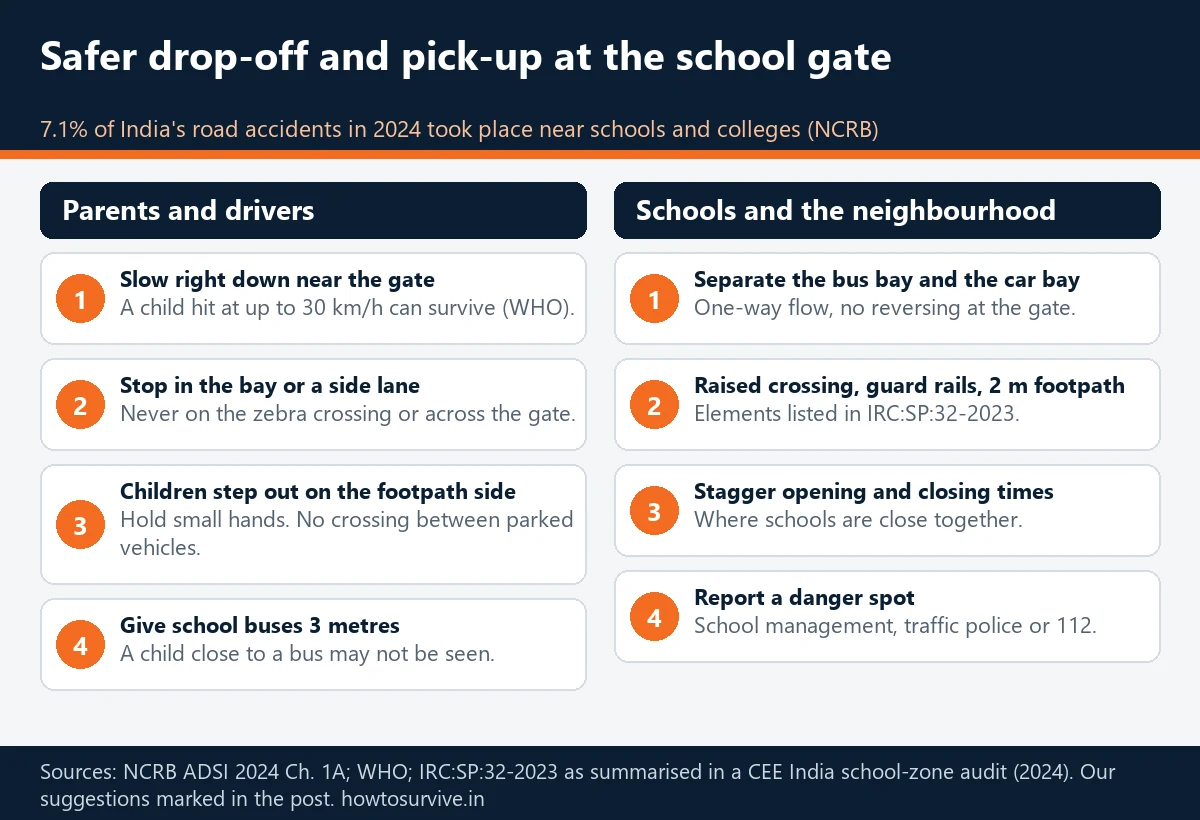
NCRB recorded 32,994 road accidents near schools, colleges or other educational institutions in 2024, which is 7.1 per cent of 4,67,967 road accidents. The figure covers all vehicles and all victims, not only children or school buses.
What speed is safe near a school gate?
WHO says pedestrians can survive an impact up to 30 km/h and that survival chances fall sharply above that. West Bengal notified 25 km/h school zones in January 2025. Limits differ by State, so look for the board at your school.
Where should I stop to drop my child at school?
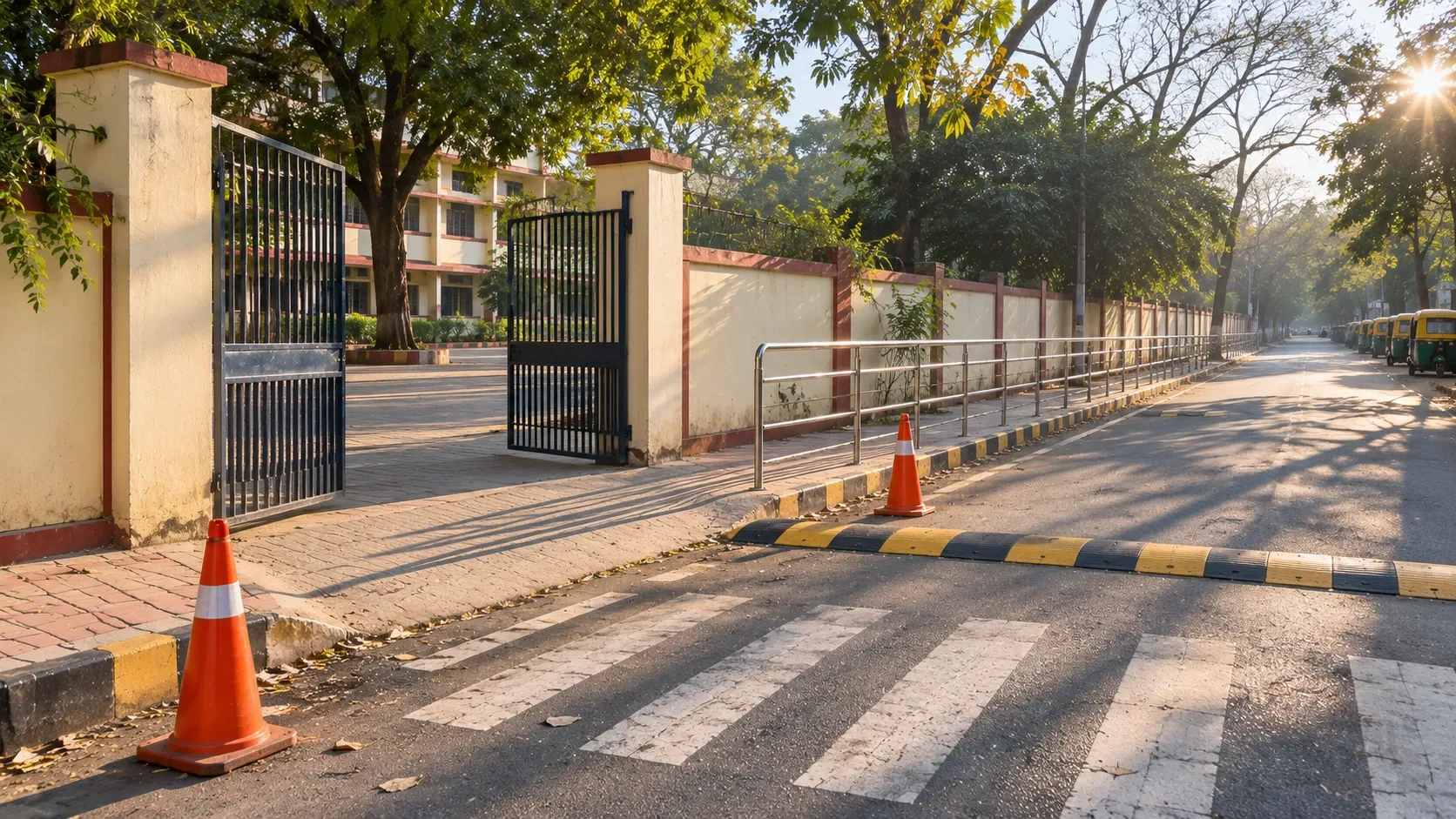
In the drop-off bay or a side lane, not on the zebra crossing, the footpath or across the gate. This is our suggestion. Children should step out on the footpath side and be walked to the gate.
How close can I go to a school bus?
The Indian school-zone guidance, as summarised in a CEE India audit, describes a danger zone of 3 metres in front of, behind and beside a school bus where a child may be out of the driver's sight. Stay clear of it.
What is a school access zone?
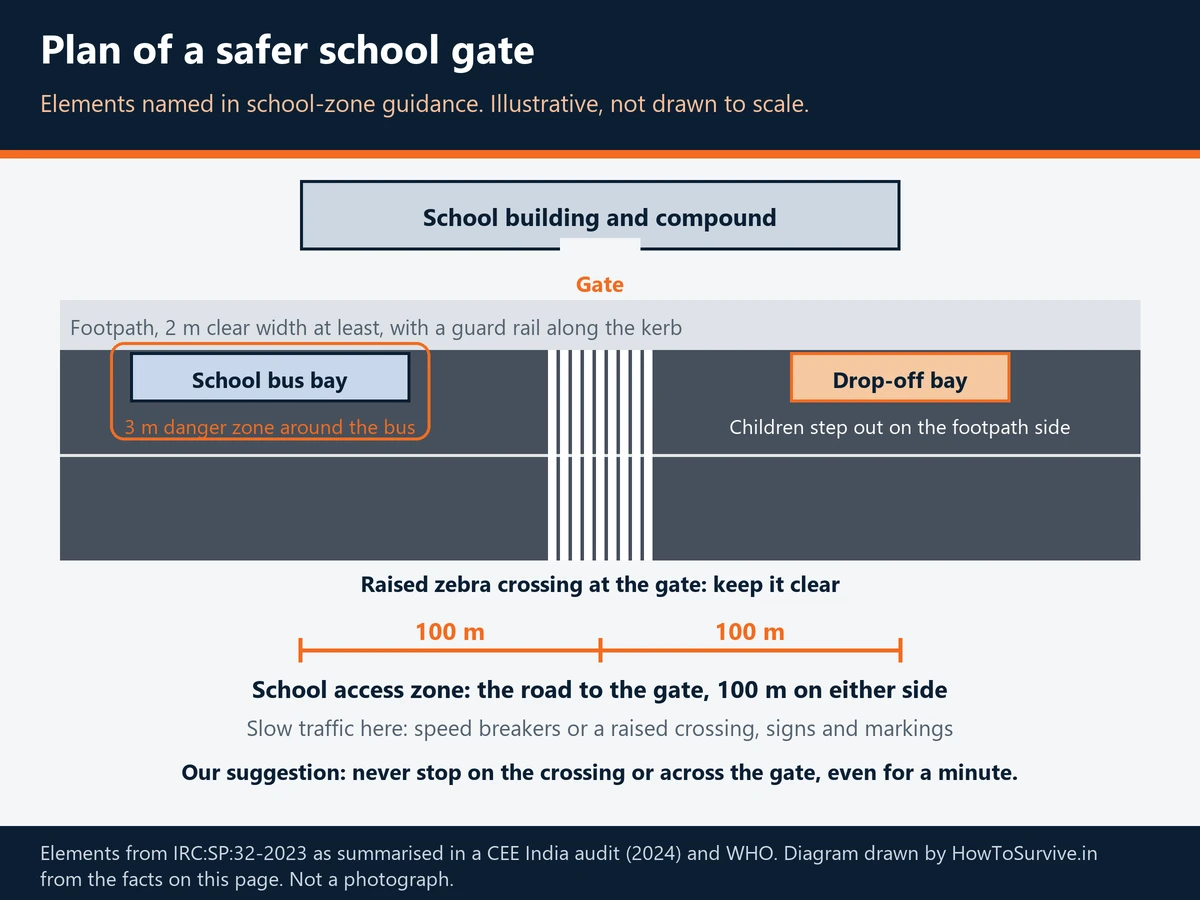
In IRC:SP:32-2023, as summarised by CEE India, it is the road leading to each school entrance, extending 100 metres on either side of the gate, where traffic should be slowed by calming measures, signs and markings.
What can a school do about the traffic outside its gate?
Separate bus and car bays, put staff at the gate in the peak 20 minutes, stagger opening and closing times where schools are close, tell parents where to stop, and ask the traffic police or the municipal body for a raised crossing, speed breakers, signs and a guard rail.
Who do I tell about a dangerous school gate?
The school management first, then the local traffic police or municipal body. In an emergency call 112.
School gate road safety matters in India because 7.1 per cent of all road accidents in 2024, 32,994 of 4,67,967, took place near schools, colleges or other educational institutions, according to the National Crime Records Bureau (NCRB). The gate is where cars, autos, vans, buses, two-wheelers, hawkers and small children all arrive in the same ten minutes. This guide sets out what the NCRB figure does and does not say, and what parents, drivers, schools and neighbours can change at the gate: speed, where vehicles stop, where children step out, and how the crossing is kept clear. Checked 13 November 2026.
In short
- 7.1 per cent of road accidents in 2024 (32,994) were near schools, colleges or other educational institutions (NCRB). The figure covers all vehicles and all victims, not only children or school buses.
- Speed decides who survives. The World Health Organization (WHO) says people on foot can survive an impact up to 30 km/h, and the chances fall sharply above that.
- Stop in the bay or a side lane, never on the zebra crossing, the footpath or across the gate. This is our suggestion.
- Children step out on the footpath side, not into the road, and cross only at the crossing with an adult.
- Give school buses room: the Indian school-zone guidance describes a danger zone of 3 metres in front of, behind and beside a bus where a child may be out of the driver’s sight.
- Schools and neighbours can ask for a raised crossing, a guard rail, a footpath at least 2 metres wide, separate bus and car bays, and staggered timings.
What the numbers say
NCRB’s Accidental Deaths and Suicides in India 2024 records 4,67,967 road accidents. Of these, 32,994 (7.1 per cent) took place near schools, colleges or other educational institutions. Separately, in urban areas 6.1 per cent of road accidents (11,445 of 1,88,555) took place at pedestrian crossings. NCRB also says rural areas had 59.7 per cent of all road accidents and urban areas 40.3 per cent.
What the 7.1 per cent cannot tell you. It counts accidents of every kind, with every type of vehicle and every person hurt, near schools and also colleges. The chapter text does not say how many involved school buses, how many victims were children, what time of day they happened or how many deaths there were. Our own guide to reporting a school bus defect makes the same point about the gate. Read the figure as a sign that the road outside an educational institution is a place where accidents are recorded in large numbers, not as a count of child deaths.
Why speed near the gate matters
WHO says vulnerable road users such as pedestrians and cyclists can survive an impact when the oncoming vehicle is travelling up to 30 km/h, and that survival chances fall sharply as speed rises; it welcomed a 30 km/h school-zone limit in Malaysia as evidence-based best practice. In another WHO commentary, a person hit by a vehicle at 80 km/h (50 miles an hour) has a three times higher risk of dying than one hit at 48 km/h (30 miles an hour). In India, West Bengal notified a 25 km/h limit in school zones in January 2025 as part of a State speed policy (ThePrint). Limits and signs differ by State and city, so look for the board at your own school and, where there is none, ask for one.
What Indian school-zone guidance suggests
The Indian Roads Congress guidelines for a safer commute to schools, IRC:SP:32-2023, are summarised in a 2024 school-zone safety audit by the Centre for Environment Education (CEE India) for a college in Pimpri-Chinchwad. We could not open the IRC document, so what follows is what that audit reports from it:
- School access zone: the road leading to each entrance of the school, extending 100 metres on either side of the gate.
- School proximal zone: an area around the school, whose radius depends on the road and the school level. On local streets it ranges from 150 metres for a primary school to 250 metres for a senior secondary school; on urban and inter-urban roads, 400 to 500 metres.
- At the gate: traffic calming such as speed breakers, raised crossings and narrowed road width, with signs and markings.
- Pick-up and drop-off areas for school buses and for private vehicles (autos, vans, cycles, cars and two-wheelers).
- The bus danger zone: 3 metres in front, on either side and behind a school bus.
- Walking space: a raised footpath on both sides on collector roads and above, with at least 2 metres of clear width; guard rails to keep children from running onto the road; pedestrian crossings of 2 to 4 metres; refuge islands on wide roads.
- Roles: the audit assigns traffic calming and enforcement to the road and traffic agencies, temporary traffic management during school hours and staggered opening and closing times where school zones overlap to the school, and use of designated drop-off and pick-up points and the safety checklist to parents.
If you are driving or riding to the gate
These are our suggestions, built on the guidance above:
- Slow down well before the gate, slower than the board says if children are on the road. Do not overtake, honk through the crowd or reverse near the entrance.
- Stop in the bay or in a side lane, not on the zebra crossing, the footpath or across the gate. A vehicle stopped on the crossing hides the children behind it from the traffic behind you.
- Keep the crossing clear and do not make a U-turn at the gate. If there is no bay, a short walk from a side street is safer than a stop on the main road.
- Look between parked vehicles. Children come out from between them, from behind autos and vans.
- Two-wheelers: keep to a walking pace at the gate and watch for children stepping off the footpath.
- Around a school bus, stay well back, keep 3 metres clear on every side, and wait until the children have crossed.
If you are a parent or a child
- Children step out on the footpath side, not into the road. Open the door only after the vehicle has stopped at the kerb.
- Walk the last stretch with the child, holding hands for younger ones, and see them through the gate.
- Cross at the crossing, with an adult, after looking both ways. Our guide to walking on Indian roads covers how to cross, and to walk on the footpath.
- Pick-up: wait in the pick-up area, on the footpath side, and let the child come to you. Do not call a child across the road.
- Teach it as a habit: no phones and no running near the road, and no crossing between parked vehicles.
If you run or govern the school
- Separate the flows: a bus bay and a car bay, one-way movement, and no reversing in the lane in front of the gate.
- Put staff at the gate in the peak 20 minutes to wave vehicles on and keep the crossing clear. The CEE audit says school administrators carry out temporary traffic management during school hours.
- Stagger the timings where two schools or a school and a college share a road.
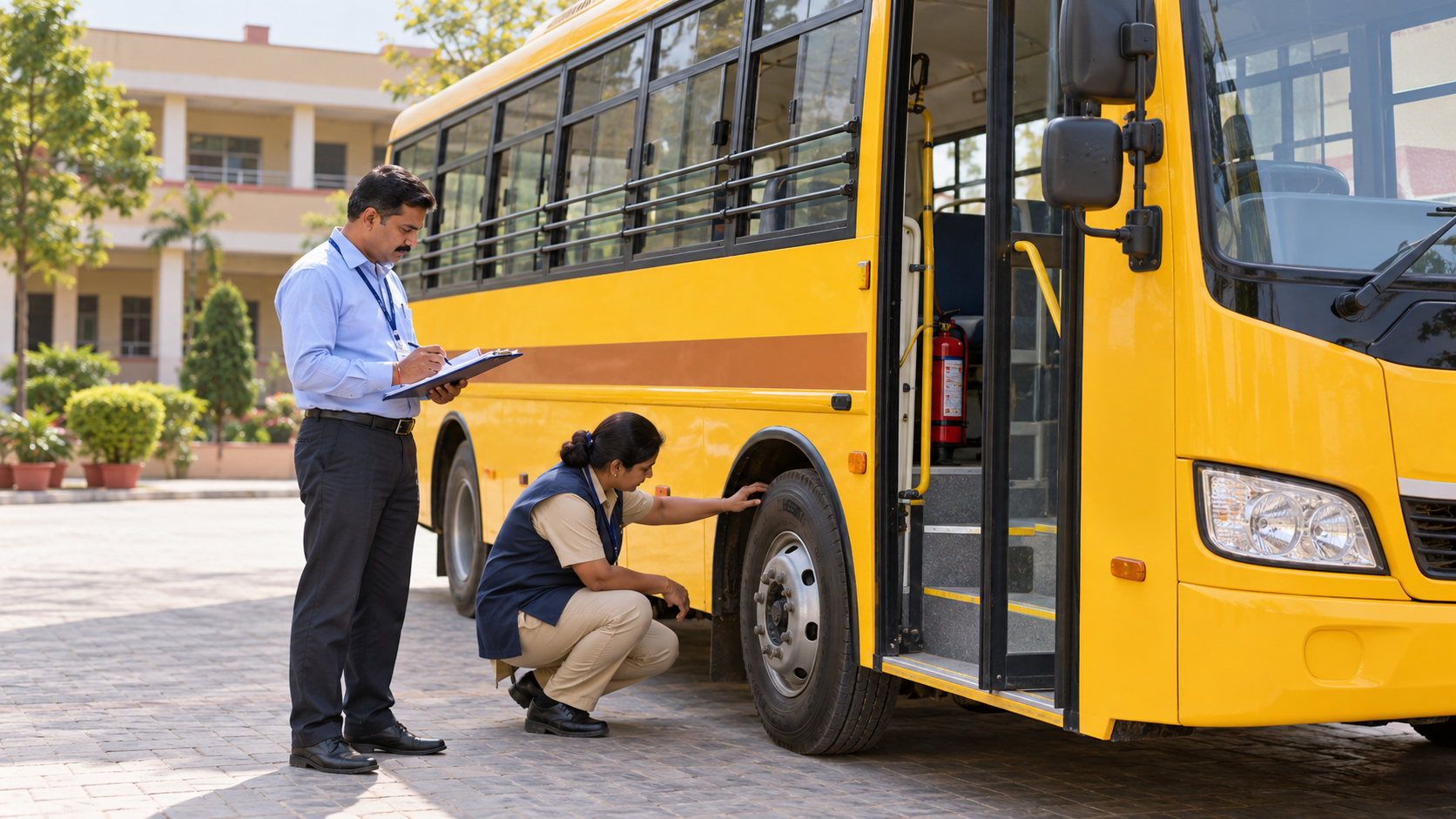
- Tell parents where to stop, in writing and at the gate, and check the school bus the way our guide to school bus defects describes.
- Ask the traffic police or the municipal body for a raised crossing, speed breakers, signs and road markings, a guard rail and a footpath at least 2 metres wide.
If you see a danger spot
Tell the school management first, then the local traffic police or municipal body. In an emergency, call 112. Our guide to how to call 112, 101 or 108 says what to tell the control room. For children at school more generally, see our guide to child emergencies at home and school.
What we could not confirm
NCRB’s chapter text does not split the 32,994 accidents near educational institutions by victim age, vehicle, time or deaths. We could not open IRC:SP:32-2023 itself, so the zone sizes come from a CEE India audit report that cites it. We found no single national speed limit for school zones on an official page we could open, so we give the West Bengal example as reported and say limits differ by State. The two videos below are general safety learning, one from Mumbai and one from the United States, and were not watched in full. This page is general safety information, not legal advice.
Do this this week
- At the next drop-off, stop in the bay or a side lane, not on the crossing, and walk your child to the gate.
- If you are on the school committee, ask for a staff member at the gate for the peak 20 minutes.
- Send the traffic police or the municipal body one written request for a raised crossing and a sign at your gate.
What needs attention
- 7.1 per cent of India's road accidents in 2024, 32,994, took place near schools, colleges or other educational institutions (NCRB).
- The NCRB figure covers all vehicles and all victims; it is not a count of school bus accidents or child deaths.
- WHO says pedestrians can survive impacts up to 30 km/h and that survival chances fall sharply above that.
- Indian school-zone guidance, as summarised by CEE India, includes a 100 metre access zone, a 3 metre bus danger zone and a footpath at least 2 metres wide.
- We could not open IRC:SP:32-2023 itself and found no single national school-zone speed limit on an official page.
Controls that reduce risk
- Slow down well before the gate and stop in the bay or a side lane.
- Walk children to the gate; they step out on the footpath side.
- Keep the crossing clear and keep 3 metres from school buses.
- Schools: separate bays, staff at the gate, staggered timings, tell parents where to stop.
- Ask the traffic police or municipal body for a raised crossing, guard rail, signs and a 2 metre footpath.
Common unsafe practices
- Stopping on the zebra crossing or across the gate to drop a child.
- Letting a child step out on the road side or cross between parked vehicles.
- Overtaking, honking or reversing near the school entrance.
- Standing close to a school bus, within its 3 metre danger zone.
- Calling a child across the road at pick-up.
- Treating the NCRB figure as a count of child deaths.


Leave a comment