
Quick answers
What are the key safety practices in the chemical industry?
Key practices include thorough risk assessment, safety training and drills, correct handling and storage of chemicals, use of suitable PPE, an emergency response plan, regular maintenance and inspection, and environmental protection.
How should chemicals be stored safely in a factory?
Store chemicals according to their hazard classification, keep incompatible substances apart, and use proper containers and clear labels to prevent mix-ups and spills.
What emergency equipment should a chemical plant have?
A facility should have an emergency response plan for spills, fires and other accidents, and be equipped with fire extinguishers, eyewash stations and spill kits.
What lessons does the Bhopal gas tragedy teach chemical industries?
The Bhopal disaster of December 1984, in which methyl isocyanate leaked from a pesticide plant and more than 500,000 people were exposed, shows the importance of proper maintenance, safety systems, emergency planning and protecting neighbouring communities.
India’s chemical belts, from Vapi, Ankleshwar and Dahej to Thane-Belapur, Taloja and the pharma clusters around Hyderabad, make products the whole economy depends on. They also handle substances that can burn, explode or poison. Workers on the shop floor and families living next to the boundary wall carry most of the risk when things go wrong. This page sets out the practices that keep a chemical unit safe and the Indian rules that apply.
Key safety practices
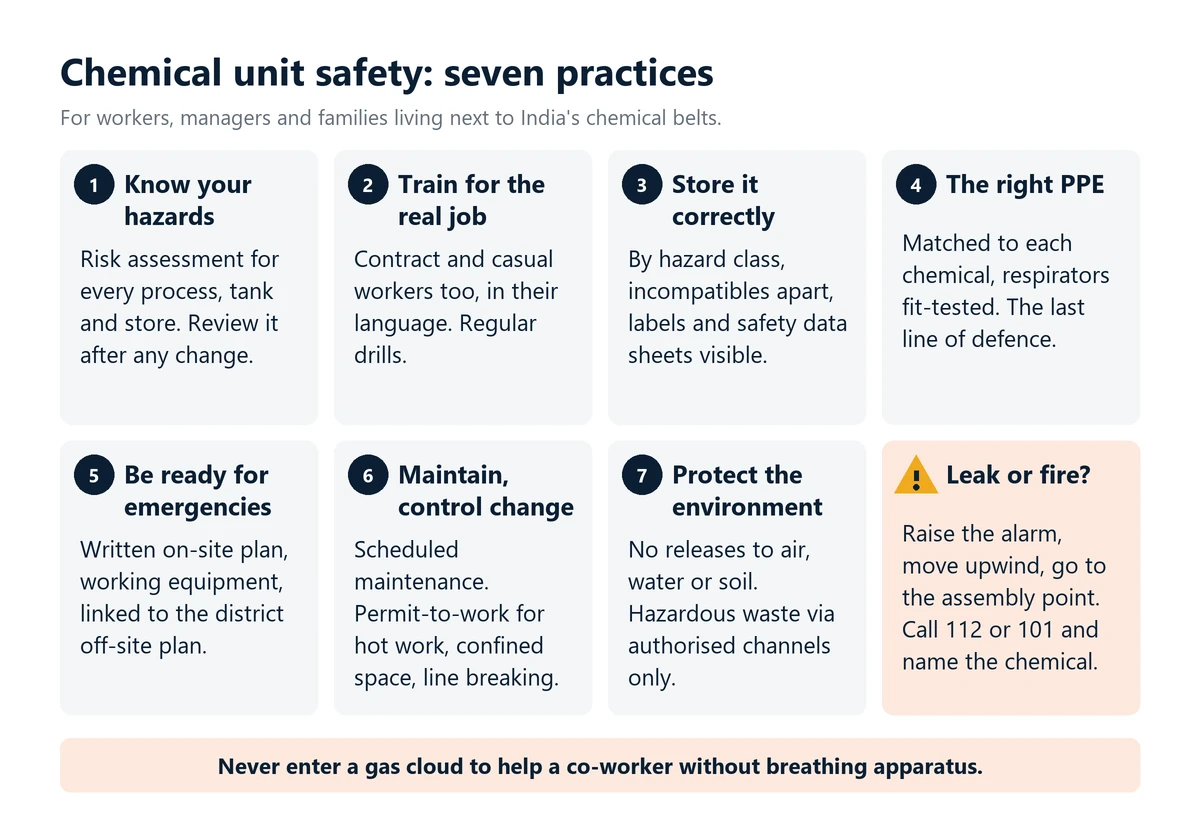
1. Know your hazards
Carry out a proper hazard and risk assessment for every process, tank and store: what you handle, how much, at what temperature and pressure, and what could go wrong. Use it to decide your controls, from process design and interlocks to ventilation, gas detection and PPE. Review it whenever the process, the chemicals or the quantities change.
2. Train every worker for the actual job
Train every worker, including contract and casual labour, on the specific hazards they face, in a language they understand. Hold regular emergency drills and refresher training so people know what to do when an alarm sounds.
3. Store and handle chemicals correctly
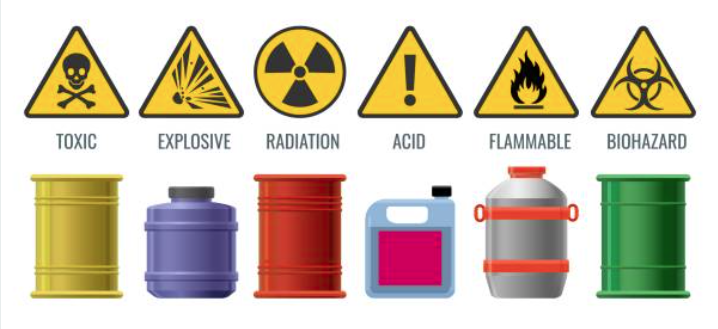
- Store chemicals by hazard class and keep incompatible ones apart, for example oxidisers away from flammables and acids away from bases.
- Use the right containers, with clear labels, and keep safety data sheets where workers can see them.
- Control quantities in process areas and keep bulk stock in properly designed stores.
4. Use the right PPE, and look after it
Provide gloves, goggles, face shields, chemical suits and respirators suited to each chemical, and make sure workers wear them. Respirators must match the contaminant and be fit-tested. Inspect and replace PPE regularly. PPE is the last line of defence; it does not replace safe process design.
5. Be ready for an emergency
- Have a written on-site emergency plan for spills, gas leaks, fires and explosions, with clear roles, alarms, assembly points and head counts.
- Keep fire extinguishers, hydrants, eyewash stations, safety showers and spill kits in working order.
- Share information with the district administration so the off-site emergency plan protects neighbouring communities, and practise it with them.
6. Maintain, inspect and control change
Maintain pumps, valves, pipelines, relief valves, tanks and instruments to a schedule. Use permit-to-work for hot work, confined-space entry and line breaking. Many serious accidents begin with a small change to a process or a piece of equipment that nobody reassessed.
7. Protect the environment
Prevent releases to air, water and soil, and dispose of hazardous waste only through authorised channels.
The Indian rules
- The Occupational Safety, Health and Working Conditions Code, 2020, in force from 21 November 2025. It replaced the Factories Act, 1948, including the Act’s chapter on hazardous processes. During the changeover, the existing rules and standards made under the old laws continue to apply until new ones replace them.
- The Manufacture, Storage and Import of Hazardous Chemicals Rules, 1989, which set duties for sites handling listed hazardous chemicals, including safety reports, on-site emergency plans and informing the public.
- The Chemical Accidents (Emergency Planning, Preparedness and Response) Rules, 1996, which set up crisis groups at the centre, state, district and local levels.
- Petroleum and explosives laws administered by PESO, where they apply.
US OSHA and EU REACH rules are useful for comparison and for export work, but in India the Indian law is what applies. Keep up with changes, carry out internal and external safety audits, close the findings, keep records of training, incidents and inspections, and report incidents to the authorities as the law requires.
Lessons from two disasters
Bhopal gas tragedy, 1984
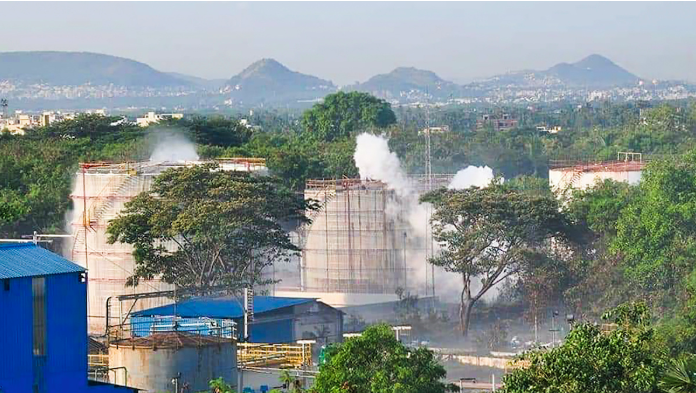
On the night of 2 to 3 December 1984, methyl isocyanate gas leaked from the Union Carbide pesticide plant in Bhopal. More than 500,000 people were exposed. It is still counted among the worst industrial disasters in the world. Its lessons are proper maintenance, working safety systems, honest risk communication and an emergency plan that protects the people living next to the plant. India’s chemical accident rules were written in its shadow.
BP Texas City refinery explosion, USA, 2005
On 23 March 2005, an explosion at the BP refinery in Texas City killed 15 workers and injured 180 others, according to the US Chemical Safety Board. Investigators found a series of safety lapses and weak safety management. The lesson: good personal-safety numbers do not prove that process safety is under control.
If there is a leak or fire
Raise the alarm, move upwind and away from the release, and go to your assembly point. Do not go back for belongings, and do not try to help a collapsed co-worker in a gas cloud without breathing apparatus. Call 112 or 101 and tell them which chemical is involved. If you live near a chemical unit, find out today what its siren sounds like and what the district plan says you should do.
What needs attention
- Most serious chemical accidents involve process safety failures, not just personal carelessness
- Unassessed changes to processes, equipment or quantities are a common starting point for disasters
- Incompatible chemicals stored together can react, burn or release toxic gas
- Contract and casual workers are often the least trained but closest to the hazard
- Communities near chemical units need to know the siren and the off-site emergency plan
- Good personal injury numbers do not prove that process safety is under control
Controls that reduce risk
- Carry out a hazard and risk assessment for every process, tank and store, and review it after any change
- Train every worker, including contract labour, in their own language
- Store chemicals by hazard class with incompatible ones kept apart and clearly labelled
- Provide suitable, fit-tested PPE and check it regularly
- Maintain plant on schedule and use permit-to-work for hazardous jobs
- Prepare and practise the on-site emergency plan, and support the district off-site plan
- Check that your compliance is up to date with the OSH Code, 2020, the MSIHC Rules and the Chemical Accidents Rules
- Audit regularly, close findings and record incidents and near misses
Common unsafe practices
- Treating a risk assessment as a one-time document and never reviewing it
- Storing oxidisers with flammables, or acids with bases
- Skipping permit-to-work for hot work, confined spaces or line breaking
- Training only permanent staff and leaving out contract workers
- Giving workers the wrong respirator, or one that has not been fit-tested
- Rescuing a collapsed co-worker in a gas cloud without breathing apparatus
- Not telling the district authorities or neighbours what the site stores
- Ignoring audit findings or closing them on paper only
Leave a comment