
Quick answers
How can a workplace prepare for emergencies?
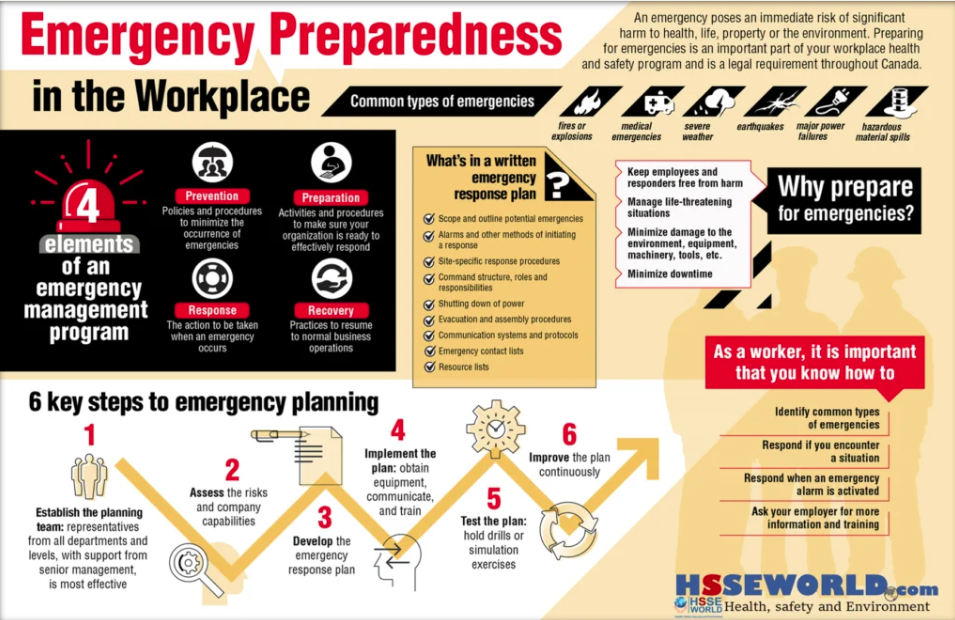
Conduct regular mock drills, keep fire exits unlocked and accessible, keep first-aid kits, extinguishers and AEDs visible and maintained, and appoint floor marshals and emergency coordinators.
Should all employees learn first aid and CPR?
Yes. Basic first aid and CPR training should cover all staff, not just security teams, because any employee can be the first responder in a fire or medical crisis.
Which emergency numbers should be displayed at work?
Workplaces should display emergency contact boards with the local 108 and 112 numbers so staff can call for help quickly.
Why do people freeze or panic during workplace emergencies?
Most employees freeze, panic or run the wrong way because they have never been conditioned through training. Short sessions on fire safety, first aid and evacuation can turn fear into a practised response.
Every workplace, from a small office to a large factory, is one short circuit, one gas leak or one cardiac arrest away from an emergency. Yet many have no working alarm, no exit plan that anyone has practised, and nobody trained to act.
In 2024, NCRB recorded 5,971 fire accidents that killed 5,888 people in India. Most of those deaths (60.4%) were in homes, but NCRB also records fires in commercial buildings, factories and government offices. Fire is only one risk at work. Gujarat alone reported 232 deaths in industrial accidents in 2023, across 49,246 registered factories (state labour minister’s reply in the Assembly, February 2024).
Why this matters
Fire alarms, exit signs and first-aid boxes look good on paper. In real life they are often locked, empty or not working. When something goes wrong in an office or factory, panic spreads faster than the fire.
Preparedness is not a luxury. It is a duty that every employer owes every worker. And any employee can be the first responder, if they have been trained.
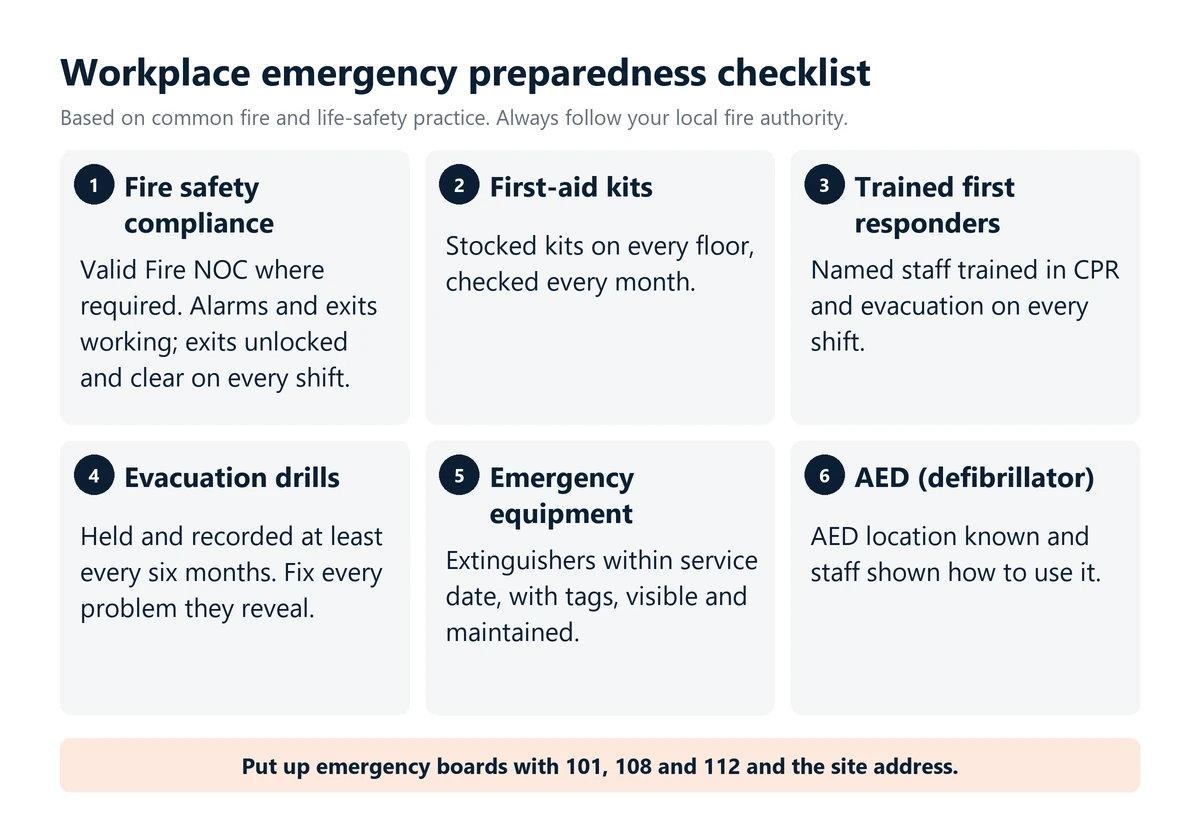
Workplace preparedness checklist
| Area | What to check at your site |
|---|---|
| Fire safety compliance | Valid Fire NOC where required; alarms and exits working |
| First-aid kits | Stocked kits on every floor, checked every month |
| Trained first responders | Named staff trained in CPR and evacuation on every shift |
| Evacuation drills | Drills held and recorded at least every six months |
| Emergency equipment | Extinguishers within service date, with tags |
| AED (defibrillator) | AED location known and staff shown how to use it |
This checklist is based on common fire and life-safety practice. Always follow your local fire authority’s requirements.
Risks by type of workplace
| Workplace | Main risks | What to check |
|---|---|---|
| IT and corporate offices | Electrical fires, cardiac arrest | Fire alarm, clear exits, CPR-trained staff and an AED |
| Factories | Chemical exposure, machine injuries, fire | Trained responders, spill kits, machine guarding, hot-work permits |
| Warehouses and logistics | Vehicle accidents, fires in stored goods | Clear aisles and exits, sprinklers where required |
| Hospitals and labs | Fire, oxygen leaks, infection | Oxygen-line checks, regular drills, a plan to move patients |
| Schools and colleges | Fire, earthquakes, crowding | Drills, maintained equipment, crowd control at gates |
What went wrong in real fires
- Mundka, Delhi (May 2022): fire in a four-storey building used for company offices. At least 27 people were killed, and some jumped from windows. The building had no fire department clearance and no extinguishers.
- Rajkot TRP Game Zone (May 2024): 27 lives lost, including children and staff. The game zone ran without a fire NOC.
In both cases, people were trapped with no safe way out and nobody had practised what to do.
Key figures
- Fire accidents in India, 2024 (NCRB): 5,971 cases, 5,888 deaths, 330 injured.
- Where people died: 60.4% of fire deaths were in residential buildings.
- Most fire cases: Maharashtra, with 625 of 5,971.
- Industrial accident deaths in Gujarat: 244 in 2021, 238 in 2022 and 232 in 2023.
India does not publish a national survey of how prepared workplaces are. Earlier versions of this page quoted such survey percentages and several incidents that we could not trace, so we have removed them.
The human factor
In a crisis, most people freeze, panic or run the wrong way. That is not carelessness. It is because they have never practised. A single two-hour session on fire safety, first aid and evacuation can turn fear into action.
What every workplace should do
- Hold mock drills at least every six months, and fix every problem they reveal.
- Keep fire exits unlocked and clear at all times, on every shift.
- Keep first-aid kits, extinguishers and AEDs visible and maintained.
- Train all staff in basic first aid and CPR, not just the security team.
- Put up emergency boards with 101, 108 and 112 and the site address.
- Appoint floor marshals and an emergency coordinator for every shift.
- Keep fire blankets, such as Life Safety Blankets, near kitchens, electrical panels and labs, and show staff how to use them.
What needs to change
- Emergency preparedness made a clear legal duty for every factory, shop and office, and checked.
- Safety audits renewed every year, with problems fixed and recorded.
- Incentives such as lower insurance premiums for workplaces with good safety records.
- Safety training built into every company’s induction and HR calendar.
- Volunteer fire and first-responder teams in industrial clusters, through groups like VFF India.
References
- National Crime Records Bureau (NCRB): Accidental Deaths & Suicides in India 2024, Chapter 1 (fire accidents)
- Bureau of Indian Standards: National Building Code of India 2016, Part 4 Fire and Life Safety
- Gujarat labour minister’s reply in the state Assembly on industrial accident deaths, February 2024
- News reports on the Mundka (2022) and Rajkot TRP Game Zone (2024) fires
Do not wait for a policy. Tomorrow, ask your manager or HR one question: “When was our last fire drill?” Then learn where the nearest exit, extinguisher and AED are from your desk.
What needs attention
- Fire killed nearly 5,900 people in India in 2024, including in offices, shops and factories
- Workplace fires turn deadly when exits are blocked and nobody has practised escape
- Gujarat alone reports more than 230 industrial accident deaths a year
- Cardiac arrest at work needs CPR and an AED within minutes
- Equipment that is not maintained gives false comfort
- India publishes no national data on workplace preparedness
Controls that reduce risk
- Hold a timed evacuation drill and fix what it reveals
- Train staff on every shift in CPR and first aid
- Check extinguisher tags and restock first-aid kits monthly
- Appoint floor marshals and an emergency coordinator
- Put up boards with 101, 108, 112 and the full site address
- Keep fire blankets near kitchens, panels and labs
Common unsafe practices
- Locking fire exits for security or storage
- Training only the security staff
- Letting extinguishers and first-aid kits expire
- Holding drills only for inspections
- Not knowing where the AED is, or not having one
- Running back for laptops and files


Leave a comment