
Quick answers
What is a fire bucket used for?
It holds water or sand for a quick first response to a small fire. Water cools ordinary materials such as wood and paper, and sand smothers small oil or petrol fires by cutting off the air.
When should I use sand instead of water?
Use sand on small fires of flammable liquids such as petrol, diesel or oil, because water can spread them. Use water on wood, paper and cloth. For an electrical fire, switch off the power first if it is safe, and never throw water on live equipment.
How do I use a fire bucket safely?
Only on a small fire with a clear way out behind you. Stay back, do not stand downwind, throw water at the base of the fire with a sweeping action or pour sand over it, then watch for flare-ups with another bucket ready.
Where should fire buckets be kept?
Where everyone can see and reach them, such as near exits, kitchens, workshops and common areas, with a clear sign. Check them every month for water, dry sand, rust and cracks.
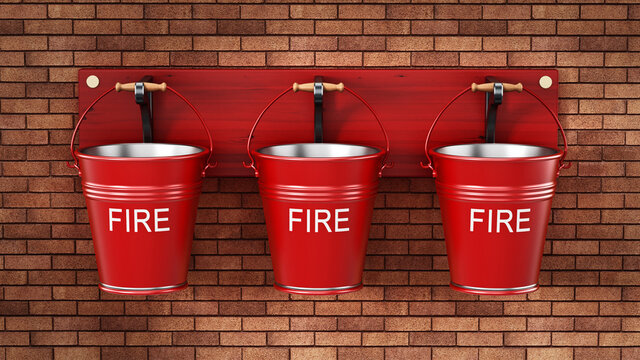
You have seen them a hundred times: a row of red buckets on a stand at a petrol pump, a railway platform, a godown or a building site, half of them with sand and half with water. Most people walk past without a thought. But on a small fire, in the first minute, a full bucket in the right hands can stop it from becoming a big one.
A fire bucket is the simplest firefighting tool there is. Here is what it can and cannot do, how to use one and how to keep it ready.
An old idea that still works
People have fought fires with buckets for centuries. In medieval times, towns kept leather buckets filled with water or sand in public places and homes so they could be grabbed quickly. The idea has not changed. Water cools the burning material, and sand smothers the fire and cuts off its air.
Water bucket or sand bucket
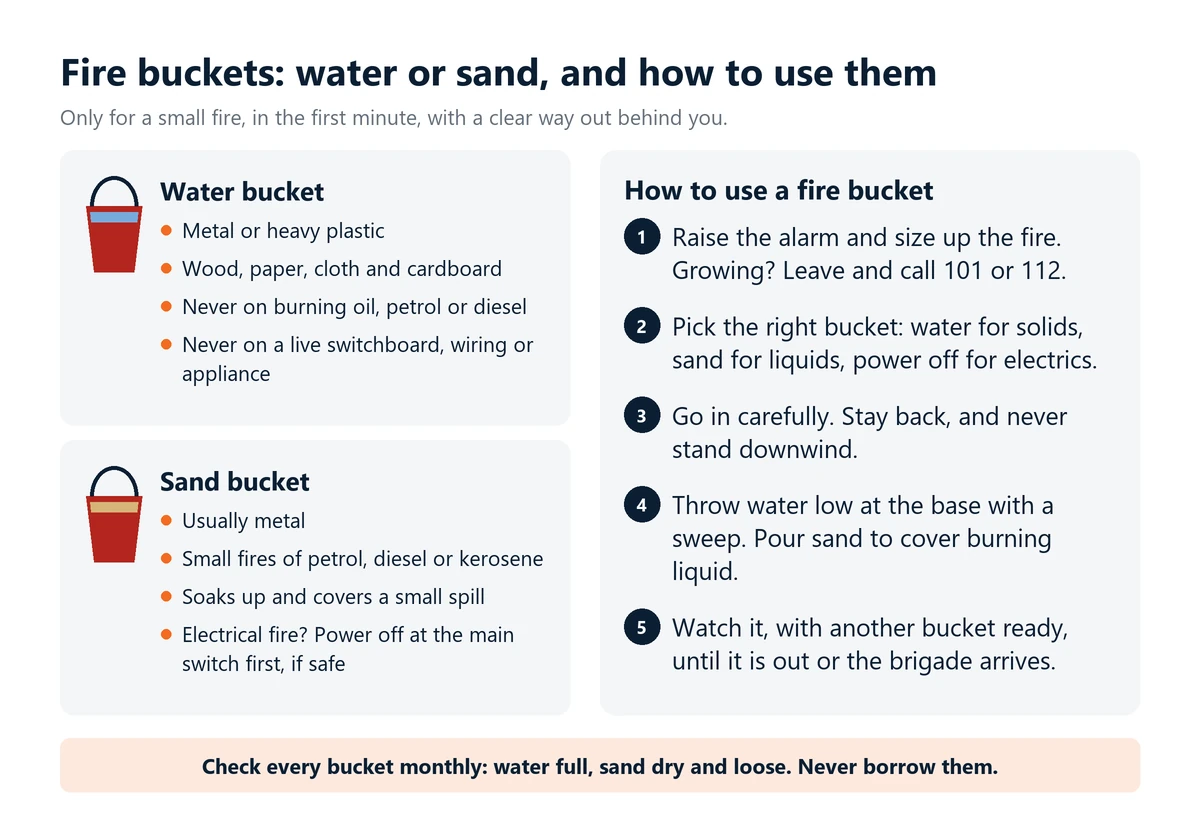
- Water buckets are made of metal or heavy plastic. Use them on fires in ordinary materials such as wood, paper, cloth and cardboard.
- Sand buckets are usually metal. Use them on small fires of flammable liquids such as petrol, diesel or kerosene, and to soak up and cover a small spill.
Never use water on burning oil, petrol or diesel. It can spread the burning liquid. And never throw water on a live switchboard, wiring or appliance. For an electrical fire, switch off the power at the main switch first, if you can reach it safely.
Why buckets still earn their place
- They are simple. Anyone can lift a bucket, though every adult should still practise once. Children should never fight a fire. Teach them to shout “Fire!”, get out and tell an adult.
- They are cheap. A set of buckets and a stand costs far less than most other firefighting equipment, so homes, schools and small shops can afford them.
- They are right there. A bucket hung at the right spot is in your hands in seconds, while the fire is still small.
A bucket is a backup, not a replacement. Keep extinguishers and smoke alarms too, and follow your state fire rules on what your premises must have.
How to use a fire bucket
- Raise the alarm and see how big the fire is. A bucket is only for a small fire with a clear way out behind you. If the fire is already growing, leave and call 101 or 112.
- Pick the right bucket. Water for wood, paper and cloth. Sand for a small fire of oil, petrol or other flammable liquid. Power off first for anything electrical.
- Go in carefully. Stay a safe distance back and do not stand downwind, where the smoke and heat will blow at you.
- Throw it at the base. Throw water low, at the base of the flames, with a sweeping action. Pour sand over the fire so it covers the burning liquid.
- Watch it. Fires flare up again. Stay and watch, with another bucket ready, until it is fully out or the fire brigade arrives.
Keeping buckets ready
- Check them on a fixed day every month. Water buckets should be full. Sand should be dry and loose, not caked into a lump.
- Replace damaged buckets. Rust, cracks or a leaking bottom make a bucket useless when you need it.
- Do not borrow them. A fire bucket used for mopping or for storing things is usually empty on the day of a fire.
- Hang them where people can see them. Near exits, kitchens, workshops and common areas, never hidden behind stock.
- Put up a sign. In larger buildings and outdoor yards, a clear sign helps people find the bucket point in a hurry.
Today, check every fire bucket at your home, shop or workplace. If one is empty, cracked or full of rubbish, fix it now. It takes five minutes.
What needs attention
- A fire bucket is useful only on a small fire, and only in the first moments
- Water suits wood, paper and cloth; sand suits small flammable-liquid fires
- Water on live electrical equipment can kill; switch off at the main first
- Empty, rusted or cracked buckets are common and useless in an emergency
- Buckets hidden behind stock or without signs are not found in time
- Children should never fight a fire; their job is to shout, get out and tell an adult
Controls that reduce risk
- Keep buckets filled, with dry sand in sand buckets, and check them on a fixed day each month
- Replace rusted, cracked or leaking buckets
- Hang them near exits, kitchens, workshops and common areas where everyone can see them
- Put up a clear sign at each bucket point
- Show every adult in the house or workplace how and when to use them
- Keep buckets as a backup to, not a replacement for, extinguishers and alarms
Common unsafe practices
- Throwing water on a live switchboard, meter or appliance
- Using water on burning oil or petrol
- Leaving buckets empty, or using them for cleaning and storage
- Standing downwind of the smoke, or with the fire between you and the exit
- Carrying on when the fire keeps growing
- Asking children to help fight the fire

Leave a comment