
Quick answers
Why are hospitals at high risk of fire?
Hospitals have oxygen in cylinders and pipelines, heavy electrical loads from ICU machines and ACs, and plenty of bedding and plastics that burn. Add locked exits, fire systems that do not work and untrained staff, and a small fire can turn deadly.
What should I check when a family member is admitted?
Ask where the nearest fire exit is, look for smoke detectors and an extinguisher on the floor, notice whether the ICU is crowded with extension boards and wires, and know two ways out of that floor.
What should I do if a fire breaks out in a hospital?
Raise the alarm and tell the nursing station. Cover your nose and mouth, stay low under smoke and move with your patient to the safe area the staff point you to. Do not use the lift.
How did patients die in India's major hospital fires?
In many cases smoke, not flames, killed them. At AMRI Kolkata, smoke from a basement store rose into the wards above, and patients who could not move were trapped.
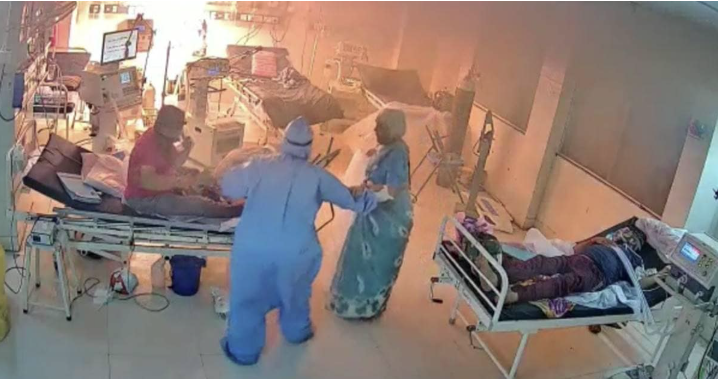
A hospital is the one place a family expects to be safe. Yet some of the deadliest fires in India in recent years started in ICUs and newborn units: 18 dead at a COVID hospital in Bharuch (May 2021), 10 newborns at Bhandara (January 2021) and 10 newborns on the night of the Jhansi NICU fire (November 2024). We could not find an official national count of hospital-fire deaths.
The people who died were patients on ventilators, babies in incubators and the critically ill in ICU beds. They could not get up and run. In several of these fires, smoke, poor storage, electrical faults or missing safety measures turned a small fire into a disaster.
Why hospitals are high-risk
- Oxygen in cylinders and pipelines makes anything burn faster and hotter.
- Heavy electrical load from ventilators, monitors, warmers and ACs running day and night.
- Things that burn easily, such as bedding, plastics, alcohol-based sanitiser and stored supplies.
- Patients who cannot move on their own, and few staff on duty at night.
Put these together and ignore fire safety, and smoke can fill a ward full of patients who have no way out.
India’s deadliest hospital fires: what happened
- AMRI Hospital, Kolkata (December 2011): a fire in the basement storage area sent smoke up through the hospital. AP reported 88 deaths that day, most of them patients and including at least three staff. Later court reporting gives the toll as 92. A state minister alleged that senior hospital authorities ran away, and the hospital denied safety violations.
- Shrey Hospital, Ahmedabad (August 2020): 8 COVID patients died in an ICU fire.
- Uday Shivanand Hospital, Rajkot (November 2020): 5 COVID patients died in the ICU. A preliminary probe blamed a short circuit in a ventilator.
- Bhandara District Hospital, Maharashtra (January 2021): 10 newborn babies died in the Special Newborn Care Unit (SNCU).
- Welfare Hospital, Bharuch (May 2021): 18 people died after a fire in the ICU, 16 COVID patients and two nurses.
- Jhansi Medical College NICU (November 2024): 10 newborns died on the night of the fire. PTI reported 18 deaths by 25 November, and officials blamed the later deaths on illness.
In every one of these cases, families had taken a loved one to hospital for care, and lost them to a fire instead.
Common causes of hospital fires
- Electrical overload and faults. Ventilators, monitors, warmers and ACs run on old or overloaded circuits.
- Oxygen near a spark. A leak close to a spark, or bedding and plastics in an oxygen-rich room, burns fiercely.
- Fire systems that don’t work. No alarm, no sprinklers, hydrants without water.
- Blocked or locked exits. Patients cannot move, and staff are left with nowhere to take them.
- Untrained staff. Nurses, guards and doctors who have never practised moving patients in a fire.
What happened after
- After Bhandara, Maharashtra ordered fire-safety and electrical audits of all newborn care units and a fire audit of all its hospitals.
- WHO’s Hospital Safety Index (2nd edition, 2017) gives hospitals a way to check their structural and non-structural safety and how ready they are for emergencies and disasters.
What families can do
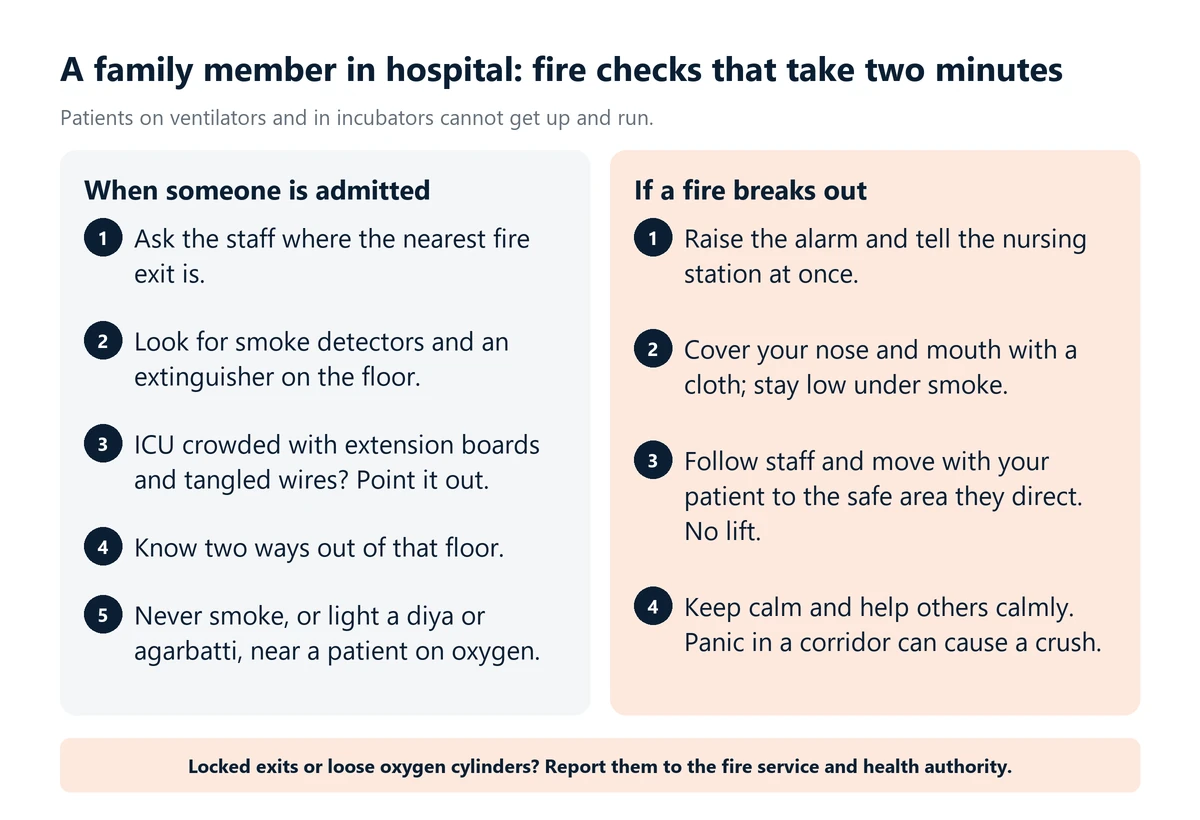
When a family member is admitted:
- Ask the staff where the nearest fire exit is.
- Look for smoke detectors and an extinguisher on the floor.
- Notice whether the ICU is crowded with extension boards and tangled wires, and point it out if it is.
- Know two ways out of that floor.
- Never smoke, or light a diya or agarbatti, anywhere near a patient on oxygen.
If a fire breaks out:
- Raise the alarm and tell the nursing station at once.
- Cover your nose and mouth with a cloth and stay low under smoke.
- Follow staff instructions and move with your patient to the safe area they direct you to. Do not use the lift.
- Keep calm and help others calmly. Panic in a corridor can cause a crush.
If you see locked exits or loose oxygen cylinders, report them to the fire service and the local health authority.
What needs to change
- A fire safety audit of every hospital every year, with the results shared.
- Electrical systems designed for heavy ICU and oxygen loads, with separate, protected circuits for critical equipment.
- Penalties for hospital owners and administrators who ignore fire safety.
- Regular mock drills, including at night, so every shift knows how to move patients.
- Public information on each hospital’s fire safety status.
Look at the exits, not just the doctors
Patients in these fires died not of their illness but because the building around them failed. The next time you or someone at home is admitted, take two minutes to find the nearest staircase and check that the way to it is clear. If you see a locked exit, or cartons and cylinders stacked in a corridor, tell the nursing station that same day.
What needs attention
- No official national figure exists for hospital-fire deaths; the old '120 in 5 years' claim could not be traced
- ICU and newborn units have been hit hardest, because patients depend completely on staff
- Electrical faults in ICU equipment were blamed in several recent fires
- AMRI showed how smoke from a basement store can reach wards above
- Several of the deadliest fires came during COVID, with ICUs full and oxygen use high
- After Bhandara, Maharashtra ordered fire and electrical audits of hospitals
Controls that reduce risk
- Audit every ICU, NICU and ward for fire and electrical safety every year
- Provide separate, protected circuits for critical equipment
- Store and secure oxygen cylinders safely
- Clear combustible storage out of basements and corridors
- Train every shift to move patients horizontally to a safe zone
- Hold mock drills, including at night
Common unsafe practices
- Overloaded circuits and extension boards in ICUs
- Oxygen cylinders kept loose or near heat and sockets
- Combustible material stored in basements under wards
- Fire systems installed but not maintained
- Locked or blocked exits
- Too few trained staff at night

Leave a comment