
Quick answers
What causes fires in hospitals?
Hospital fires are often linked to short circuits, faulty oxygen storage and air-conditioning units running nonstop. Patients who are immobile or weak may be unable to escape in time.
How can I check if a hospital is fire safe?
Check whether the hospital has fire exits and alarms, and ask the management about its oxygen cylinder safety protocol.
What should hospital staff do to prepare for a fire?
Staff should attend fire safety drills and know the evacuation routes so they can help patients who cannot move on their own.
What should I do if I notice unsafe storage in a hospital?
Report unsafe storage, such as poorly kept oxygen cylinders, to fire officials immediately.
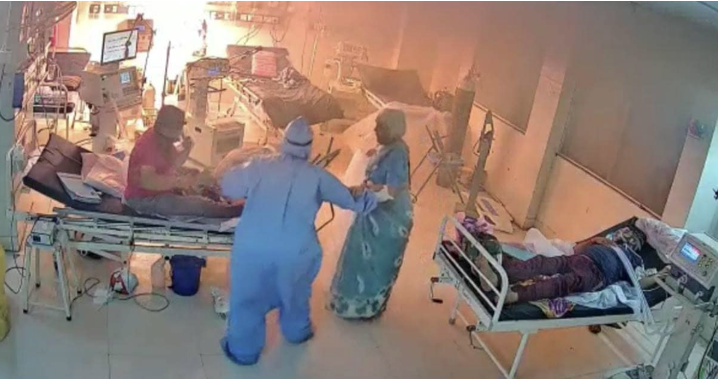
When we admit a parent to an ICU or a newborn to a nursery, we worry about the illness. We almost never think about fire. Yet some of India’s worst fires in recent years have been in hospitals, and the people who died were patients who could not get out of bed.
What we know, and what we don’t
There is no official national count of hospital-fire deaths in India. The NCRB records fire deaths by cause and by type of place, but it does not list hospitals separately. So any single number you see for “hospital fire deaths in India” should be treated with caution.
What we do have are the individual tragedies, and they are grim enough:
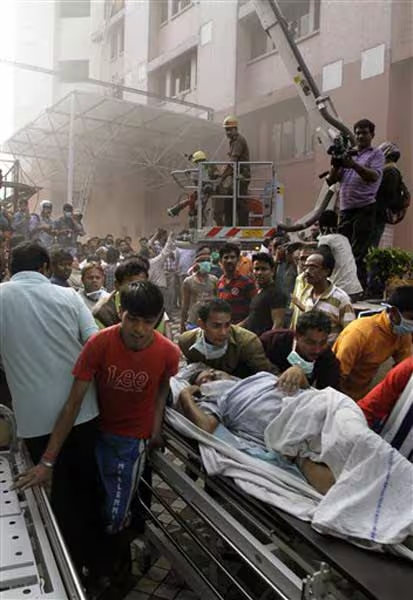
- AMRI Hospital, Kolkata (December 2011): smoke from a basement store spread into the wards. News reports counted 88 to 89 dead on the day; later court reporting gives the toll as 92. Most were patients.
- Shrey Hospital, Ahmedabad (August 2020): 8 COVID patients died in an ICU fire.
- Uday Shivanand Hospital, Rajkot (November 2020): 5 COVID patients died in the ICU; a preliminary probe blamed a short circuit in a ventilator.
- Bhandara District Hospital, Maharashtra (January 2021): 10 newborns died in the newborn care unit.
- Welfare Hospital, Bharuch (May 2021): 18 died, 16 COVID patients and two nurses.
- Jhansi Medical College NICU (November 2024): 10 newborns died on the night of the fire; PTI reported 18 deaths by 25 November, with officials blaming the later deaths on illness.
Several of these fires happened during COVID, when ICUs were packed, oxygen use was very high and electrical equipment ran round the clock.
Why hospitals are so dangerous in a fire
- Patients cannot run. People on ventilators, drips or in incubators need staff to move them, and there are rarely enough staff at night.
- Oxygen makes fire fiercer. In an oxygen-rich room, bedding, clothing and plastics catch fire easily and burn much faster.
- Heavy electrical load. Ventilators, monitors, warmers and air conditioners running nonstop on old or overloaded wiring are a common starting point.
- Smoke travels. Stores, basements and false ceilings let smoke reach the wards before anyone sees flames.
Two myths
“Hospitals are the safest buildings in a fire.” Not automatically. A hospital is only as safe as its wiring, its smoke barriers, its alarms and the number of trained staff on duty at 3 AM. In several of the fires above, investigators and officials pointed to electrical faults, poor storage or missing safety measures.
“Hospital fires are rare accidents.” They are not frequent, but when they happen they kill the most helpless people in the building. That is why the standard has to be higher than for an ordinary building, not lower.
What you can do
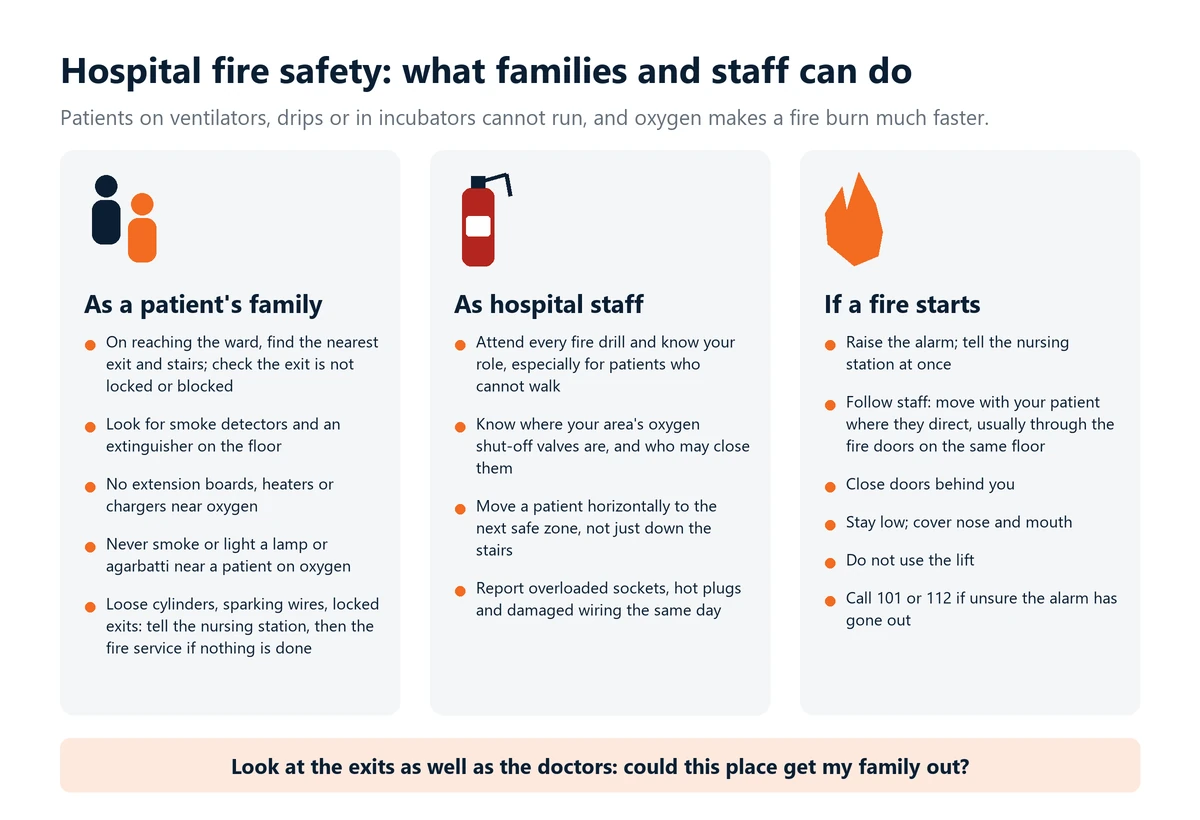
As a patient’s family
- When you reach the ward, find the nearest exit and the stairs, and check the exit is not locked or blocked.
- Look for smoke detectors and an extinguisher on the floor.
- Do not use extension boards, heaters or mobile chargers near oxygen.
- Never smoke or light a lamp or agarbatti anywhere near a patient on oxygen.
- If you see oxygen cylinders lying loose, wires sparking or exits locked, tell the nursing station, and report it to the fire service if nothing is done.
As hospital staff
- Attend every fire drill and know your role, especially for patients who cannot walk.
- Know where the oxygen shut-off valves are for your area, and who is allowed to close them.
- Learn how to move a patient horizontally to the next safe zone, not just down the stairs.
- Report overloaded sockets, hot plugs and damaged wiring the same day.
If a fire starts in a hospital
- Raise the alarm and tell the nursing station at once.
- Follow staff instructions. Move with your patient to the area staff direct you to, usually through the fire doors on the same floor.
- Close doors behind you to hold back the smoke.
- Stay low and cover your nose and mouth if there is smoke.
- Do not use the lift.
- Call 101 or 112 if you are not sure the alarm has gone out.
Next time you walk into a hospital, look at the exits as well as the doctors. Ask yourself: if a fire started now, could this place get my family out?
What needs attention
- No official national figure for hospital-fire deaths exists, so single headline numbers should be treated with caution
- Patients in ICUs, nurseries and wards depend on staff to move them, and night staffing is thin
- Oxygen-rich rooms make bedding and plastics burn much faster
- Overloaded or faulty electrical equipment was blamed in several recent ICU and nursery fires
- Smoke from stores, basements and false ceilings can reach wards before flames are seen
- Several of the deadliest recent fires came during COVID, when ICUs were packed and oxygen use was high
Controls that reduce risk
- Get an electrical and fire safety audit of every ICU, nursery and ward
- Keep oxygen cylinders secured and away from heat and sockets
- Fit and maintain smoke detection, sprinklers and fire doors
- Train every shift in moving patients horizontally to a safe zone
- Mark oxygen shut-off valves and name who may close them
- Hold fire drills regularly, including at night
Common unsafe practices
- Assuming a hospital is automatically fire safe
- Extension boards, heaters and chargers near oxygen
- Loose, unsecured oxygen cylinders in wards and corridors
- Locked or blocked exits and fire doors propped open
- Storing combustible material in basements and stores
- Too few trained staff at night to move patients
- Using lifts to evacuate during a fire
Leave a comment