
Quick answers
What causes most hospital fires in India?
In a 2023 study of reported Indian hospital fires since 2010, electrical short circuits caused 89 per cent of the fires and flammable chemicals 4 per cent. These are figures from the study's sample, not national rates.
Why are ICUs at higher risk of fire?
ICUs and newborn units hold the most fragile patients, who are hardest to move. Oxygen leaking from supply lines also makes the air richer in oxygen, so fires start more easily and burn harder.
Is a Fire NOC enough to make a hospital safe?
No. Alarms, detectors, extinguishers, hydrants, pumps, sprinklers and exits must be tested regularly and staff must know how to use them. Many hospitals in the study had equipment that did not work when the fire came.
What should staff do when a fire starts in a hospital?
Raise the alarm, follow the evacuation plan, move patients sideways to a safe zone under trained direction, keep fire doors shut and avoid lifts unless approved for evacuation. Tell the fire brigade which patients need oxygen or help to move.
A fire in a hospital is not like a fire in an office. Many of the people inside cannot get up and walk out. A patient on a ventilator, a newborn in a warmer or an elderly man after surgery depends on staff to move them, and on the building to hold the fire back long enough for that to happen. Yet hospital fires keep happening in India, and the same failures show up again and again.
This page sums up a 2023 peer-reviewed study by Juyal and colleagues in the Journal of Failure Analysis and Prevention, which looked at reported hospital fires in India from 2010 onwards. You can read the full paper here. The figures below are from that study’s own collection of cases, put together from research papers, news reports and online sources. They are not a complete national count, and the authors accept that fires that never made the news may be missing.
How the study was done
The authors gathered every hospital fire they could find from 2010 onwards and sorted them by cause, effect and type of hospital. They then charted how often each cause came up, how many hospitals were not following the rules, and how government and private hospitals compared.
According to the paper, Indian hospitals had no automatic fire systems before 1950, as in most of the developing world, and safety codes came in gradually after that. Even so, fires have kept breaking out.
What the study found
The number of hospital fires went up and down from year to year, but the study’s trend line shows the frequency rising sharply since 2010.

Government hospitals and private hospitals were almost equally affected: 54% of the fires in the sample were in government hospitals and 46% in private ones.

Electrical short circuits caused 89% of the fires in the sample. Flammable chemicals were a distant second, at 4%.

At least half of the hospitals in the sample were reported as not complying with fire safety requirements.

The cases behind the numbers
Hospitals must get safety clearances to operate. The authors found that fire equipment is often installed only to get that permission, and then nobody keeps it working or trains staff to use it. Some hospitals were still running after their licence to operate had expired. The cases they describe show how this plays out.
- AMRI Hospital, Kolkata, 2011. India’s worst hospital fire killed 93 people. Flammable material was stored illegally in a basement meant for car parking. The centrally air-conditioned building had no mechanical smoke ventilation, so many people suffocated. Staff were poorly prepared, smoke detectors and alarms were faulty, and about one and a half hours passed before the fire brigade could start fighting the fire.
- PBM Hospital, Bikaner. Old, poorly insulated wiring short-circuited. The load had grown over the years with air conditioners, medical equipment and computers, and there had been no compulsory inspection of the power supply.
- ESIC Hospital, Mumbai, 2018. An illegal canteen had stored twenty LPG cylinders on the ground floor. The fire started there and spread fast because of the gas.
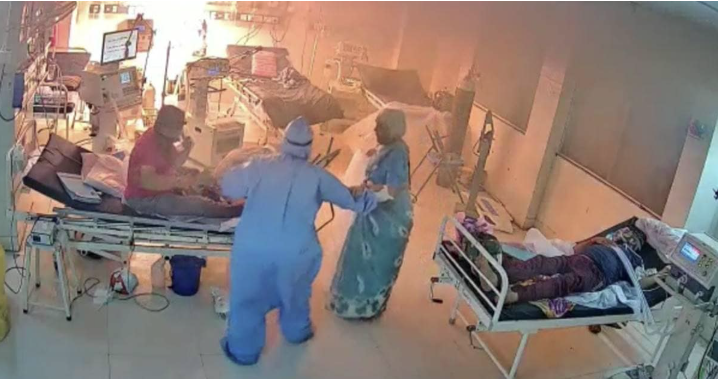
- Shrey Hospital, Ahmedabad. A fire in the ICU killed 8 patients. There were no extinguishers inside the ICU, and staff could not use the ones outside because they had never been trained.
- Murshidabad hospital, West Bengal. The emergency exit gate was shut, the fire alarm and lift did not work, and the hospital had no extinguishers.
- District General Hospital, Bhandara, 2021. Ten babies died. The hospital did not have the required extinguishers, and staff were not trained to use what equipment there was.
- Sunrise Hospital, Bhandup, Mumbai, March 2021. This COVID-19 hospital, on the third floor of Dreams Mall, was running on a provisional occupancy certificate. A fire killed 11 people. An audit later found that the risers, pumps, sprinklers, underground water tanks and hydrants had been installed, but none of them worked.
After the Bhandara fire, 484 government hospitals in Maharashtra were checked. In more than 80% of them a fire safety audit had never been done, fewer than half had ever held a mock drill, and almost none had a fire safety certificate from the authority.
Why ICUs are especially risky
ICUs, newborn units and operation theatres hold the patients who are hardest to move. They also use a lot of oxygen. Oxygen leaking from patient supply lines makes the air richer in oxygen, and things burn more easily and more fiercely in that air. Add many electrical devices running at once, and these rooms need their own fire plan. The paper also points to another study, by Kodur and colleagues, warning that newer buildings use far more plastic-based materials, which adds to the fire load.
What hospitals should do
The study’s conclusion is simple. Regular fire safety audits find the weak spots before a fire does. Training and mock drills at regular intervals keep staff ready. In practice, that means:
- have the electrical load and wiring checked by a competent electrical engineer, especially after adding ACs or new equipment;
- test alarms, detectors, extinguishers, hydrants, pumps and sprinklers on schedule, and fix every fault you find;
- keep exits, staircases and fire brigade access clear and unlocked at all times;
- keep LPG, chemicals, linen and waste out of basements, corridors and unauthorised rooms;
- give every ward a written plan for moving patients who need oxygen or cannot walk;
- train every shift, including night staff, and run drills that do not put patients at risk.
The Union Health Ministry has also issued national guidelines on fire and life safety in healthcare facilities that hospital managements should follow.
If you are a patient or visitor
When you visit someone in hospital, take a minute to see where the nearest staircase is. If you find an exit locked, or cylinders and cartons piled in a corridor, tell the nursing station. If a fire starts, follow the staff’s instructions, keep fire doors shut and do not use the lift. Call 101 or 112 if no one has raised the alarm.
What needs attention
- Hospitals mix many ignition sources with patients who cannot get out on their own, so the fire plan must protect patients where they are, move them in stages when needed and keep life support running
- The study built its sample from news, research and online reports, not an official register; within that sample, 89 percent of fires were blamed on short circuits, 4 percent on flammable chemicals, 54 percent were in government hospitals and 46 percent in private ones, and at least half the hospitals were not following the rules
- The cases show again and again that installing equipment is not enough; alarms, detectors, extinguishers, hydrants, pumps, sprinklers, exits and smoke control must be tested and staff must know how to use them
- A Fire NOC on the wall does not prove the systems still work
- ICUs, newborn units, operation theatres and oxygen-use areas need special planning because patients are fragile, moving them is hard and extra oxygen makes fires burn harder
- Growing electrical load, temporary equipment and changes in how a ward is used need regular review
- After the Bhandara fire, checks of 484 government hospitals in Maharashtra found most had never had a fire safety audit and fewer than half had held a mock drill
Controls that reduce risk
- Get a competent engineer to check electrical load, wiring condition, protection settings and maintenance records
- Test alarms, detectors, emergency lights, fire doors, smoke control, pumps, hydrants and sprinklers on schedule, and close every fault
- Keep exits, stairs, fire brigade access and fire doors usable at all times
- Keep oxygen, LPG, chemicals, linen and waste separated and in authorised places only
- Make a ward-wise evacuation plan for patients on oxygen, patients who cannot walk and those on continuous care
- Train every shift to raise the alarm, fight a small fire, move patients sideways to a safe zone and hand over to the fire brigade
- Run realistic drills without putting patients at risk, and write down the time taken, problems found and who will fix them
- Recheck fire safety after any renovation, new equipment, change of use or temporary ward expansion
Common unsafe practices
- Treating a Fire NOC or an audit report as proof that the systems still work
- Adding ACs and medical equipment without checking whether old wiring can take the load
- Locking exits or blocking fire brigade access
- Keeping LPG, chemicals, waste or other combustible material in unauthorised areas
- Assuming nurses and ward boys will know how to move dependent patients without a practised plan
- Quoting the study's sample figures as national rates


Leave a comment