
🔴 Truth Drop
When a person collapses from a cardiac arrest, the heart stops pumping blood within seconds.
👉 Brain death begins in 4–6 minutes.
👉 Ambulances in India take 20–30 minutes on average to arrive.
That means the only person who can save a life — is you.
Yet, fewer than 2% of Indians know CPR, compared to 70% in Japan and the US.
(Source: AIIMS, WHO-SEARO 2024)
📖 Why This Matters
A cardiac arrest can strike anyone, anywhere — at home, gym, office, mall, or temple.
If a bystander performs CPR immediately, survival chances rise by 200–400%.
Without CPR, the same person has less than 5% chance of survival.
India loses 7 lakh lives every year to sudden cardiac arrests — many of them could have been saved if someone nearby knew what to do.
🧠 What is Bystander CPR?
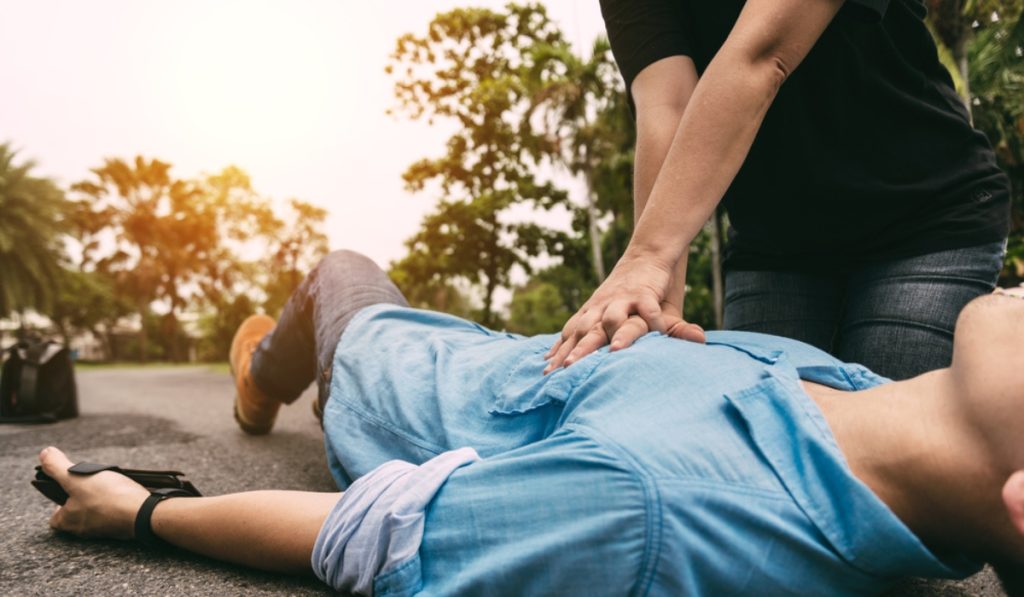
CPR (Cardiopulmonary Resuscitation) is a simple technique that keeps blood and oxygen flowing until professional help arrives.
It doesn’t require medical equipment — just two hands and courage.
👉 Hands-Only CPR:
Push hard and fast in the center of the chest — at a rate of 100–120 compressions per minute (to the beat of the song “Stayin’ Alive”).
That rhythm literally keeps life alive.
📊 Data Snapshot: CPR Awareness & Survival
| Country | Bystander CPR Rate | Survival Rate (Cardiac Arrest in Public) |
|---|---|---|
| 🇮🇳 India | 2–3% | <5% |
| 🇺🇸 USA | 70% | 55–60% |
| 🇯🇵 Japan | 75% | 50% |
| 🇸🇪 Sweden | 80% | 70% |
(Source: American Heart Association, Japan Resuscitation Council, AIIMS 2024)
💡 Every minute without CPR reduces survival chances by 10%.
After 10 minutes — survival is almost zero.
🩺 Real Stories That Define Hope
Story 1 – Delhi Metro, 2024:
A young man collapsed at Rajiv Chowk station. A co-passenger, trained in CPR from a workshop, performed compressions for 4 minutes until a doctor arrived. The man’s heartbeat returned before reaching the hospital.
👉 One person’s readiness saved another’s future.
Story 2 – Mumbai Office, 2023:
A 32-year-old collapsed during a team meeting. No one knew CPR. Ambulance arrived after 22 minutes. He didn’t survive.
👉 Knowledge was missing — not the opportunity.
Story 3 – Japan vs India Contrast:
In Japan, schoolchildren learn CPR as part of curriculum — saving thousands annually.
In India, even hospitals lack AEDs in waiting areas.
Result: Awareness saves, ignorance kills.
📉 Key Facts
- 70% of cardiac arrests occur at home. The first responder is often a family member.
- Hands-Only CPR can double or triple survival rates.
- CPR + AED (Defibrillator) within 5 minutes = 70% chance of survival.
- Without CPR, chances drop by 10% per minute.
- In India, over 95% victims die before reaching hospital.
🛡 Survival Lessons for Citizens
✅ Learn Hands-Only CPR — 15 minutes of training can save lives.
✅ If someone collapses:
1. Tap & shout.
2. Call 108 / 112.
3. Begin compressions — push hard & fast in the center of the chest.
✅ Don’t fear legal issues — you’re protected by India’s Good Samaritan Law.
✅ Encourage workplaces, schools, and gyms to host CPR workshops.
✅ Share CPR awareness videos with family & community groups.
📢 Systemic Lessons
India must:
- Make CPR training compulsory in schools, colleges, and corporate offices.
- Mandate AED installation in public places (malls, metros, airports).
- Train police, teachers, and transport staff as first responders.
- Integrate CPR drills in National Disaster Management programs.
- Launch a national campaign — “Every Hand Can Save a Heart.”
📣 Call to Action
🚨 Don’t wait for emergencies to learn CPR.
When a life stops beating, your hands can bring it back.
👉 Learn CPR. Teach others.
Because someday, you might be the only difference between life and death.
📎 References
- AIIMS Cardiology Annual Report 2024
- Indian Council of Medical Research (ICMR) – Cardiac Emergency Data 2023
- American Heart Association (AHA) Global CPR Trends 2022
- Japan Resuscitation Council 2023
- WHO-SEARO Regional Cardiac Care Outlook 2024
🔚 Closing Line
A heart stops — but help shouldn’t.
This is why we built HowToSurvive.in — to make every citizen a responder, not a spectator.
What needs attention
- The article topic must be linked to the actual occupancy and hazard
- Prevention and early warning provide more safety margin than last-second intervention
- Equipment is effective only when correctly selected, accessible and maintained
- People need short practised actions and a clear decision to stop and escape
- Children, visitors and people needing assistance require explicit planning
- Records, drills and inspections matter only when defects are corrected
Controls that reduce risk
- Complete a task- and site-specific hazard assessment
- Verify applicable Indian, state and local requirements
- Use competent inspection for installed systems and specialist hazards
- Keep alarms, exits, signs and emergency access usable
- Train intended users and practise evacuation
- Record defects with an owner and completion date
- Review the plan after changes, incidents or near misses
Common unsafe practices
- Relying on equipment without a hazard assessment
- Blocking or compromising escape routes
- Delaying the alarm or emergency call
- Attempting a response beyond training or safe conditions
- Re-entering before authorised clearance
- Treating a checklist as a substitute for competent inspection


Leave a comment