
What happened here
 1 / 2
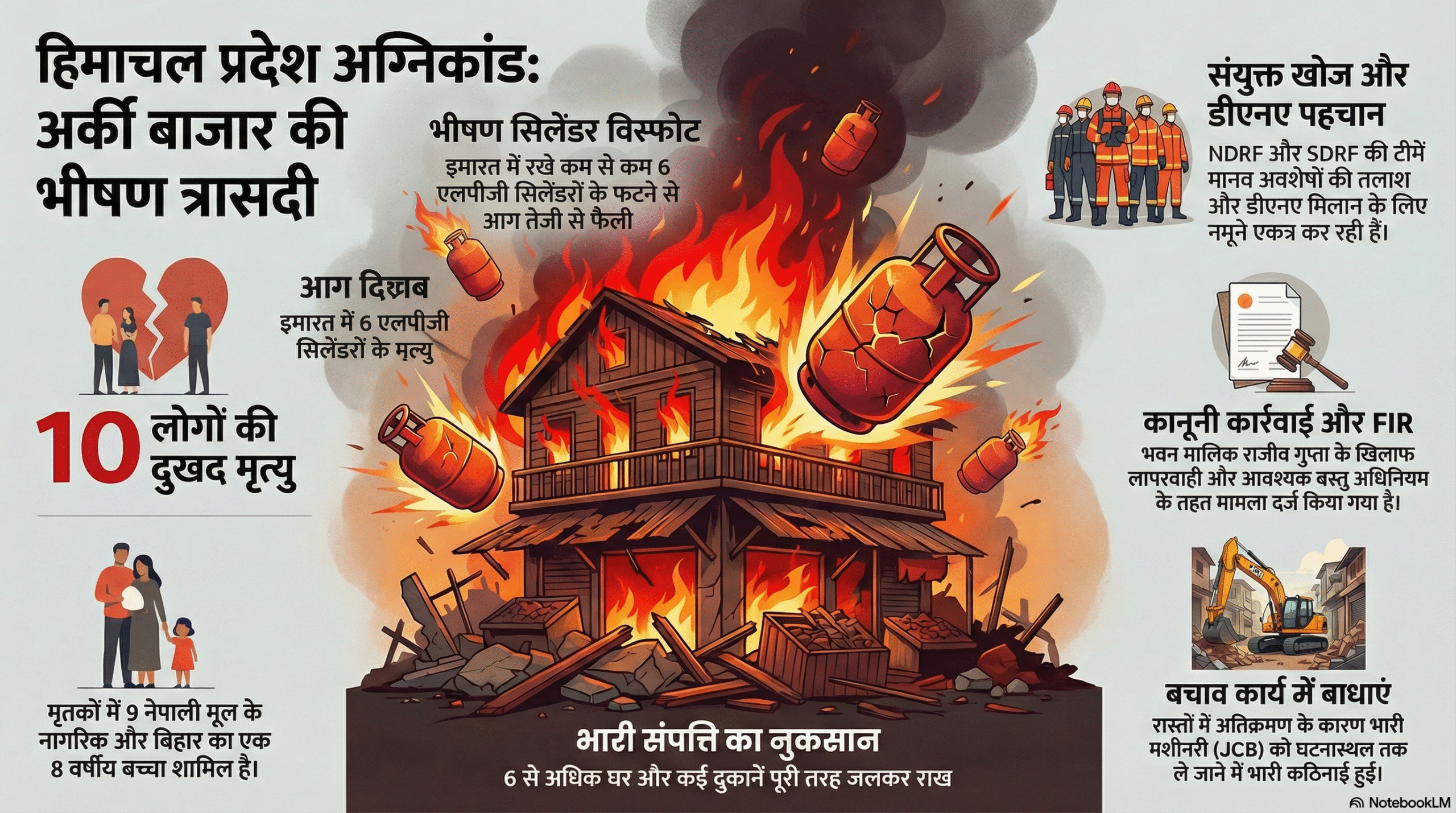
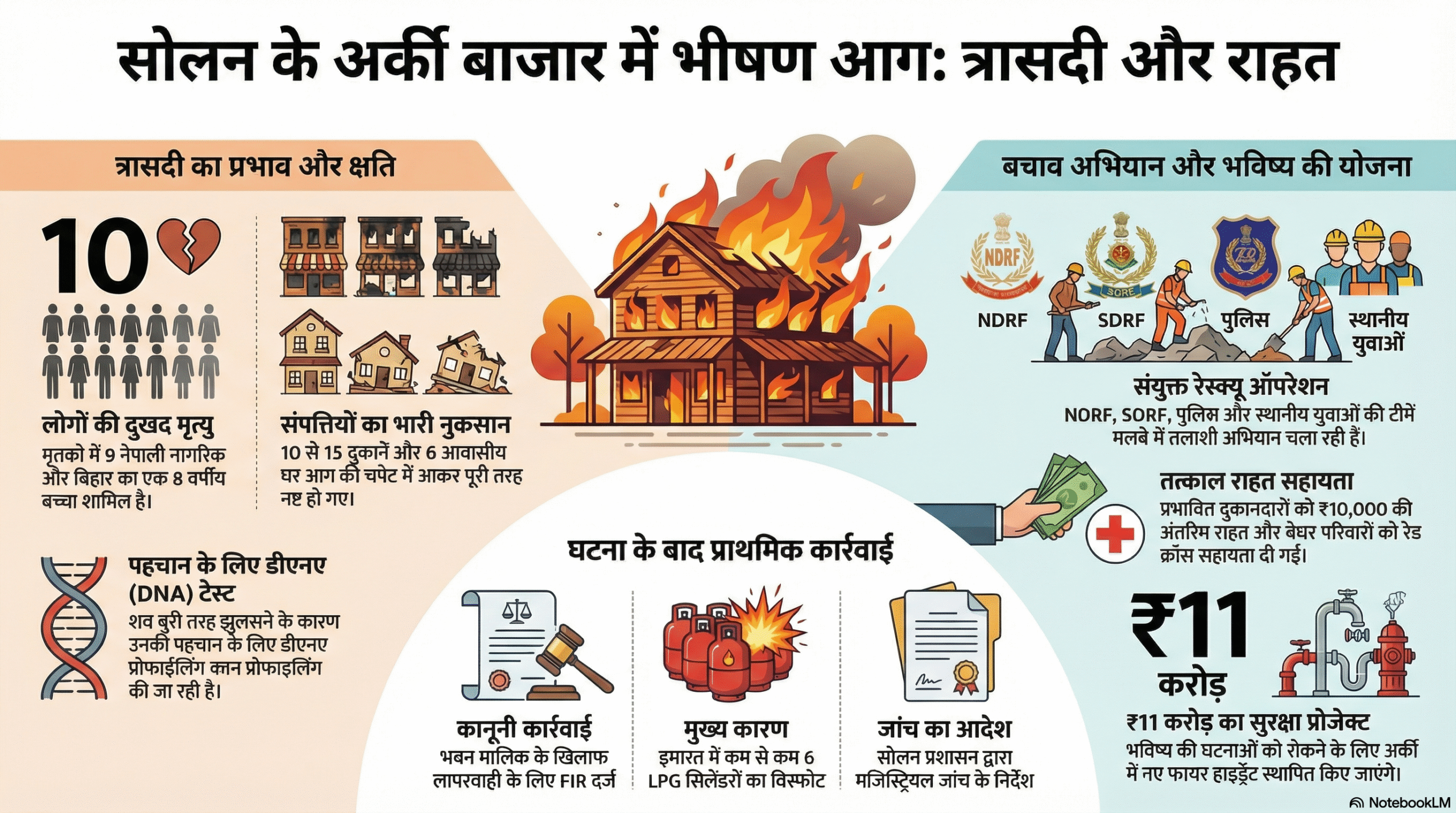
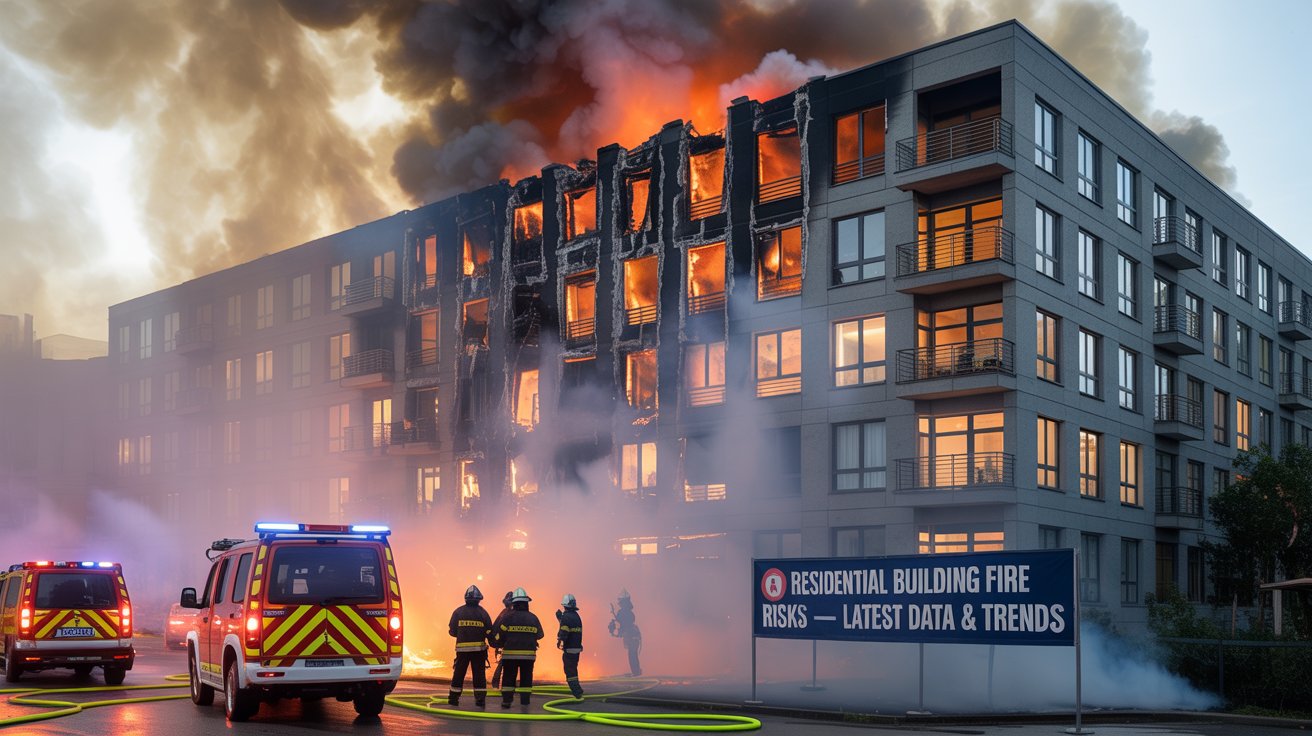
1 / 2 A late-night fire in an old wooden mixed-use building spread through shops and homes and involved multiple LPG cylinders; the final reported toll reached 10.
Quick answers
What happened in the Arki market fire in Himachal Pradesh?
A late-night fire broke out in an old wooden mixed-use building in Arki market, Solan district, where families lived above shops. It spread through connected shops and homes after multiple LPG cylinder explosions, and the final reported toll reached 10.
What is known about how the Arki fire started?
Officials have not announced the cause; the Solan administration ordered a magisterial inquiry and police registered an FIR under BNS Section 287. The fire grew after at least six LPG cylinders stored in the building exploded.
Why did the Arki fire become so deadly?
Families were asleep when it began, there was no fire alarm or smoke detection, gas cylinders were stored indoors and the wooden buildings were connected. Encroachments on the road also slowed the search, and water had to come in tenders and tankers from several towns.
How to survive a night fire in an old wooden building?
Raise the alarm and call 112 or 101, then leave immediately by the nearest safe exit. Stay low beneath smoke, cover the mouth with cloth, crawl to the exit and never go back. Keep a flashlight and cloth near the bed and never use open-flame heaters indoors.
📅 Date & Location of Incident
📅 Date: 12 January 2026
📍 Location: Arki Market, Solan District, Himachal Pradesh, India
🕯️ What Happened?
In the early hours of Monday, 12 January 2026, a fire broke out in an old four-storey wooden building in Arki’s main market. Officials gave the start time as roughly 2:00 to 2:45 AM.
Shops used the ground and first floors. The top two floors were rented to migrant workers from Nepal and Bihar, including families.
Early police accounts said at least six LPG cylinders exploded; a later joint inspection found eight domestic cylinders in the building, three of which had burst (The Tribune, 14 January 2026). The fire spread to nearby shops and houses.
The cause has not been officially established. The district administration ordered a magisterial inquiry.
The toll reached 10: nine Nepalese nationals and an eight-year-old boy from Bihar. Most remains were burnt beyond recognition and kept for DNA identification.
🔍 Core Mistakes / What Went Wrong?
- ❌ No fire alarm or smoke detection system
- ❌ Multiple gas cylinders stored unsafely indoors
- ❌ Old wooden construction let the fire spread fast — the Deputy Commissioner said so himself
- ❌ Encroachments on the road slowed the search, as earth-moving machines could not move freely
- ❌ Water had to come in fire tenders and tankers from several towns, including Solan and Nalagarh
- ❌ Families trapped during sleep — zero chance to escape
⚖️ Truth You Must Know
🔴 The building was old and made of wood. The Deputy Commissioner said this is why the fire spread so fast.
🔴 At least six domestic LPG cylinders stored in the building exploded. Police began action against the owner under the Essential Commodities Act.
🔴 Police registered an FIR under Section 287 of the Bharatiya Nyaya Sanhita (negligent conduct with fire or combustible matter).
🔴 Shops ran on the lower floors while workers’ families slept above — a mixed shop-and-home building.
🔴 Children were among the dead, and most remains were beyond recognition.
🧯 How This Could Have Been Prevented
✅ Smoke alarms and early warning
✅ Clear exits and alternate escape paths
✅ Prohibition of bulk LPG storage in residential buildings
✅ Working fire hydrants in town
✅ Separate residential & commercial building use
✅ Public education on winter heating fire risks
🛡️ How to Survive This Situation
✔ Stay low if trapped in smoke
✔ Cover mouth with cloth
✔ Crawl to the nearest exit
✔ Never use open flame heaters indoors
✔ Keep flashlight + cloth near bed
✔ Teach kids how to react to smoke and fire
🚨 Emergency Numbers: 101 (Fire) | 112 (National Emergency)
📊 Stat/Data Box
| Data Point | Figure |
|---|---|
| Deaths | 10 (9 Nepalese nationals, 1 child from Bihar) |
| LPG cylinders that exploded | At least 6 (police, via Times of India) |
| Building | Old four-storey wooden building; shops below, rented rooms above |
| Legal action | FIR under BNS Section 287; magisterial inquiry ordered |
| Fire-accident deaths in India, 2024 | 5,888 (NCRB, Accidental Deaths & Suicides in India 2024) |
🙏 Voices That Matter
“Only human remains are being found, as this was an extremely severe fire.”
— Rahul Jain, Additional Deputy Commissioner, Solan (Times of India, 14 January 2026)
📢 Systemic Lesson
India’s small towns are urbanizing fast — but without fire infrastructure.
Old wooden buildings + stored LPG + people asleep above shops = a deadly mix.
Fire safety must be made core to development — not an afterthought.
🔚 Closing Line
This is why we started HowToSurvive.in — because no life should be lost due to silence, delay, or missing systems.
Let Arki be the last such loss.
Latest update (16 October 2026)
The search at the site ended on 15 January 2026 after four days. ETV Bharat reported that 20 sets of human remains were recovered and sent for forensic examination, and that police registered a case against the building owner. The number of remains is not the same as the number of people who died; the toll stays at 10 until DNA results say otherwise.
We found no published inquiry finding, DNA result, arrest or compensation announcement by 16 October 2026.
- Families occupy rooms above/near shops
- Late-night fire develops in old market structure
- LPG involvement accelerates spread
- Fire crosses connected combustible construction
- Teams and dogs recover remains for DNA identification
- Joint inspection finds eight 14.2 kg domestic LPG cylinders in the building, three of them burst; hoarding suspected (The Tribune)
- Search ends after four days with 20 sets of human remains recovered and sent for forensic tests; police register a case against the building owner (ETV Bharat)
- No inquiry finding, DNA result, arrest or compensation report found
Why consequences escalated
- Wooden connected buildings enable rapid concealed spread
- LPG stock beneath sleeping accommodation is a severe mixed-use hazard
- Early warning is essential during sleeping hours
- Bathrooms do not protect against heat and smoke
- Market fire plans need hydrants, access and exposure protection
Failures and risk multipliers
- Storing at least six domestic LPG cylinders inside an old wooden building where families slept
- No fire alarm or smoke detection to wake people sleeping above the shops
- Shops below and rented family rooms above, in connected wooden buildings
- Encroachments on the road that slowed the earth-moving machines during the search
- No reliable water supply in town, so tankers had to come from Solan and Nalagarh
Actions that reduce risk
- Allow no bulk LPG storage in mixed shop-and-home buildings
- Fit smoke alarms in every room where people sleep, especially in old wooden buildings
- Give upper floors a second way out that does not pass through the shops
- Install working hydrants and water storage in hill-town markets
- Clear road encroachments so fire tenders can reach the market
- Inspect rented rooms above shops and record who sleeps there
Leave a comment