
Quick answers
What are the most common causes of home fires in India?
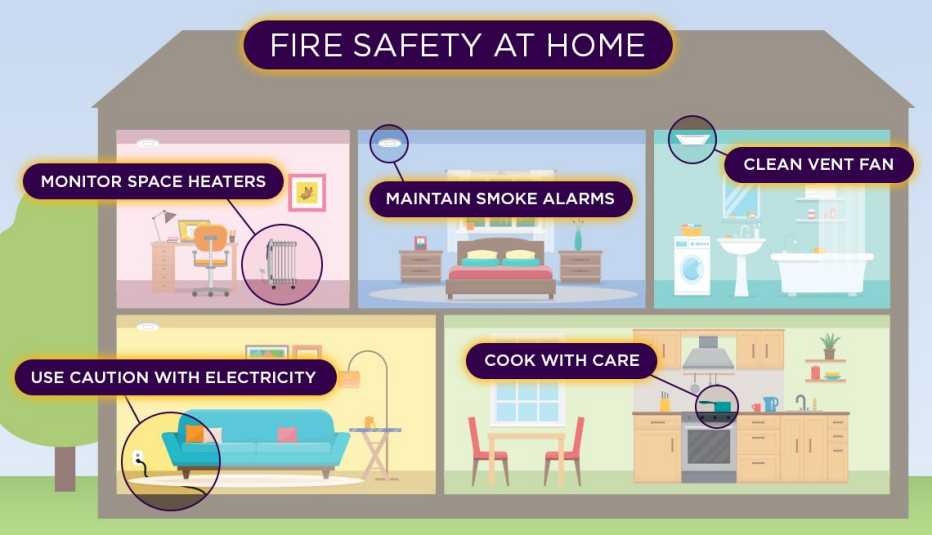
Common causes include unattended cooking, overloaded plug boards, old or torn wires, gas cylinders kept near heat sources, and blocked exits or locked balconies that delay escape.
How can I prevent a fire in my kitchen?
Never leave cooking unattended, keep the gas pipe short, flexible and regularly replaced, keep the cylinder away from heat and sunlight, and keep a suitable extinguisher in the kitchen.
How often should smoke alarms at home be tested?
Test smoke alarms monthly and replace their batteries regularly, as part of a home fire prevention checklist.
Why should families practise a night evacuation drill?
Many fatal home fires happen at night, and locked grills or cluttered exits can trap people. Practising a night drill and keeping exits, balconies and stairways clear helps everyone get out quickly.
In 2024, 3,555 of the 5,888 people killed in fire accidents in India died in homes. That is 60.4%. Not factories, not offices, not markets, but residential and dwelling buildings, where we cook, sleep and charge our phones.
(Source: NCRB, Accidental Deaths & Suicides in India 2024.)
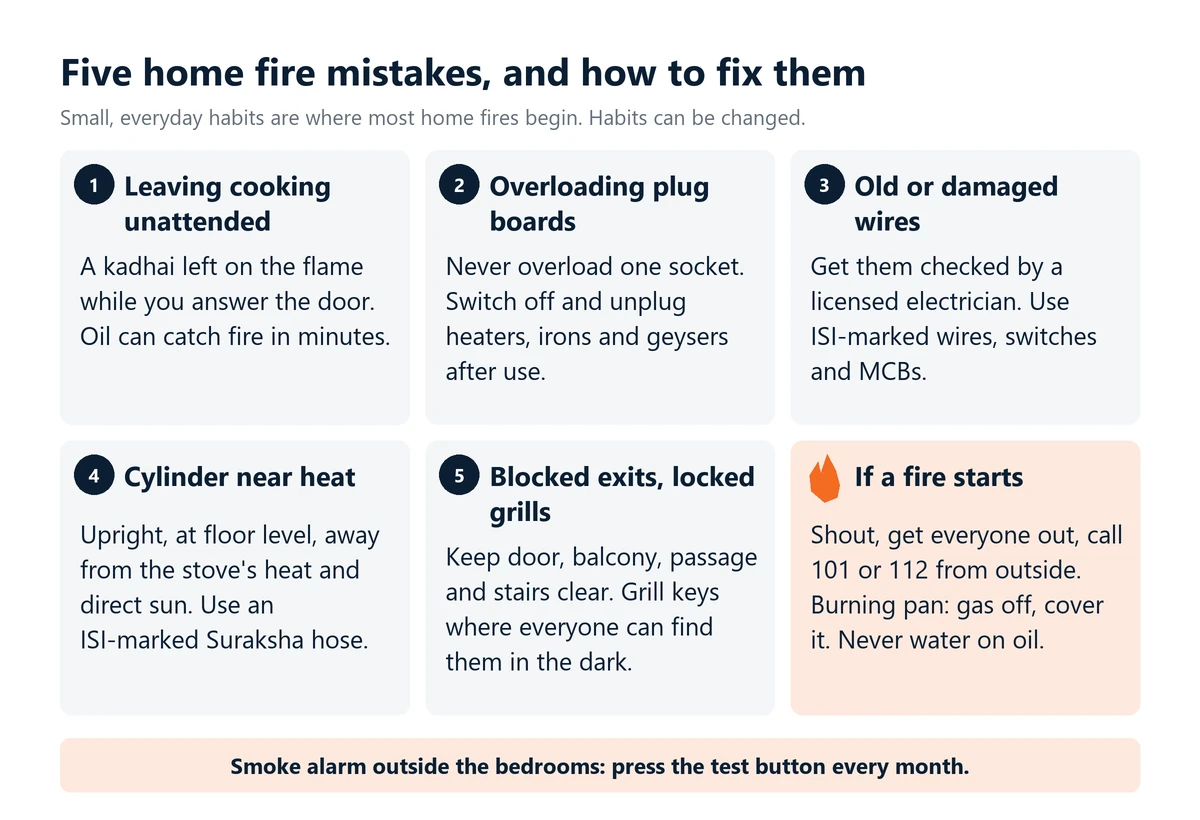
Most home fires do not start with anything dramatic. A kadhai left on the flame while you answer the door. Five plugs running off one extension board. A cylinder kept next to the stove because there is no other space. Small, everyday habits are where most home fires begin, and that is good news, because habits can be changed.
Fire accidents in India (NCRB, 2023 and 2024)
| Indicator | 2023 | 2024 |
|---|---|---|
| Fire accidents (cases) | 7,054 | 5,971 |
| Deaths in fire accidents | 6,891 | 5,888 |
| Deaths in fires from electrical short circuits | 1,673 | 1,012 |
| Deaths in fires from cooking gas cylinder or stove bursts | 1,532 | 1,389 |
(Source: NCRB, Accidental Deaths & Suicides in India 2023 and 2024, as reported by States/UTs.)
What the data tells us:
- 3,555 of the 5,888 fire deaths in 2024 (60.4%) were in residential or dwelling buildings.
- Women were 2,868 of the 5,888 people killed in fire accidents in 2024, almost half.
- These are police-reported accidental fires compiled by NCRB. They are not a count of every fire in the country.
Five common mistakes at home
- Leaving cooking unattended. Oil left on the flame can catch fire in minutes.
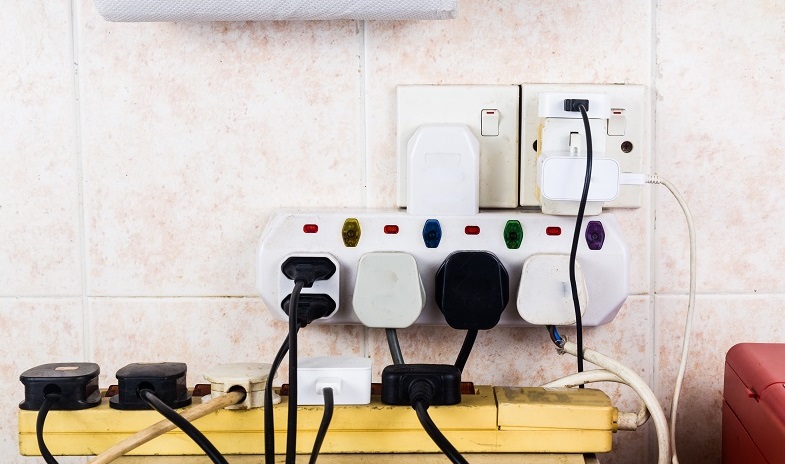
- Overloading plug boards. A fridge, a heater, a charger and a mixer on one extension board is asking for trouble.
- Living with old or damaged wires. Loose connections and torn insulation spark and heat up inside the wall, long before you see smoke.
- Keeping the cylinder near heat. A cylinder in the sun or right next to the stove is in the wrong place.
- Blocked exits and locked grills. If the main door is blocked by fire and the balcony grill is locked with the key lost somewhere, the family is trapped.
A checklist for every home
- Keep a small ABC dry powder extinguisher in the kitchen or near the way out, and learn how to use it.
- Put up a smoke alarm outside the bedrooms. Press the test button every month and change the battery as the maker recommends.
- Never touch switches with wet hands.
- Use an ISI-marked Suraksha LPG hose, keep it short and visible, and replace it before its expiry date.
- Keep the cylinder upright, at floor level and away from the stove’s heat and direct sun.
- Switch off and unplug heaters, irons and geysers when you are not using them.
- Keep the main door, balcony, passage and staircase free of clutter, and keep grill keys where everyone can find them in the dark.
- Do a night evacuation drill with the family at least twice a year.
Electrical safety
- NCRB recorded 1,012 deaths in fires caused by electrical short circuits in 2024.
- Get old, loose or damaged wiring checked by a licensed electrician. Do not wait for a burning smell.
- Use ISI-marked wires, switches and MCBs, and never overload one socket.
If a fire starts at home
- Shout to wake everyone, and get out first. Call 101 or 112 from outside.
- If the fire is small, just starting and you have a clear way out behind you, you can try the extinguisher. If it is spreading, leave.
- For a burning pan, turn off the gas only if you can reach the knob safely. If the flame is small and inside the pan, slide a fitting metal lid on from the side and leave it there until the pan is completely cool. Never pour water on burning oil, never use a damp towel and never carry the pan. If the flames spread beyond the pan, get out and call 101 or 112. Correction, 19 October 2026: an earlier version of this page suggested covering the pan with a damp, well-wrung towel. Fire services now warn against that, because even a few drops of water can make burning oil flare up.
- Stay low under smoke, close doors behind you and never go back in for belongings.
What needs to change
- Regular fire safety checks for residential societies, with problems actually fixed.
- Basic fire safety requirements built into builder approvals and the home-buying process.
- Fire volunteer training for residents through RWAs and societies.
- Help for low-income families to get smoke alarms and extinguishers.
Do this tonight
Walk through your home with fresh eyes. Find the overloaded plug board, the cracked hose and the locked grill with no key in sight, and fix one of them before you sleep. Then tell everyone at home the two ways out and where to meet outside.
Not sure how many of these mistakes apply to your home? Our home fire safety score takes twelve quick questions, and your answers stay on your phone.
References
- NCRB, Accidental Deaths & Suicides in India 2024, Chapter 1 and Tables 1.7, 1.8 and 1.12 (ncrb.gov.in)
- NCRB, Accidental Deaths & Suicides in India 2023, Table 1.7
- Bureau of Indian Standards, National Building Code of India 2016, Part 4, Fire and Life Safety
What needs attention
- Six out of ten fire-accident deaths in 2024 happened in people's homes
- Women were almost half of all those killed in fire accidents in 2024
- Short circuits and cooking gas were the two biggest named causes of fire deaths
- Fire deaths fell from 2023 to 2024, but nearly 6,000 people still died
- Most home fires start with everyday habits, not rare events
Controls that reduce risk
- Fit a smoke alarm outside the bedrooms and test it monthly
- Keep a small ABC extinguisher near the way out and learn to use it
- Get the wiring checked by a licensed electrician
- Use ISI-marked wires, switches, MCBs and Suraksha LPG hose
- Keep exits, passages and staircases free of clutter
- Hold a night evacuation drill at least twice a year
Common unsafe practices
- Leaving cooking unattended
- Running many appliances off one plug board
- Ignoring old, loose or damaged wiring
- Keeping the LPG cylinder in the sun or next to the stove
- Locked balcony grills with no key nearby
- Pouring water on a burning pan of oil
- Going back inside for belongings
Leave a comment