
Quick answers
What should I do if cooking oil starts smoking?
Smoking oil is already too hot. Turn off the heat and let it cool without moving the pan.
How do I put out a small grease fire in a pan?
If a tiny flame is wholly inside the pan and a fitting lid is at hand, slide it on from the side without leaning over, turn off the heat if safely reachable and keep the pan covered until completely cool.
Can I throw water or flour on a grease fire?
No. Water creates rapid steam that can eject and spread flaming oil, and flour is combustible. Also never carry the burning pan to a sink, balcony or outdoors.
When should I leave the kitchen instead of fighting an oil fire?
If flame spreads beyond the pan, reaches the hood or cabinets, smoke grows, the exit is blocked or a lid is not at hand, shout a warning, evacuate, close the door and call 112.
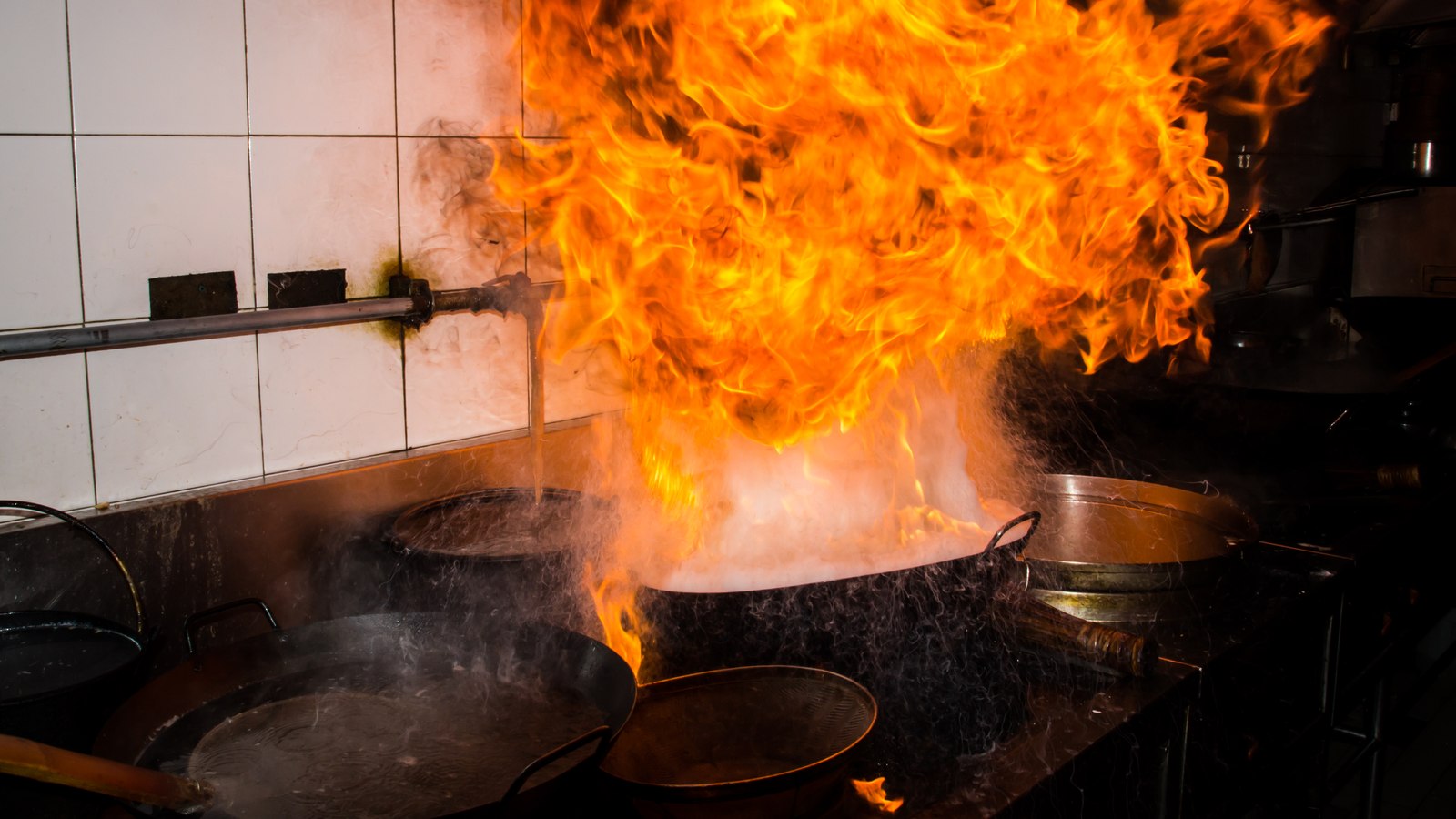
Imagine this. Oil is heating in a kadhai for puris, the doorbell rings, and you step away for a minute. When you come back the oil is smoking. A few seconds later it catches fire.
What you do in the next few seconds matters a lot. Here is what works, and what makes it worse.
If the oil is smoking but not burning
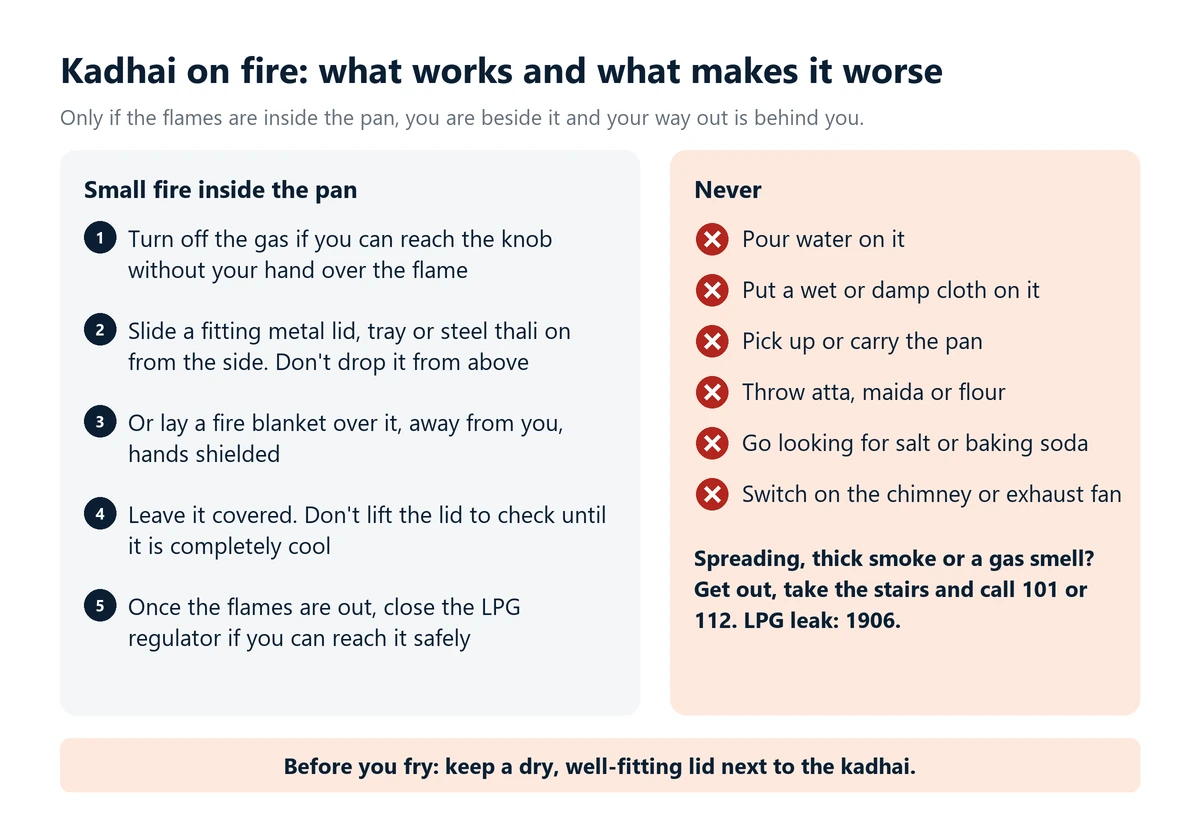
Smoking oil is already too hot. Turn off the gas and leave the kadhai where it is to cool. Do not try to carry it to the sink or the balcony.
If a small fire is burning inside the pan
Only try this if the flames are still inside the kadhai or frying pan, you are standing right beside it, and your way out of the kitchen is behind you, not past the fire.
- Turn off the gas if you can reach the knob without putting your hand over the flame.
- Cover the pan. Take a metal lid that fits, or a flat metal tray or large steel thali that covers the whole pan. Slide it on from the side so your hand and face never come over the fire. Do not drop it from above.
- Using a fire blanket? Only if you keep one in the kitchen and its instructions say it is suitable for cooking-oil fires. Some fire services advise a lid instead, because some blankets have not worked on burning oil. If yours is suitable, pull it out by the tapes, fold the top edge over your hands to shield them, and lay it over the pan, away from you.
- Leave it alone. Do not lift the lid to check. Hot oil can catch fire again the moment air gets back in. Leave the pan covered and where it is until it is completely cool.
- Close the cylinder. Once the flames are out, switch off the regulator on the LPG cylinder, but only if you can reach it without going near the fire.
Things you must never do
- Never pour water on it. Water sinks under the oil, turns into steam in an instant and throws burning oil out of the pan, onto you and across the kitchen.
- Never put a wet or damp cloth on it. Older advice said to use a damp towel. Fire services have since dropped that advice, because even a few drops of water from the cloth can make the oil burst out. If you have no fitting lid, and no fire blanket that its maker says is suitable for oil fires, get out.
- Never pick up the pan. Carrying a burning kadhai to the sink, the balcony or outside can spill flaming oil on you and spread the fire along your way out.
- Never throw atta, maida or any flour. Flour burns and scatters, and it can spread the fire.
- Do not go looking for salt or baking soda. An earlier version of this page suggested it. By the time you find the dabba, the fire has grown, and a small handful can splash burning oil. A lid is quicker and safer.
- Do not switch on the chimney or exhaust fan once the oil is burning. It can pull flames into the greasy duct.
When to get out and call for help
Leave the kitchen at once if:
- the flames have spread outside the pan
- the chimney, cabinets or curtains have caught
- smoke is getting thick
- you cannot cover the pan straight away
- you smell gas, or the cylinder is close to the fire
- the fire is between you and the door
Shout to warn everyone at home and get them out. Pull the kitchen door shut behind you if it does not slow you down. In a flat, take the stairs, never the lift. From outside, call 101 for the fire brigade or 112. Tell them the full address and floor, how to reach you, that there is an LPG cylinder inside and whether anyone is still in the house. For an LPG leak, the emergency helpline is 1906.
About fire extinguishers
American articles talk about “Class K” extinguishers. In India, fires in cooking oils and fats are Class F under BIS IS 2190:2024. If you are buying an extinguisher for a home, restaurant or dhaba kitchen, look for the Class F marking and take advice from a competent fire-safety supplier.
Use one only if you have been trained, the fire is still small and the exit is behind you. Remember PASS: Pull the pin, Aim at the base of the fire, Squeeze the handle, Sweep from side to side. Stand back so the discharge does not splash the oil, and stop and get out the moment the fire grows.
A restaurant with large fryers needs more than a hand-held extinguisher. It needs fixed hood and duct suppression, a fuel shut-off and regular duct cleaning, maintained by a competent agency.
If someone gets burnt
First get everyone away from the fire. Cool the burn under cool, clean running water for 20 minutes. No ice, toothpaste, oil or butter. Do not use any other home remedy either. Take off rings, bangles or tight clothing near the burn unless they are stuck to the skin, cover it loosely with a clean cloth and see a doctor. Call 108 for an ambulance for burns on the face, hands, joints or private parts, for large or deep burns, or if the person breathed in smoke.
If someone’s clothes catch fire: stop, drop to the ground and roll.
For the kitchen, our fire extinguisher chooser shows which type suits a cooking-oil fire.
Before you start frying
- Keep a dry, well-fitting lid next to the kadhai before you heat the oil.
- Stay in the kitchen while frying. If you must step away, turn off the gas first.
- Keep dupattas, kitchen cloths, paper and plastic packets away from the flame.
- Pat wet vegetables dry and lower food in gently, so the oil does not splash.
- Turn pan handles inward, and keep children and pets out of the kitchen while you fry.
- Wipe grease off the stove and clean the chimney filters as the maker advises.
- For a lot of frying, a thermostat-controlled fryer is safer than an open kadhai.
- Get the LPG hose, regulator and kitchen ventilation checked as your gas agency advises.
Practise once with the stove cold: pick up the lid, slide it on from the side, turn off the knob. It takes a moment, and your hands will remember it when it matters.
What needs attention
- The old step list repeated the lid step twice with other methods in between, which could slow down the safest choice
- The real decision is not which powder to grab; it is whether you can cover a small fire right now and still get out
- "Class K" is an American label; India uses Class F for cooking oils and fats
- Water sinks under oil, flashes into steam and can throw burning oil out of the pan
- Carrying a burning pan combines flame, hot liquid and a trip risk, and can spread fire along your way out
- A cloth can catch fire, hang into the oil or burn your hands, and a damp one adds water; a rigid lid that fits is the clear choice
- The lid has to stay on while the oil cools, because hot oil can catch fire again once air gets in
- PASS alone is not enough; the right rating, distance, how the extinguisher sprays, where your exit is and training all matter
- Class F wet-chemical extinguishers work differently from ordinary dry powder and are chosen for hot cooking oil
- A commercial fryer holds far more oil and heat than a home kadhai and needs fixed suppression and engineered controls
- Once the chimney, hood or duct is burning, it is no longer a pan fire
- Burn first aid starts only after everyone is safe; oil, toothpaste and ice can harm the skin or complicate treatment
Controls that reduce risk
- Keep a clean, dry, fitting lid or flat metal tray beside the pan before you heat the oil
- Clean grease from the stove and chimney filters as the maker advises
- Keep cloths, dupattas, paper, packets, aerosol cans and oil bottles away from the flame
- Stay in the kitchen while frying and turn off the gas before you step away
- Use a thermostat-controlled fryer for a lot of deep frying
- Keep children and pets out of the kitchen while oil is hot
- Teach every adult at home five words: gas off, cover, don't move it, no water, get out
- Put 101, 112 and your full address up near the door
- Check that the stairs and the meeting point outside your building are clear
- Ask a competent supplier whether you need a Class F extinguisher, and train the adults who would use it
- In a restaurant kitchen, keep hood and duct suppression, the fuel shut-off and cleaning records up to date
- Do not keep an extinguisher where using it would push you towards the stove or away from the door
- Keep clean dressings in the first-aid box instead of burn creams
- Practise with the stove cold: small fire in the pan and a lid at hand means cover it; anything more means get out
- After any fire, replace used extinguishers and get the LPG, wiring and ventilation checked before cooking again
Common unsafe practices
- Throwing water on burning oil
- Picking up or carrying the burning kadhai
- Leaning over the flame to put the lid on
- Putting a wet lid, or a wet or damp cloth, on hot oil
- Throwing atta, maida, sugar or any other powder on the fire
- Running around for salt or baking soda while the fire grows
- Using too little powder and splashing burning oil
- Lifting the lid to see whether the fire is out
- Switching on the chimney or exhaust fan after the fire starts, which can pull flames into the greasy duct
- Using any extinguisher without checking that it is suitable for Class F
- Standing with the fire between you and the door
- Carrying on with the extinguisher after the fire spreads beyond the pan
- Reaching through flame or thick smoke to shut the LPG regulator
- Taking the lift when leaving a building
- Putting ice, butter, oil, toothpaste or a home remedy on a burn
- Cooking again before the LPG line, wiring, chimney and any suppression system have been checked
Leave a comment