
What happened here
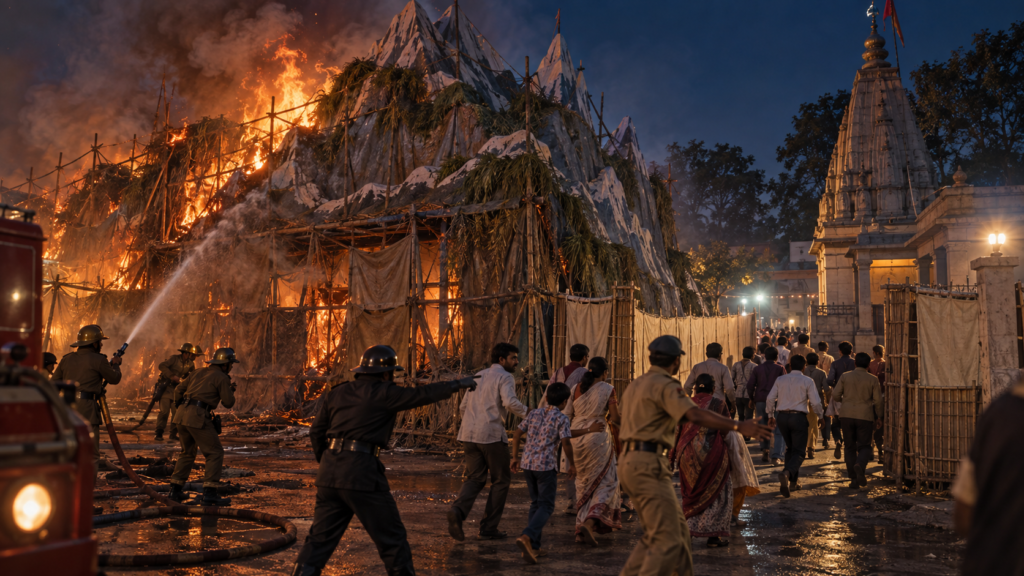
A tall walk-through Himalayan replica made from timber, cloth, jute and grass burned rapidly during a crowded religious exhibition. A parliamentary reference recorded 49 deaths; contemporary official statements and press reports ranged from 46 to at least 60.
A combustible mountain built for a crowd
On 6 December 1981, visitors were moving through a multi-storey replica of the Himalayas erected for a religious exhibition outside the Neelkanth Mahadev temple in Asarwa, Ahmedabad. Contemporary accounts describe a structure about 20 metres high, made from timber, cloth, jute and grass. When fire took hold, the display was consumed in minutes.
What happened
The earliest explanation was an electrical short circuit. Later reporting attributed the failure more specifically to faulty wiring and overload after melted conductors were examined. At least 100 people were reported to be climbing through the display. People near the upper levels had little time to descend, and an exit into an adjacent school was reported closed after the fire began.
Why the fatality figure varies
A Rajya Sabha reference on 7 December recorded 49 deaths. A contemporary India Today investigation reported conflicting official figures of 46 and 60, while The Indian Express archive said at least 60. This review uses 49 as the parliamentary reference figure and keeps the higher early estimates visible as uncertainty rather than choosing whichever number appears most dramatic.
Permission and control failures
Contemporary reporting said the exhibition had not received the required permission and that its run had been extended. A tall, enclosed, combustible temporary structure with a public route through it required engineered load, fire, electrical and evacuation controls. Popular demand could not safely substitute for a renewed inspection and authorization.
What modern organisers must change
Any temporary exhibition entered by the public should be treated as an occupied building. Designers must control flame spread, certify structural and electrical work, limit capacity, provide independent exits from every level, maintain emergency lighting and station trained staff who can stop entry instantly. An unavailable exit or unapproved extension should trigger closure.
- A public walk-through Himalayan display was erected outside the temple
- The exhibition period was reportedly extended by four days
- At least 100 visitors were reported inside or climbing the structure
- An electrical failure ignited the combustible display
- The large temporary structure was substantially destroyed
- Rajya Sabha referenced 49 reported deaths
- The Union government made a statement in Parliament
- Reporting identified faulty wiring, overload, permission failures and an exit that became unavailable
Why consequences escalated
- Combustible decorative materials formed the occupied enclosure and escape route.
- A tall multi-level visitor path increased evacuation time while available escape time was only minutes.
- Later reporting linked melted wiring to overload rather than treating 'short circuit' as a complete explanation.
- An exit into an adjacent school was reported to have closed during the emergency.
- Authorities said permission had not been secured for the exhibition.
- Conflicting death totals demonstrate the need to preserve dated official figures and later corrections separately.
Failures and risk multipliers
- Allowing the public into a tall combustible temporary structure.
- Using inadequately designed or overloaded temporary electrical wiring.
- Operating without confirmed permission and inspection.
- Extending an event without renewed safety review.
- Depending on an exit that could become closed or unusable.
- Failing to control the number and movement of visitors on upper levels.
- Presenting a disputed historical toll without attribution.
People closest to the evidence
“Rajya Sabha formally referenced a reported 49 deaths on 7 December 1981”
Rajya Sabha Official Debates · https://www.rsdebate.nic.in/handle/123456789/3/simple-search?etal=0&filter_field_1=ministry&filter_field_2=debatetype&filter_field_3=debatdate&filter_type_1=equals&filter_type_2=equals&filter_type_3=equals&filter_value_1=HOME+AFFAIRS&filter_value_2=Part+2Other+than+Question+and+Answer&filter_value_3=1980+TO+1989&order=desc&query=&rpp=15&sort_by=score&start=75
“The temporary display was made from timber, cloth and grass; later examination pointed to overloaded faulty wiring”
Contemporary India Today investigation reproduced by Chaitanya Kalbag · https://www.chaitanyakalbag.com/spate-of-senseless-tragedies/
Actions that reduce risk
- Require engineered approval for every public walk-through temporary structure.
- Use flame-retardant, tested materials and limit the combustible fuel package.
- Design certified temporary electrical distribution with load calculations and protective devices.
- Provide an independent protected escape route from every occupied level.
- Interlock admission with a live capacity count.
- Keep every exit unlocked, staffed, illuminated and physically verified throughout opening hours.
- Require a new inspection before extending an event.
- Stop public entry immediately when any critical safety condition changes.
Leave a comment