
What happened here
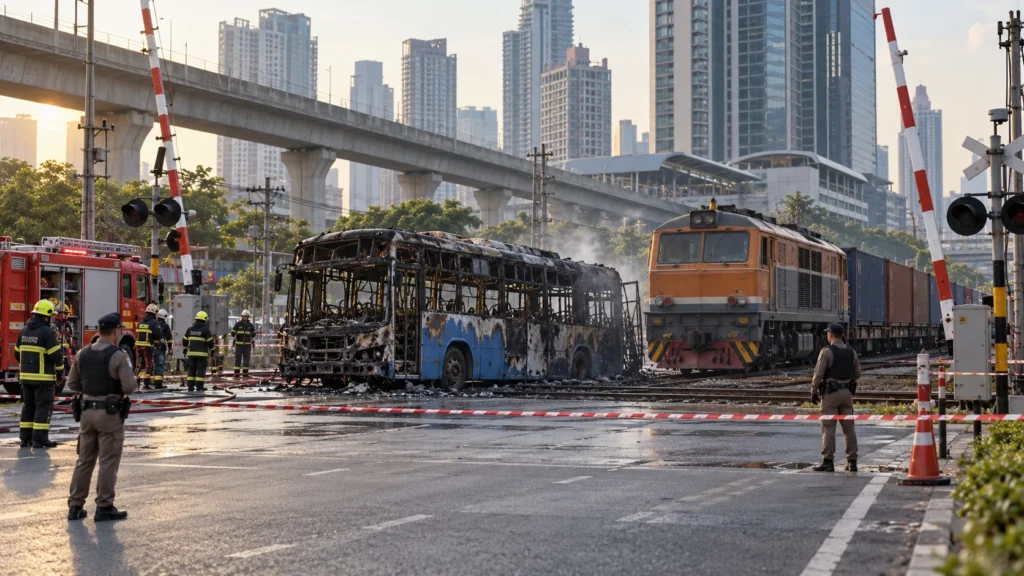
On 16 May 2026 a heavy SRT freight train hit a Route 206 city bus stuck on a gated level crossing near Makkasan station in Bangkok. The bus caught fire and eight people on it died. The barrier failure is disputed, the train driver tested positive for drugs, and six people were later ordered indicted.
Quick answers
How many people died in the Bangkok train and bus collision?
Eight people died, all of them on the bus. Reports put the injured at 30 to 35; Reuters and the Transport Ministry used 32.
Where did the crash happen?
At the level crossing on Asok–Din Daeng Road near the Makkasan station of the Airport Rail Link in central Bangkok, on 16 May 2026.
Did the crossing barriers fail?
This is disputed. Witnesses and a widely shared video suggested the barrier arm stayed up. The SRT said the barriers could not be lowered because traffic was blocking the crossing. No final official finding had been published by 17 October 2026.
Who has been charged?
In August 2026 prosecutors ordered six people indicted: the train driver, the crossing-barrier operator, the bus driver, two motorcyclists and a pickup driver. The train driver also faces a drug-use charge. These are charges, not convictions.
What was the compensation?
The Transport Ministry said each bereaved family would get about 2.39 million baht from the BMTA, the SRT and the Department of Rights and Liberties Protection.
What is the lesson for Indian drivers?
Never enter a level crossing unless there is room to clear the far side, keep the marked area clear, and if you are stuck on the tracks, get everyone out and move away at once.
What happened
On the afternoon of Saturday, 16 May 2026, a State Railway of Thailand (SRT) freight train hit a crowded public bus that was standing on a level crossing on Asok–Din Daeng Road in central Bangkok, near the Makkasan station of the Airport Rail Link. The Nation put the collision at about 3.35 to 3.40 p.m.; Thai PBS World said the 199 emergency line was alerted at 3.42 p.m.
The train was freight train No. 2126, running from Laem Chabang to Bang Sue Junction with containers, according to The Nation. The bus was a blue air-conditioned Route 206 bus of the Bangkok Mass Transit Authority (BMTA). Early official accounts said the bus had stopped across the tracks because it was held at a red traffic light just beyond the crossing, in heavy traffic. Cars, a pickup truck and several motorcycles were also caught at the crossing.
The bus caught fire within minutes and its fuel tank exploded, Thai PBS World reported, and the fire spread to nearby vehicles. The Department of Rail Transport said the train dragged the bus about 80 metres before it stopped, according to the Bangkok Post. Firefighters from Phaya Thai fire station brought the blaze under control in under an hour.
The people
Eight people were killed, and all of them were on the bus, according to The Nation, citing Reuters. Two of the dead had still not been formally identified on 20 May, the Bangkok Post reported. Injury counts differ: Reuters and Thai PBS World reported 32 injured, ABC News (Australia) and some other outlets reported 35, and the Bangkok Post later gave 30. We use 32, the figure the Transport Ministry briefing used on 18 May, and treat the others as reported variations.
The bus driver survived. On 17 May The Nation listed him and the train driver among six injured people still in one Bangkok hospital, where a bus passenger and the bus fare collector were in intensive care. One early Thai PBS World report said the bus driver was among the dead; later reports, including his charging in August, show that was wrong. We are not publishing the names of the dead.
Response and investigation
Prime Minister Anutin Charnvirakul ordered a full fact-finding inquiry and told the SRT and the BMTA to jointly pay for treatment and help for families. The Department of Rail Transport led an investigation at the site, and the SRT handed over the train’s data recorder and CCTV footage.
The barrier question is still disputed. Thai PBS World reported that the barrier arms did not come down and the warning signals were not activated, and a widely shared video appeared to show a barrier arm stuck upright. The SRT’s account, reported by The Nation, is that the barriers could not be lowered because traffic was blocking the crossing, so the railway signal did not change, and the driver should have been watching for hand or flag signals from crossing staff. The Department of Rail Transport told a parliamentary committee that CCTV showed a railway worker waving a red flag at 3.35 p.m. and then withdrawing it while vehicles were still on the tracks, and returning to the barrier controls five seconds before impact.
The SRT said the train had covered about 2.8 km from Khlong Tan station at an average of about 34 km/h, and that emergency braking began only about 100 metres before the crash. Transport officials told the Bangkok Post that the train carried 20 containers weighing more than 1,100 tonnes and needed up to 1 km to stop under SRT standards.
Police said the train driver tested positive for drugs. The SRT said a preliminary test found methamphetamine and cannabis, admitted that drug tests were not routine before every shift, and said he was not yet licensed under the new Rail Transport Act system that came into force on 27 March 2026. The crossing-barrier operator tested negative. He told reporters he had waved the red flag, pressed the button to lower the barriers and signalled the train to stop, and he denied negligence.
On 18 May the Transport Ministry announced 100 per cent drug screening for public transport drivers, alcohol tests before every duty, a rule that passenger trains must not move if barriers are not down, and plans to keep most freight trains out of Bangkok in the daytime. A House transport committee later found operational weaknesses, including the lack of routine drug testing and staff at busy crossings having to lower barriers, direct traffic and signal trains at the same time.
Police submitted the case file to prosecutors on 24 July 2026, and in August prosecutors ordered six people to be indicted, MGR Online and Pattaya Mail reported: the train driver (negligence causing death and injury, and drug use), the crossing operator (negligence causing death and injury), the bus driver (negligent driving causing death and injury, and obstructing rail transport), and two motorcyclists and a pickup driver who were stopped on the yellow cross-hatched box at the crossing (obstructing rail transport). These are charges, not findings of guilt.
Compensation
The Transport Ministry said each bereaved family would receive about 2.39 million baht in all: 1.75 million from the BMTA and its insurance, 0.34 million from the SRT and 0.3 million from the Department of Rights and Liberties Protection. On 20 May, the House committee chairman said some payments were delayed because two victims had not yet been formally identified and insurers wanted identity numbers. We could not confirm whether every family has now been paid.
Why this matters for India
This was not a remote, unmanned crossing. It was a manned, gated crossing in the middle of a capital city, and it still failed, because a bus stopped on the tracks in a traffic queue and nobody could stop a heavy train in time. Indian cities have many level crossings with the same mix of traffic signals, jams and impatient drivers just beyond the gate.
NCRB’s Accidental Deaths and Suicides in India 2024 recorded 1,892 railway crossing accidents and 1,888 deaths across India, most of them in Uttar Pradesh (610) and West Bengal (549). A train at speed cannot swerve and may need hundreds of metres or more to stop. The only safe place for a vehicle is off the tracks.
Lessons for drivers, bus crews and passengers
- Never stop on the tracks. Cross only when there is room for your whole vehicle on the far side. In a jam, wait behind the gate or the stop line, even if the car ahead goes.
- Keep the box clear. The marked area around a crossing is not a parking spot or a queue. Three of the six people indicted in Bangkok were motorists stopped there.
- Bus drivers carry everyone’s life. A long bus needs more clear space on the far side. If it cannot clear the tracks fully, it must not start across.
- If your vehicle is stuck on the tracks, get everyone out at once. Do not wait to restart the engine. Move well away from the tracks, then call for help so the railway can be warned.
- Passengers may speak up. If a bus or auto stops on the tracks, ask the driver to move or get off and walk clear.
- Know your bus exits. When you board, look for the emergency door, windows that open and the hammer. A bus fire can spread in minutes.
- Railway staff and operators: regular drug and alcohol tests, licensed drivers and a clear rule that a train does not pass a crossing with open barriers at speed save lives.
What is still not known
The full cause has not been officially published. It is still disputed whether the barriers failed or were blocked by traffic, when exactly the crossing staff warned the train, and why braking began so late. The court has not ruled on the six people indicted, and we could not confirm through 17 October 2026 whether all compensation has been paid or whether the crossing has been rebuilt. We will update this page when official findings or a verdict are published.
- A railway worker waves a red flag at the crossing, then withdraws it while vehicles are still on the tracks, per CCTV described by the Department of Rail Transport
- Freight train No. 2126 hits the Route 206 bus stuck on the tracks; the bus is dragged about 80 m and catches fire
- The 199 emergency line is alerted; Phaya Thai firefighters respond and control the fire in under an hour
- Eight bodies found in the bus; the crossing-barrier operator is detained and charged with negligence; BMTA pledges compensation
- Police say the train driver tested positive for drugs; PM Anutin orders a full inquiry and care for victims
- SRT admits drug tests were not routine before each shift; Transport Ministry orders 100 per cent drug screening and crossing rules
- House transport committee finds operational failures and says some compensation is delayed by identification issues
- Police submit the case file to prosecutors
- Prosecutors order six people indicted, including the train driver, crossing operator and bus driver
- No verdict or final official cause report found
Why consequences escalated
- Eight people on the bus died; the train driver and bus driver survived with injuries.
- The bus stopped across the tracks in a traffic queue at a red light just beyond the crossing, according to early official accounts.
- Whether the barriers malfunctioned or were blocked by traffic is disputed between witnesses and the SRT.
- Emergency braking began only about 100 m before impact, according to the SRT.
- The train driver tested positive for methamphetamine and cannabis, and was not yet licensed under the new Rail Transport Act system.
- SRT drug testing was not routine before each shift, a gap the House committee also identified.
Failures and risk multipliers
- A bus entering a crossing without room to clear it on the far side.
- Cars and motorcycles stopping on the marked box around the tracks.
- A traffic signal just beyond the crossing that held vehicles on the tracks.
- No routine drug testing of train drivers before each shift.
- Crossing staff expected to lower barriers, direct traffic and signal trains at the same time.
Actions that reduce risk
- Cross a railway line only when your whole vehicle can clear the far side.
- Keep the marked area at a crossing clear, even in a jam.
- Coordinate road traffic signals near crossings so vehicles are never held on the tracks.
- Test train and bus drivers for drugs and alcohol before every duty.
- Give busy crossings enough staff, cameras and traffic police, and plan grade separation where traffic is heavy.
Leave a comment