

Quick answers
Can a restaurant kitchen be in a basement under NBC 2026?
Clause 4.2.19.1 says a restaurant kitchen should not be in a basement, although a state may change the list. Clause 4.7.9 says LPG kitchens are not allowed there. A small induction, piped gas or electric kitchen may be allowed as an incidental use.
How must a commercial kitchen be separated from other areas?
Clause 4.5.3.6 asks that live cooking areas with any fuel, including induction, LPG and PNG, in hotels, hostels, food courts, malls and other commercial kitchens be segregated by 120 minutes of fire rating. Pantries without live cooking are exempt under clause 4.5.3.7.
Does NBC 2026 say how to store LPG cylinders at home?
We found no clause for the one or two cylinders in an ordinary flat or house. The cylinder rules in Part E are written for commercial, industrial, educational and institutional premises, with one sub-clause for flats societies with a cylinder bank.
Where may gas pipes run in a building?
In separate shafts used only for gas, on external walls and away from staircases. Gas lines are not to pass through an enclosed staircase, an electrical shaft, an escape route or a refuge area.
Is NBC 2026 mandatory?
No. It is voluntary until a state or local authority adopts it. Your state's building rules and the fire department decide what applies to your building.
Under NBC 2026, a live cooking area in a commercial kitchen should be separated from other areas by 120 minutes of fire-rated construction (clause 4.5.3.6). A restaurant kitchen and an LPG kitchen are not allowed in a basement. Gas pipes stay out of stairs and escape routes, gas meters sit in a ventilated metal cupboard, and gas is never turned back on during a fire. Detailed commercial kitchen rules are sent to IS 18271:2023, which we have not read, and the standard has no clause for the one or two LPG cylinders in a home kitchen. It is voluntary until your state adopts it. Checked 15 November 2026. Basements and EV charging are in our companion chapter on basement parking and EV charging under NBC 2026.
In short
- Live cooking: any live cooking area, whether induction, LPG or piped gas, in hotels, hostels, food courts, malls and other commercial kitchens, is segregated by 120 minutes of fire rating (clause 4.5.3.6).
- Not in a basement: a restaurant kitchen should not be in a basement, and an LPG kitchen is not allowed there.
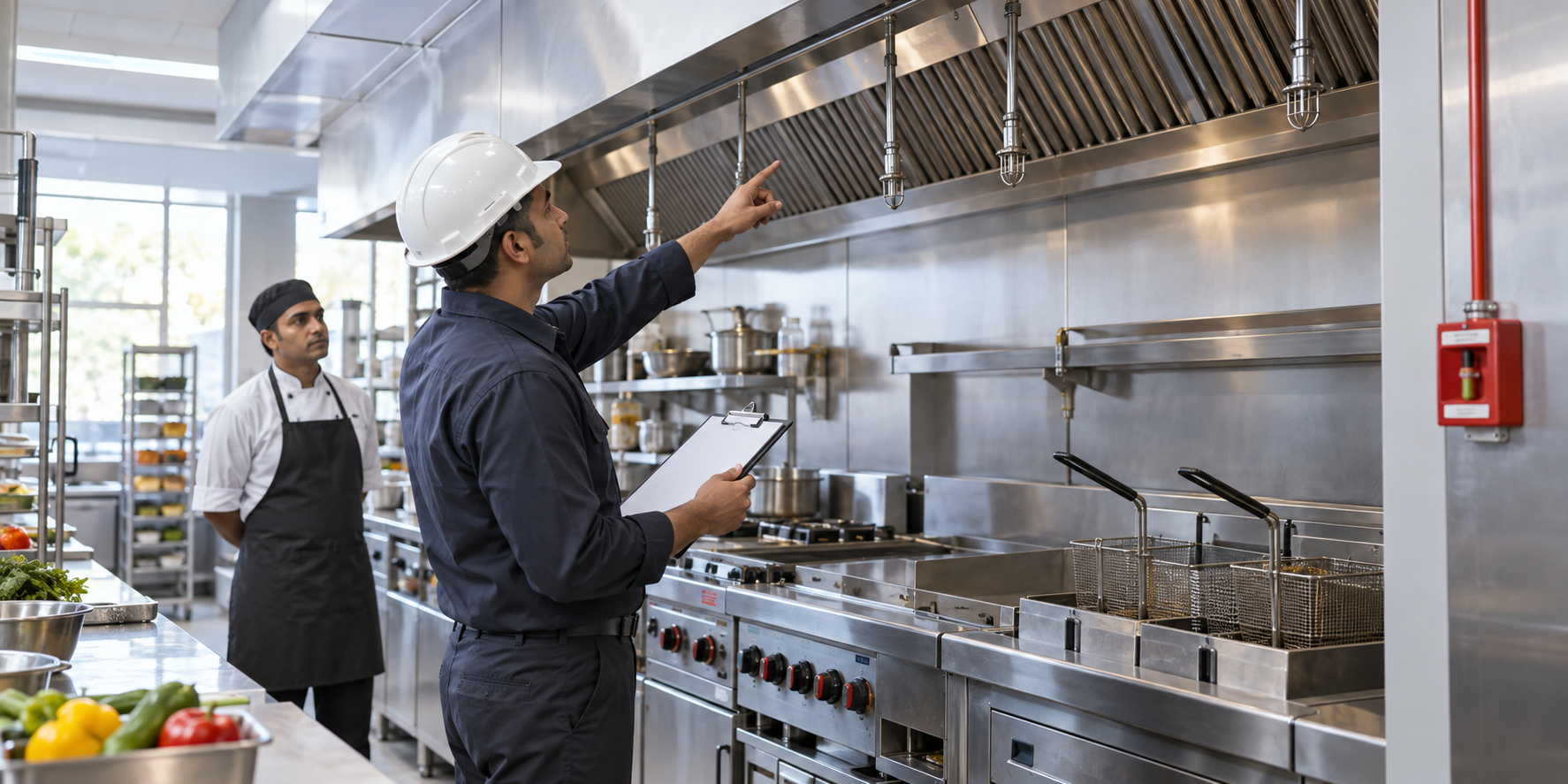
- Hood and duct: cooking ranges and fryers need a hood with a fire suppression system, and the exhaust is cleaned every six months.
- Gas pipes and meters: kept out of stairs and escape routes, with meters in a ventilated metal cupboard.
- Cylinders: the Part E cylinder rules are for commercial, industrial, educational and institutional premises, with one sub-clause for a flats society’s cylinder bank.
- Silent: no clause for the one or two cylinders in an ordinary home kitchen.
Why kitchens and gas belong together
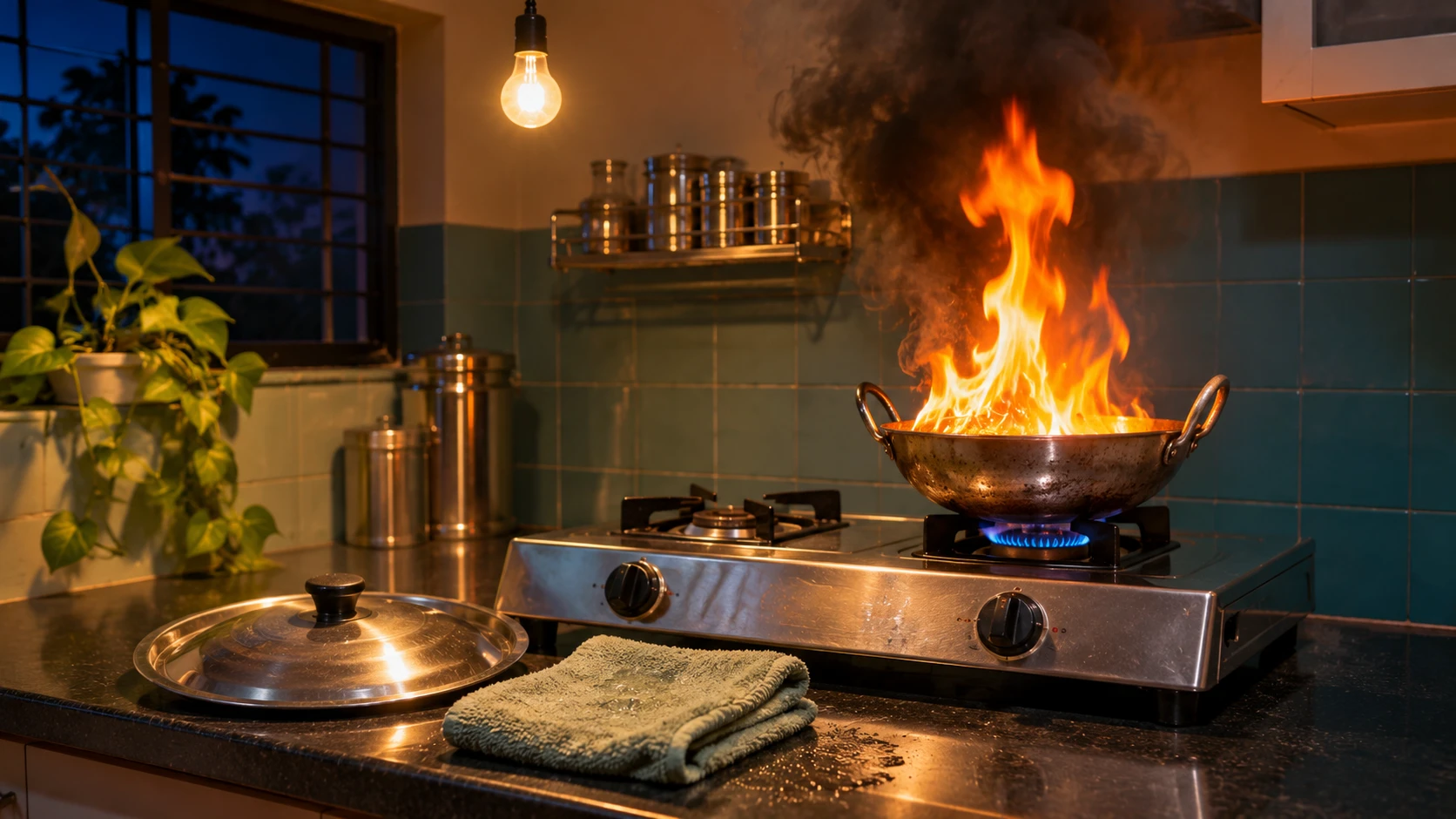
A kitchen and its gas supply are among the commonest causes of fires inside homes. They meet in one building: a restaurant on the ground floor may share shafts and ducts with the flats above, and the meter and cylinders stand close by. NBC 2026 deals with them in different places, so this chapter gathers the verified points. This is the sixteenth chapter in our series on the 2026 national building standards, split in two so each part is easier to read. See also our chapters on water and first-aid fire fighting, and on fire officers, drills and maintenance.
Kitchens: what the standard asks for
BIS says in the foreword of Part F that fire protection of a commercial kitchen is now dealt with through the detailed standard IS 18271:2023, Fire safety in commercial kitchen, guidelines. We have not read that standard, so we do not repeat its numbers. These are the kitchen points we did read in Part F and Part D.
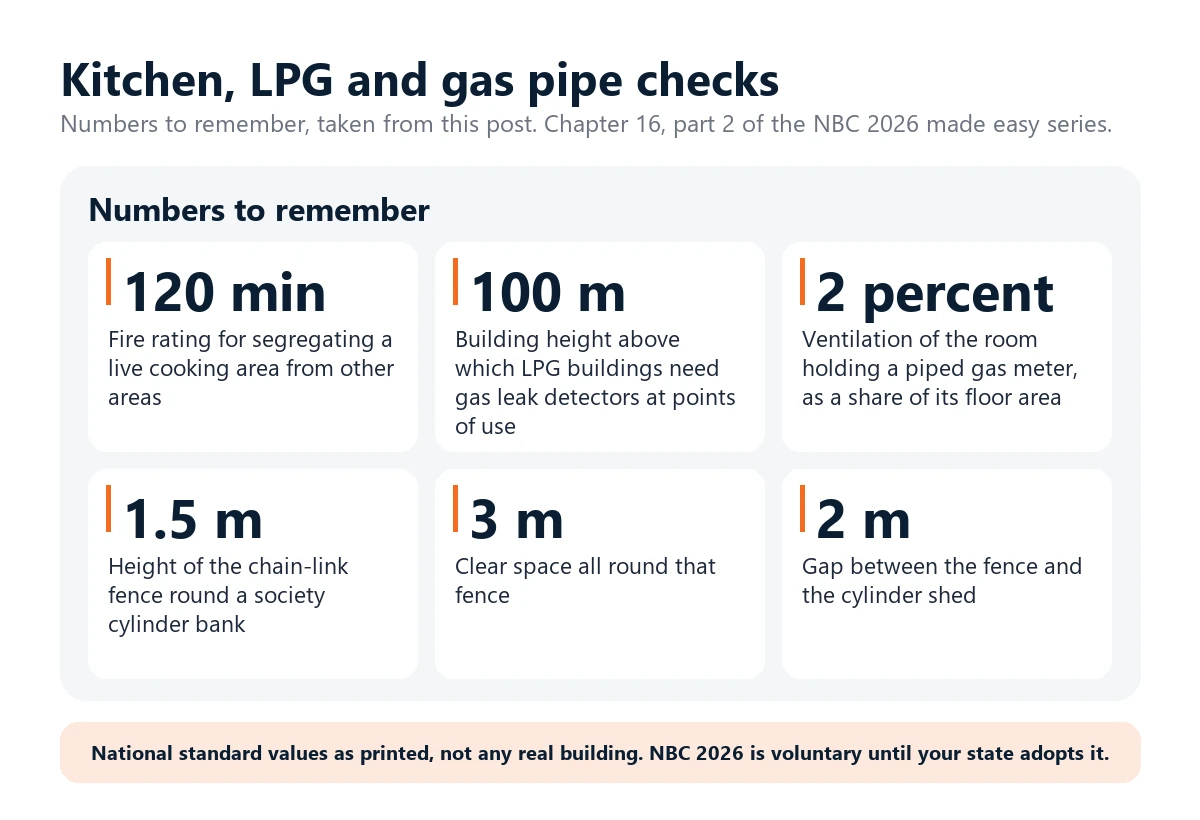
- Separate the cooking: clause 4.5.3.6 asks that all live cooking areas, with any type of fuel (induction, LPG, PNG and so on), in hotels, IT parks, business buildings, cafeterias, hostels, educational buildings, food courts, malls and any commercial kitchens be 120 minutes fire rated and segregated from other areas. The next clause, 4.5.3.7, exempts pantries without live cooking, buffet counters, breakout areas with microwaves, and tea and coffee maker areas.
- Not in a basement: a restaurant kitchen should not be in a basement (clause 4.2.19.1), and an LPG kitchen is not allowed there (clause 4.7.9). A small kitchen using induction, piped gas or electricity may be allowed in a basement as an incidental use. Our chapter on basement parking and EV charging covers the other basement rules.
- Hoods: the Part D ventilation section describes Type I hoods, which collect grease, smoke, steam and heat and carry grease filters, baffles and a fire suppression system. Cooking ranges, fryers, broilers and griddles need Type I hoods.
- Exhaust duct: where a kitchen flue or duct passes through a compartment wall or floor, it is encased in non-combustible construction, kept clear of combustibles, and no damper is allowed in it. This is the opposite of the general duct rule, and it is meant for grease ducts.
- Cleaning: the kitchen exhaust is cleaned every six months so carbon soot in the duct does not catch fire. Equipment that burns wood or charcoal gets its own duct or a spark arrestor.
- Position: it is advisable to put cooking on an outside edge of the building so it can ventilate naturally if the fans fail.
- Detection: large kitchens in hotels and hospitals in tall buildings should have thermal detectors in the fume hoods that trip the exhaust fan, and the gas, if used, shuts off (clause 4.7.2).
- Water level: Table 7A, note 1, says a building that has a kitchen is at hose-protection level HL-2 (HL means a hose-stream-only water level; in the residential rows we read, only the lodging and dormitory rows cite this note, so ask your fire officer whether it applies to your building).
Part D gives two different sets of figures for the thickness of the kitchen duct steel and for where it discharges above the roof, so we leave those out. Table 9 also prints a kitchen row in a way that looks like a misprint, so we do not use it for hood suppression advice. Our guide to kitchen hood suppression inspections explains what an inspection covers, and seven kitchen fire rules for Indian homes covers the home kitchen.
Gas pipes and meters: what the standard says
Part F, clause 4.7, and Part E, Section 4 (gas supply), cover gas. The points below were read from the printed pages.
- Pipes: gas pipes in a building run in separate shafts used only for that purpose, on external walls, away from staircases (4.7.1). Gas lines are not to pass through an enclosed staircase, an electrical shaft, an escape route or a refuge area (4.7.8).
- Meters: gas meters sit in a suitably built metal cupboard in a well-ventilated space, keeping in mind that LPG is heavier than air and natural gas is lighter (4.7.6). For piped gas, the meter is normally on an outside wall, and the room that holds it has ventilation of at least 2 percent of its floor area (Part E, 12.6).
- Cylinders and manifolds: they should be in a detached, ventilated enclosure with no other occupancy close by, and if a manifold is on a podium it is kept away from air intakes, smoke exhaust openings and windows (4.7.3, 4.7.4).
- Leak detectors: in buildings above 100 m that use LPG, gas leak detectors at the points of use, watched from the fire command centre (4.7.7).
- Shut-off valve: each building has an approved outside gas shut-off valve, clearly marked (4.8).
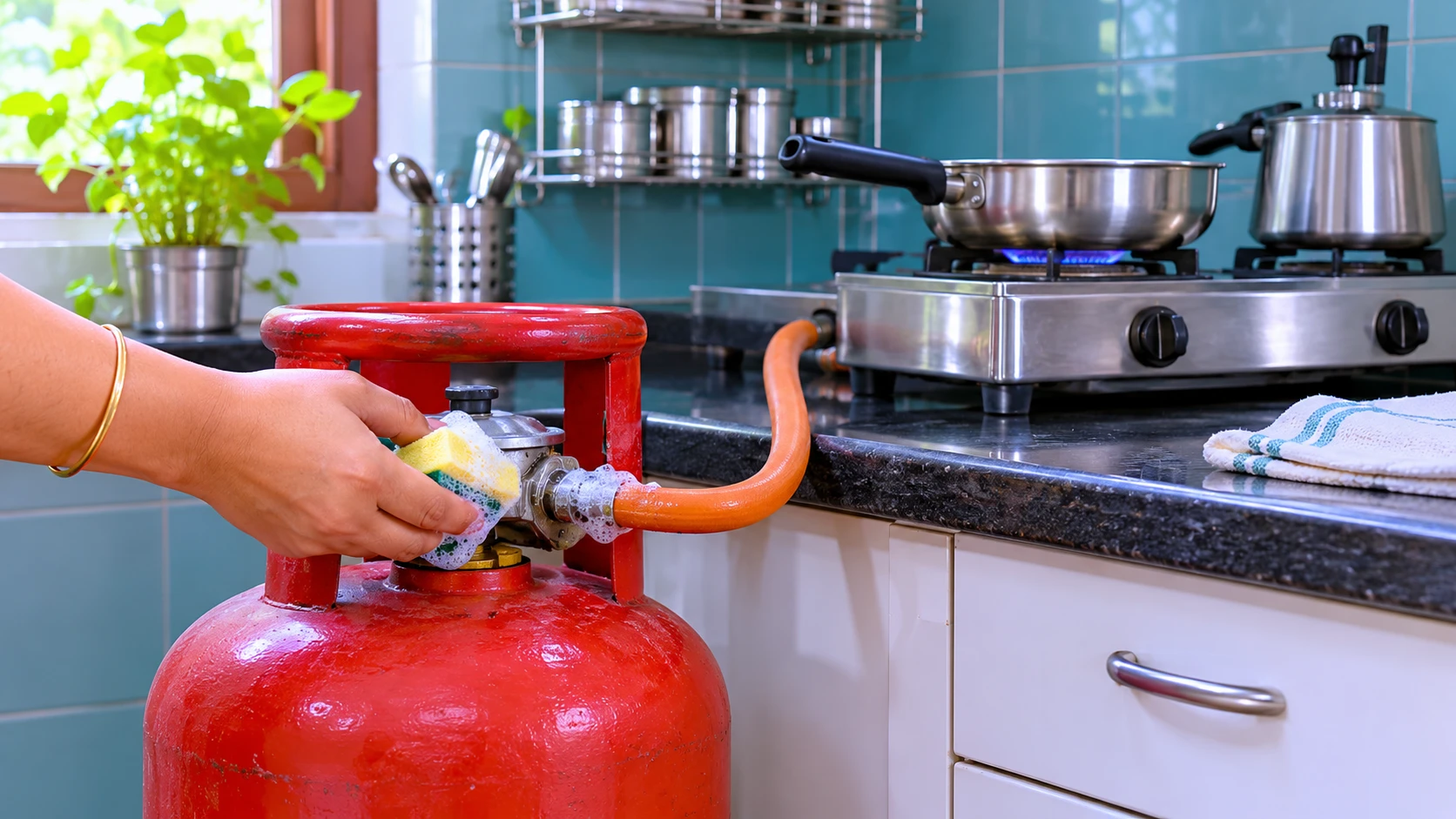
- Looking for a leak: no matches or flame, soap and water solution is recommended, and a gas detector is also recommended. While searching, do not switch electric lights on or off (Part E, 10.2, 10.3, 10.8).
- After a fire or a leak: gas is not to be turned on in the event of a fire. Only the gas company or its permitted person turns the supply on (Part E, 6.1, 6.2).
- Never decant: LPG is never transferred from the cylinder it came in to another container (Part E, 11.3.1.4).
LPG cylinders: where the standard is silent
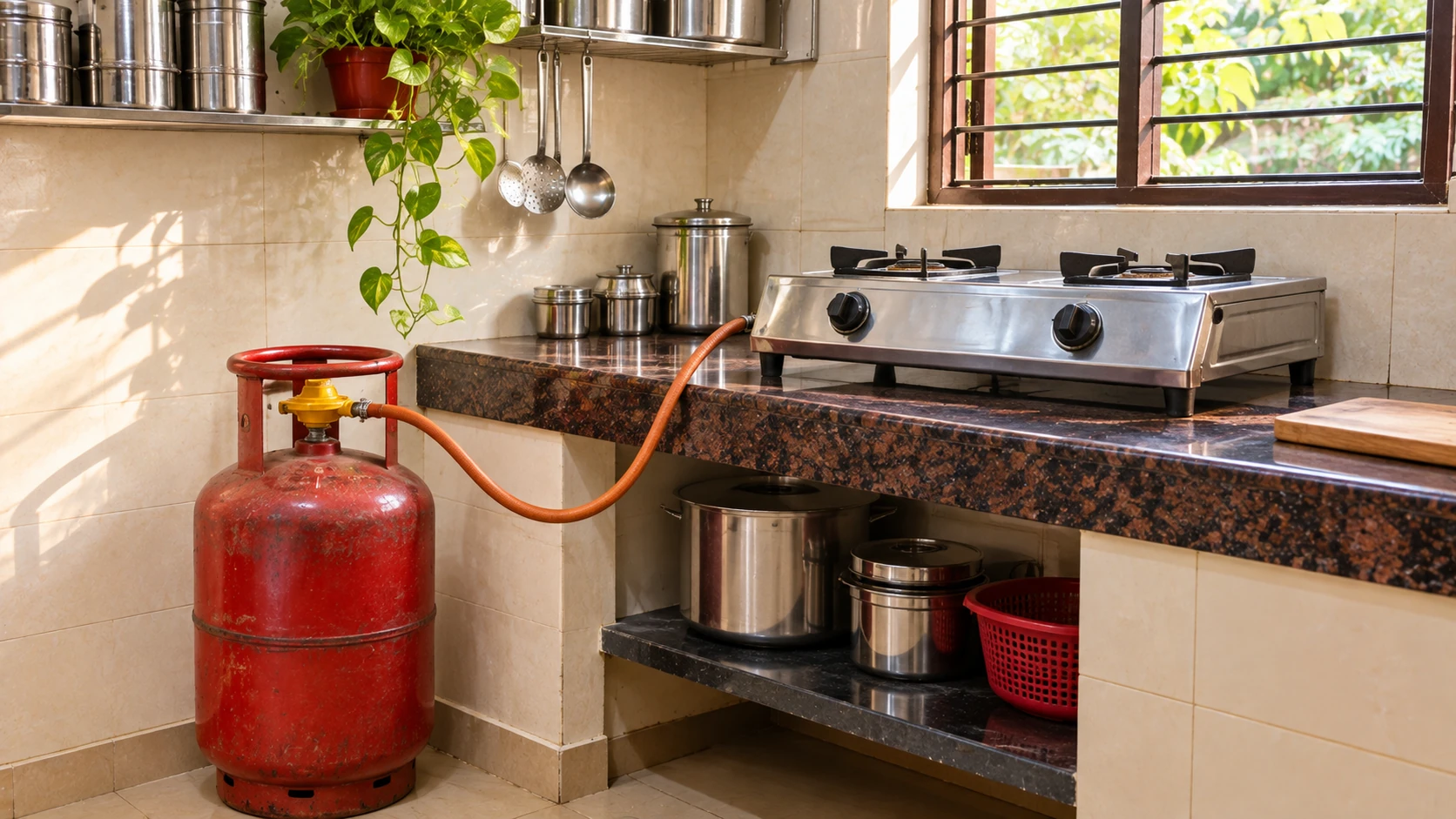
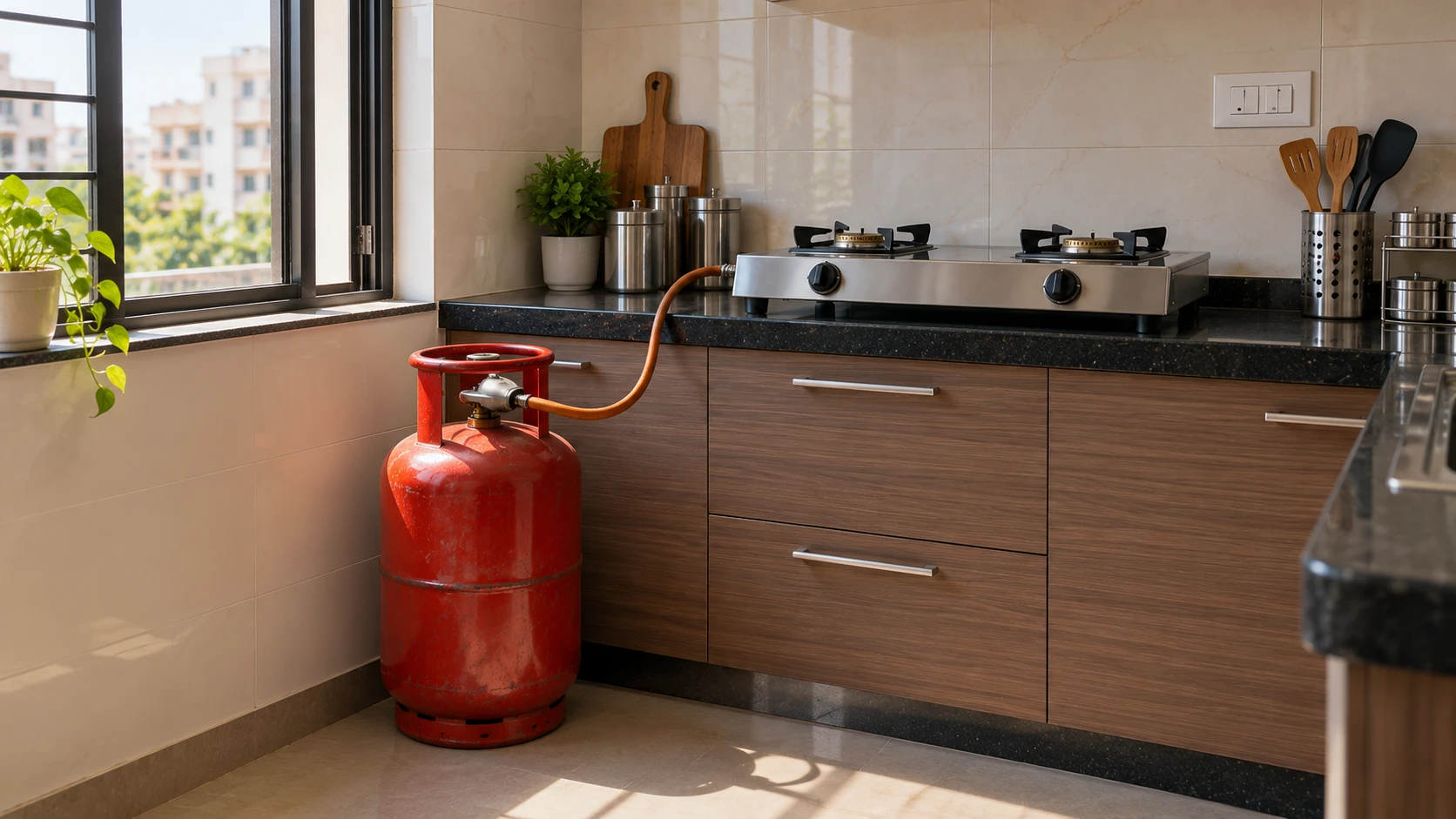
The cylinder rules in Part E, clause 11.3, say they apply to commercial, industrial, educational and institutional premises. They are not written for a home. We found no clause for the one or two cylinders in an ordinary flat or house kitchen. The only drawing of a home LPG arrangement is a schematic figure, and its dimensions carry no explanation, so we do not use it.
One sub-clause, 11.3.2.1(q), does name residential complexes. For a multistorey building or a flats society with a cylinder bank, it asks for a safe, marked place, away from roads with moving traffic and away from where children can reach it. It also asks for a covered shed open on all sides, a fence of chain link 1.5 m high with one gate, 3 m clear all round the fence and 2 m between fence and shed. The bank is not to be under a stairway, in a basement or cellar, or near steam pipes, boilers, transformers or generator sets. Cylinders stand upright, valve up, on a firm floor raised at least 100 mm, and 1 m from combustible material.
The commercial limits in the same clause do not line up with each other. One line allows up to 50 kg in a stationary installation indoors on any floor, and another says a cylinder of more than 20 kg shall not be on a floor above ground level. We do not give a single indoor limit. Our hub on LPG cylinder safety in India and what to do right now in an LPG leak cover home use. See also our guide on kitchen gas leak accidents, in the related cards below.
If you smell gas: our general advice
This is our own plain-words advice, not text from the standard. Put out any flame. Do not switch lights or fans on or off, and do not use a phone or lighter near the smell. Open doors and windows. If it is safe, close the regulator on the cylinder. Leave the room, then leave the building, and call the LPG emergency helpline 1906 or your gas company from outside. If there is a fire or you hear a hiss and cannot reach the valve, leave and call 101. Do not go back in to turn gas on or off after a leak, and do not turn it on again until the gas company says so.
Worked example: a restaurant kitchen
This is a simple illustration of how to read the national standard, not the legal answer for any real building. A real building is decided by its approved plan, the version of the rules your state uses and your fire officer.
A restaurant plans a kitchen with a gas range and a fryer. Part F says the kitchen should not be in a basement, and an LPG kitchen is not allowed there at all. On an upper floor, the live cooking area is segregated with 120 minutes of fire rating (clause 4.5.3.6). The cooking line needs a Type I hood with grease filters and a fire suppression system, an exhaust duct that is grease-tight and has no damper where it passes a fire wall, and a duct cleaning schedule of every six months. The LPG cylinders go to a ventilated, detached place outside the kitchen, never under a staircase, and the building has a marked gas shut-off valve outside. If the owner wants a kitchen in the basement, the choice is a small induction, piped gas or electric kitchen as an incidental use, not a restaurant kitchen. The detailed requirements are in IS 18271:2023, which the owner or designer should read.
What this means for owners and tenants
- Kitchens: a restaurant or canteen tenant should show a record of exhaust cleaning and hood suppression service. See kitchen hood suppression inspections.
- Cooking area: ask what separates the live cooking from the dining or office area, and whether the door is kept shut.
- Gas: keep cylinders upright, out of basements and stair spaces, and know where the gas shut-off is. See what to do in an LPG leak.
- Meters and pipes: check nothing is stored in the meter cupboard and no gas line runs through a stair or escape route.
- Everyone: fire safety is an ongoing job, and maintenance for building owners covers it.
Ask your fire officer
These are fair questions to put to a society, a mall manager or a restaurant owner.
- Which clause or state rule decided the separation of our live cooking area, and what is its fire rating?
- When was the kitchen exhaust duct last cleaned, and when was the hood suppression last tested?
- Where are the gas cylinders or meter, and is there a marked shut-off valve outside?
- Is any kitchen or cylinder store in a basement or under a stair?
- Which version of the standard or state rule applied when this was approved?
Where this stands in law
The National Building Construction Standards 2026, Part F, is voluntary. It binds a building only once a state or local authority adopts it, and until then your state’s building rules and the fire department decide what applies. Older buildings were approved under earlier rules. Our guide to fire safety laws in India explains the layers. This guide is general safety information. It is not legal or engineering advice, and it does not tell you whether a particular building complies.
What we could not confirm
- The contents of IS 18271:2023, which we have not read.
- A rule for domestic LPG cylinders in a flat or house. We found none.
- A single indoor LPG weight limit, because the clauses do not line up.
- The kitchen duct steel thickness and roof discharge height, because Part D gives two sets of figures.
- How a state that has adopted the standard may have changed any of this.
- The listed videos, which were checked for public status and embedding but not watched in full.
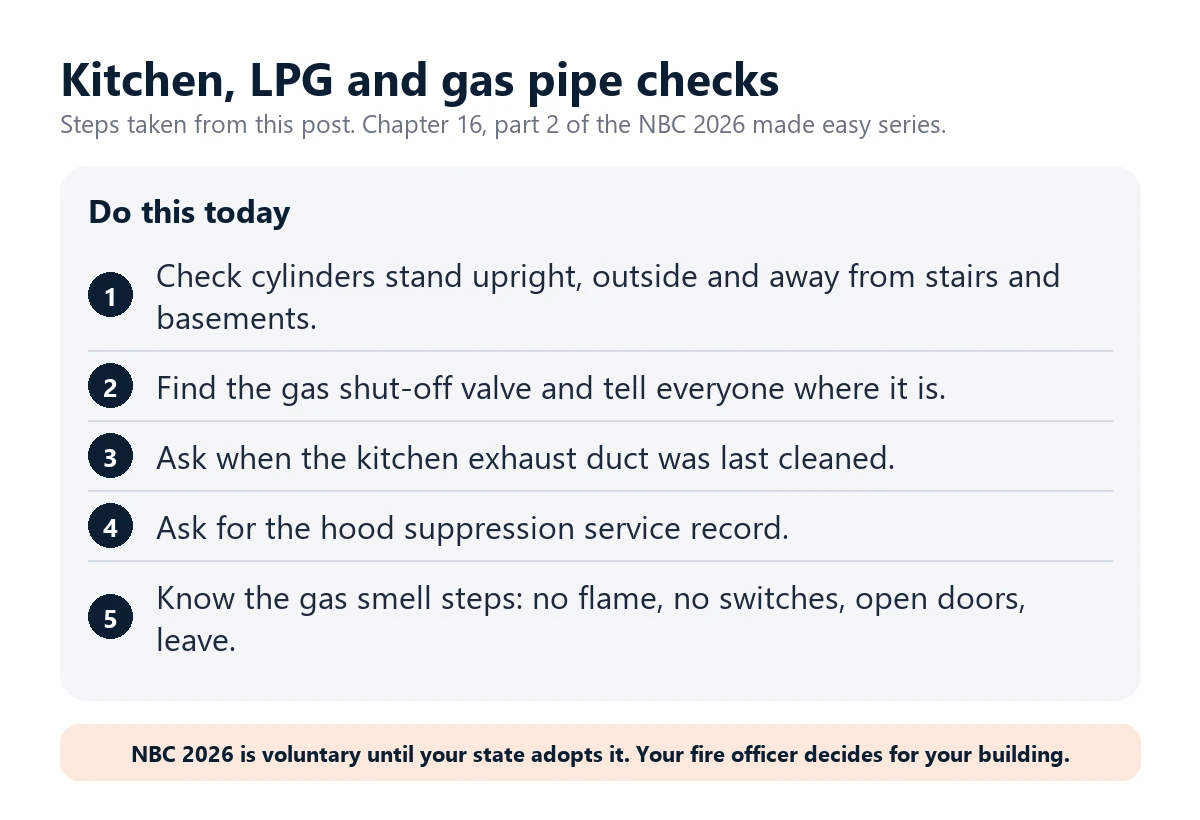
Do this today
Look at where your gas cylinders stand. They should be upright, outside, and away from stairs and basements. Find the gas shut-off valve and tell everyone at home or work where it is. If you run or rent a commercial kitchen, ask when the exhaust duct was last cleaned. Then read what to do right now in an LPG leak with your family. For basements and EV charging, read our companion chapter on basement parking and EV charging under NBC 2026. Other chapters in this series cover water and first-aid fire fighting, and fire officers, drills and maintenance.
What needs attention
- Live cooking areas in commercial kitchens are segregated by 120 minutes of fire rating; pantries without live cooking are exempt.
- A restaurant kitchen and an LPG kitchen are not allowed in a basement.
- Commercial kitchens are sent to IS 18271:2023; kitchen exhaust is cleaned every six months and has no damper at a fire wall.
- Gas lines stay out of enclosed stairs, electrical shafts, escape routes and refuge areas.
- Gas is not turned on during a fire, and LPG is never decanted.
- The Part E cylinder rules are for commercial, industrial, educational and institutional premises; there is no clause for one or two cylinders in a home kitchen.
- The standard is voluntary until a state adopts it.
Controls that reduce risk
- Check cylinders stand upright, outside, away from stairs and basements.
- Find the gas shut-off valve and tell everyone where it is.
- Ask for the kitchen exhaust cleaning and hood suppression records.
- Keep the meter cupboard clear and ventilated.
- Ask your fire officer which rule decided the kitchen separation.
Common unsafe practices
- Leaving kitchen exhaust ducts uncleaned for years.
- Keeping LPG cylinders under a stair or in a basement.
- Running a gas line through a stair or escape route.
- Turning gas back on after a fire or a leak instead of calling the gas company.
- Propping open the door of a separated cooking area.
- Treating this guide as proof that a building complies.


Leave a comment