

Quick answers
Where should I keep a portable generator during a power cut?
Outdoors only, with the exhaust pointing away from the building. US CDC and CPSC guidance says at least 20 feet (about 6 metres) from doors, windows and vents. Never run one in a room, basement, garage, closed balcony or tent, even with a door open.
Why is it dangerous to run a generator indoors?
The exhaust contains carbon monoxide, which you cannot see or smell. It can get into the house through windows, doors or vents even when the generator is outside. An open door or a CO alarm cannot make a generator in a closed space safe.
What are the signs of carbon monoxide poisoning from a generator?
Common signs include headache, dizziness, weakness, nausea, vomiting, chest pain and confusion. If several people near a running generator feel unwell at the same time, treat it as an emergency.
What should I do if the CO alarm goes off while the generator is running?
Get everyone out into fresh air at once without stopping for belongings. Call 112 and get urgent medical help. Do not go back in to silence the alarm or switch off the generator, and wait for responders to say it is safe.
When the power goes for hours, many shops, clinics and some homes bring out a small petrol or diesel generator. It keeps the lights and the fridge going, but it brings a second danger with it. The exhaust contains carbon monoxide (CO), a gas you cannot see or smell. It can drift into a house through a window, door or vent even when the generator itself is standing outside.
This is general safety advice for households and small premises. It is not an account of the Koder House fire or a claim about what caused it.
Decide where the generator goes before you start it
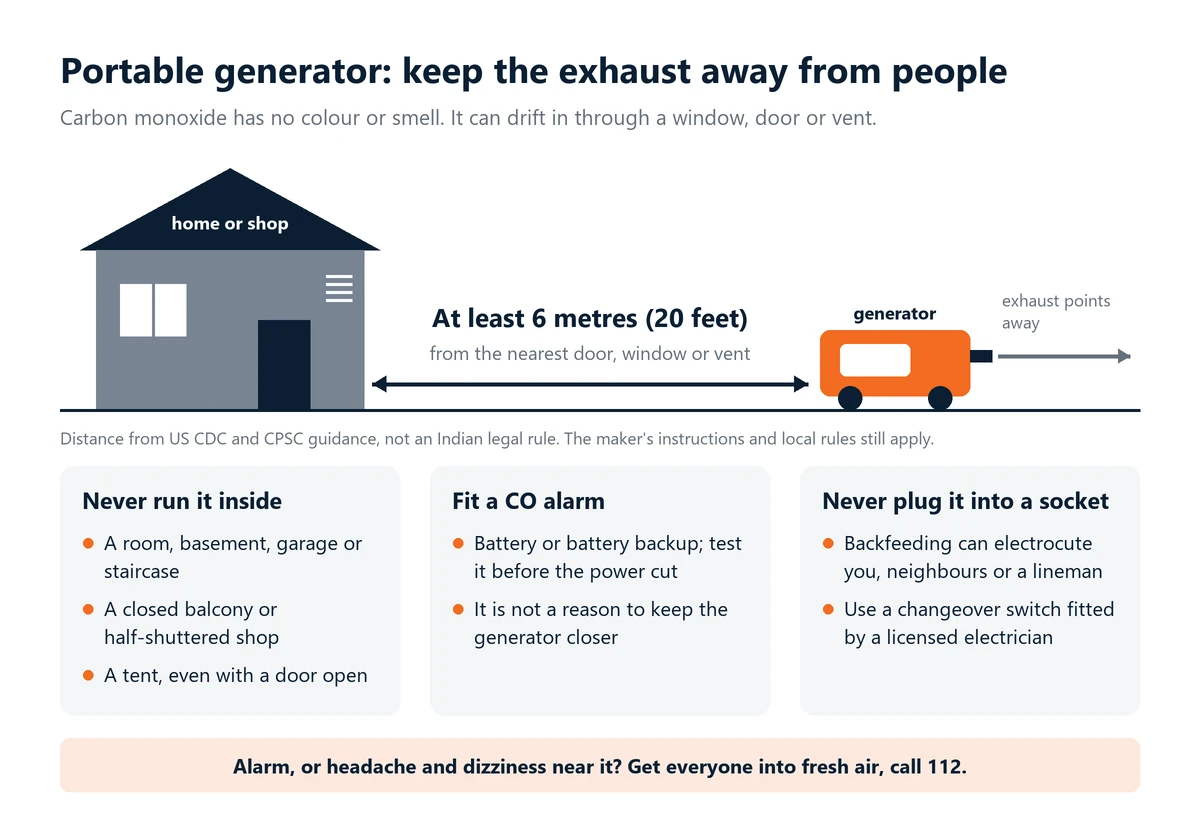
Guidance from the US Centers for Disease Control and Prevention (CDC) and the US Consumer Product Safety Commission (CPSC) says to run a portable generator outdoors only, at least 20 feet (about 6 metres) from doors, windows and vents, with the exhaust pointing away from the building.
Never run one inside a room, basement, garage, staircase, closed balcony, shop with the shutter half down, or a tent, even with a door open. Measure the 6 metres from the nearest opening, not just from the outer wall. If your premises has no spot that meets this distance and the maker’s instructions, do not try to make an indoor arrangement work.
Protect the people inside
Fit a working CO alarm that runs on batteries or has a battery backup, and place and maintain it as the maker says. Test it before the power cut, and change the battery or the unit when it is due. The alarm is an extra warning. It is not a reason to keep the generator closer to the house.
Keep children away from the hot exhaust, the fuel and the cables. Follow the maker’s instructions for rain and ventilation. Never plug the generator into a household socket to power the wiring. This is called backfeeding and it can electrocute you, your neighbours or a lineman working on the supply. If you want the generator to run the house circuits, get a licensed electrician to fit a proper changeover switch.
Know the signs of CO poisoning
The CDC lists headache, dizziness, weakness, nausea, vomiting, chest pain and confusion among the common symptoms. If several people near a running generator feel unwell at the same time, treat it as an emergency.
If the alarm goes off, or you suspect CO, get everyone out into fresh air at once. Call 112 and get urgent medical help. Do not go back inside to switch off the alarm or collect your things, and wait for the fire brigade or responders to say it is safe before you return.
A quick check before the next power cut
- Pick an outdoor spot at least 6 metres from openings, and a safe route for the cable.
- Test the CO alarm and keep a spare battery.
- Store fuel as the maker says, away from the house.
- Work out how to keep the generator dry without boxing it in or pointing the exhaust at people or windows.
- Decide who will start and stop it.
- Agree how everyone will get out, and how you will check that nobody is left inside, if the alarm sounds.
For any connection to the building wiring, get a licensed electrician to design and fit it. This article is not an installation manual.
What this advice is based on
The 20-foot (about 6-metre) distance comes from US CDC and CPSC guidance. It is not an Indian legal rule. The layout of your site, the generator maker’s instructions and any local rules still apply. We do not give an Indian accident rate or claim a measured drop in risk. A CO alarm or an open door cannot make a generator in a closed space safe.
Tonight, walk around your home or shop and decide where the generator would stand if the power went out. If there is no safe outdoor spot, plan on an inverter or another battery backup instead.
What needs attention
- CO has no colour and no smell, so you cannot judge safety by your nose
- An open shutter, door or window does not make it safe to run a generator indoors
- Even outdoors, distance and exhaust direction matter because gas can enter through openings
- A CO alarm gives extra warning but does not replace safe placement
- The advice here is from US CDC and CPSC guidance adapted for India, with 112 as the emergency number
Controls that reduce risk
- Mark a safe outdoor spot for the generator before the next power cut
- Test and maintain the CO alarm
- Keep the exhaust away from doors, windows, vents and people
- Use a licensed electrician and a changeover switch if the generator will run house circuits
- Tell everyone at home or at work the symptoms and that the answer is fresh air and 112
- Read the generator maker's instructions for running it in rain and wind
Common unsafe practices
- Running a generator in a garage, closed balcony, staircase or room
- Placing it right outside an open window, door or vent
- Pointing the exhaust at the building or at people
- Ignoring a CO alarm or putting symptoms down to tiredness
- Plugging the generator into a household socket or doing DIY wiring
- Going back inside before the fire brigade or responders say it is safe
Leave a comment