
What happened here
 1 / 3
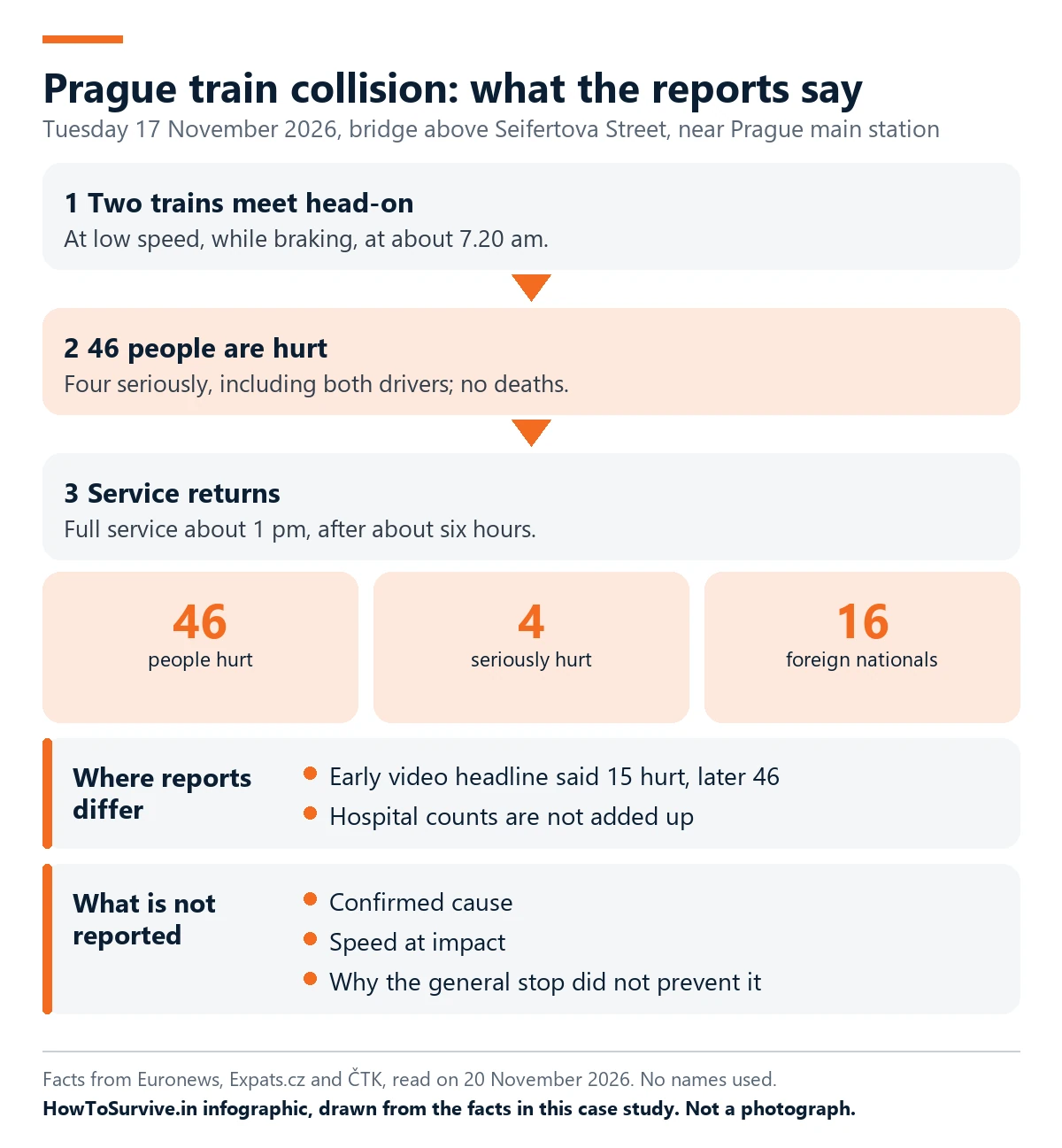
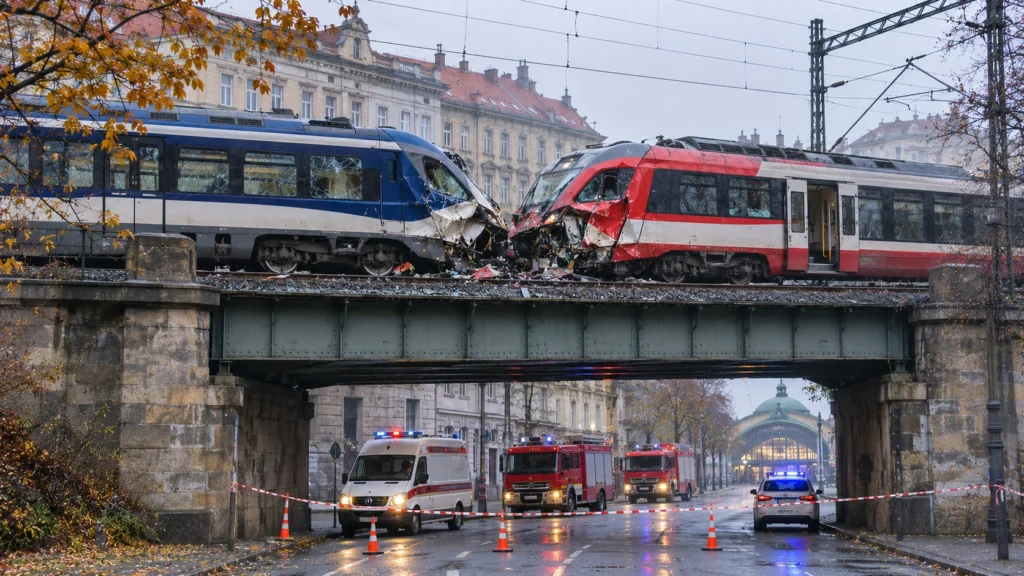
Two passenger trains collided head-on at low speed on the bridge above Seifertova Street, Prague 3, near the main station, at about 7.20 am on Tuesday 17 November 2026. 46 people were hurt: four seriously, including both drivers, 12 moderately and 30 slightly. According to the transport minister, the Milovice-bound train appears to have passed a signal forbidding movement, but the cause is not confirmed. Service was fully back about 1 pm.
Quick answers
What happened in Prague on 17 November 2026?
Two passenger trains collided head-on at low speed on the bridge above Seifertova Street near the main station at about 7.20 am. 46 people were hurt and no deaths were reported.
How badly were people hurt?
Four were seriously hurt, including both drivers, 12 moderately and 30 slightly.
Who reported it?
Euronews, Expats.cz and the Czech news agency ČTK, read on 20 November 2026.
What caused the collision?
The cause is not confirmed. The transport minister said the train bound for Milovice appears to have passed a signal forbidding movement, and that technical fault or human error is not yet established.
Why did the train protection not stop it?
A general stop command was activated but did not prevent the collision. The European Train Control System does not cover the approach to the main station, where it is planned for 2029.
What should a passenger do after a train collision?
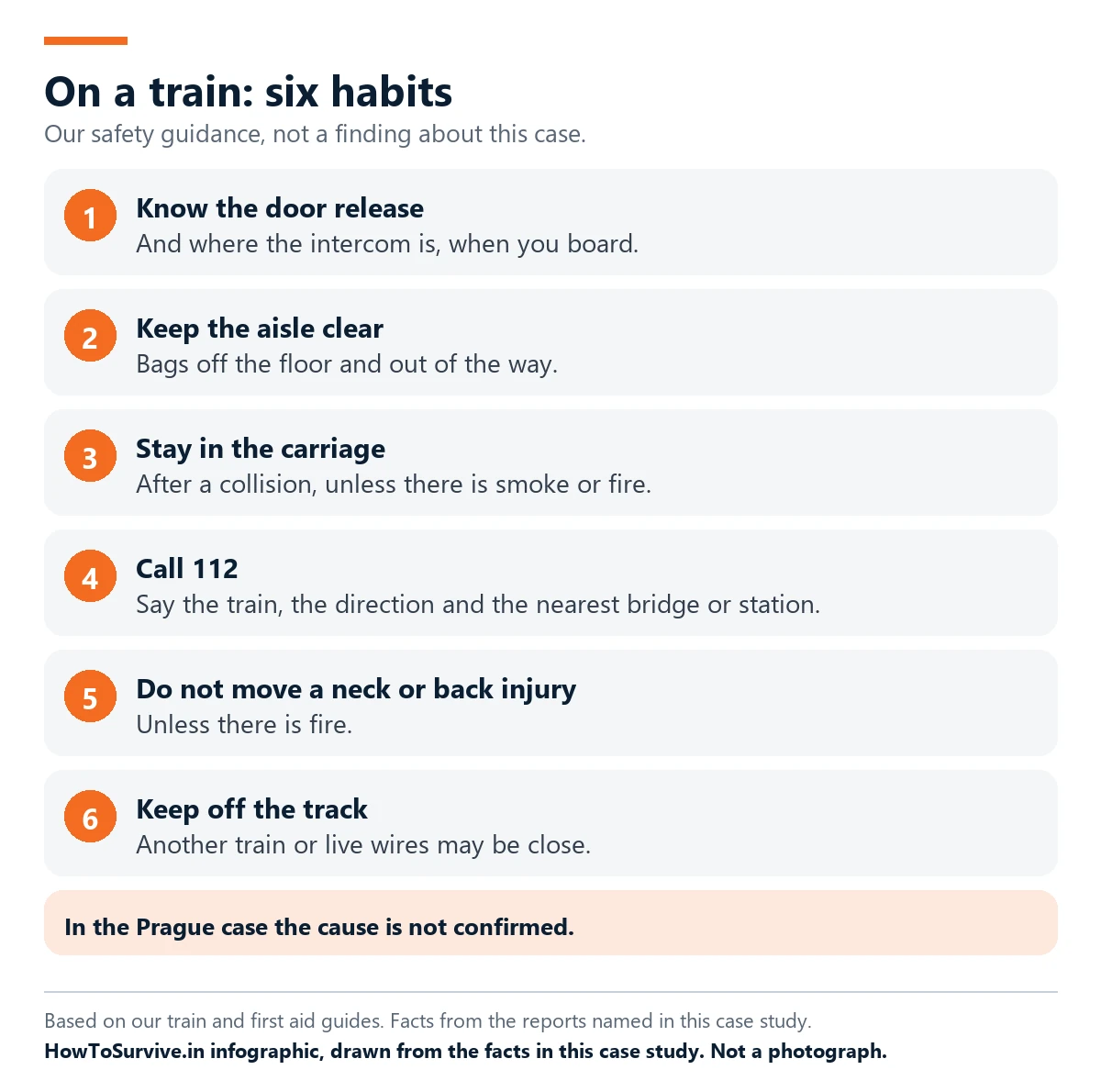
Stay in the carriage unless there is smoke or fire, call 112, do not move anyone with a neck, back or head injury, and keep away from the track and overhead wires. These are our own suggestions.
What are the emergency numbers in the Czech Republic?
112 is the European emergency number and the national numbers are 150 for fire and rescue, 155 for the ambulance and 158 for the police, according to the Czech Fire Rescue Service.
What happened
The Prague train collision hurt 46 people on the morning of Tuesday 17 November 2026. Two passenger trains collided head-on at low speed, while braking, on the bridge above Seifertova Street in Prague 3, near the main railway station, according to Euronews, Expats.cz and the Czech news agency ČTK. Four people were seriously hurt, including both train drivers, 12 had moderate injuries and 30 had minor injuries. No deaths are reported.
The transport minister said that the first information points to the train bound for Milovice having passed a signal that forbids movement, but he and the investigators stress that no cause is confirmed. This page names no one. It sets out what the reports say, where they differ and what passengers can do on a train.
What the reports say
- When: Tuesday 17 November 2026, about 7.20 am (Expats.cz; ČTK)
- Where: On the bridge above Seifertova Street, Prague 3, near Prague main station, Czech Republic (Euronews; Expats.cz; ČTK)
- What happened: Two passenger trains collided head-on at low speed while braking; one was heading to Milovice and the other arriving from Mladá Boleslav (Expats.cz; ČTK)
- Hurt: 46 people: four seriously, including both drivers, 12 moderately and 30 slightly; none is reported dead (Euronews; Expats.cz; ČTK)
- Foreign nationals: Police said 16 of the injured were foreigners, from Slovakia, Ukraine, Russia, Nigeria and Bulgaria (Expats.cz; ČTK)
- The signal: The transport minister said the Milovice-bound train appears to have passed a signal forbidding movement; he stressed that technical fault or human error is not yet established (Expats.cz; ČTK)
- Train protection: A general stop command was activated but did not prevent the collision; the European Train Control System is not installed around the main station and is planned there for 2029 (Expats.cz; ČTK)
- Response: Prague ambulance crews arrived within four minutes; fire crews worked at a second-degree alarm and did not have to cut anyone out; the injured went to several Prague hospitals (Euronews; Expats.cz; ČTK)
- Disruption: The trains were separated about 11.30 am and full service returned about 1 pm after roughly six hours; the Railway Inspectorate put the damage above 16 million Czech crowns (Expats.cz; ČTK)
Where reports differ and what we do not know
- How many were hurt: The reports opened here agree on 46 hurt: four serious, 12 moderate, 30 slight. An early video headline from TVP World said 15 injured. We use 46, the figure from the ambulance service.
- The cause: The transport minister said the Milovice-bound train seems to have passed a signal showing stop. He also said technical fault or human error is not yet established, and the police spokesperson said expert opinions can take months or even years. We say a signal passed at danger is suspected and the cause is not confirmed.
- Drivers and alcohol: ČTK reports that Czech Television said both drivers tested negative for alcohol. Euronews and Expats.cz do not mention it. We give it as ČTK reports it.
- Hospital numbers: ČTK lists 10 passengers with lighter injuries at one hospital, nine at another and 11 at the central military hospital, and says that Czech Television reported in the evening that 10 of those 11 could go home after checks. These hospital figures are not added up in any report and we do not add them.
- Not reported: The reports do not say whether the line has a second signal or speed check at that spot, how fast either train was going at impact, or how the railway will pay each passenger. We do not guess.
What this teaches
Two trains and a bridge over a city street, a signal that may have been passed, and 46 people hurt in the morning rush. The reports describe a collision at low speed, which the transport minister himself said could have ended worse. Four people, both drivers among them, were seriously hurt.
For passengers on trains, the steps open to them are plain. Our own suggestions, not official rules: when you board, note where the emergency door release and the intercom are in your carriage, keep bags off the floor and out of the aisle, stay in the carriage after a collision unless there is smoke or fire, and keep well away from the track and overhead wires. Call 112, the European emergency number, and say the train, the direction and the bridge or station nearby. Do not move anyone with a neck, back or head injury unless there is fire. Keep your ticket and photos if you want to claim from the railway, which says it will compensate passengers of both trains.
Compare other rail accidents on this site, such as the El-Ayyat train collision in Egypt, the train collision near Toledo in Spain and the Digaru train derailment in Assam. Our guides explain how to travel safely in buses, trains and metros, railway platform safety and basic first aid for bleeding, burns and shock. This is a place outside India, so there is no city safety guide for it.
- Two passenger trains collide head-on at low speed on the bridge above Seifertova Street, Prague 3 (Expats.cz; ČTK)
- The first ambulance crew reaches the scene; fire crews work at a second-degree alarm and do not need to cut anyone out (Euronews; ČTK)
- Some tracks reopen for limited service and the ambulance service says the trauma response is concluded (Euronews; ČTK)
- The two trains are pulled apart (ČTK; Expats.cz)
- Full service returns after roughly six hours (Euronews; Expats.cz; ČTK)
- The Railway Inspectorate puts the damage above 16 million Czech crowns and the railway promises compensation to passengers of both trains (Expats.cz; ČTK)
Why consequences escalated
- Two passenger trains collided head-on at low speed near Prague main station on 17 November 2026 and 46 people were hurt, four of them seriously.
- The transport minister said the train bound for Milovice appears to have passed a signal forbidding movement, and that the cause is not confirmed.
- The European Train Control System does not cover the approach to the main station, where it is planned for 2029.
- No deaths were reported and the railway says it will compensate passengers of both trains.
Failures and risk multipliers
- No finding is published. The reports leave these questions open:
- Whether the signal was passed through a technical fault or human error.
- Why the general stop command did not prevent the collision.
- What speed each train had at impact and what protection checks are used at that spot.
- These are open questions, not findings of fault.
Actions that reduce risk
- When you board, note where the emergency door release and the intercom are in your carriage.
- After a collision stay in the carriage unless there is smoke or fire, and wait for staff or rescuers before opening doors.
- Call 112 and give the train, the direction and the nearest bridge or station; do not move anyone with a neck, back or head injury.
- Keep well away from the track and overhead wires; another train or live wires can be close.
- Keep your ticket and photos of damage or injury if you want to claim from the railway.


Leave a comment