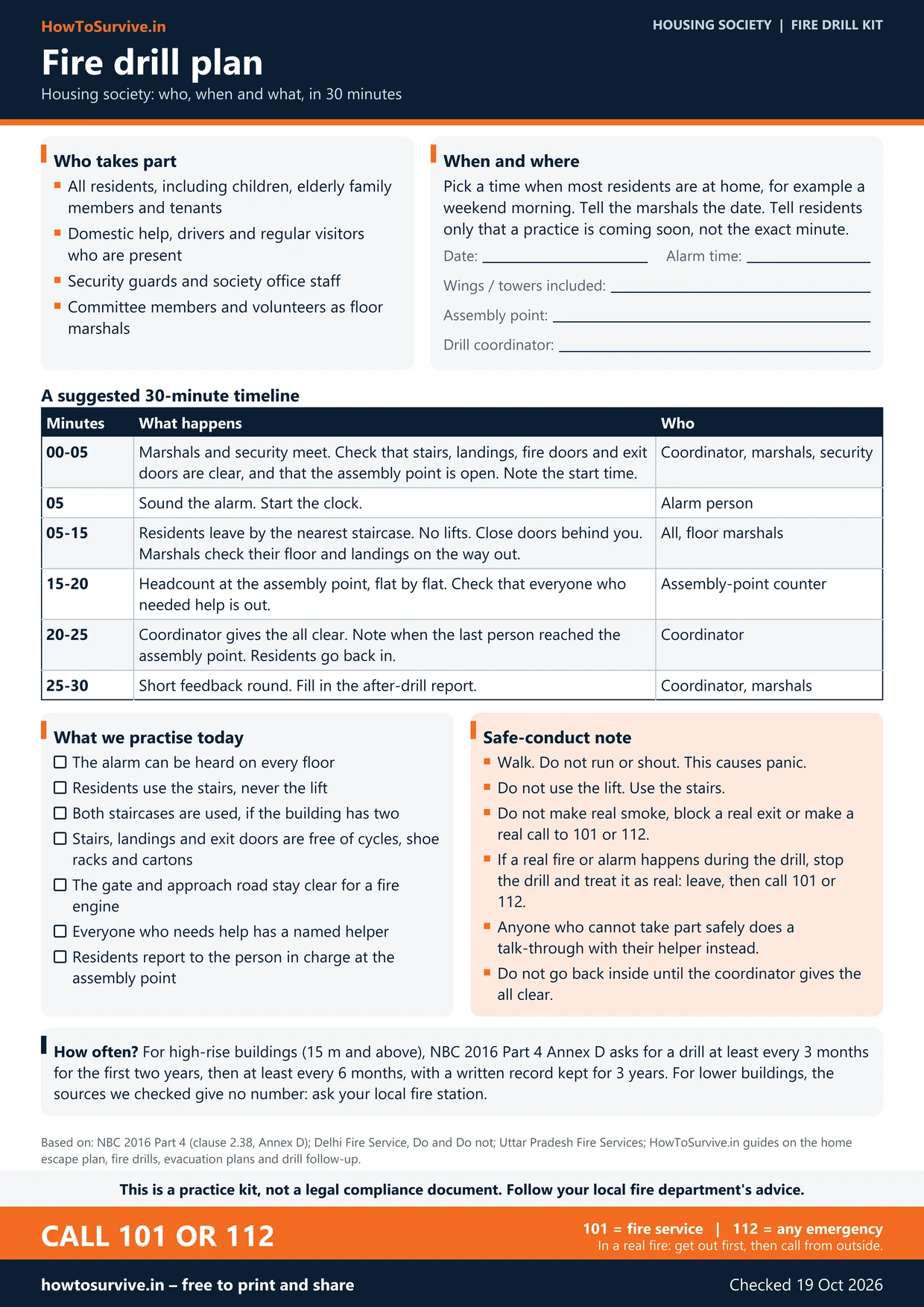
How often? For high-rise buildings (15 m and above), NBC 2016 Part 4 Annex D asks for a drill at least every 3 months for the first two years, then at least every 6 months, with a written record kept for 3 years. For lower buildings, the sources we checked give no number: ask your local fire station. The Code also says that in a high-rise drill, people other than the building's service staff need not leave their floor or use the exits (NBC 2016 Part 4, Annex D, clause D-3.2). This kit asks everyone to leave, because that is better practice for a society.
A practice kit, not a legal compliance document. Follow your local fire department's advice.
The 5 sheets
1
Drill plan
Who takes part, when and what, with a suggested 30-minute timeline and a safe-conduct note.
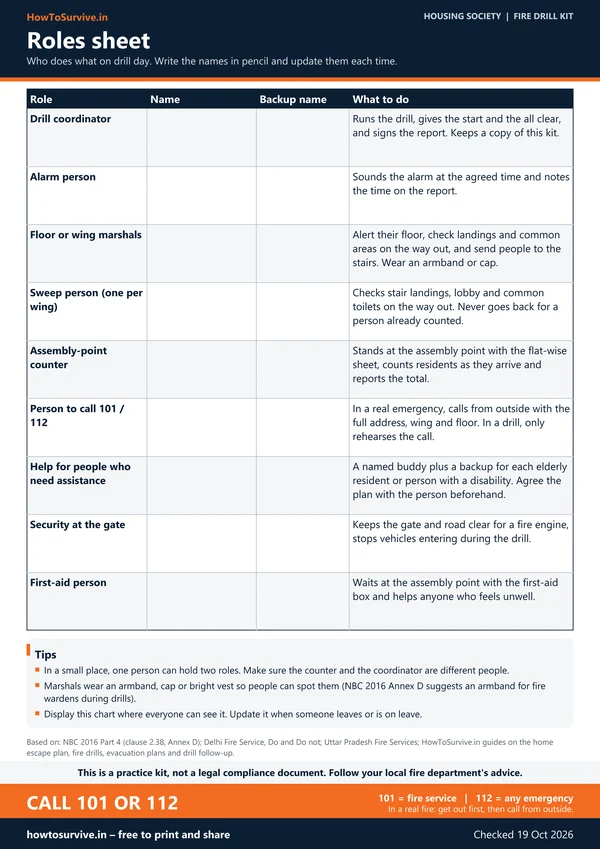
Name a drill coordinator and fill in the roles sheet: floor or wing marshals, an alarm person, an assembly-point counter, someone to call 101 or 112, a first-aid person and a named helper for each resident who needs assistance.
2
Walk the building with the marshals. Check that stairs, landings, fire doors and exit doors are clear, that the gate and road stay open for a fire engine, and choose and mark one assembly point away from the building.
3
Ask your local fire station for advice and tell your security guards. For high-rise buildings (15 m and above) NBC 2016 Part 4 Annex D gives drill frequency and record-keeping guidance; ask what applies to your building.
4
Tell the marshals the date. Tell residents that a practice is coming soon, not the exact minute, so nobody waits at the door with a bag.
5
Sound the alarm and note the time. Residents leave by the nearest staircase: walk, do not run or shout, close doors behind you, and never use the lift.
6
Marshals check their floor and landings on the way out. No real smoke, no blocked real exit, no real call to 101 or 112.
7
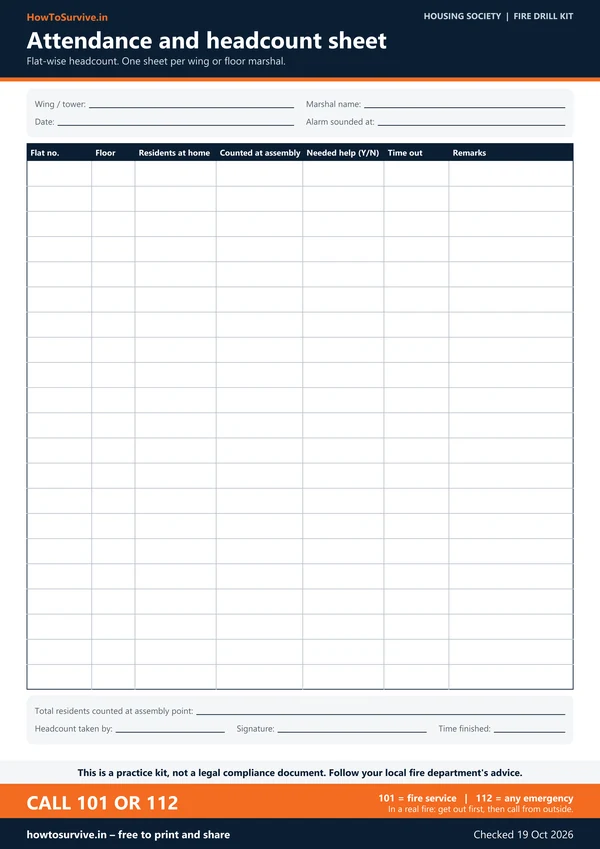
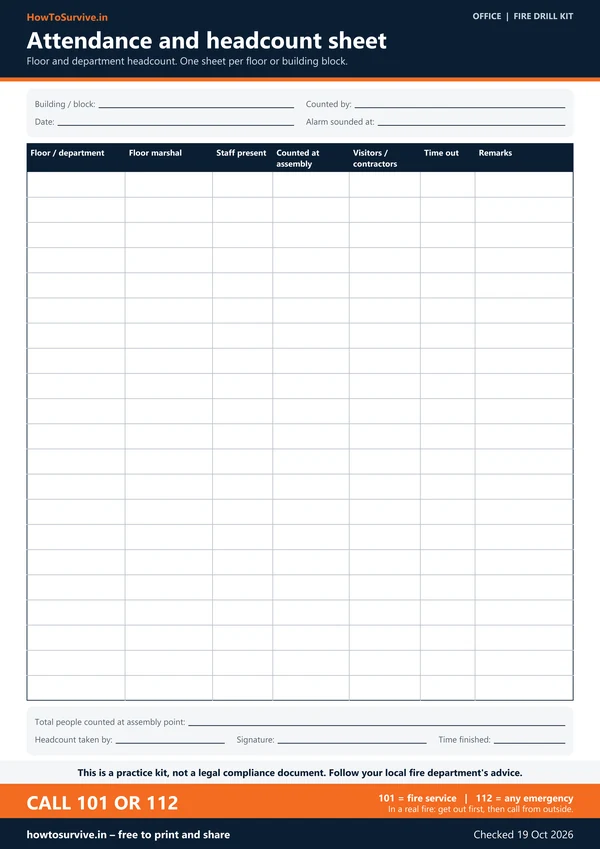
Everyone reports to the person in charge at the assembly point. Count flat by flat on the attendance sheet, check that those who needed help are out, and tell everyone not to go back in until the all clear.
8
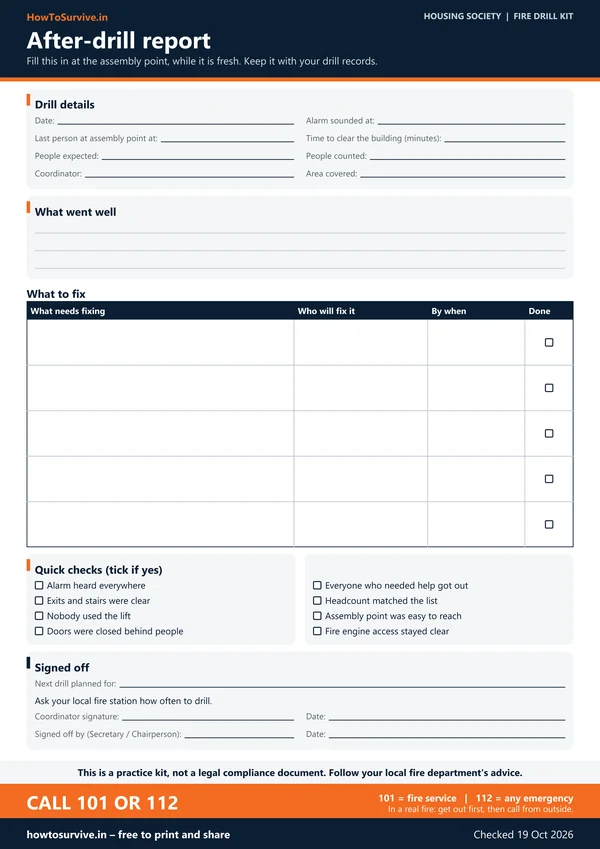
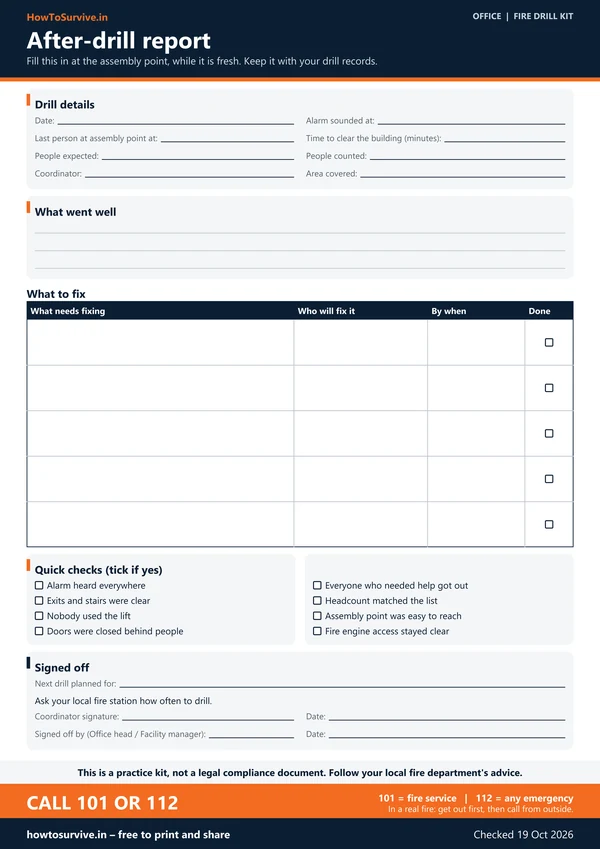
Give the all clear, note when the last person arrived, then fill in the after-drill report: what went well, what to fix, who will fix it and by when. Keep it with your drill records and set the next date.
See the suggested 30-minute timeline
Suggested 30-minute timeline: a practice format, not an official schedule
Minutes
What happens
Who
00-05
Marshals and security meet. Check that stairs, landings, fire doors and exit doors are clear, and that the assembly point is open. Note the start time.
Coordinator, marshals, security
05
Sound the alarm. Start the clock.
Alarm person
05-15
Residents leave by the nearest staircase. No lifts. Close doors behind you. Marshals check their floor and landings on the way out.
All, floor marshals
15-20
Headcount at the assembly point, flat by flat. Check that everyone who needed help is out.
Assembly-point counter
20-25
Coordinator gives the all clear. Note when the last person reached the assembly point. Residents go back in.
Coordinator
25-30
Short feedback round. Fill in the after-drill report.
Coordinator, marshals
Common questions about the housing society kit
How often should a housing society hold a fire drill?
The sources we checked do not give one number for every building. For high-rise buildings (15 m and above), NBC 2016 Part 4 Annex D asks for drills at least every 3 months for the first two years and at least every 6 months after that, with a written record kept for 3 years. For lower buildings, ask your local fire station.
Does running this drill meet a legal requirement?
No. This is a practice kit, not a legal compliance document. What your society must do depends on your state fire law, the building's fire NOC and your local fire department. Follow your local fire department's advice.
Should residents use the lift?
No. Delhi Fire Service says not to use the lift as a means of escape, and NBC 2016 Annex D asks for signs at lift landings reading IN CASE OF FIRE, USE STAIRS UNLESS INSTRUCTED OTHERWISE. Use the stairs.
How do we include elderly residents and people with disabilities?
Agree the plan with the person beforehand and give each of them a named buddy and a backup. NBC 2016 Annex D asks for an updated list of people who cannot use stairs unaided and arrangements to assist them. If someone cannot take part safely, do a talk-through with their helper.
What should we do after the drill?
Fill in the after-drill report while it is fresh, give each fix to a named person with a date, and check it before the next drill. Keep the reports together as your drill record.
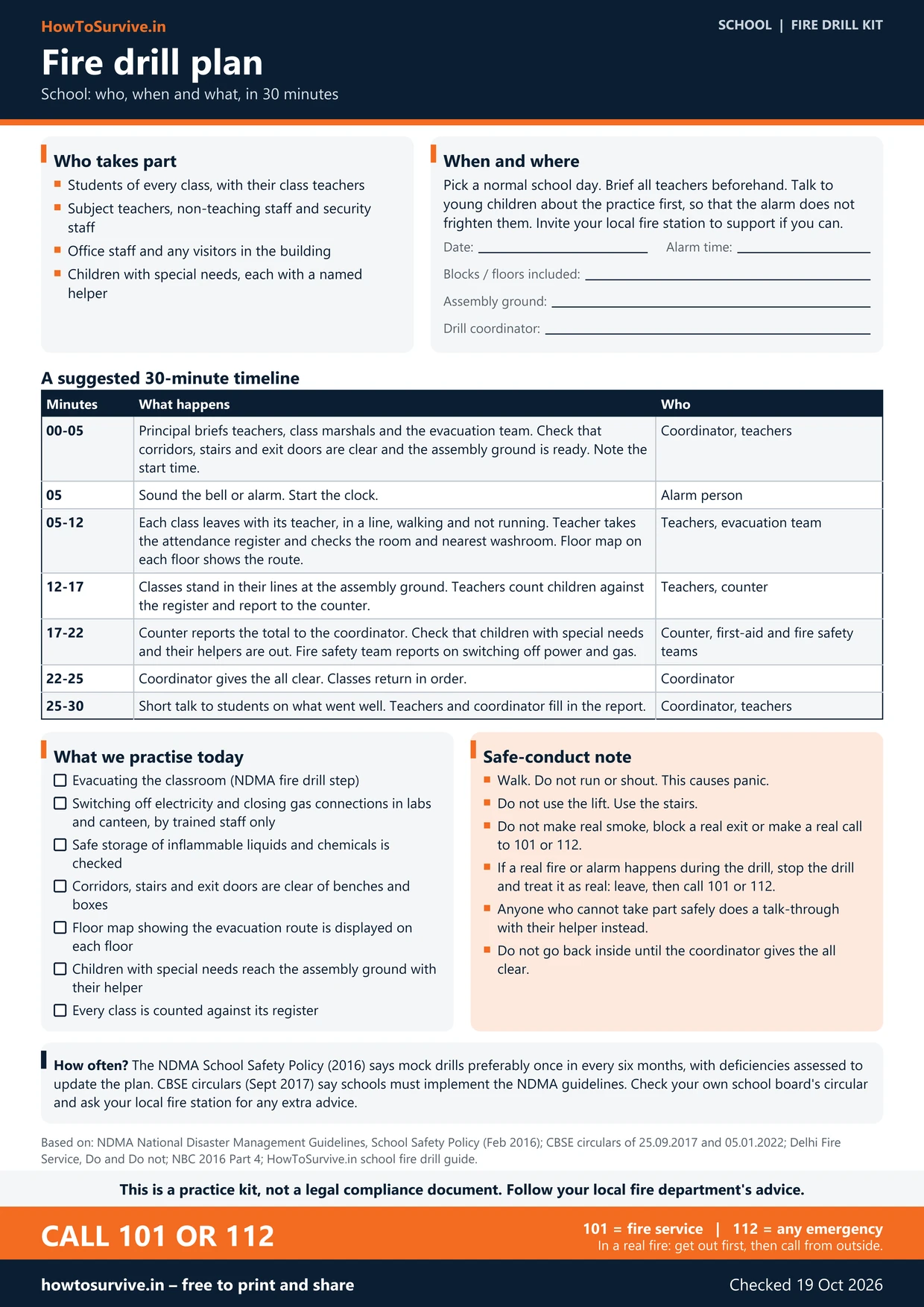
How often? The NDMA School Safety Policy (2016) says mock drills preferably once in every six months, with deficiencies assessed to update the plan. CBSE circulars (Sept 2017) say schools must implement the NDMA guidelines. Check your own school board's circular and ask your local fire station for any extra advice.
A practice kit, not a legal compliance document. Follow your local fire department's advice.
The 5 sheets
1
Drill plan
Who takes part, when and what, with a suggested 30-minute timeline and a safe-conduct note.
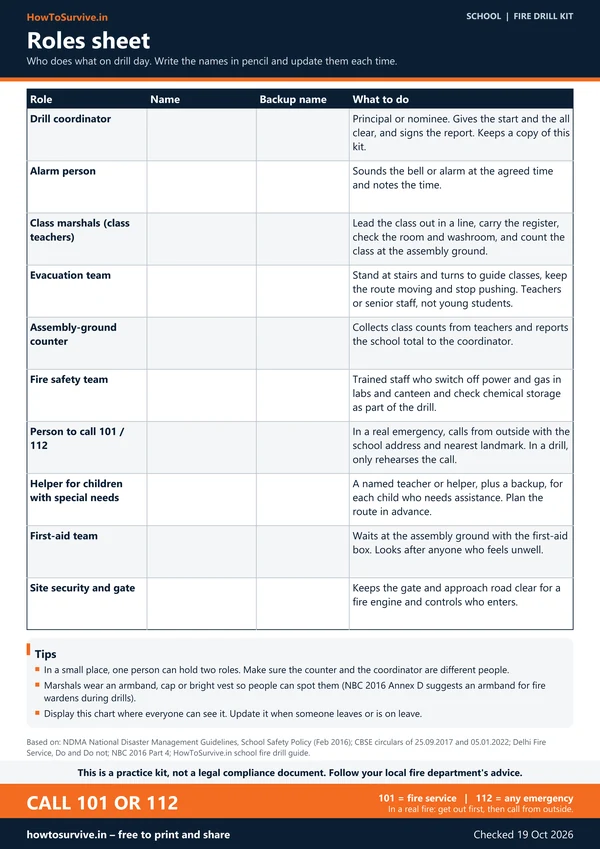
Name a drill coordinator and fill in the roles sheet: class marshals (class teachers), an evacuation team, a fire safety team, a first-aid team, site security and a named helper for each child with special needs.
2
Check the floor-wise evacuation map is displayed on each floor, corridors, stairs and exit doors are clear, and the assembly ground is ready. Invite your local fire station to support if you can.
3
Brief all teachers before the day. Talk to young children about the practice first so the alarm does not frighten them.
4
Sound the bell and note the time. Each class leaves with its teacher in a line, walking and not running. The teacher carries the register and checks the room and nearest washroom.
5
The fire safety team switches off power and gas in labs and the canteen and checks chemical storage, as in the NDMA fire drill steps. No real smoke, no blocked real exit, no real call to 101 or 112.
6
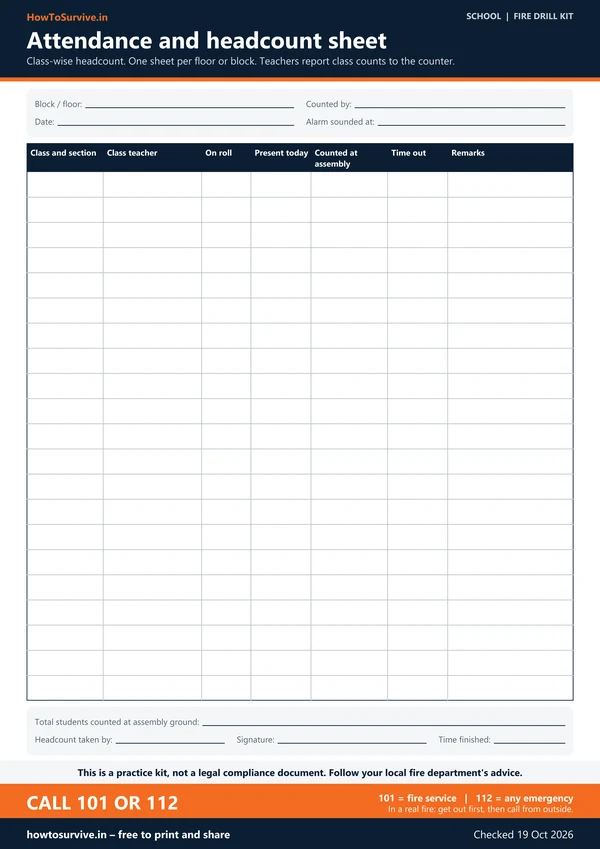
Classes stand in their lines at the assembly ground. Teachers count children against the register and report to the counter, who reports the school total to the coordinator.
7
Check that children with special needs and their helpers are out. Give the all clear and bring classes back in order.
8
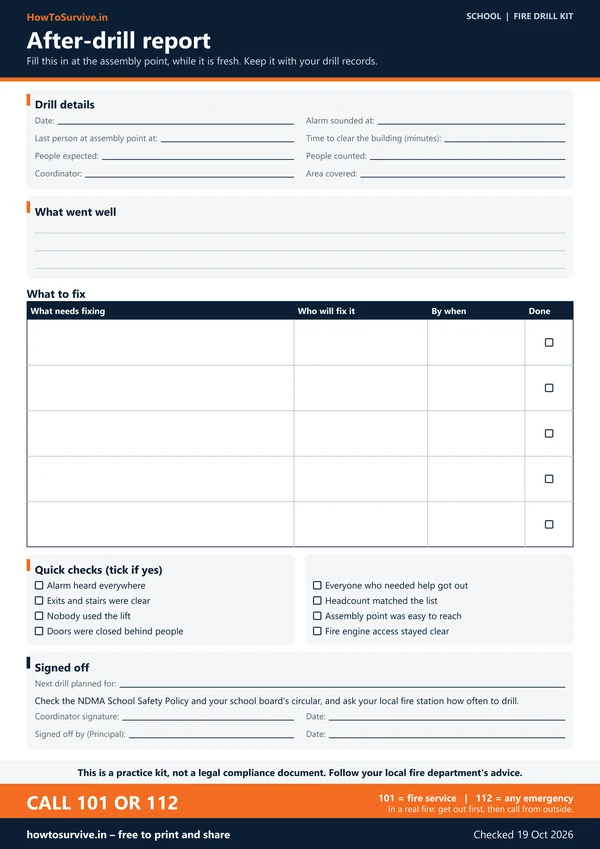
Hold a short talk for students, then fill in the after-drill report: what went well, what to fix, who will fix it and by when. NDMA says to assess deficiencies and update the plan.
See the suggested 30-minute timeline
Suggested 30-minute timeline: a practice format, not an official schedule
Minutes
What happens
Who
00-05
Principal briefs teachers, class marshals and the evacuation team. Check that corridors, stairs and exit doors are clear and the assembly ground is ready. Note the start time.
Coordinator, teachers
05
Sound the bell or alarm. Start the clock.
Alarm person
05-12
Each class leaves with its teacher, in a line, walking and not running. Teacher takes the attendance register and checks the room and nearest washroom. Floor map on each floor shows the route.
Teachers, evacuation team
12-17
Classes stand in their lines at the assembly ground. Teachers count children against the register and report to the counter.
Teachers, counter
17-22
Counter reports the total to the coordinator. Check that children with special needs and their helpers are out. Fire safety team reports on switching off power and gas.
Counter, first-aid and fire safety teams
22-25
Coordinator gives the all clear. Classes return in order.
Coordinator
25-30
Short talk to students on what went well. Teachers and coordinator fill in the report.
Coordinator, teachers
Common questions about the school kit
How often should a school hold a fire drill?
The NDMA School Safety Policy (February 2016) says mock drills may be conducted at periodic intervals, preferably once in every six months, and the deficiencies assessed to update the plan. Also check your own school board's circular and ask your local fire station.
Are CBSE schools required to follow the NDMA guidelines?
A CBSE circular dated 25 September 2017 says it is mandatory for affiliated schools to implement the NDMA School Safety Policy guidelines, and a circular of 26 September 2017 calls them statutory. CBSE Circular 01/2022 says schools must follow fire safety norms and hold valid fire safety certificates. The circulars we read do not set a drill frequency. This kit does not replace those requirements.
Does running this drill meet a legal requirement?
No. This is a practice kit, not a legal compliance document. Follow your local fire department's advice and your school board's circulars.
How do we include children with special needs?
Name a teacher or helper, plus a backup, for each child who needs assistance and plan the route in advance. NDMA's mock drill guidance mentions identifying a task force in advance to help special children. If a child cannot take part safely, do a talk-through with their helper.
What should we do after the drill?
Fill in the after-drill report straight away, give each fix to a named person with a date, and check it before the next drill. NDMA's guidance also asks for follow-up of mock drills in class.
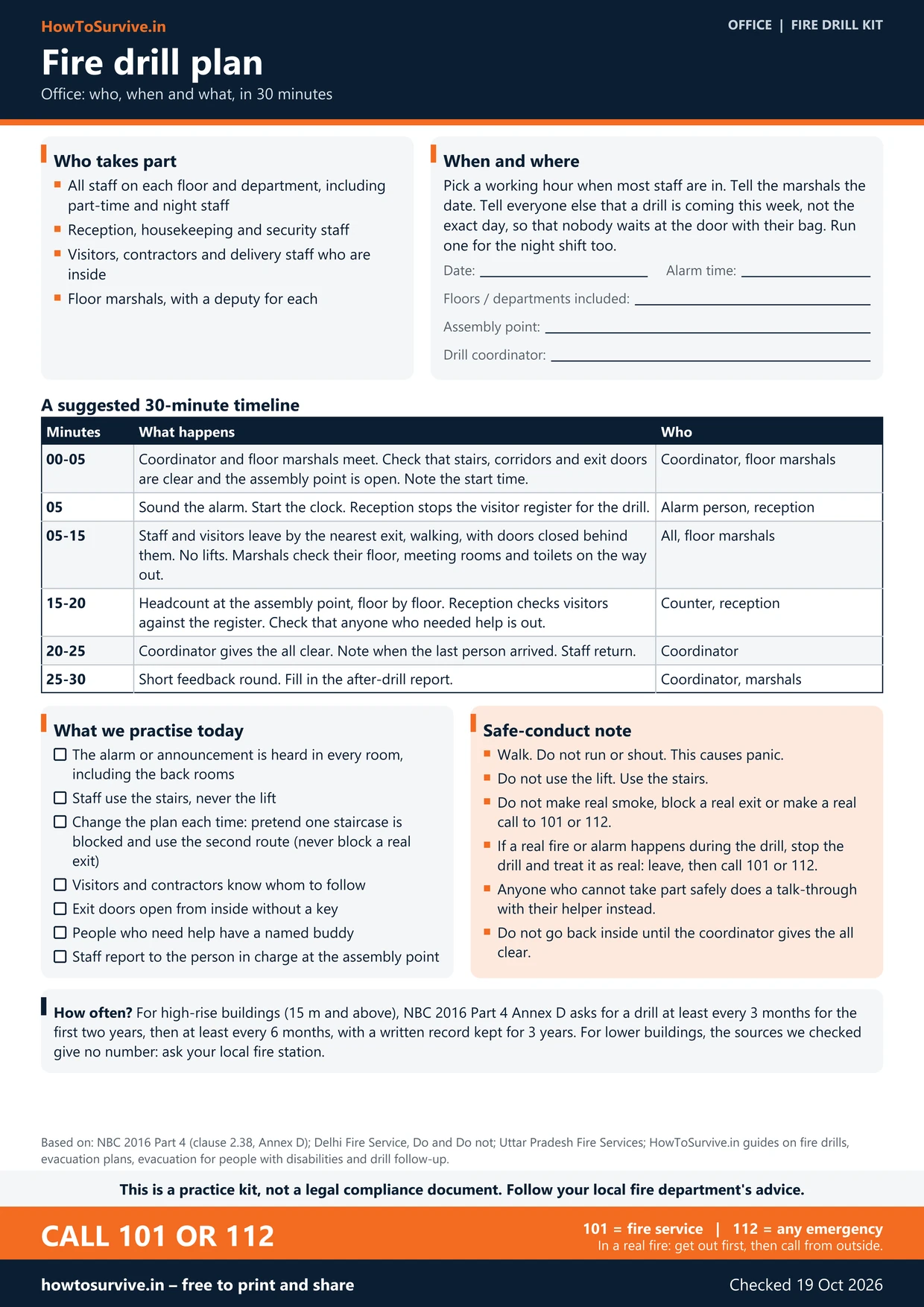
How often? For high-rise buildings (15 m and above), NBC 2016 Part 4 Annex D asks for a drill at least every 3 months for the first two years, then at least every 6 months, with a written record kept for 3 years. For lower buildings, the sources we checked give no number: ask your local fire station.
A practice kit, not a legal compliance document. Follow your local fire department's advice.
The 5 sheets
1
Drill plan
Who takes part, when and what, with a suggested 30-minute timeline and a safe-conduct note.
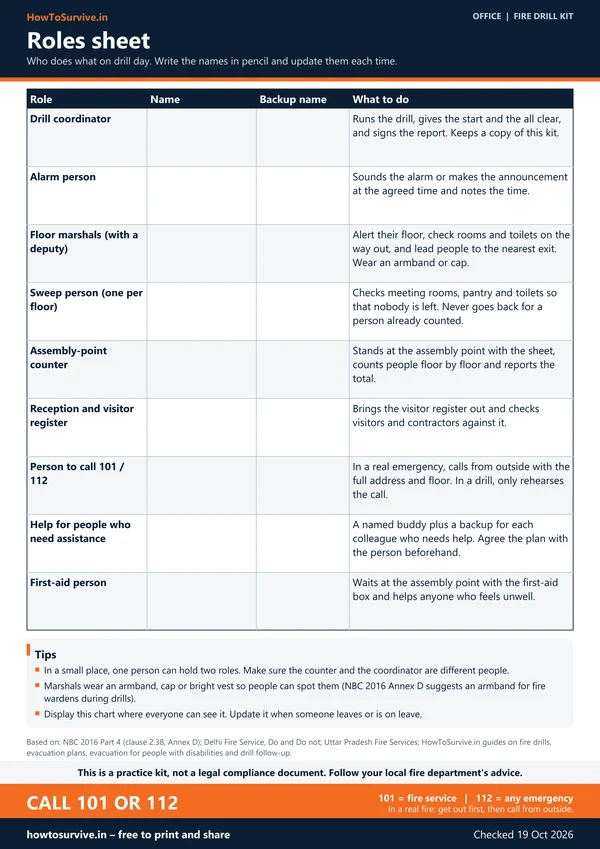
Name a drill coordinator and fill in the roles sheet: floor marshals with a deputy each, an alarm person, an assembly-point counter, reception for the visitor register, someone to call 101 or 112, a first-aid person and a named buddy for each colleague who needs assistance.
2
Walk each floor with the marshals. Check that stairs, corridors and exit doors are clear and open from inside without a key, and choose and mark one assembly point away from the building and out of the fire engine's way.
3
Ask your local fire station for advice. For high-rise buildings (15 m and above) NBC 2016 Part 4 Annex D gives drill frequency and record-keeping guidance; ask what applies to your building.
4
Tell the marshals the date. Tell everyone else that a drill is coming this week, not the exact day. Plan a night-shift drill as well.
5
Sound the alarm and note the time. Staff and visitors leave by the nearest exit: walk, do not run or shout, close doors behind you, and never use the lift. Pretend one staircase is blocked on paper, but never block a real exit.
6
Marshals check their floor, meeting rooms and toilets on the way out. No real smoke and no real call to 101 or 112.
7
Everyone reports to the person in charge at the assembly point. Count floor by floor on the attendance sheet, and let reception check visitors against the register.
8
Give the all clear, note when the last person arrived, then fill in the after-drill report with named fixes and dates. Keep it with your drill records and set the next date.
See the suggested 30-minute timeline
Suggested 30-minute timeline: a practice format, not an official schedule
Minutes
What happens
Who
00-05
Coordinator and floor marshals meet. Check that stairs, corridors and exit doors are clear and the assembly point is open. Note the start time.
Coordinator, floor marshals
05
Sound the alarm. Start the clock. Reception stops the visitor register for the drill.
Alarm person, reception
05-15
Staff and visitors leave by the nearest exit, walking, with doors closed behind them. No lifts. Marshals check their floor, meeting rooms and toilets on the way out.
All, floor marshals
15-20
Headcount at the assembly point, floor by floor. Reception checks visitors against the register. Check that anyone who needed help is out.
Counter, reception
20-25
Coordinator gives the all clear. Note when the last person arrived. Staff return.
Coordinator
25-30
Short feedback round. Fill in the after-drill report.
Coordinator, marshals
Common questions about the office kit
How often should an office hold a fire drill?
The sources we checked do not give one number for every office. For high-rise buildings (15 m and above), NBC 2016 Part 4 Annex D asks for drills at least every 3 months for the first two years and at least every 6 months after that, with a written record kept for 3 years. For lower buildings, ask your local fire station.
Does running this drill meet a legal requirement?
No. This is a practice kit, not a legal compliance document. What your office must do depends on your state fire law, the building's fire NOC and your local fire department. Follow your local fire department's advice.
What about visitors and contractors?
Include them. Reception should bring the visitor register out and check visitors and contractors against it at the assembly point. Tell new visitors whom to follow when the alarm sounds.
Should we run a drill for the night shift?
Yes, if you have one. Our guide on fire drills suggests changing the scenario each time, for example a night-shift drill or a drill with the main staircase pretended to be blocked. Never block a real exit.
What should we do after the drill?
Fill in the after-drill report while it is fresh. Distinguish a confirmed problem from an impression, give each fix to a named person with a review date, and check it before the next drill.
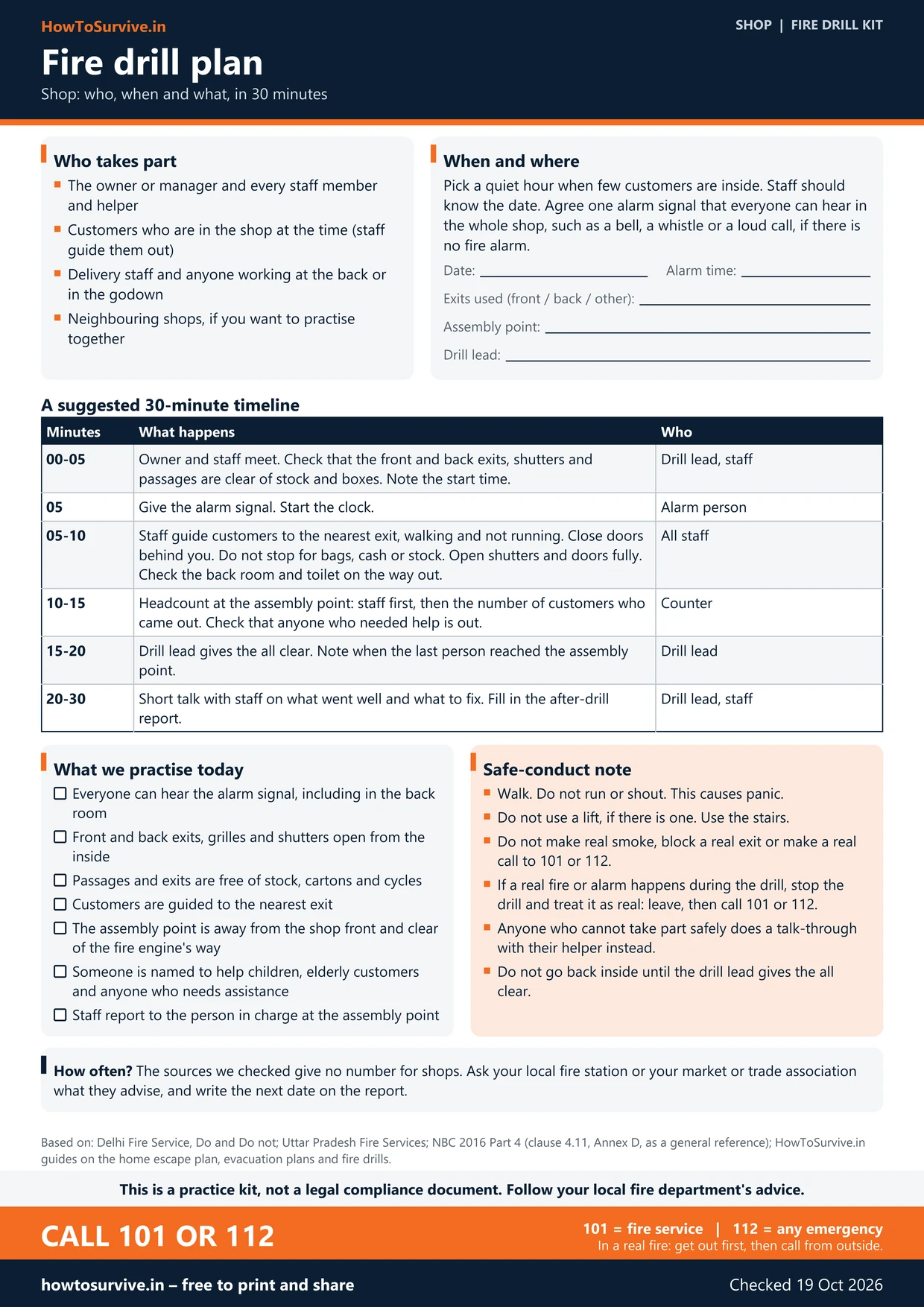
How often? The sources we checked give no number for shops. Ask your local fire station or your market or trade association what they advise, and write the next date on the report.
A practice kit, not a legal compliance document. Follow your local fire department's advice.
The 5 sheets
1
Drill plan
Who takes part, when and what, with a suggested 30-minute timeline and a safe-conduct note.
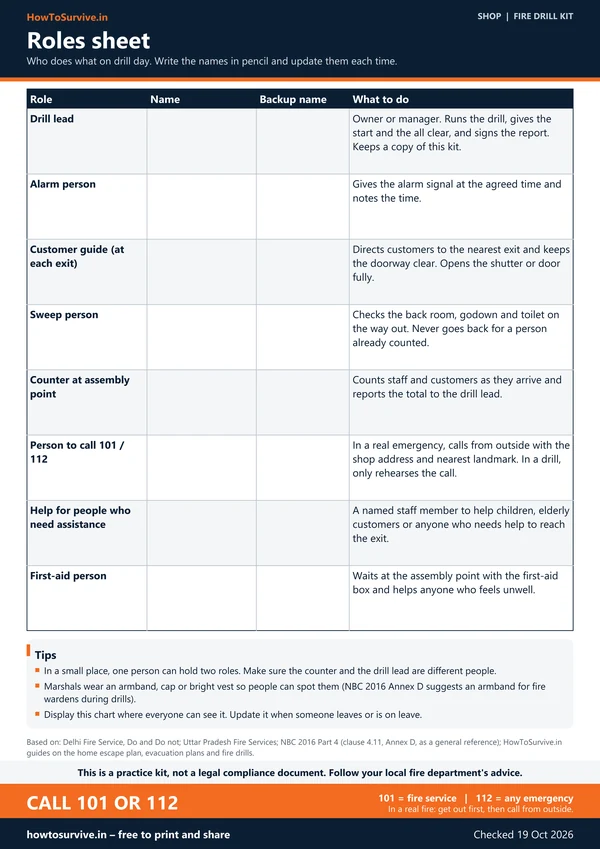
Name a drill lead and fill in the roles sheet: an alarm person, a customer guide at each exit, a sweep person, a counter, someone to call 101 or 112, a first-aid person and a named helper. In a small shop one person can hold two roles.
2
Walk the shop with your staff. Check that the front and back exits, grilles and shutters open from inside, passages are free of stock and cartons, and choose one assembly point away from the shop front and the fire engine's way.
3
Agree one alarm signal that everyone can hear in the whole shop, such as a bell or whistle, if there is no fire alarm. Ask your local fire station for advice.
4
Pick a quiet hour with few customers. Tell your staff the date.
5
Give the alarm signal and note the time. Staff guide customers to the nearest exit: walk, do not run or shout, close doors behind you, and do not stop for bags, cash or stock. Open shutters and doors fully.
6
Check the back room, godown and toilet on the way out. No real smoke, no blocked real exit, no real call to 101 or 112.
7
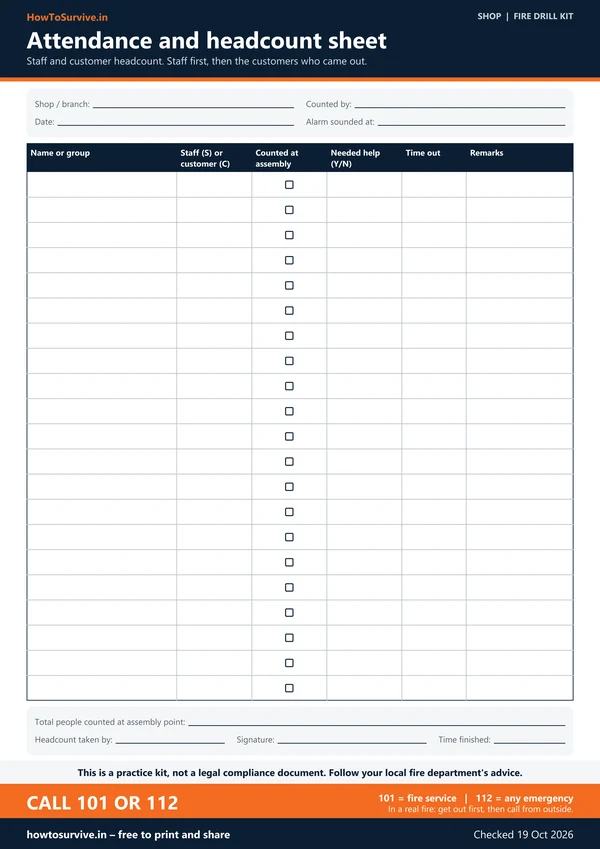
Everyone reports to the person in charge at the assembly point. Count staff first, then the customers who came out, and check that anyone who needed help is out. Tell everyone not to go back in.
8
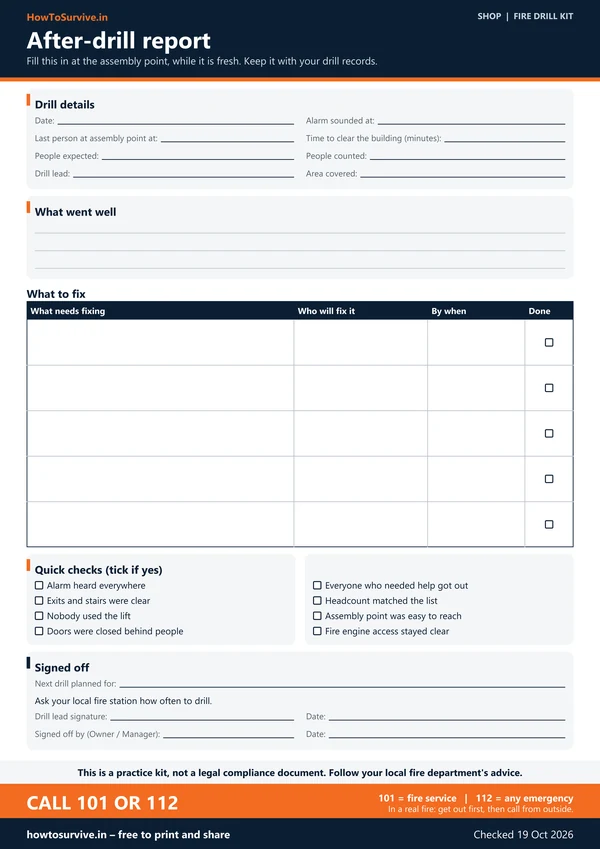
Give the all clear, note when the last person arrived, then fill in the after-drill report with named fixes and dates. Set the next date after asking your local fire station.
See the suggested 30-minute timeline
Suggested 30-minute timeline: a practice format, not an official schedule
Minutes
What happens
Who
00-05
Owner and staff meet. Check that the front and back exits, shutters and passages are clear of stock and boxes. Note the start time.
Drill lead, staff
05
Give the alarm signal. Start the clock.
Alarm person
05-10
Staff guide customers to the nearest exit, walking and not running. Close doors behind you. Do not stop for bags, cash or stock. Open shutters and doors fully. Check the back room and toilet on the way out.
All staff
10-15
Headcount at the assembly point: staff first, then the number of customers who came out. Check that anyone who needed help is out.
Counter
15-20
Drill lead gives the all clear. Note when the last person reached the assembly point.
Drill lead
20-30
Short talk with staff on what went well and what to fix. Fill in the after-drill report.
Drill lead, staff
Common questions about the shop kit
How often should a shop hold a fire drill?
The sources we checked give no number for shops. Ask your local fire station or your market or trade association what they advise, and write the next date on the report.
Does running this drill meet a legal requirement?
No. This is a practice kit, not a legal compliance document. What your shop must do depends on your state fire law, any fire NOC and your local fire department. Follow your local fire department's advice.
We have no fire alarm. What do we use?
Agree one clear signal that everyone in the shop can hear, such as a bell, a whistle or a loud call. Our evacuation plan guide lists a hand bell among the ways to warn people. Test that it can be heard in the back room.
What do we do about customers?
Assign a staff member at each exit to guide customers to the nearest exit and keep the doorway clear. Count staff first, then the number of customers who came out. Do not ask customers to stay for the drill; pick a quiet hour.
What if there is a real fire during the drill?
Stop the drill and treat it as real. Get everyone out, do not go back in, and call 101 or 112 from outside. NBC 2016 Annex D says anyone discovering fire, heat or smoke should report it to the fire brigade immediately.
Assembly point sheets
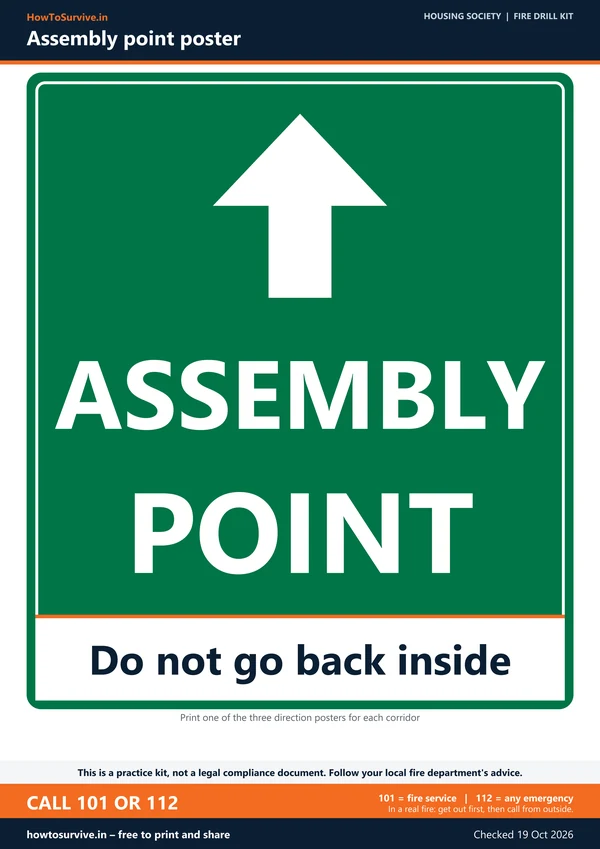
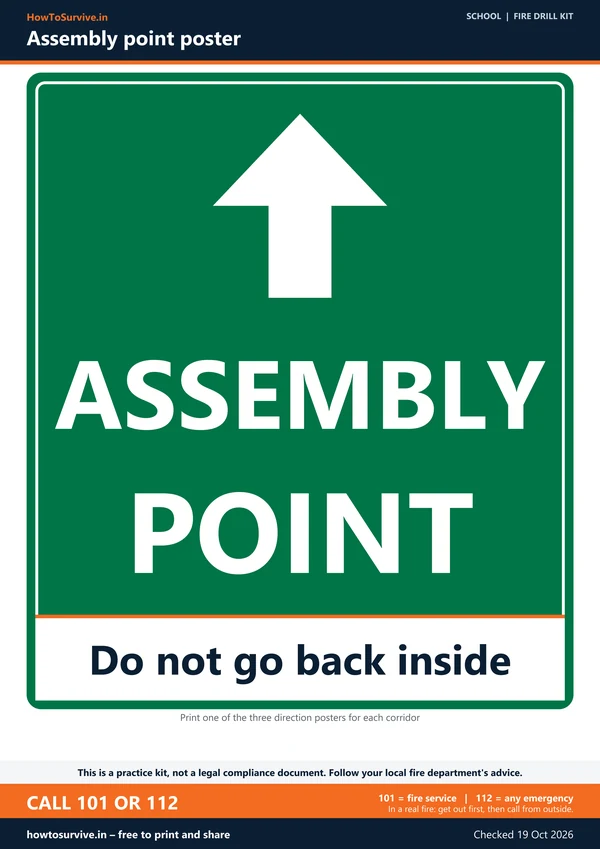
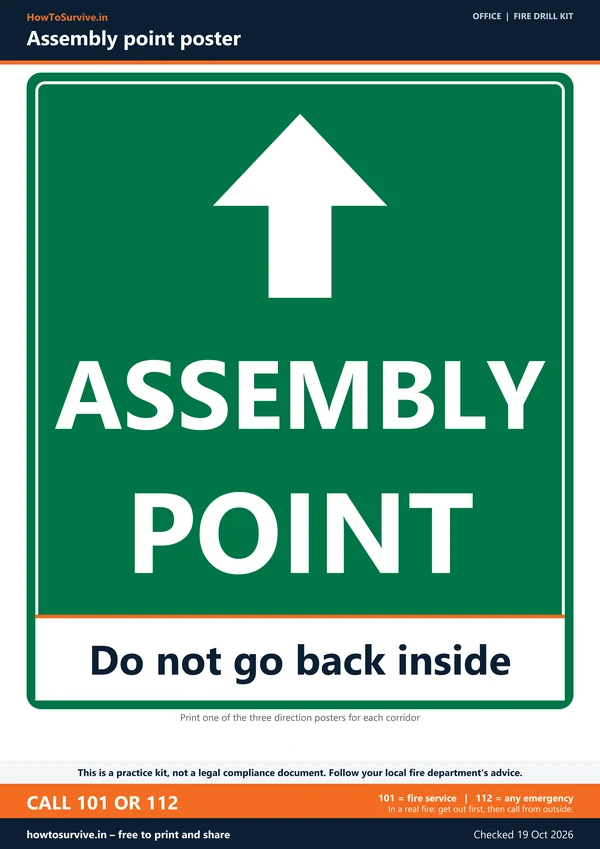
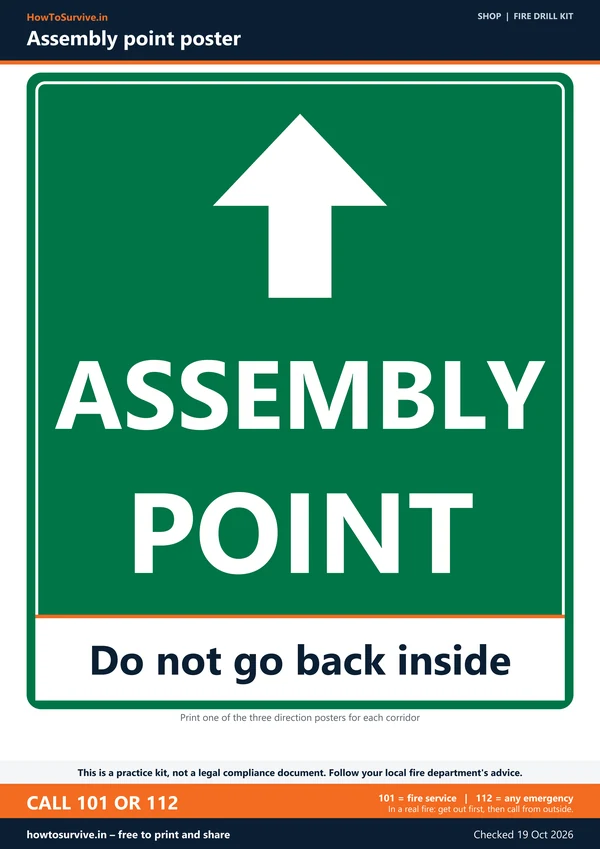
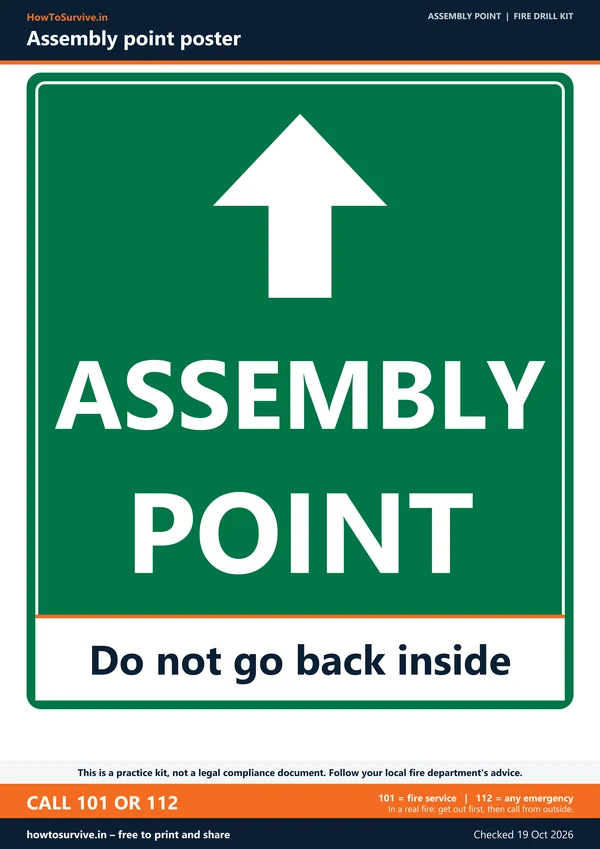
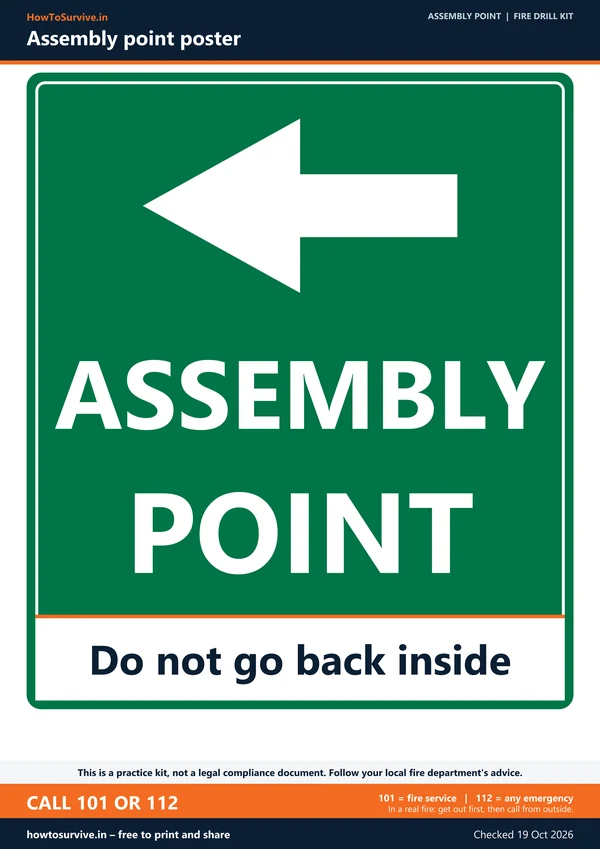
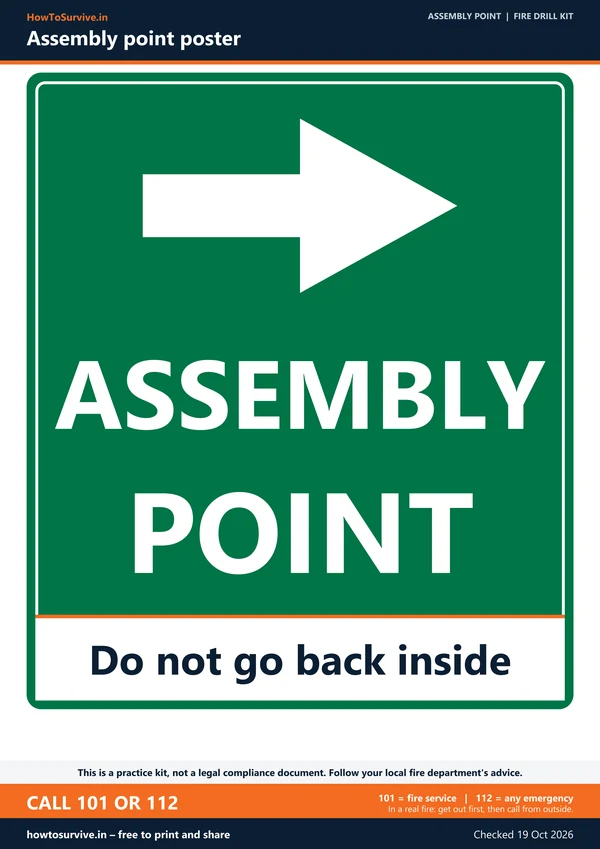
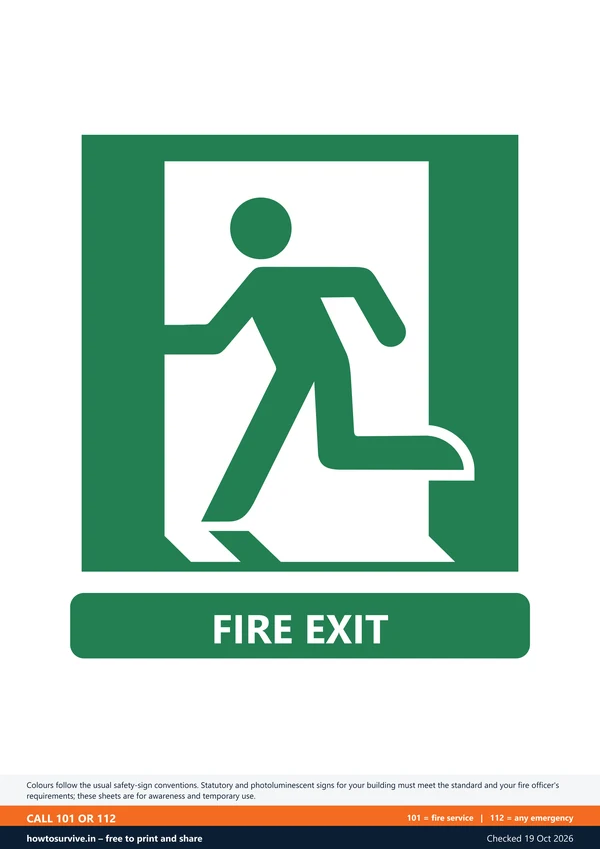
Print one of the three direction sheets for each corridor. The in-kit sheet shows the standard E007 sign only, with no words and no arrow. The assembly point sheets below add a plain green arrow (up, left or right) in a separate white panel below the sign; print one for each corridor.
Assembly point sheet, arrow up
The standard E007 sign, unaltered, with a separate white panel below it holding a plain green arrow pointing up. No words on the sign.
Single sheets to print and put up. Each is A4 unless it says otherwise. They are guides, not legal compliance documents; follow your local fire department's advice.
Extinguishers and fire basics
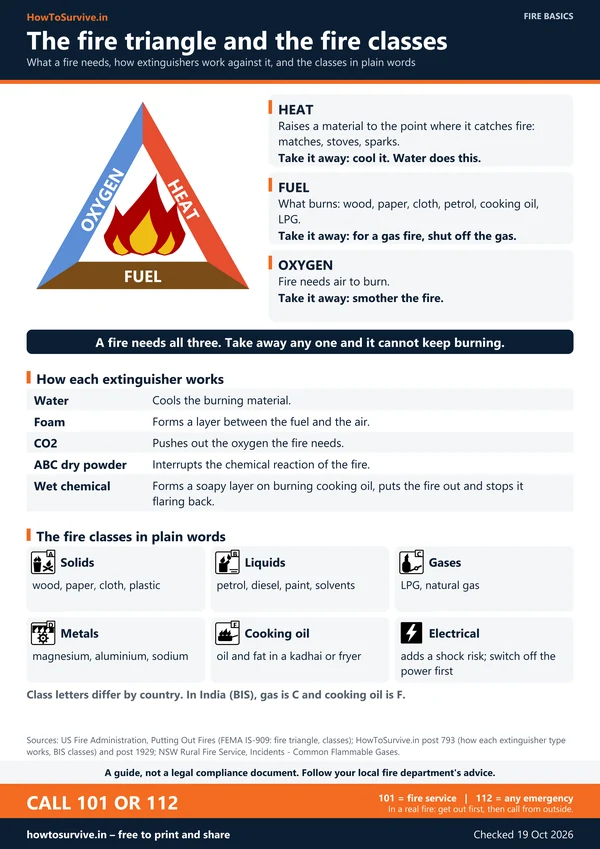
How fire works, which extinguisher to use and how to use it.
Fire extinguisher types and uses chart
Which extinguisher suits which class of fire, where to use it and where never to, The class symbols on this chart are indicative drawings in the style of IS 15683, not copies of the standard's symbols, and the colour zones shown are the UK and European ones. Always read the class marking on your own extinguisher.
How to prevent kitchen fires and what to do when cooking oil catches fire: do not move the pan, never throw water, switch off the heat only if it is safe, and leave and call if the fire is not small.
The nine GHS hazard pictograms with their names and meanings, plus basics on labels, storage, mixing, ventilation, protective equipment, spills and exposure.
A log for extinguishers, alarms and call points, emergency lights, exits and hose reels, with blank date, location, status, remarks and initials columns.
A before, during and after checklist for floor wardens and marshals, built from the NBC Annex D warden duties (written for high-rise buildings) and our drill kit roles.
A practical fire safety guide for homes, shops and offices
An 8-page A4 booklet: how fires start, prevention, smoke alarms, extinguishers, escape plan, drills, what to do in a fire, cooking oil, LPG and electrical safety, burns first aid and emergency numbers.
Each line in the kit comes from an official source we read, from one of our own published guides, or is our own practice format. Last checked 19 October 2026.
Our own guides, which are editorial guidance and not official rules: the escape plan, the evacuation plan, how to run a drill, helping people with disabilities, school drills, high-rise norms and the after-drill follow-up.
Drill frequency. We found a number only for high-rise buildings (NBC Annex D) and for schools (NDMA, "preferably once in every six months"). For societies, offices and shops below 15 m, and for shops generally, no number was found, so the kit says to ask your local fire station.
State rules. No official Maharashtra or Karnataka page on fire drills was found, so nothing from those states is used. Delhi and Uttar Pradesh fire services are used for general guidance; neither gives a frequency.
NBC Annex D is written for high-rise buildings. We have not checked whether your state or city has adopted it, and the kit never says that a drill satisfies a legal requirement.
The NBC copy is a 2016 licensed copy hosted by a municipal body. A draft fourth revision of Part 4 (November 2024) exists and we did not read it, so requirements may change.
CBSE circulars confirm the NDMA guidelines bind affiliated schools but set no drill frequency. Other boards were not checked.
The all-emergency number 112 comes from our own guides; it was not re-checked on a government page in this pass.
What is our own design
Our own practice format, not from any source: the 30-minute timeline and minute splits, the role names and what-to-do lines, the attendance and report layouts, the quick-check tick list and the safe-conduct note.
This is a practice kit, not a legal compliance document. Follow your local fire department's advice. Last checked 19 October 2026.