
How fire-safe is our housing society?
A walk-round checklist for your committee. Answer yes or no, and get a score out of 100, the five fixes to make first and a one-page report you can put on the notice board.
Most of the fixes that matter in a society cost little. A staircase full of shoe racks, a terrace door locked "for safety", an extinguisher whose tag nobody has read in years: these turn up on a walk-round, not in a laboratory. This check takes your committee through the building once, with a guard, and shows where to start.
It is a self-check, not an audit. It cannot tell you whether your building meets your state's fire law, and a good score is not a fire NOC. It tells you what the people who live there can see for themselves.
- About 25 minutes
- Up to 46 checks, only those that fit your building
- Saved only on this device, not sent to us
Housing society fire safety check
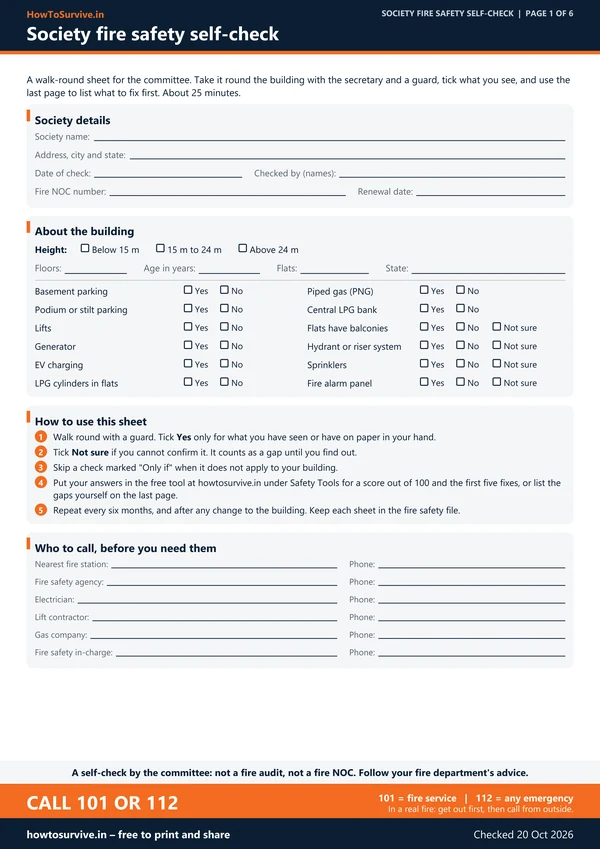
Printable walk-round form
How the score worksPoints, bands and the critical checks
Each check carries points, from 1 to 10, with more points for the things that matter most in a fire, such as clear stairs, unlocked exit doors and a working alarm. Yes earns the points. No and Not sure earn none. Checks that do not apply to your building are left out. For the fire NOC check, and for Form B where it is asked, you can choose "Not required for our building (fire office said so in writing)": that counts as Yes and leaves out the renewal-date check, and it only records what the fire office told you. The points were set by HowToSurvive.in from the National Building Code 2016 Part 4 and our own guidance. They have not been reviewed by a fire officer and are not an official rating.
If any check marked as critical for your building is answered No or Not sure, or counts as No because a required system is missing, the band cannot be higher than 'Needs work', whatever the score.
Bands
- Urgent attention, 0 to 39. Several basics are missing. Start with the first three fixes this week and tell the whole committee.
- Needs work, 40 to 69. You have some protection in place and several gaps to close. Work down the fix list, starting with the first item.
- Mostly in place, 70 to 89. Most checks are in place. Close the last gaps and keep the records current.
- Nearly all checks answered Yes, 90 to 100. Nearly every check is in place. Keep the records, repeat the drills and check again after any change to the building. This is a self-check by your own committee, not a certificate.
How we know
The checks follow the National Building Code 2016 Part 4 and the fire rules of Maharashtra, Gujarat and Delhi that we read; other states differ. Last checked 20 October 2026.
Read the guides behind this tool
- Community Emergency Preparedness: How Your Society or Colony Can Get Ready
- Undri High-Rise Fire: A Teen’s Death, a Shut Door, and a Society That Fought Flames Together
- High-Rise Fire Safety Norms in India: What NBC 2016 Requires
- High-Rise Fire Safety: What Residents and Office Workers Should Do
- Fire NOC in India: How It Works, Common Loopholes and What You Can Check
- Fire Extinguisher Types in India: Which One Works on Which Fire
- How to Run an Effective Fire Drill at Work, School and Home
- How to Make an Emergency Evacuation Plan That Actually Works
Common questions
Is this a fire audit or a fire NOC?
No. It is a self-check by your own committee. A fire NOC or fire safety certificate comes from your state's fire service or a licensed agency. A good score here does not replace either.
Does our society need a fire NOC?
It depends on your state and the height of the building. The National Building Code 2016 treats a building of 15 m or above as high-rise. In Gujarat the state portal says a residential building above 15 m needs a certificate. In Delhi a residential Fire Safety Certificate is valid for five years. In Maharashtra a licensed agency issues Form B twice a year. Other states differ, so ask your state fire service.
How often should a society hold a fire drill?
For high-rise buildings the National Building Code's drill guidelines say every three months in the first two years and then at least every six months. For a building under 15 m, we suggest at least twice a year. Our drill kit has the sheets.
What does "Not sure" do to the score?
It earns no points, the same as No, because a step you cannot confirm cannot be counted on. Find out, then take the check again.
Why does my band say "Needs work" when my score is high?
A few checks are critical: stairs kept clear, exit doors not locked, a working alarm and fire pumps in a high-rise, and a clear route for the fire engine. If one of them is not confirmed as Yes, the band cannot go higher, however good the rest is.
Who should take this check?
The secretary and one or two committee members, with a security guard, walking the building: ground floor, a middle floor, the top floor, terrace, meter room, pump room and basement.
Are my answers saved?
Yes, on your own phone or computer only, so a walk-round is not lost if you press Back or the page reloads. The answers are kept in this browser and are never sent to us. A Saved note is shown, and the Clear saved answers button deletes them. They are removed automatically after 60 days. We count visits with Google Analytics, and the page translator is Google's, so do not type names while it is on.
More free safety tools
- Fire drill kitPrintable plan, roles sheet, assembly point sheet, attendance sheet and report for a housing society, school, office or shop.
- Which fire extinguisher?Pick what is burning and where. Get the right extinguisher type, what never to use, and when to leave instead.
- Home Fire Safety ScoreTwelve yes or no questions. Get a score out of 100 and the three things to fix first.
- All Safety ToolsThe full list in one place.
- City Safety GuidesFire brigade numbers and stations, city by city.
These tools are for awareness. They do not replace a fire audit, an electrician's visit, medical advice or a call to the emergency services. In an emergency, call 112.