
How To SurviveLife-Safety Intelligence for India
Language
Automatic translation
Home / Safety Blogs / 🌊 Myths Around Flood Safety (Cars in Floodwater & More)
Safety Blog · Ready For Review

🌊 Myths Around Flood Safety (Cars in Floodwater & More)

🌊 Myths Around Flood Safety (Cars in Floodwater & More) uses a rescuer-safe approach: call 112, reach or throw from safety, avoid hazardous water entry and provide trained CPR after recovery when breathing is abnormal.

TopicDisaster Preparedness · First AidUpdated2026-09-16
01
The guide
🌊 Myths Around Flood Safety (Cars in Floodwater & More)

⚠️ The Myth

“Water up to the tyre? I can drive through.”
“Floods rise slowly — I’ll have time to escape.”
“Strong swimmers can always survive floods.”

These myths cost hundreds of lives in India every monsoon.
Floods don’t look dangerous — until it’s too late.

“Most flood deaths don’t happen in rivers — they happen on roads.”


✅ The Fact

Even 6 inches of moving water can knock a person off their feet,
and 12 inches (1 foot) can sweep away a small car.
Floods are not about depth — they’re about force and velocity.


📊 Flood Fatalities & Vehicle-Linked Deaths (India 2019–2025)

YearTotal Flood DeathsVehicle-Linked Deaths% of Total
20191,83041222.5%
20201,59036623%
20211,76041123%
20222,05047823.3%
20232,33055523.8%
20242,62060122.9%
2025 (till Aug)1,48032121.7%

(Sources: NDMA Flood Mortality Review 2025, IMD Monsoon Data)

📈 Nearly 1 in 4 flood deaths in India involve vehicles caught in rising water.


🚫 Common Flood Myths vs Life-Saving Facts

MythReality
“My car is heavy; it won’t float.”Even SUVs can lose traction in 2 feet of water. Water weighs 1,000 kg/m³ — more than most cars.
“Water looks calm, so it’s safe.”Flash floods move with invisible undercurrents that can pull entire vehicles.
“I can see the road; I’ll drive slowly.”Floodwater hides open manholes, sharp debris, and live electrical wires.
“I can swim through it.”Floods carry mud, sewage, and chemicals — survival rate <10% once swept.
“It won’t reach my area.”Cities like Delhi, Bengaluru, and Chennai flood every year due to blocked drains, not rivers.

🧠 Case Study: Bengaluru Tech Park Flood (2022)

  • Dozens of employees trapped in basement parking after trying to move vehicles.
  • Floodwaters rose within 8 minutes, blocking exits.
  • 3 fatalities — all from asphyxiation in sealed cars.
  • Lesson: In floods, property can be replaced — people can’t.

🧭 What To Do (Practical Survival Tips)

Turn Around, Don’t Drown: Never drive through moving or unknown-depth water.
Abandon your car immediately if water enters and rises above the tyres.
Move to higher ground — even a few feet makes a difference.
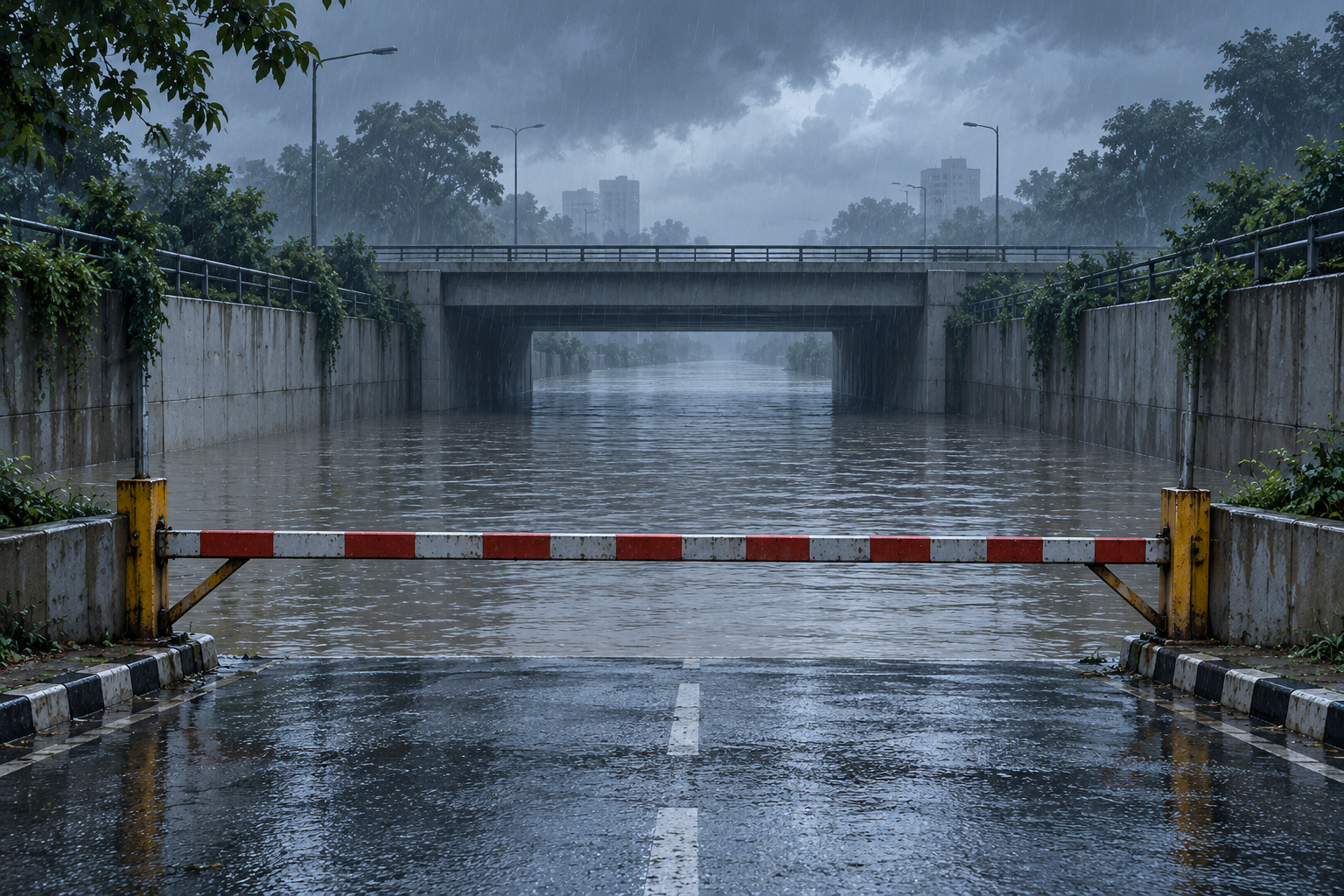
Avoid basements, underpasses, and subways.
Disconnect electricity and move valuables upward at home before flood season.
Carry flood essentials: torch, power bank, first aid, dry food, rope, ID copies.


⚙️ Prevention Measures

1️⃣ Cities must install stormwater drain sensors and public flood alert sirens.
2️⃣ Strict zoning laws to prevent construction in floodplains.
3️⃣ Community flood-awareness programs in every monsoon-prone district.
4️⃣ Digital flood alert SMS for all citizens via IMD + NDMA integration.


📢 Systemic Lessons

Floods aren’t unpredictable — ignorance is.
The line between inconvenience and disaster is usually a few minutes of bad judgment.


📣 Call to Action

🌧️ During floods — never underestimate water.
👉 Share this truth: “Turn Around, Don’t Drown.”
Your awareness might save a stranger — or someone you love.


📎 References

  • NDMA “Flood Preparedness and Response Framework,” 2025
  • IMD “Extreme Rainfall Events Data,” 2024
  • NDRF “Flood Rescue Operation Reports,” 2023
  • WHO “Urban Flood Risk and Mortality Analysis,” 2024

🔚 Closing Line

Floods don’t wait for warnings — they punish assumptions.
This is why we built HowToSurvive.in — to replace overconfidence with awareness, and myths with mindful survival.

What needs attention

  • The article topic must be linked to the actual occupancy and hazard
  • Prevention and early warning provide more safety margin than last-second intervention
  • Equipment is effective only when correctly selected, accessible and maintained
  • People need short practised actions and a clear decision to stop and escape
  • Children, visitors and people needing assistance require explicit planning
  • Records, drills and inspections matter only when defects are corrected

Controls that reduce risk

  1. Complete a task- and site-specific hazard assessment
  2. Verify applicable Indian, state and local requirements
  3. Use competent inspection for installed systems and specialist hazards
  4. Keep alarms, exits, signs and emergency access usable
  5. Train intended users and practise evacuation
  6. Record defects with an owner and completion date
  7. Review the plan after changes, incidents or near misses

Common unsafe practices

  • Relying on equipment without a hazard assessment
  • Blocking or compromising escape routes
  • Delaying the alarm or emergency call
  • Attempting a response beyond training or safe conditions
  • Re-entering before authorised clearance
  • Treating a checklist as a substitute for competent inspection
02
Watch & learn

Related Videos

Captions
Related learning — external video page

Stay safe during a flood — video PSA

US Centers for Disease Control and Prevention · English

Floodwater drowning-risk awareness. This short PSA does not teach drinking-water treatment or certify a building safe for return. Source page checked 19 September 2026. Open on publisher website; embedded playback not verified.

03
Facts & action

Evidence, Cases & Next Steps

112Emergency number
Reach or throw from safety; do not enter hazardous water without training and equipmentRescuer priority
Avoid walking or driving through moving waterFloodwater
112Emergency number
Reach or throw from safety; do not enter hazardous water without training and equipmentRescuer priority
Avoid walking or driving through moving waterFloodwater
Start CPR if trained and use an AED when availableRecovered person not breathing normally
Current, depth, contamination and submerged hazards are often invisibleEvidence boundary

What the evidence supports

  • Emergency number | 112
  • Rescuer priority | Reach or throw from safety; do not enter hazardous water without training and equipment
  • Floodwater | Avoid walking or driving through moving water
  • Recovered person not breathing normally | Start CPR if trained and use an AED when available
  • Evidence boundary | Current, depth, contamination and submerged hazards are often invisible

Immediate prevention actions

  1. Save 112 and display the full address
  2. Identify two usable escape routes where possible
  3. Remove one obstruction or unsafe condition
  4. Check the relevant alarm, PPE or safety equipment
  5. Assign assistance for children, older people and people with disabilities
  6. Schedule the next drill, service or competent inspection

Emergency survival steps

  1. Raise the alarm and warn others
  2. Move away from smoke, fire, traffic, electricity or another immediate hazard
  3. Use the safest available exit and do not use lifts during an ordinary building fire
  4. Call 112 from a safe place with the full address and hazard details
  5. Assist others only within your capability and without losing your own escape
  6. Do not re-enter until the responsible authority gives clearance

Limitations

  • Requirements vary by occupancy, state, local authority, equipment, hazard and user capability. Existing article images are retained as editorial assets but their original reuse rights and captions require confirmation. Videos supplement—not replace—hands-on training or competent advice.
Community discussion

Questions, experience and constructive safety discussion

Comments publish immediately unless security controls identify spam. Please do not post private information, unsupported allegations or unsafe instructions.

Leave a comment

* Name and email are required. Your email address will not be published.


The reCAPTCHA verification period has expired. Please reload the page.