
Quick answers
How can I protect my family from a house fire?
Put up a smoke alarm outside the bedrooms and test it every month, know two ways out of your building, look after the gas and wiring, and do a short family fire drill every three months.
Which emergency numbers should I save for a fire at home?
Save 101 for the fire brigade, 108 for an ambulance and 112 for all emergencies. Call from a safe place and give the full address and what is burning.
Is a building with a Fire NOC completely safe from fire?
No. Fires still happen in NOC-approved buildings. Working alarms, clear exits and trained staff are what save lives, and they must be kept in order.
What causes fires in Indian homes?
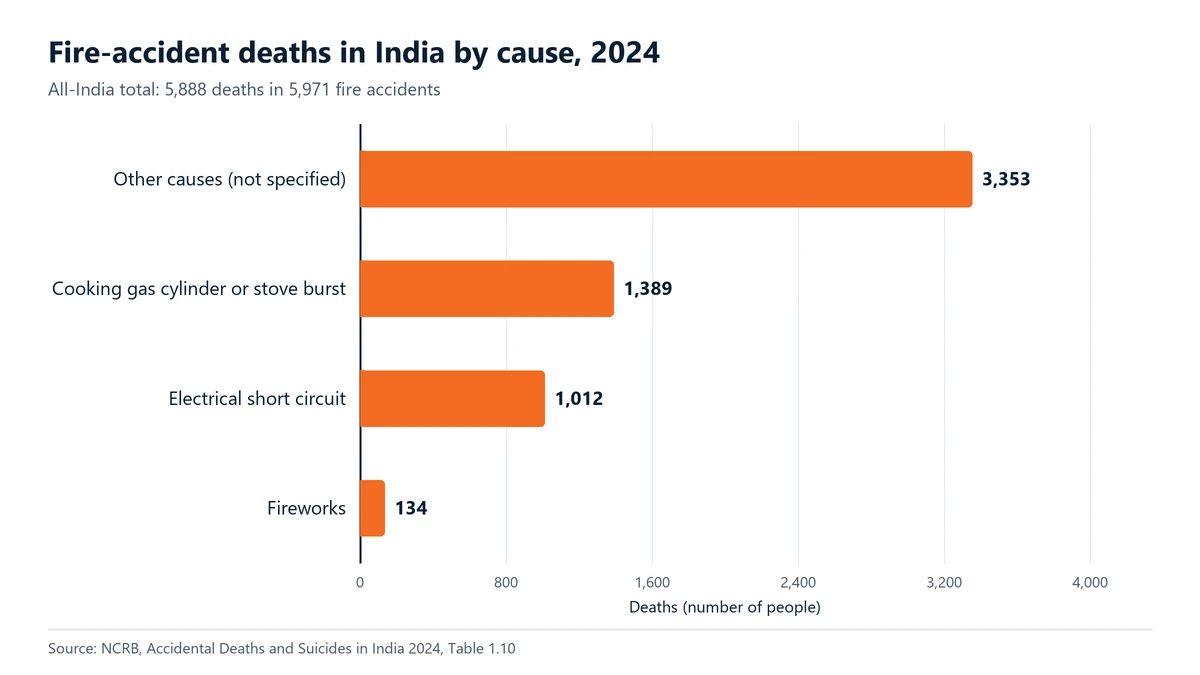
Cooking gas cylinder or stove bursts and electrical short circuits were the two biggest named causes of fire deaths in 2024, according to NCRB. A gas leak, an overloaded socket or a stove left on can start a fire in any home.
Which state reports the most fire accidents in India?
In 2024 Maharashtra reported the most, 625 fire accidents and 639 deaths, according to NCRB. Tamil Nadu, Uttar Pradesh, Madhya Pradesh and Odisha followed on deaths.
Are women more at risk in kitchen fires?
Yes. NCRB data for 2024 shows women were 875 of the 1,389 people killed by cooking gas cylinder or stove bursts. Check the LPG hose and regulator, and keep loose dupattas and sleeves away from the flame.
How much money does India lose to fires every year?
There is no reliable national figure. NCRB records cases, injuries and deaths, not property losses, so be wary of any rupee figure quoted without a source.

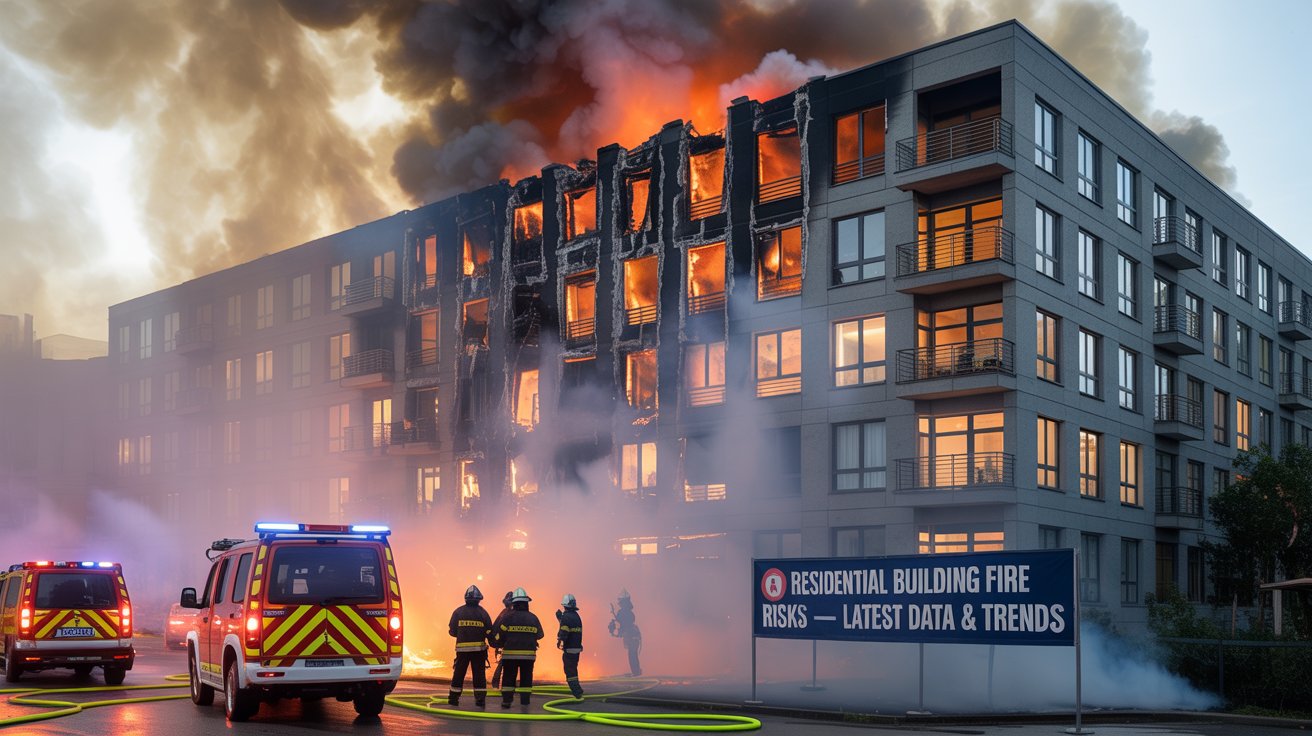
When we hear about a big fire, most of us picture a factory, a godown or a crowded market. The official numbers tell a different story. Most people who die in fire accidents in India die in their own homes.
What the official numbers say
The National Crime Records Bureau (NCRB) publishes these figures every year in its report Accidental Deaths and Suicides in India. The latest edition covers 2024:
- 5,971 fire accidents were reported across the country, down 15.4% from 7,054 in 2023.
- These fires killed 5,888 people and injured 330. That works out to about 16 deaths every day.
- 3,555 of those deaths, or 60.4%, happened in residential or dwelling buildings. In other words, in people’s homes.
- Cooking gas cylinder or stove bursts caused 1,389 deaths, and electrical short circuits caused 1,012. NCRB puts most of the rest under “other causes”.
For 2023, the government told the Lok Sabha that 6,891 people were killed and 284 injured in 7,054 fire accidents.
The trend is going down, which is good news. But nearly 6,000 deaths in a year is still a lot of families, and most of those fires started at home, often in the kitchen or in the wiring.
Who dies, and in which states
Of the 5,888 people killed in fire accidents in 2024, 3,020 were men and 2,868 were women. The kitchen is where women are hit hardest. Women were 875 of the 1,389 people killed by cooking gas cylinder or stove bursts. Short-circuit fires show the opposite pattern, with men making up 826 of the 1,012 deaths.
Maharashtra reported the most fire accidents in 2024: 625 cases, or 10.5% of the national total, and 639 deaths. Tamil Nadu (537 deaths), Uttar Pradesh (489), Madhya Pradesh (452) and Odisha (442) came next.
Fire made up only about 1.3% of the 4,67,857 accidental deaths NCRB recorded in 2024. Traffic accidents were by far the largest share, at 42.6%. A small share still means close to 6,000 lives, and six in ten of them were lost at home.
NCRB counts cases, injuries and deaths. It does not record what fires cost in money, and there is no reliable national figure for that, so we do not quote one.
How does India compare with the world?
The honest answer is that a neat ranking is not possible. Using NCRB’s own population figure for 2024, India’s recorded fire-accident deaths come to about 0.4 per lakh people. The U.S. Fire Administration puts the American fire death rate for 2023 at 13.1 per million, which is about 1.3 per lakh.
So on paper, India records fewer fire deaths per head than the United States. Please don’t read that as “India is safer”. The two countries collect these numbers in different ways, so the figures are not directly comparable. The World Health Organization says burns kill an estimated 1,80,000 people worldwide every year, mostly in low- and middle-income countries, and that in India over 10 lakh people are moderately or severely burnt every year.
Two myths worth dropping
“Fire deaths only happen in factories or slums.” Not true. In 2024, six out of every ten fire-accident deaths were in homes. A gas leak, a short circuit or a stove left on can start a fire in any house, including a well-kept flat in a good society.
“Our building has a Fire NOC, so it is safe.” An NOC does not make a building fireproof. Fires still happen in NOC-approved buildings. What gets people out is working alarms, clear exits and trained staff, and those help only if they are kept in order.
What you can do today
- Put up a smoke alarm at home, in the passage outside the bedrooms, and press its test button every month.
- Save 101 (fire), 108 (ambulance) and 112 on speed dial in every family member’s phone.
- Know two ways out of your building, and check that the second one is not locked or full of junk.
- Look after the gas. Check the LPG hose for cracks, and switch off the regulator when you go out or go to bed.
- Do not overload sockets. If a plug or switchboard gets hot or sparks, call an electrician.
- Do a five-minute fire drill with the family every three months. Decide who wakes whom, which way you go and where you meet outside.
Ask your society
At the next committee meeting, ask one simple question: do we have working smoke alarms and clear staircases? If not, push for them. One resident asking is often how it starts.
If a fire does start
- Shout and wake everyone. Get out first, then call from outside.
- Stay low under smoke and close doors behind you.
- Take the stairs, never the lift.
- Never go back in for a phone, jewellery or papers.
Every number on this page is a person, and a family left behind. That is why HowToSurvive.in exists.
What needs attention
- Six out of every ten fire-accident deaths in 2024 were in people's homes, not in factories or markets
- Cooking gas cylinder or stove bursts and electrical short circuits were the two biggest named causes of fire deaths in 2024
- Women were 875 of the 1,389 people killed by cooking gas cylinder or stove bursts in 2024
- Maharashtra reported the most fire accidents (625) and fire deaths (639) in 2024
- Fire accidents and deaths fell from 2023 to 2024, but nearly 6,000 deaths in a year is still a heavy toll
- Country comparisons are not like-for-like: India's recorded rate is lower than the U.S. rate, but the two countries collect fire-death data differently
- A Fire NOC is a starting point, not a guarantee; it helps only if alarms, exits and training are kept up
- Children, elderly parents and anyone who needs help must be named in the family plan
Controls that reduce risk
- Fit a smoke alarm outside the bedrooms and test it every month
- Get the LPG hose and regulator checked, and replace a cracked hose
- Have an electrician check overloaded sockets and old wiring
- Walk both exit routes in your building and report locked or blocked ones to the society
- Raise smoke alarms and drills at your society's next meeting
- Decide who helps children, elderly parents and anyone with a disability
- Hold a family fire drill every three months
Common unsafe practices
- Believing fire only happens in factories or slums
- Treating the building's Fire NOC as a guarantee
- No smoke alarm at home, or one with a dead battery
- Ignoring a gas smell, a cracked LPG hose or a hot, sparking socket
- Not knowing a second way out of the building
- Delaying the call to the fire brigade
- Going back inside for belongings
- Using the lift during a building fire

Leave a comment