

Quick answers
How can I escape a fire in a high-rise building?
Know two escape routes, use the staircase instead of the lift, and cover your nose and mouth with a wet cloth to reduce smoke inhalation.
What safety violations make high-rise fires deadly?
Common problems include non-working sprinklers and detectors, locked or blocked exits, dry hydrants, illegal floor additions, misused basements, false ceilings covering sensors and unauthorised electrical changes.
What can residents do to make their building safer?
Never block fire doors or use staircases for storage, check that the alarm panel and extinguishers work, take part in building drills, and ask the society or builder for regular fire audits and proof of NOC renewal.
Is it safe to use the lift during a building fire?
No. Avoid using lifts during a fire and use the staircases only.
Our cities are building taller every year, but the fire safety inside many buildings has not kept pace. The National Crime Records Bureau (NCRB) recorded 7,054 fire accidents and 6,891 deaths in 2023, as the government told the Lok Sabha in February 2026. In 2024, 3,585 of the 5,971 fire accidents were in residential buildings, and 3,555 of the 5,888 people killed died in residential buildings. The NCRB does not count high-rise fires separately, so nobody can say exactly how many of these were in tall buildings.
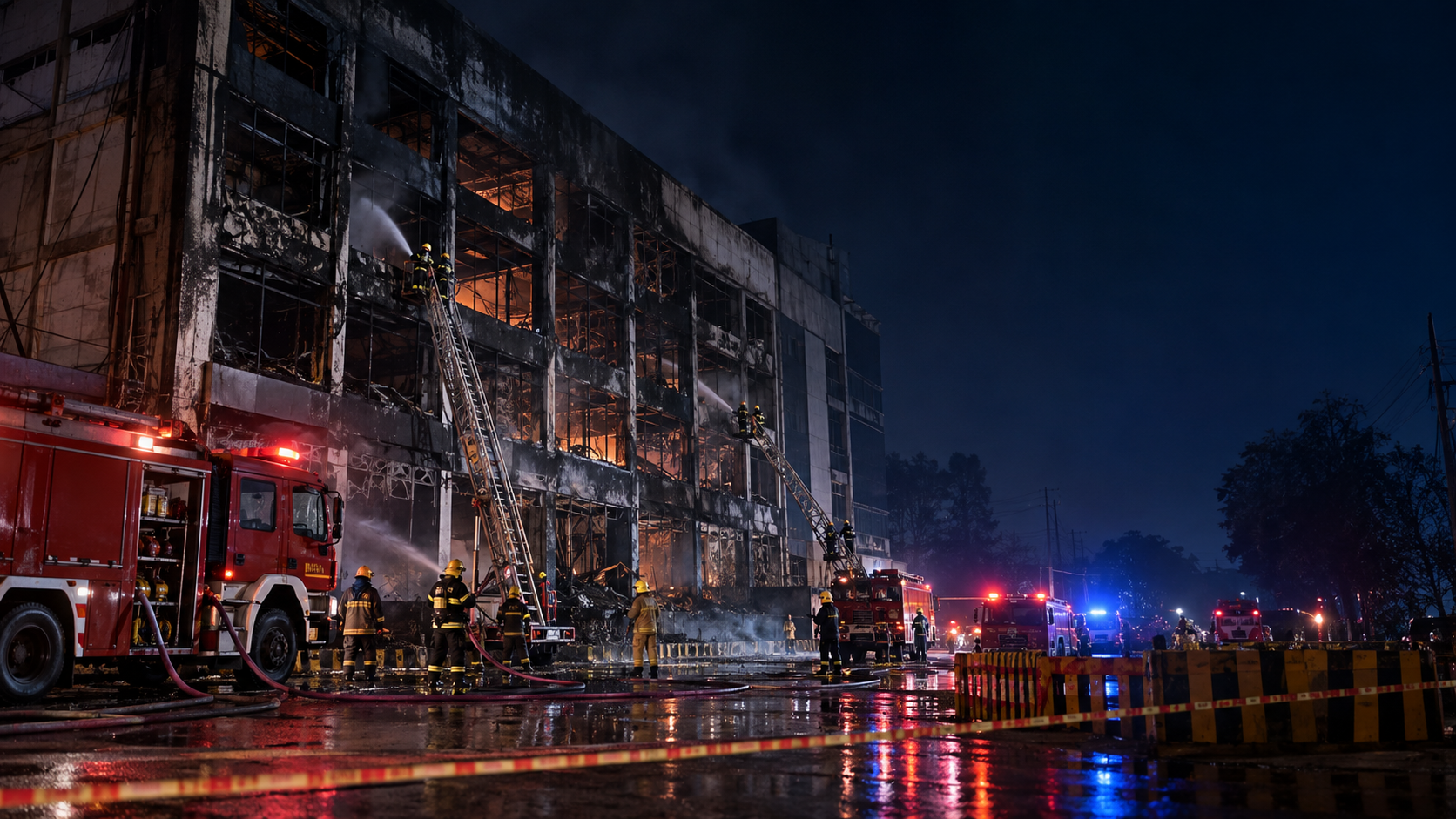
What the big fires of recent years do show is the same set of violations again and again: one staircase, no fire clearance, storage in escape routes and systems that do not work when needed.
Why this matters
A building with many floors depends on its staircases, alarms, sprinklers and hydrants. If one of them is locked, blocked or dead, people on the upper floors have very few minutes and very few choices. Locked staircases, sprinklers that do not work, false ceilings that hide smoke detectors and shafts that let smoke climb can turn one short circuit into a tragedy.
The Surat fire in 2019, the Mundka fire in Delhi in 2022 and the Rajkot game zone fire in 2024 all happened in buildings that should never have been operating the way they were.
Recent building fires
| Date | Building | Deaths | What went wrong |
|---|---|---|---|
| 24 May 2019 | Takshashila Arcade, Sarthana, Surat (coaching centre) | 22 | Students trapped on the upper floors of a commercial complex |
| 13 May 2022 | Commercial building near Mundka Metro, Delhi | 27 | Only one exit; no fire safety clearance |
| 6 October 2023 | Jay Bhavani residential building, Goregaon, Mumbai | 7 | Fire in ground-floor shops, scrap and parked vehicles spread up the staircase |
| 25 May 2024 | TRP Game Zone, Rajkot | 27 | Welding sparks fell on thermocol; no fire NOC |
| 18 May 2025 | Gulzar Houz, Hyderabad | 17 | Preliminary cause: short circuit |
Sources: WION, 24 May 2019; BOOM, 14 May 2022; Scroll, 6 October 2023; High Court of Gujarat order (via Indian Kanoon), 30 January 2025; Telangana Today, 18 May 2025. These are selected verified building fires, not a national count. Not all of them were high-rises, but the failures are the same ones that make a tall building deadly.
The violations that keep coming up
| Violation | What it does in a fire |
|---|---|
| Sprinklers or detectors not working | The fire grows unchecked and nobody is warned in time |
| Emergency exits locked or blocked | People are trapped while trying to get out |
| Dry hydrants, no pressure in the system | The fire brigade cannot get water where it is needed |
| Illegal extra floors and mezzanines | More people, more stock and the same narrow stairs |
| Basements and parking used for storage | Thick, toxic smoke rises into the floors above |
| False ceilings covering detectors | Smoke is detected late |
| Unauthorised electrical work | Overloads and short circuits |
These are the violation types seen again and again in the fires listed above.
Three fires, three lessons
Rajkot game zone, 2024
- Toll: 27 lives, including four children under 12.
- Cause: welding sparks fell on thermocol during expansion work in a structure made mostly of tin sheets.
- Finding: the game zone’s booking licence depended on a fire NOC that was never obtained, and it kept running anyway (Gujarat High Court order).
- Lesson: a place that runs without a fire NOC is not a paperwork problem. It is a fire waiting for a spark.
Mundka, Delhi, 2022
- Toll: 27 dead and 12 injured.
- Where it started: the first-floor office of a CCTV camera and router maker.
- Finding: the four-storey building had only one exit, no fire safety clearance and no sanctioned building plan, and the factory inside was running without a licence, as per the municipal enquiry quoted by the NHRC.
- Lesson: one way out is no way out once the fire blocks it.
Goregaon, Mumbai, 2023
- Toll: 7 dead, including two minors, and over 40 injured on 6 October 2023.
- Finding: fire in ground-floor shops, scrap and parked vehicles spread into the staircase, the residents’ only way out.
- Lesson: keep parking, scrap and storage well away from the staircase.
What the numbers tell us
- National scale: 6,891 fire-accident deaths in 2023 (NCRB, Lok Sabha reply).
- Homes are where most people die: in 2024, 3,585 of 5,971 fire accidents and 3,555 of 5,888 deaths were in residential buildings (NCRB, 2024).
- Fire NOC rules: how long a fire NOC is valid and when it must be renewed is set by each state’s fire service law. Check the rule for your state.
The hidden technical gaps
- Fire water used for daily needs: when the fire tank also feeds the flats, there is no reserve left for a fire.
- Pumps that do not start: booster and fire pumps fail to start on their own because the panel has not been maintained.
- Dead smoke detectors: covered in dust or hidden above a false ceiling.
- Basement ventilation: missing, or running the wrong way, so smoke fills the escape route.
- Open shafts: unsealed electrical and duct shafts carry fire and smoke from floor to floor.
For residents and office staff
- Know two ways out of your floor, and walk them once.
- Never block fire doors or use the staircase for storage, shoes or cycles.
- Check that the fire alarm panel shows normal and that extinguishers are in date.
- Use the stairs, never the lift, in a fire.
- Stay low under smoke and close doors behind you. A cloth over your nose and mouth helps a little, but getting out quickly helps much more.
- If the staircase is full of smoke, stay in your flat, shut the door, seal the gaps with wet cloth, call 101 or 112 and signal from a window or balcony.
- Take part in building drills. They are for your survival, not for inspection photos.
- Ask your builder or society for the latest fire audit and proof that the fire NOC is valid.
What needs to change
- Regular third-party fire audits for high-rise and crowded commercial buildings.
- Fire NOC renewal only after a physical inspection, not just a self-declaration online.
- A public fire-safety status for every high-rise, so residents and buyers can see it.
- Fire alarm panels and hydrant pressure linked to city fire control rooms.
- Penalties for societies and owners who lock exits or turn basements into godowns.
- A fire blanket and a household extinguisher in every flat, with residents shown how to use them.
- Fire readiness made part of what buyers are told under RERA.
Ask one question this week
A tall building is only as safe as its staircase and its hydrant pump. At your next society meeting, ask: when was our last fire drill, and does the fire pump start on its own? If nobody knows, that is your answer, and your starting point.
References
- IANS, “6,891 killed in 7,054 fire accidents in 2023: Home MoS Nityanand Rai” (10 February 2026)
- Dataful (NCRB data), “Nearly 6,000 fire accident deaths in 2024 despite sharp decline in accidents” (5 June 2026)
- National Crime Records Bureau, Accidental Deaths and Suicides in India 2024, Chapter 1
- WION, “Death toll rises to 22 in Surat fire” (24 May 2019)
- BOOM, “27 dead and 12 injured in Delhi Mundka fire, two people arrested” (14 May 2022)
- National Human Rights Commission, “NHRC expresses serious concern over devastating fire incident in Mundka” (15 May 2022)
- Scroll, “Mumbai: 7 dead, over 40 injured in fire at residential building in Goregaon” (6 October 2023)
- High Court of Gujarat (via Indian Kanoon), order in R/CR.MA/21368/2024, TRP Game Zone fire (30 January 2025)
- Business Today, “Tragic fire in Rajkot gaming zone kills 27, including children; Gujarat government orders SIT probe” (26 May 2024)
- Telangana Today, “Gulzar Houz fire incident: State government announces Rs 5 lakh ex gratia” (18 May 2025)
What needs attention
- In Mundka, a four-storey building with one exit and no fire clearance cost 27 lives
- The Rajkot game zone ran without the fire NOC its licence depended on
- In Goregaon, fire in ground-floor shops, scrap and parked vehicles spread up the only staircase
- Storage in staircases and basements, dead detectors and dry hydrants show up again and again
- Most fire deaths in India happen in residential buildings, not factories
Controls that reduce risk
- Societies: get a fire audit done and act on every defect
- Keep the fire NOC valid and renew it under your state's rules
- Test fire pumps, hydrants and the alarm panel on schedule
- Keep the fire water tank full and separate from daily use
- Clear staircases, corridors and basements of storage and parking
- Seal electrical and duct shafts floor by floor
- Hold a fire drill for residents at least once a year
Common unsafe practices
- Running a building or business without a valid fire NOC
- Locking emergency exits or using staircases for storage
- Letting the fire tank double as the daily water supply
- Hiding smoke detectors above false ceilings
- Parking vehicles and keeping scrap next to the staircase
- Doing welding or electrical work without fire precautions

Leave a comment