
Quick answers
What fire safety failures are common in Indian schools and colleges?
Common failures include expired or unserviced extinguishers, missing or disabled smoke detectors, capped or absent sprinklers, locked or blocked emergency exits, untrained staff and no fire drills.
What can parents do to make their child's school safer from fire?
Ask the school for its fire safety NOC, make sure your child knows the exit routes from the classroom and building, encourage regular drills, and report locked exits or missing systems immediately.
What should children be taught to do in a school fire?
Teach them not to panic, to follow their teacher, and not to run blindly. Practising exit routes in drills helps them act calmly.
What fire safety measures should every school have?
Schools should have working fire exits, alarms and extinguishers, trained teachers and staff, regular fire drills, and valid fire safety certification.
Is a school Fire NOC just paperwork?
No, where it is required it is the one time an outside expert checks the exits, alarms and extinguishers. But it is a check on one day. Ask when the last drill was held and look at the exits and extinguishers yourself.
What if my child's school says it does not need a Fire NOC?
Under the National Building Code, educational buildings below 15 metres do not need one, though state rules can differ. The NDMA School Safety Policy still applies, so ask for the latest fire safety audit and the date of the last drill.
What should school management do to improve fire safety?
Hold drills every term with every class, put exit maps in every corridor, keep gates unlocked during school hours, train teachers to use extinguishers, keep the kitchen and LPG away from classrooms, and plan help for children who cannot get out on their own.
India has about 14.72 lakh schools with around 24.8 crore students (UDISE+ 2023-24), plus lakhs of colleges, coaching centres and tuition classes. Every day, crores of children and young people spend hours inside these buildings. How many of those buildings are fire safe? Nobody publishes a reliable national answer.
Why this matters
Schools and colleges are meant to be places of learning and safety. The record shows what happens when they are not:
- Kumbakonam school fire, Tamil Nadu (July 2004): 94 children died (the Supreme Court’s 2009 judgment refers to 93). The fire started where the mid-day meal was being cooked, in a crowded building with a thatched roof.
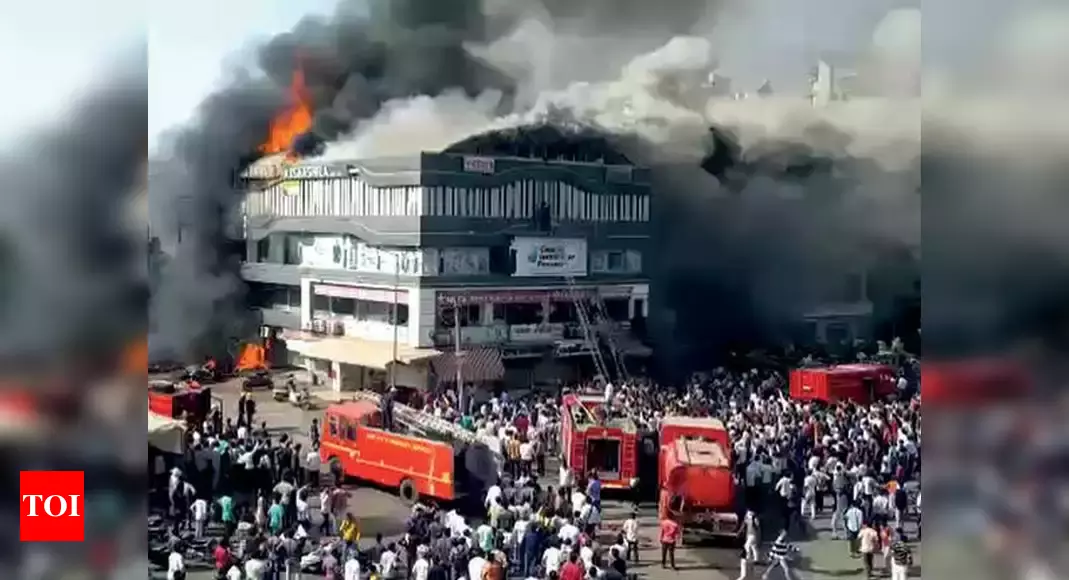
- Takshashila coaching centre fire, Surat (May 2019): 22 people died, almost all of them students, in a coaching class built on the terrace. The only way down was a wooden staircase near where the fire started, and some students jumped to escape.
- Rajkot game zone fire (May 2024): not a school, but a place full of children and teenagers on holiday. Children were among those killed.
The NCRB recorded 11 fires in school buildings in 2024, with 9 deaths. That figure does not include coaching centres, tuition classes or hostels in other kinds of buildings. When parents send children to study, they trust the system. A missing alarm, a locked exit or an untrained teacher can break that trust in minutes.
What the rules say
- National Building Code 2016: sets fire and life safety requirements for educational buildings, including exits, alarms and extinguishers. States adopt it through their own building and fire rules.
- Supreme Court, 2009 (Avinash Mehrotra v. Union of India): after the Kumbakonam fire, ordered all government and private schools to install fire extinguishers, train staff to use them, and make sure school buildings follow the National Building Code before recognition.
- NDMA School Safety Policy guidelines, 2016: apply to every school, government, aided or private, and call for clear exits, working alarms, refilled extinguishers, safe wiring and regular safety audits.
- Fire NOC: depends on the state’s rules and the building. Under the NBC, educational buildings below 15 metres do not need one, as the Supreme Court noted in September 2025.
On paper the rules are strict. In practice, too many schools have paper audits, no drills and expired equipment, and nobody checks.
Two ways a school can look safe on paper
- It has a Fire NOC, but the systems have decayed. An NOC is a check on one day. Since then the extinguishers may have expired, the alarm may have been disconnected, and the second staircase may have become a store room.
- It never needed a Fire NOC. Many schools, tuition centres and coaching classes run in buildings below 15 metres, so a fire officer may never have visited. The NDMA guidelines still apply to them in full.
Many schools also share a building with shops, godowns or a coaching centre, or run from an old building that was never designed as a school. What keeps children safe is what is in the building today, not the certificate or the sign at the gate.
What goes wrong on the ground
These are the failures we and others keep finding in schools, colleges and coaching centres:
- Fire extinguishers expired or never serviced
- Smoke detectors missing or disconnected
- Exits locked during class hours or blocked with furniture
- Coaching classes in basements, on terraces or in shops with one staircase
- Teachers and staff never trained in evacuation
- No fire drills, so children panic and crowd the stairs
- Mid-day meal kitchens and LPG cylinders close to classrooms, as at Kumbakonam, where the fire started in the kitchen
What parents and students can do
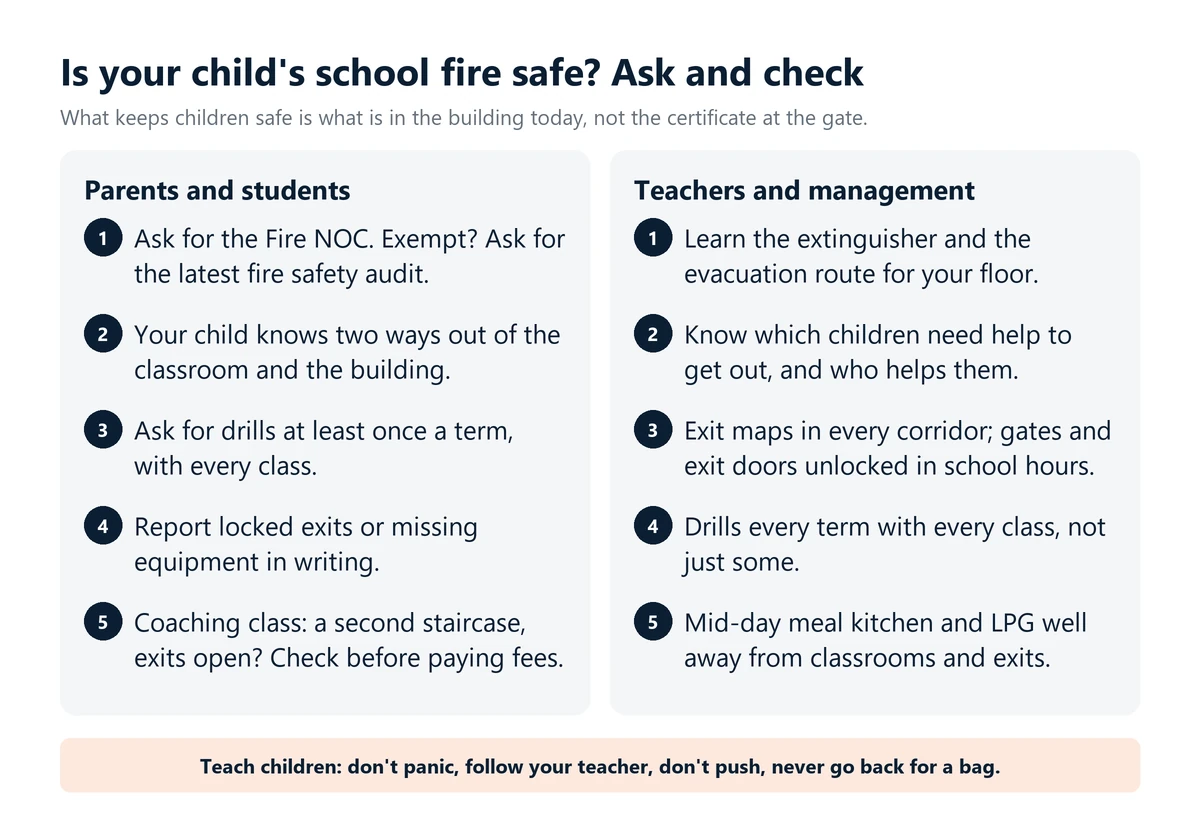
- Ask the school, college or coaching centre for its Fire NOC. If it says the building is exempt, ask for its latest fire safety audit.
- Make sure your child knows two ways out of the classroom and the building.
- Ask for evacuation drills at least once a term, with every class taking part.
- Report locked exits or missing fire equipment to the management in writing, and to the fire service if nothing is done.
- Teach children simple rules: don’t panic, follow your teacher, walk quickly, don’t push, and never go back for a bag.
- For coaching classes, check before you pay the fees: is there a second staircase, and are the exits open?
What teachers and school management can do
Young children follow adults. When frightened they often hide, and the youngest cannot open a heavy door or find an exit on their own. So the adults in the building have to plan for them.
- Teachers: learn to use an extinguisher and know the evacuation route for your floor. Know which children in your class will need help to get out, and who will help them.
- Management: put up exit maps in every corridor, keep gates and exit doors unlocked during school hours, and hold drills every term with every class, not just some.
- Kitchen: keep the mid-day meal kitchen and LPG cylinders well away from classrooms and exits.
- Shared buildings: if the school shares a building with shops or godowns, get it checked for fire separation and a second way out.
What needs to change
- A fire safety audit every academic year for every school, college and coaching centre, whatever the building height
- Fire drills as a regular part of the school calendar, like PT
- Fire and disaster preparedness in teacher training
- No recognition or affiliation for institutions without working safety systems
- Audit reports shared with parents
Key numbers
- Schools in India: about 14.72 lakh, with 24.8 crore students (UDISE+ 2023-24)
- Fires in school buildings, 2024: 11, with 9 deaths (NCRB)
- Kumbakonam school fire, 2004: 94 children died
- Takshashila coaching centre fire, Surat, 2019: 22 died
- National share of schools with a valid Fire NOC: not published
Parents, teachers and students are the first line of safety. Don’t ignore a missing extinguisher or a locked exit. Ask questions, ask for answers and raise complaints. Every child deserves not just an education, but protection. A school that cannot keep children safe has failed its first duty.
What needs attention
- No reliable national data shows how many schools follow fire safety norms; the old 7% and 10% figures could not be traced
- The Supreme Court and NDMA require basic fire safety in every school, but checking is weak
- Coaching centres in basements, on terraces or above shops are a recurring danger
- Kumbakonam and Takshashila both show how one blocked or narrow escape route can kill many students
- Untrained staff and no drills turn a small fire into panic on the stairs
- Parents and students are often the only people checking day to day
- A Fire NOC is a check at one point in time; extinguishers, alarms and exits can decay afterwards
- Schools and coaching classes in buildings under 15 metres may never get a fire officer's visit
Controls that reduce risk
- Hold a fire safety audit every academic year and share it with parents
- Run evacuation drills at least once a term with every class
- Train all teachers and staff in evacuation and extinguisher use
- Keep at least two exits open and clear during class hours
- Service extinguishers and test alarms on schedule
- Refuse recognition to institutions without working safety systems
- Display exit maps in every corridor
- Keep mid-day meal kitchens and LPG cylinders away from classrooms and exits
- Make sure each teacher knows which children will need help to get out
Common unsafe practices
- Assuming recognition or affiliation means a building is fire safe
- Locking exits or gates during class hours
- Running classes on terraces, in basements or with one staircase
- Letting extinguishers expire and disconnecting smoke detectors
- Never training teachers or holding drills
- Paying coaching fees without checking the building
- Treating a Fire NOC, or an exemption from one, as proof the school is safe today
- Cooking or storing LPG near classrooms and exits
- Running a school in a building shared with godowns or shops without fire separation

Leave a comment