
Quick answers
What are the most common causes of urban fires in India?
Common causes include electrical failures such as short circuits, overloading and faulty wiring, kitchen and cooking gas leaks, commercial negligence like blocked exits and capped sprinklers, industrial accidents, and festival fireworks.
How can I prevent an electrical fire at home?
Check wiring regularly, avoid overloading sockets, and use certified electricians instead of shortcuts.
How can I make my kitchen safer from fire?
Use an LPG leak detector, keep a fire blanket in the kitchen, and do not leave stoves unattended.
What should I check when entering a mall, office or theatre?
Check where the exits are before you settle in, and if you see capped sprinklers, blocked hydrants or locked exits, report them to management or the fire department.
In 2024, the NCRB recorded 5,971 fire accidents in India, which killed 5,888 people and injured 330. In 2023 there were 7,054 fire accidents and 6,891 deaths. The NCRB does not separate urban and rural fires. (Source: NCRB, Accidental Deaths & Suicides in India 2023 and 2024)
Most of these deaths came not from big disasters but from everyday fires at home: 3,555 of the 5,888 deaths in 2024 happened in homes. Where the NCRB names a cause, cooking gas cylinder or stove bursts (1,389 deaths) and electrical short circuits (1,012) top the list.
Why this matters
Many of us in cities think big fires happen only in factories or slums. The numbers say otherwise. Your flat, your office, your child’s coaching centre or your favourite restaurant can catch fire on an ordinary evening.
A city fire does not just burn a building. It takes lives within minutes, leaves families without an earner, wipes out years of savings, and sends toxic smoke across whole neighbourhoods. And most of these fires start from causes we already know how to prevent.
The main causes of fires in Indian cities
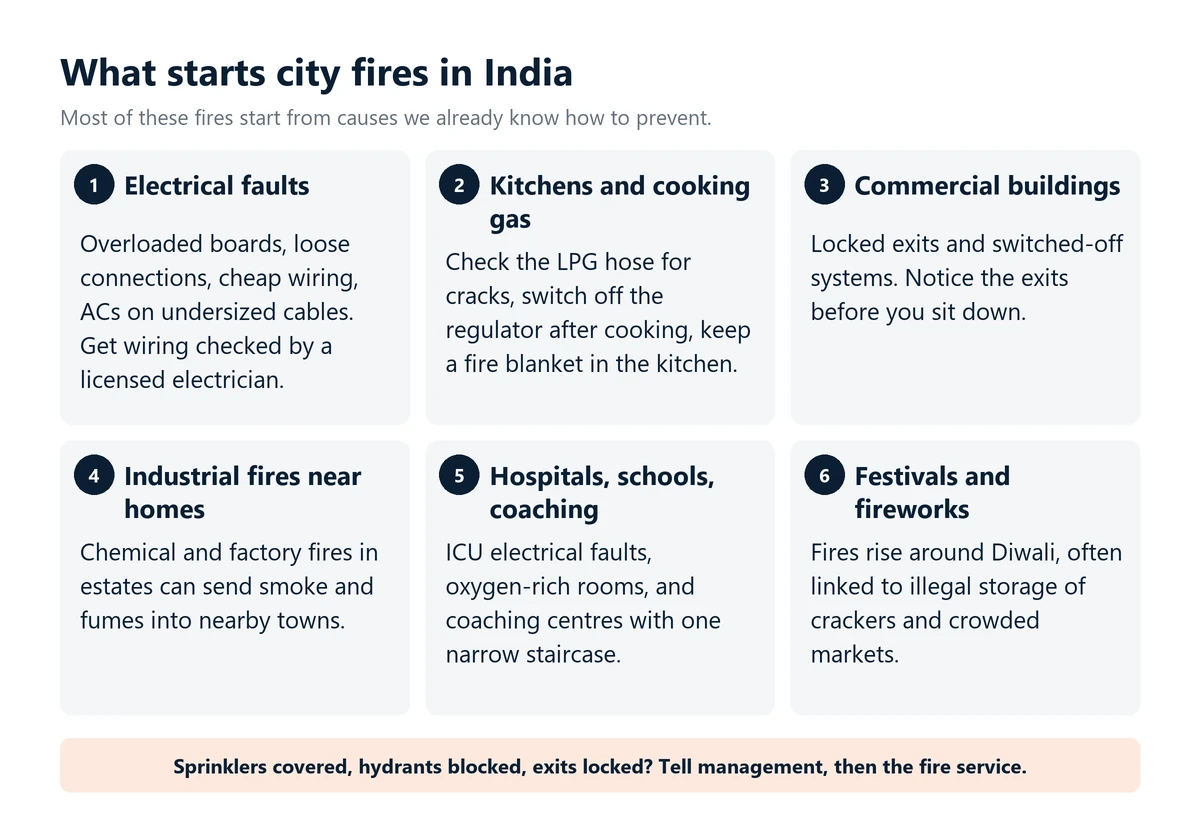
1. Electrical faults: short circuits, overloading and old wiring
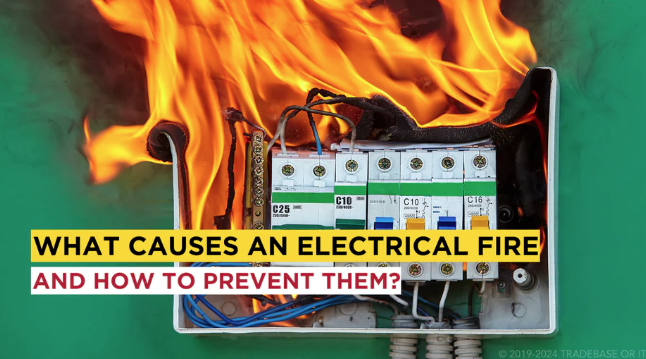
The NCRB recorded 1,042 fire accidents and 1,012 deaths from electrical short circuits in 2024, and 1,673 deaths in 2023. Overloaded extension boards, loose connections, cheap wiring and air conditioners on undersized cables are common culprits in flats, markets and offices.
2. Kitchens and cooking gas
Cooking gas cylinder or stove bursts caused 1,389 deaths in 2024, the largest named cause in the NCRB’s data. Women were 875 of those 1,389 deaths, a reminder of who spends the most time at the stove.
3. Negligence in commercial buildings
Blocked or locked exits, fire systems that are switched off or not maintained, and buildings running without the approvals they need. The Rajkot game zone fire (2024) and the Kamala Mills fire in Mumbai (2017) both showed how quickly crowded commercial spaces turn deadly when these basics fail.
4. Industrial fires near homes
Chemical and factory fires in industrial estates, such as the GIDC areas around Bharuch, Vapi and Ankleshwar, can send smoke and fumes into nearby towns.
5. Hospitals, schools and coaching centres
ICU fires linked to electrical faults and oxygen-rich rooms, and coaching centres run from buildings with one narrow staircase. These fires hurt the people least able to escape: patients and children.
6. Festivals and fireworks
The NCRB recorded 110 fireworks-related fire accidents and 134 deaths in 2024. Fires rise around Diwali and other festivals, often linked to illegal storage of crackers and crowded markets.
Patterns we see again and again
- Safety systems installed for show, not kept working
- No regular maintenance or checks
- Residents and customers who do not ask questions
- Inspections that are rare or not followed up
- Almost no culture of fire drills
What you can do
- Get your wiring checked by a licensed electrician, and stop overloading sockets and extension boards.
- Use proper electrical fittings and qualified electricians, not shortcuts.
- Check the LPG hose for cracks, switch off the regulator after cooking, and keep a fire blanket in the kitchen. An LPG leak detector adds an extra warning.
- When you enter a mall, office, restaurant or cinema, notice where the exits are before you sit down.
- If you see sprinklers covered or painted over, hydrants blocked or exits locked, tell the management, and report it to the fire service if nothing changes.
What the system needs
- Regular fire audits for all public and multi-storey buildings, with results shared with occupants
- Strict enforcement of electrical safety rules
- Enough fire stations and firefighters to reach every part of a city quickly
- Accountability for anyone who issues or uses a false fire approval
- Easy ways for citizens to report fire hazards and see what action was taken
Key numbers
- Fire accidents killed about 16 people a day in India in 2024: 5,888 deaths (NCRB)
- 60.4% of fire deaths in 2024 happened in homes: 3,555 of 5,888 (NCRB)
- Fire stations: 3,377 against 8,559 required (Rajya Sabha reply, June 2019)
- Fire personnel: 54,239 against 5,57,123 required, a shortfall of about 90% (Rajya Sabha reply, June 2019; data as on 31 December 2018)
Don’t wait for the news
Look around your home, office, school and society today. If you find unsafe wiring, missing detectors or locked exits, report them to your RWA, management or the fire service, and share them with us at HowToSurvive.in. One voice can prevent one fire.
City fires are not fate. They come from neglect, ignorance and silence, and each of those can be fixed.
What needs attention
- Most fire deaths in India happen in homes, from everyday causes rather than big disasters
- Cooking gas cylinder or stove bursts are the largest named cause of fire deaths, and most of those killed are women
- Electrical short circuits caused over a thousand deaths in 2024
- Commercial fires turn deadly when exits are locked and fire systems are not maintained
- Fireworks and festival seasons bring a clear rise in fire risk
- India had less than half the fire stations it needed, according to 2018 data
Controls that reduce risk
- Get home wiring checked by a licensed electrician
- Replace cracked LPG hoses and switch off the regulator after cooking
- Keep a fire blanket in the kitchen
- Ask your RWA for annual fire audits and drills
- Report locked exits and blocked hydrants to the fire service
- Buy and store crackers only from licensed sellers, in small quantities
Common unsafe practices
- Overloading sockets and extension boards
- Using unqualified electricians and cheap wiring
- Leaving the LPG regulator on and ignoring cracked hoses
- Locking exits and switching off fire systems in commercial buildings
- Storing crackers illegally in homes and shops
- Never checking where the exits are in public places

Leave a comment