
Is my child's school building safe?
Honestly, a visit cannot tell you that. Here is what you can check and ask: a short checklist for your next school visit, and a polite one-page letter that asks the school the right questions.
After the school roof collapse in Peshawar, Pakistan, in October 2026, and the Jhalawar school roof collapse in Rajasthan in July 2025, the question comes up for every parent: how do I know my child's school building is safe?
Honestly, you cannot know that from a visit. A building's strength lies inside its walls, slabs and papers. What you can do is notice a few things that any parent can see, and ask the school the right questions in writing. This tool helps you do both.
Before you start
- Follow the school's visitor rules, and do not go up to a roof or into a locked area.
- Do not photograph other people's children. If you take a photo of a crack or a damp patch, keep children out of the frame, and ask the school's permission first.
- Answer only what you saw yourself. Leave the rest as Not sure.
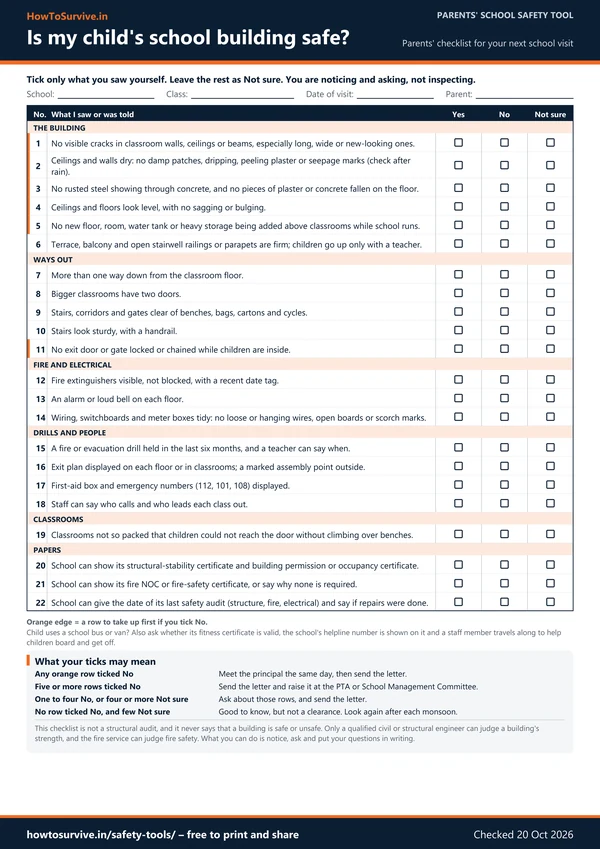
The checklist
Answer only what you saw yourself. Yes is the reassuring answer. Leave the rest as Not sure. Your answers stay in this page and are not sent to us or saved. We count visits with Google Analytics, and the page translator is Google's.
Answer a few more questions to see what to do next.
If plaster is falling, a ceiling is sagging or water is coming through right now, ask staff to move children out at once and call 112.
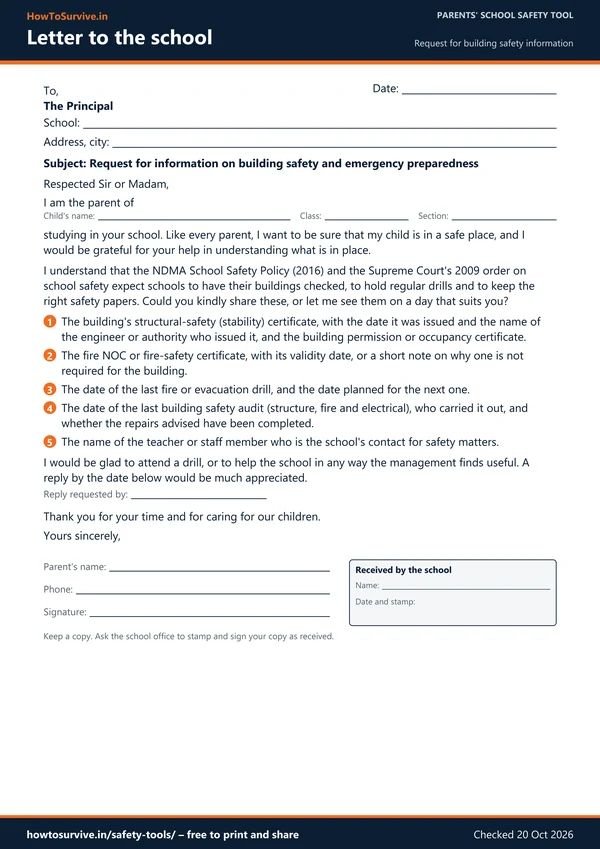
Letter to the school
A polite one-page letter that asks the school for its safety papers and drill dates. Fill in the boxes to see your own copy, or print the blank sheet and write by hand.
To,
The Principal
[School name]
[Address, city]

Date: [date]

Subject: Request for information on building safety and emergency preparedness

Respected Sir or Madam,

I am the parent of [child's name], studying in Class [class] Section [section] of your school. Like every parent, I want to be sure that my child is in a safe place, and I would be grateful for your help in understanding what is in place.

I understand that the NDMA School Safety Policy (2016) and the Supreme Court's 2009 order on school safety expect schools to have their buildings checked, to hold regular drills and to keep the right safety papers. Could you kindly share these, or let me see them on a day that suits you?

1. The building's structural-safety (stability) certificate, with the date it was issued and the name of the engineer or authority who issued it, and the building permission or occupancy certificate.
2. The fire NOC or fire-safety certificate, with its validity date, or a short note on why one is not required for the building.
3. The date of the last fire or evacuation drill, and the date planned for the next one.
4. The date of the last building safety audit (structure, fire and electrical), who carried it out, and whether the repairs advised have been completed.
5. The name of the teacher or staff member who is the school's contact for safety matters.

I would be glad to attend a drill, or to help the school in any way the management finds useful. A reply by [date] would be much appreciated.

Thank you for your time and for caring for our children.

Yours sincerely,
[Parent's name]
Parent of [child's name], Class [class] Section [section]
[Phone number]
Keep a copy. Ask the school office to stamp and sign your copy as received.
Printable sheets
Who to approach nextFrom the principal up to the state education department
- Principal or head of school. In person first, then the letter. Keep a stamped copy.
- School Management Committee (government schools) or Parent Teacher Association (private schools). Ask for the point to be placed on the next meeting's agenda.
- For a private or board-affiliated school: the school's management or trust, and then the board it is affiliated to (CBSE, ICSE or a state board). Write to the management first. Then write to the board's affiliation office, quoting the school's affiliation number. It is on the school's certificate and usually on its website.
- Block Education Officer (BEO). Write with a copy of your letter to the school and any reply.
- District Education Officer (DEO). If the BEO's office does not act.
- District Collector or District Magistrate, and the District Disaster Management Authority (DDMA). The NDMA policy gives the DDMA a role in seeing that schools meet the National Building Code.
- The local municipal or council building department and the fire station for your area. For any school, government or private, you can write to ask whether the building has a fire NOC and a structural safety certificate on record. We have not listed a portal for this, because it differs by city.
- State or Union Territory School Education Department. Where the problem continues.
This ladder follows the Education Ministry's 2021 Guidelines on School Safety and Security (sections 4.4 to 4.6). Under section 32 of the RTE Act, any person can also make a written complaint to the local authority. Your state may have its own online complaint channel. We have not verified any, so ask the District Education Office or look on your state education department's website.
How we know
The questions follow the NDMA School Safety Policy 2016, the Supreme Court's 2009 order on school safety, the National Building Code 2016 and the Education Ministry's 2021 school safety guidelines. Last checked 20 October 2026.
Read the guides behind this tool
- School Fire Safety Plan: What Principals and Teachers Must Put in Place
- Fire Safety Standards in Indian Schools and Colleges: Are They Followed?
- Did You Know? Schools Under 15 Metres May Not Need a Fire NOC
- Fire NOC in India: How It Works, Common Loopholes and What You Can Check
- School Safety – Fire Drills & Preparedness Status (2019–2025)
Common questions
Is this a structural audit of the school?
No. Only a qualified civil or structural engineer can assess a building's strength. The NDMA policy says structural assessment is to be done by a civil engineer or licensed building surveyor, while non-structural checks can be done by teachers and students. This checklist helps a parent notice and ask. It does not give a verdict, and it never says that a building is safe or unsafe.
What can a parent actually see on a school visit?
Cracks, damp patches and peeling plaster, sagging ceilings, rusted steel showing through concrete, building work going on above classrooms, how many ways down there are, whether stairs and gates are clear and unlocked, the extinguishers and wiring, and whether drill dates and exit plans are on display. That is what the twenty-two questions cover.
Will the school be upset if I send the letter?
Most schools welcome a polite, specific request. The letter asks for information, it does not accuse. Offering to attend a drill or to help usually sets a friendly tone. It also works well when sent by a group of parents through the PTA.
Does every school need a fire NOC?
It depends on your state and on the height and size of the building. Some small school buildings do not need one. That does not remove the school's duty to follow the national school-safety guidelines. See our post on schools under 15 metres. The letter asks and never claims.
What if the school does not reply?
Write again after about two weeks and raise it at the PTA or School Management Committee. Then move up the ladder: Block Education Officer, District Education Officer, District Collector, and the state or Union Territory education department. Keep copies of everything.
How often should I repeat the checklist?
Once after each monsoon, whenever building work starts, and at the start of each school year. The NDMA policy suggests drills preferably every six months, and the Education Ministry's guidelines suggest a school safety walk every quarter.
More free safety tools
- Fire drill kitPrintable plan, roles sheet, assembly point sheet, attendance sheet and report for a housing society, school, office or shop.
- Which fire extinguisher?Pick what is burning and where. Get the right extinguisher type, what never to use, and when to leave instead.
- Emergency wallet cardMake your family's emergency card. Print it at wallet size or save it as a phone lock-screen picture.
- All Safety ToolsThe full list in one place.
- City Safety GuidesFire brigade numbers and stations, city by city.
These tools are for awareness. They do not replace a fire audit, an electrician's visit, medical advice or a call to the emergency services. In an emergency, call 112.