

Quick answers
Does NBC 2026 allow EV charging in a basement?
Annex G says EV charging is preferred at ground level and in no case below the first basement, and below ground it is limited to the first basement near the entrance. Part D says no charging or EV parking in the last basement. A basement EV compartment is at most 1,000 sq m. The standard is voluntary until your state adopts it.
Do basement car parks need sprinklers under NBC 2026?
The standard asks for them, but it describes them in more than one way. Table 7A notes ask for protection level CL-3 for a sprinklered basement and CL-5 where EV parks are in a podium or basement. Clauses 8.4.2 and 8.4.5 of the parking section differ, so the standard is not consistent here. Your fire officer decides.
How big can a basement parking compartment be?
Table 6 gives 750 sq m without sprinklers and 5,000 sq m with sprinklers for an enclosed basement car park. Other basements get 750 and 2,000 sq m. States may set their own limits.
Where must EV chargers not be placed?
Not below the first basement. Part D says no charging infrastructure or EV parking in the last basement. Outdoors, or in a separate cross-ventilated building at or above ground, is the best place.
Is NBC 2026 mandatory?
No. It is voluntary until a state or local authority adopts it. Your state's building rules and the fire department decide what applies to your building.
Under NBC 2026, Part F, a basement car park is asked for sprinklers, EV charging is kept to the ground level and the first basement, and an EV charging area inside a basement is limited to a fire compartment of 1,000 sq m. Smoke detectors are asked for in basements, rate-of-rise heat detection in EV parking and charging areas, and carbon monoxide sensors in petrol and diesel car parks. The standard is voluntary until your state adopts it, and in places it does not agree with itself. We say where. Checked 15 November 2026. Kitchens and gas are in our companion chapter on kitchens, LPG and gas pipes under NBC 2026.
In short
- Basements trap smoke and heat. The standard asks for smoke ventilation, sprinklers and at least two independent exits in a basement.
- Sprinklered basement: the protection level is CL-3 (CL means combined sprinkler and hose-stream water supply level). Where EV parking or charging is in a podium or basement, the level is CL-5.
- Compartments: an enclosed basement car park may be one compartment of up to 750 sq m, or up to 5,000 sq m if sprinklered (Table 6).
- EV charging: best outdoors or in a separate, well-ventilated building. Below ground, only in the first basement, near the entrance, never in the last basement.
- Vehicles: none parked in stairwells or on ramps.
- Not consistent: the standard gives two different parking sprinkler rules and describes basement sprinkler heads in three ways.

Why basements and EV charging belong together
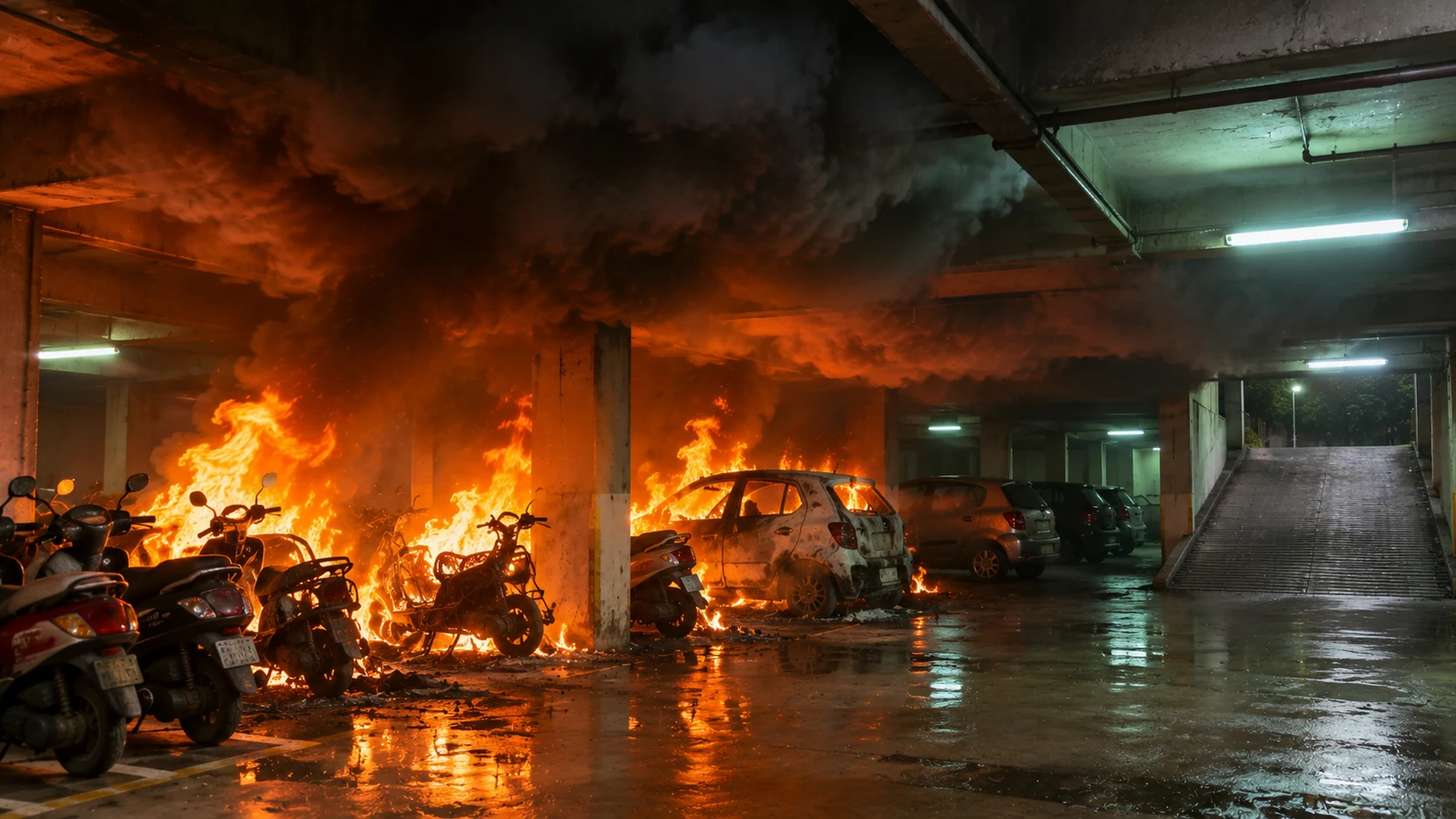
A basement car park is a closed box with cars full of fuel or batteries, one or two ramps and few windows. A charging point adds a battery that can burn hot. NBC 2026 deals with these in different places, so this chapter gathers the verified points. This is the sixteenth chapter in our series on the 2026 national building standards. Our chapters on water and first-aid fire fighting, and on fire officers, drills and maintenance, cover the next steps.
Basements: what the standard asks for
Clause 4.2.19.1 says a basement should not be used for sleeping, classrooms, hazardous industries, a restaurant kitchen, battery rooms, UPS rooms or fuel oil storage. A state may add more uses to that list. Our chapter on kitchens, LPG and gas pipes covers the kitchen and gas rules in detail. Basements should have smoke ventilation, sprinklers and redundant, enclosed exits. Clause 4.2.19.2 asks for exits sized to the basement occupancy and never fewer than two independent exits.
Smoke ventilation is in clause 4.6.2 of Part F. Each basement is ventilated separately. The vents should add up to at least 2.5 percent of the floor area, spread round the perimeter, or a mechanical system should give 12 air changes an hour in a fire. Smoke exhaust fans should be rated to work at 250 degrees C for 120 minutes. They should start when a sprinkler flow switch operates, and the fire brigade should have a manual start and stop. Smoke from a basement fire should not block an exit that serves the floors above.
The notes under Table 7A, which covers apartments and hotels, add four points about basements and EV parks. Read them with the table itself, because other building-use tables carry similar notes.
- Note 2: a basement protected with sprinklers should meet protection level CL-3.
- Note 3: a building with EV parks in a podium or basement should protect them with sprinklers and meet CL-5.
- Note 4: rate-of-rise heat detection should be provided in EV parks and charging areas. Smoke detectors should be provided in all basement areas other than petrol and diesel (internal combustion) car parks. Those car parks should have carbon monoxide sensors that are part of the fire alarm system and start the ventilation.
- Note 7: where buildings stand closer than 9 m, or the basement is used for EV parking or charging, the level is CL-5.
A rate-of-rise detector reacts to how fast the air temperature climbs, not only to a fixed temperature. CL-5 is a stronger water supply design than CL-3. Pump and tank sizes are not covered here.

How big may a basement compartment be?
| Where | Largest compartment, no sprinklers | Largest compartment, sprinklered |
|---|---|---|
| Enclosed basement car park | 750 sq m | 5,000 sq m |
| Other basements (stores, plant, other uses) | 750 sq m | 2,000 sq m |
| EV parking and charging area in a basement (Annex G) | Not split by sprinklers in the text | 1,000 sq m at most |
Scope: NBC 2026 Table 6 and Annex G clause G-6 as printed, read from page images on 15 November 2026, summarised by us. Table 6 gives the largest floor area of one fire compartment. The text says states and local authorities may set their own limits from their own risk assessment. Annex G does not say how its 1,000 sq m EV figure sits beside the 5,000 sq m car park figure, and we do not guess.
A compartment is a part of a floor sealed off by fire-rated barriers so a fire stays on one side for a time. Our chapter on fire compartments explains them in detail.
Open parking and enclosed parking
Annex G treats the two differently. A parking structure counts as open when each level has openings to the outside of at least 0.4 sq m for every metre of outside wall, spread over 40 percent of the perimeter or evenly over two opposite sides, and the inner walls are at least 20 percent open. Anything else, and every basement, is enclosed. Open parking is not asked to be compartmented. A stilt car park is sprinklered where the building itself is required to be.
For enclosed parking, clause G-4 says the sprinklers are standard response heads with a K-factor of at least 80 and coverage of 9 sq m a head, and the exit doors from the car park are painted green with exit signs. Annex G also says:
- A car park that is within, above, below, attached to or less than 3 m from another use is separated by walls and floors of 120 minutes fire resistance. A cashier or attendant booth and toilets up to 200 sq m are excepted.
- No fuel dispensing in the building.
- Vehicle ramps are not counted as exits unless pedestrian facilities are provided.
Vehicles, stairs and ramps
The section on power-driven parking says motor vehicles shall not be parked in stairwells or in generally accessible corridors, including ramps (clause 8.6). The wording sits in a section written for mechanical parking systems, but the sentence reads as a general rule and it matches common sense. A car parked on a ramp or at a stair door blocks the way out and the way in for firefighters.
For fully automatic parking systems, the same section asks for carbon monoxide control: the half-hourly average at 1.5 m above the floor should stay at or below 100 ppm, with two equal fans on separate circuits. Part D on ventilation adds that carbon monoxide sensors should be no more than 25 m from any corner, about 400 sq m to a sensor, at 0.9 m to 1.8 m above the floor.
Where the standard is not consistent: parking sprinklers
The standard says different things about which parking needs sprinklers, and it also describes the sprinkler heads in different ways. We give both as printed.
- Clause 8.4.2 (power-driven parking, PDF page 2456): automatic parking areas with more than twenty parking spaces shall be equipped with sprinklers. Smaller automatic areas get other extinguishing systems.
- Clause 8.4.5 (same section and page): a sprinkler system shall be installed in all parking areas, whatever their size, and shall cover all parked vehicles. It then repeats that this also applies to automatic areas with more than twenty spaces.
- Clause 4.2.19.1 (Part F, PDF page 2768): basements should have high-density sprinklers.
- Annex G, clause G-4(b) (PDF page 2886): enclosed parking, which includes basements, has standard response sprinklers of K-factor at least 80 at 9 sq m a head.
- Annex G, clause G-5(c) (PDF page 2887): it sits under automated parking but says all basements should have quick response sprinklers of K-factor at least 115, at least two per vehicle, not more than 7.2 sq m each, with an operating area of at least 230 sq m, for petrol, diesel, electric and hybrid vehicles alike. The text does not say whether this applies to every basement car park or only to automated ones, so we leave that question open.
- Annex G, clauses G-5(d) to (f) (PDF page 2887): this is the part for stack and puzzle parking. In a basement that stacks one car above another, where two sprinklers cannot be fitted for the car below, a quick response extended coverage horizontal side wall sprinkler of K-factor 115 is asked for, rated as the equipment maker recommends. The same clause says an electric or hybrid car should not be parked on stack parking at any level. For automated puzzle parking with no human interface, sprinklers are as for normal parking, but the riser is limited to 24 m in height. The clause then asks for added risers with isolation valves, worded as “for each riser of 15 m thereon”, so that sprinklers can be isolated after a false alarm. We give that wording as printed. All these sprinklers need a guard. Clause G-5(f) asks for fire escape staircases at least 1,250 mm wide, placed so that no spot is more than 45 m from the nearest staircase, and horizontal walkways at least 1,000 mm wide on every parking level.
So the standard is not consistent here. Do not read any one of these lines as the answer for your building. Your fire officer and your state’s rules decide, and a designer should say in writing which clause was followed.
EV charging: what the standard says
EV charging is covered in two places that agree with each other: Annex G, clause G-6, and Part D, Section 2, clause 10.7. Together they say the following.
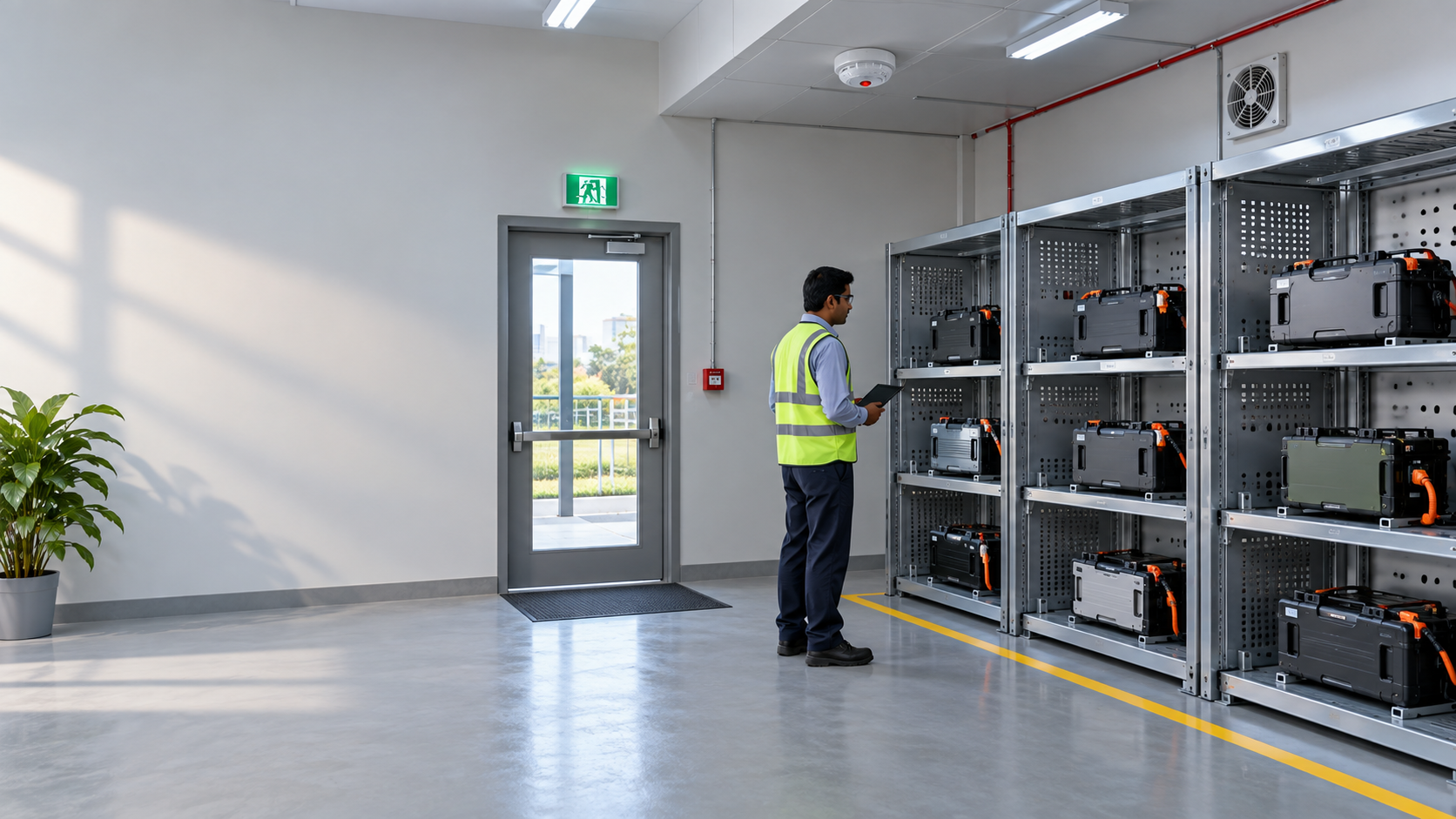
- Best place: outdoors in a well-ventilated area, or in a separate parking building at or above ground with naturally cross-ventilated sides.
- If EVs share a car park: separate them from other vehicles with both passive means (such as fire-rated walls and doors) and active means (water mist sprinklers, early thermal runaway detection, or encapsulating agents such as vermiculite, clay or mica). Fire-rated walls are preferred over fire curtains.
- Which level: the ground level is preferred and in no case below the first basement. Charging below ground is limited to the first basement, near the entrance. Part D adds that no charging infrastructure or EV parking should be in the last basement.
- Compartment: in a basement, the EV parking and charging compartment is at most 1,000 sq m.
- Switches: isolation cut-off switches and a fireman’s emergency switch, preferably automatic, or at ground level if manual.
- Ventilation: 15 to 18 air changes an hour with a gas monitoring system, in the covered first-basement case, as printed.
- Share of spaces: a recommendation of EV charging for 20 percent of parking, which may rise to 30 percent by 2030.
- Electrical: a 30 mA residual current device on each outlet, copper cables with crimped terminals, four-core cable up to 50 sq mm for charging stations, and a separate transformer recommended where the connected load goes above 100 kW. Charging is not to be fed from a diesel or gas generator.
- Portable extinguishers: access to portable fire-fighting equipment within 15 m of each charging point.
- Two-wheelers: kept apart from four-wheelers and charged on the ground floor only, with a water mist system.
The standard does not say how to put out a battery fire, and it adds that the provisions may be changed if a better extinguishing medium proves effective. Our guides explain what a lithium-ion fire looks like and how to respond: lithium-ion battery fires: prevention, detection and safe response, phone battery blasts in pockets and on charge, car fire safety in an EV, CNG or petrol car and an electric bus or car that smells of burning.
Worked example: a society with 40 EV chargers
This is a simple illustration of how to read the national standard, not the legal answer for any real building. A real building is decided by its approved plan, the version of the rules your state uses and your fire officer.
A housing society has 200 car spaces and a basement with two levels. It wants 20 percent of spaces to have charging, which is 40 points. Read against the standard, the first questions are about place. Charging may be on the ground level and in the first basement, and not in the second basement, which is the last. Each EV charging area in the basement is a compartment of at most 1,000 sq m, with sprinklers at CL-5, rate-of-rise heat detection, a fireman’s emergency switch and extinguishers within 15 m of each point. The first-basement ventilation and gas monitoring have to be designed in. If every point is 3 kW (an assumption for this example, not a figure from the standard), the load is 120 kW, which is above the 100 kW at which a separate transformer is recommended. None of this lets 40 chargers go into the lowest level to save space. The standard prefers a separate, open or cross-ventilated charging area at ground level instead. See meter box and parking-area fires in housing societies for the electrical side.
What this means for housing societies and owners
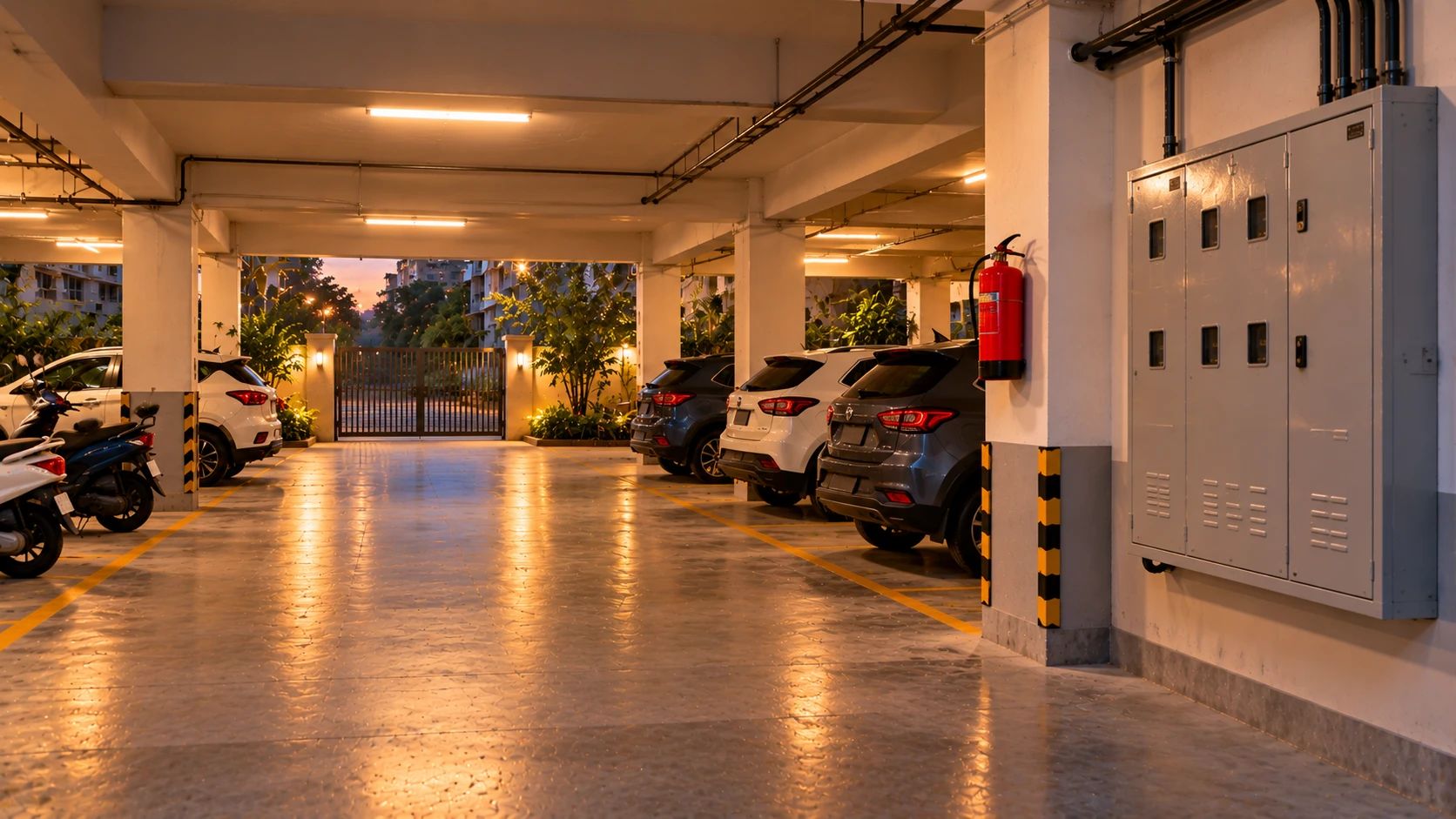
- Charging points: ask where they are, which level, and who approved the fire protection. If they are in the lowest basement, ask the fire officer.
- Parking rules: no vehicles on stairs, ramps or in corridors, and no storage in the car park.
- Sprinklers: check they are clean, unpainted and clear of stacked goods, and that no valve is left closed. Read our guide to how sprinklers work and why they fail.
- Everyone: know your nearest exit from the car park. Walk it once. Fire safety is an ongoing job, and maintenance for building owners covers it.
Ask your fire officer
These are fair questions to put to a society or a mall manager.
- Which clause or state rule decided the sprinklers in our car park, and what type of head are they?
- Which level is the EV charging on, how big is its compartment, and where is the emergency switch?
- Are there smoke detectors in the basement and carbon monoxide sensors in the petrol and diesel car park?
- Where are the exits from each basement level, and is any ramp or stair lobby used for parking?
- Which version of the standard or state rule applied when this was approved?
Where this stands in law
The National Building Construction Standards 2026, Part F, is voluntary. It binds a building only once a state or local authority adopts it, and until then your state’s building rules and the fire department decide what applies. Older buildings were approved under earlier rules. Our guide to fire safety laws in India explains the layers. This guide is general safety information. It is not legal or engineering advice, and it does not tell you whether a particular building complies.
What we could not confirm
- Which parking sprinkler clause governs a basement. The standard gives several, as shown above.
- How a state that has adopted the standard may have changed any of this.
- The listed video, which was checked for public status and embedding but not watched in full.
Do this today
Walk down to your car park. Look for vehicles on ramps or in stair lobbies. Look at the ceiling for sprinkler heads and see that they are clean. If there are EV chargers, note which level they are on and where the nearest extinguisher is. Then read our lithium-ion battery fire guide with your family. For kitchens and gas, read our companion chapter on kitchens, LPG and gas pipes under NBC 2026. Our chapters on water and first-aid fire fighting and on fire officers, drills and maintenance carry on from here.
What needs attention
- A basement is asked for smoke ventilation, sprinklers and at least two independent exits; a protected basement meets CL-3 and EV parks meet CL-5.
- Rate-of-rise heat detection is asked for in EV parks and charging areas, smoke detectors in basements, and carbon monoxide sensors in petrol and diesel car parks.
- An enclosed basement car park may be one compartment of 750 sq m, or 5,000 sq m if sprinklered; the EV charging compartment in a basement is at most 1,000 sq m.
- EV charging is kept to the ground level and the first basement, never the last basement.
- No vehicles in stairwells or on ramps.
- The standard gives two different parking sprinkler rules and describes basement sprinkler heads in three ways.
- The standard is voluntary until a state adopts it.
Controls that reduce risk
- Walk your car park and look for vehicles on ramps and stair lobbies.
- Find which level the EV chargers are on and where the emergency switch is.
- Check the sprinkler heads are clean and clear, and no valve is left closed.
- Walk the nearest exit from the car park once.
- Ask your fire officer which rule decided the sprinklers in the car park.
Common unsafe practices
- Putting EV chargers in the lowest basement to save space.
- Parking on ramps, in stair lobbies or in corridors.
- Treating one parking sprinkler clause as the answer when the standard gives several.
- Leaving a sprinkler valve closed or painting over sprinkler heads.
- Treating this guide as proof that a building complies.





Leave a comment