
Quick answers
What happened at the Mota Varachha society parking fire on 21 October 2026?
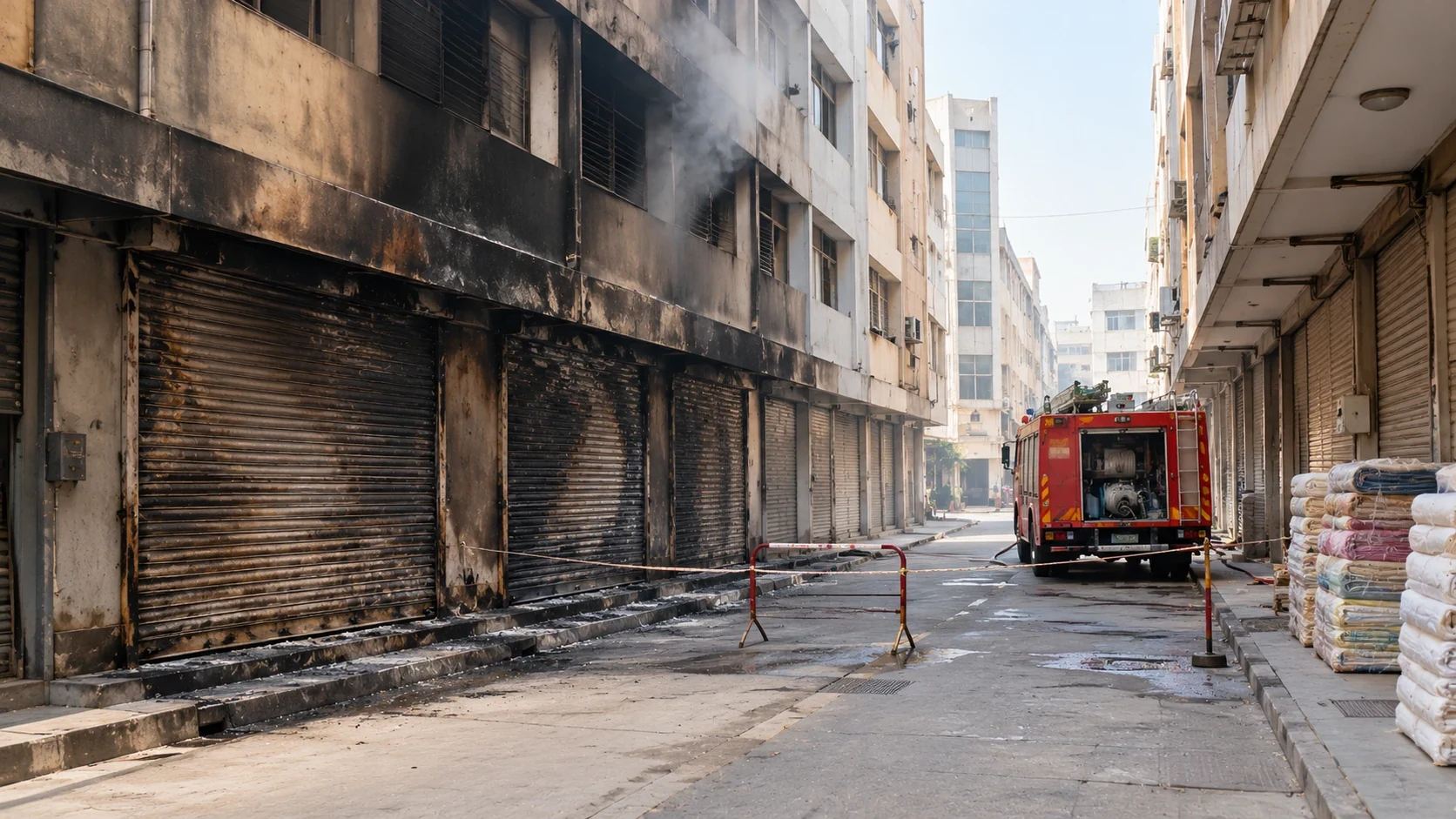
Several cars and two-wheelers burnt in the parking of a residential society in Mota Varachha, Surat, with no casualties reported. Gujarat Samachar English reports four cars and three two-wheelers and an electric vehicle explosion; a DD News Gujarati caption reports three cars and three bikes and a meter-box short circuit. The cause is not confirmed.
Can a meter box start a fire?
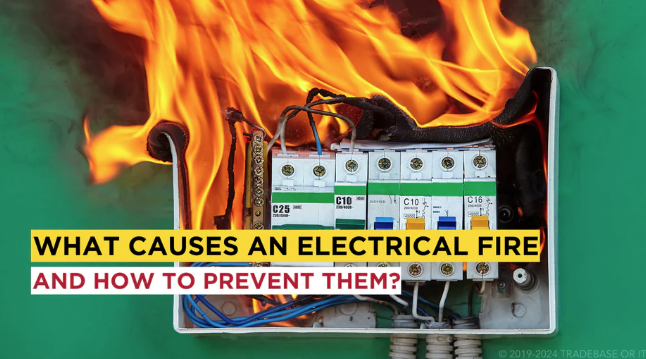
Yes, an electrical box can overheat from loose connections, overload or damage, and the NFPA lists warning signs such as frequent tripping, warm or discoloured outlets, a burning smell and sparks. Whether that happened in Mota Varachha is not confirmed.
What should a housing society check in the parking area?
A dated inspection of the meter room and main board by a licensed electrician, a clear area around the box, working extinguishers and hose reels, a rule for EV charging points, and a clear lane for the fire engine.
Is EV charging in society parking safe?
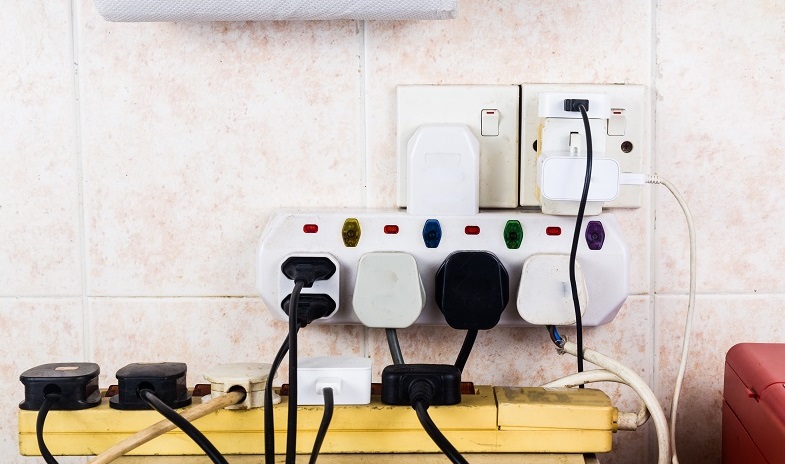
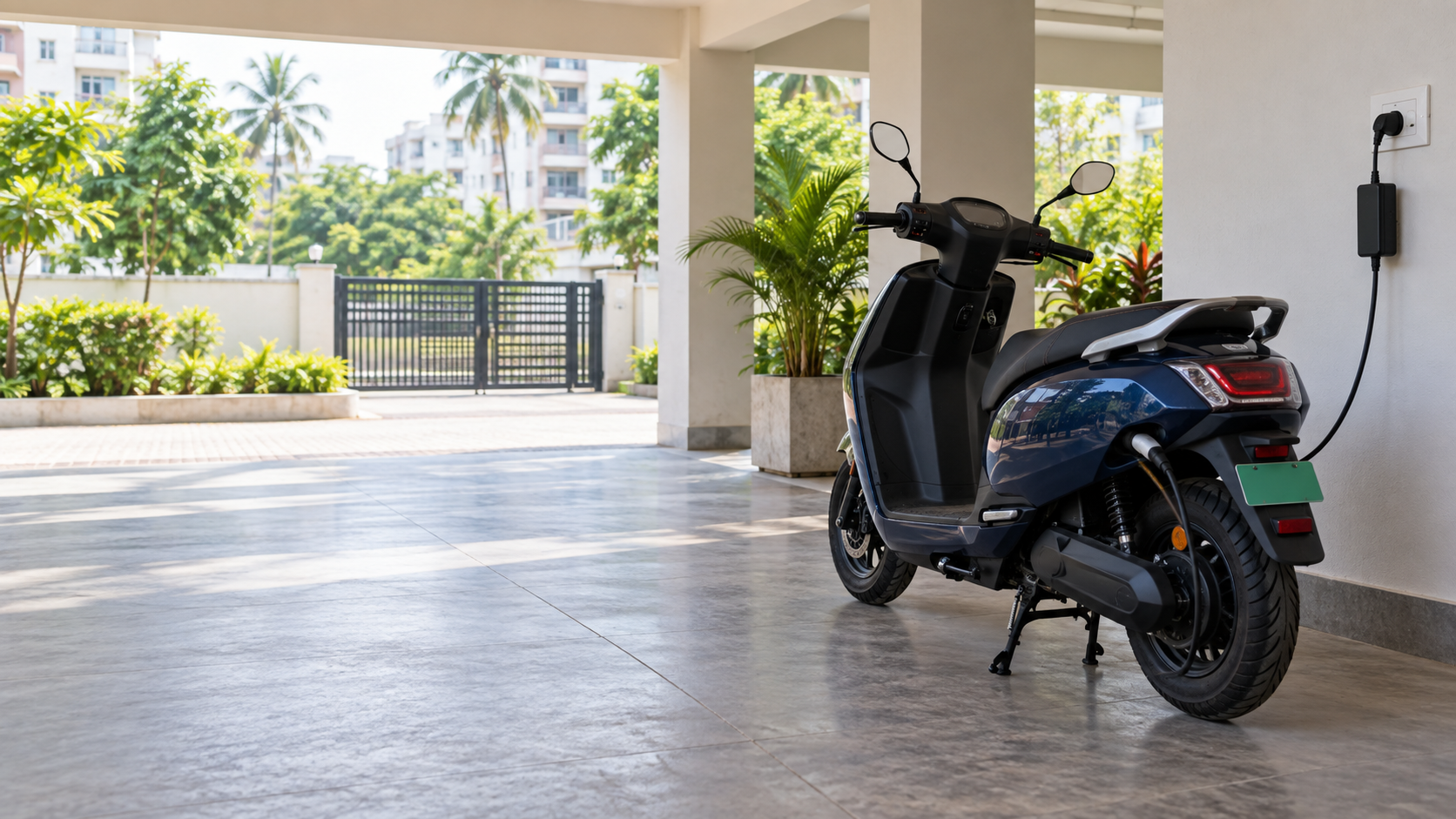
USFA advises a dedicated circuit installed by a qualified electrician, a certified charger, no extension cords or multi-plug adapters, a residual current device and no use of a damaged charger.
Is the housing society responsible for fire safety in Gujarat?
Under the Gujarat Fire Prevention and Life Safety Measures Act, 2013, section 18, the housing society or owner must keep fire prevention and life-safety measures in operational condition for buildings classified under the rules. Check with your local fire office which rules apply to your building.
What should I do if a vehicle catches fire in the parking?
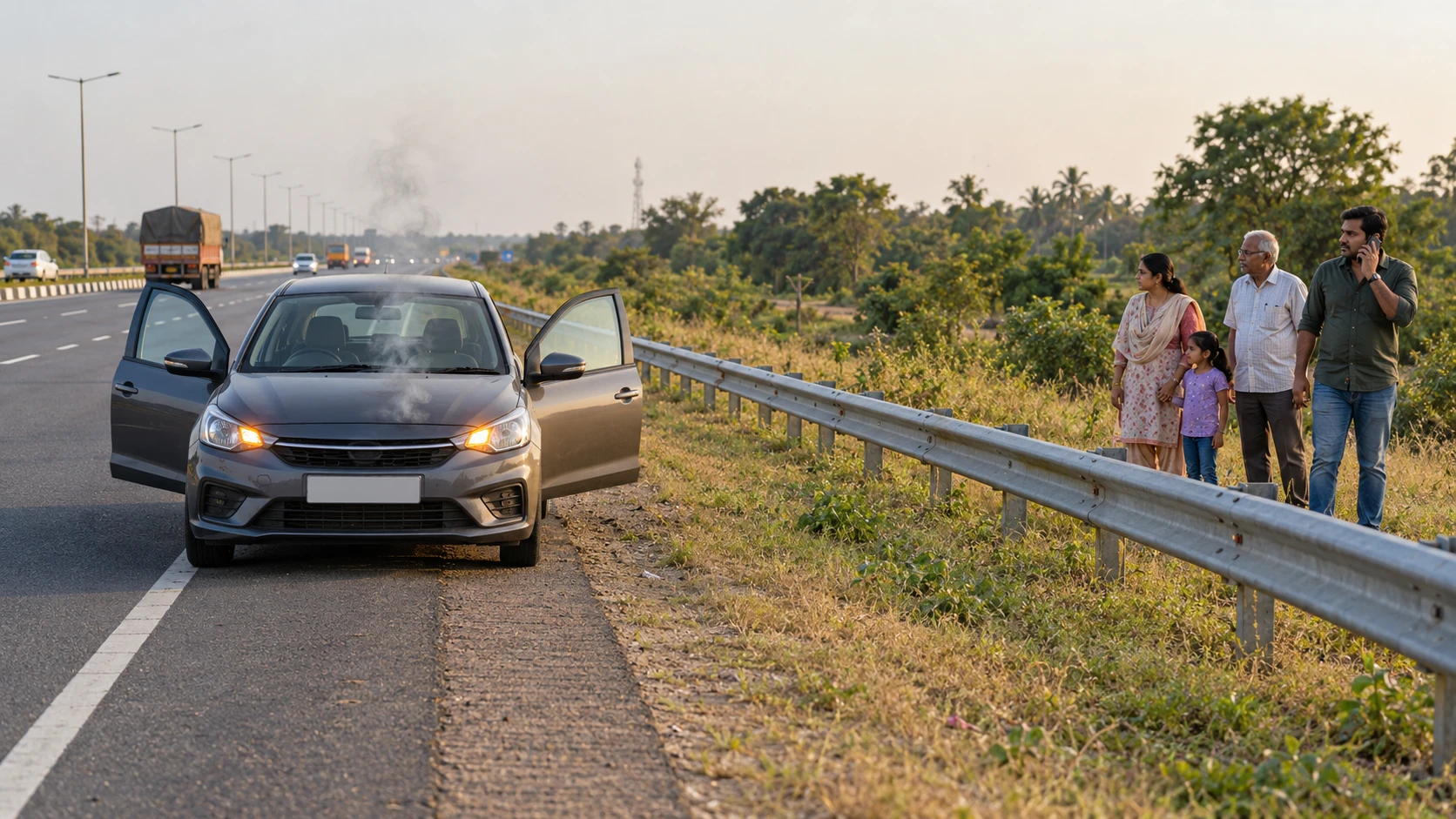
Call 101 or 112, get away, do not open the bonnet or boot, do not fight it yourself and do not try to move it. USFA advises staying at least 100 feet (about 30 metres) away.
Which numbers should I call?
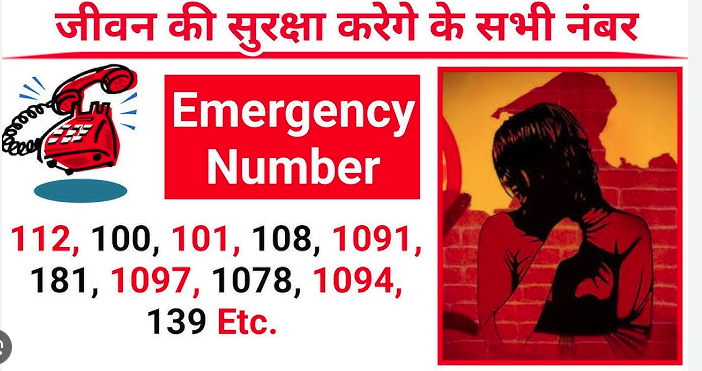
112 for any emergency, 101 for the fire brigade and 108 for an ambulance. These are national numbers and can vary by state.
On Wednesday 21 October 2026 a fire in the parking area of a residential society in Mota Varachha, Surat, burnt several cars and two-wheelers. No one was reported hurt. That much two reports agree on. They disagree on the cause and on the count. Gujarat Samachar’s English edition says an electric vehicle reportedly exploded and that four cars and three two-wheelers burnt. The caption of a DD News Gujarati video, as it was read for us, says a short circuit in a meter box started it, that three cars and three bikes burnt, and names the society and the road. We could not find a fire department statement, so we do not say what caused it. Last checked: 21 October 2026. This page is about the hazard, which every society with a parking area shares: a meter box or electrical panel in the parking, a lot of vehicles close together, and no one around when the first flame shows.
In short
- A parking area is not a harmless open space. Every car and scooter carries fuel or a battery, plastic, rubber and wiring, and they are parked a hand’s width apart.
- Meter boxes, distribution boards and charging points in parking are common places for a fault to start, mainly through loose connections, overload and damage.
- Residents can do three things quickly: spot the warning signs, call 101 or 112 early, and stay away from the burning vehicle.
- Under the Gujarat Fire Prevention and Life Safety Measures Act, 2013, the housing society is itself responsible for keeping its fire-safety equipment working.
What was reported in Mota Varachha
Gujarat Samachar (English) reported on 21 October that an electric vehicle exploded and set fire to vehicles parked nearby in Mota Varachha, with four cars and three two-wheelers burnt, no casualties, and firefighters bringing the fire under control. It gave no building name, no time and no number of fire tenders, and said the exact cause was being investigated. A DD News Gujarati Instagram video posted the same day has a caption that, in the version supplied to us, describes a fire in the parking of a residential building on D-Mart Road, Mota Varachha, from a short circuit in a meter box, with three cars and three bikes burnt and no casualties because the fire department acted in time. The Instagram page would not open for us without a login, so we could not re-read the caption or see the video. Because the two accounts differ and neither is an official statement, we treat the cause as unconfirmed, and we have not written a full case study. If a fuller report appears, we will update this page.
How a fire starts in a society parking
These are general points, not a finding about Mota Varachha.
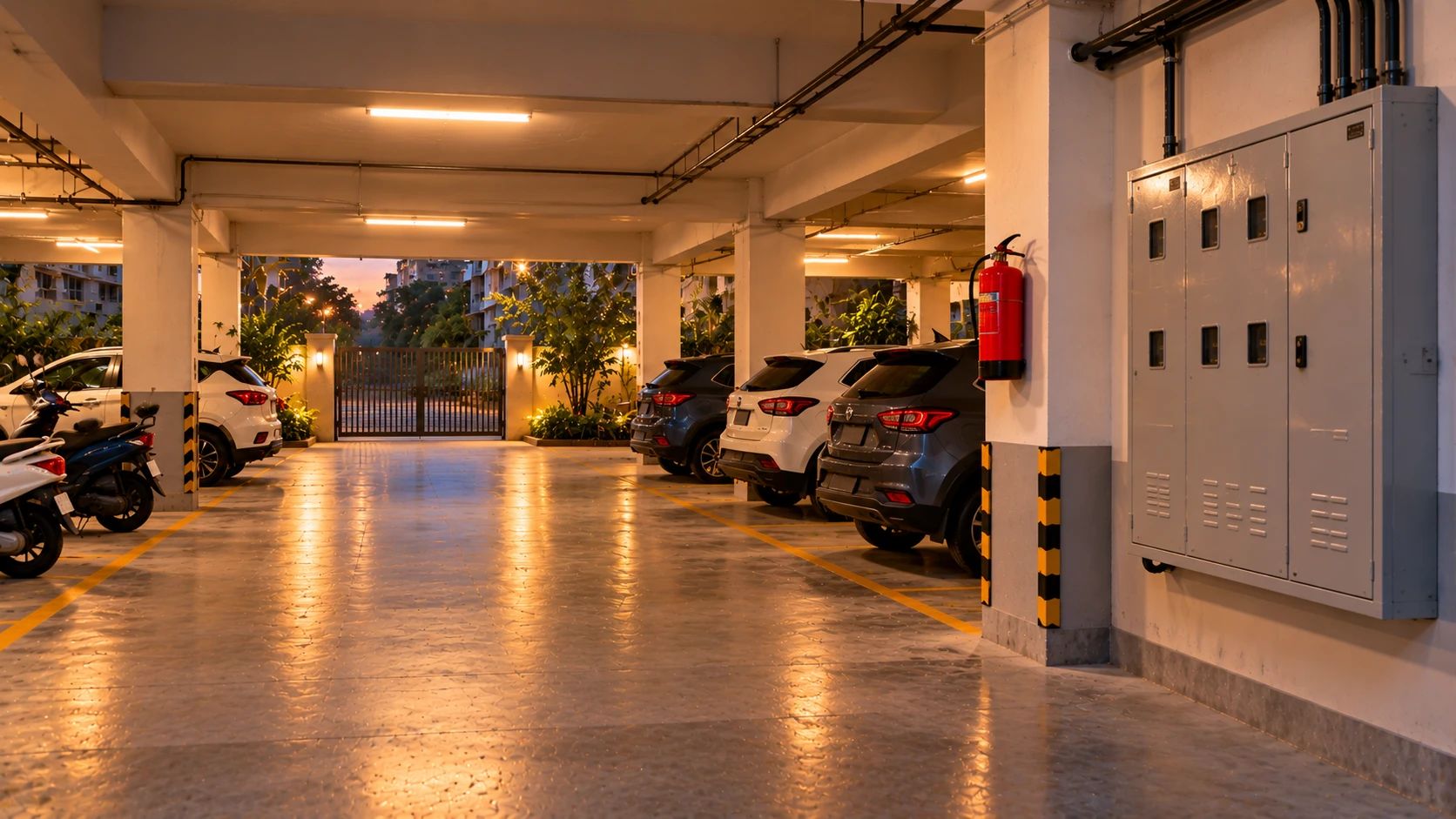
- The electrical box. The meter room or panel in many societies sits right in the parking or at the edge of it. Over time, screws work loose, cables get hot at the joint, dust and moisture collect, and extra load is added, such as a new charging point or a second air conditioner. The US National Fire Protection Association (NFPA) tip sheet lists the signs to act on: fuses blowing or breakers tripping often, warm or discoloured outlets, a burning or rubbery smell, flickering lights, and sparks. It says to call a qualified electrician for these.
- The vehicles. The US Fire Administration (USFA) names mechanical and electrical problems and crashes as common causes of vehicle fires. A parked vehicle can also catch from a fire next to it.
- Charging. More residents now charge e-scooters and electric cars at home. USFA advice for home charging is a dedicated circuit installed by a qualified electrician, a certified charger, no extension cords or multi-plug adapters, a residual current device with the charging unit, and no use of a charger that shows damage. Our guide on why e-bikes catch fire covers the battery side.
- Things stored in or near the parking. Petrol cans, LPG cylinders, cardboard and old furniture near the meter room give a small fire more to burn. USFA’s vehicle-fire advice includes keeping fuel containers sealed and upright and away from passengers.
What a society committee can do this month
This is our advice, drawn from the sources below, and it is not a legal checklist.
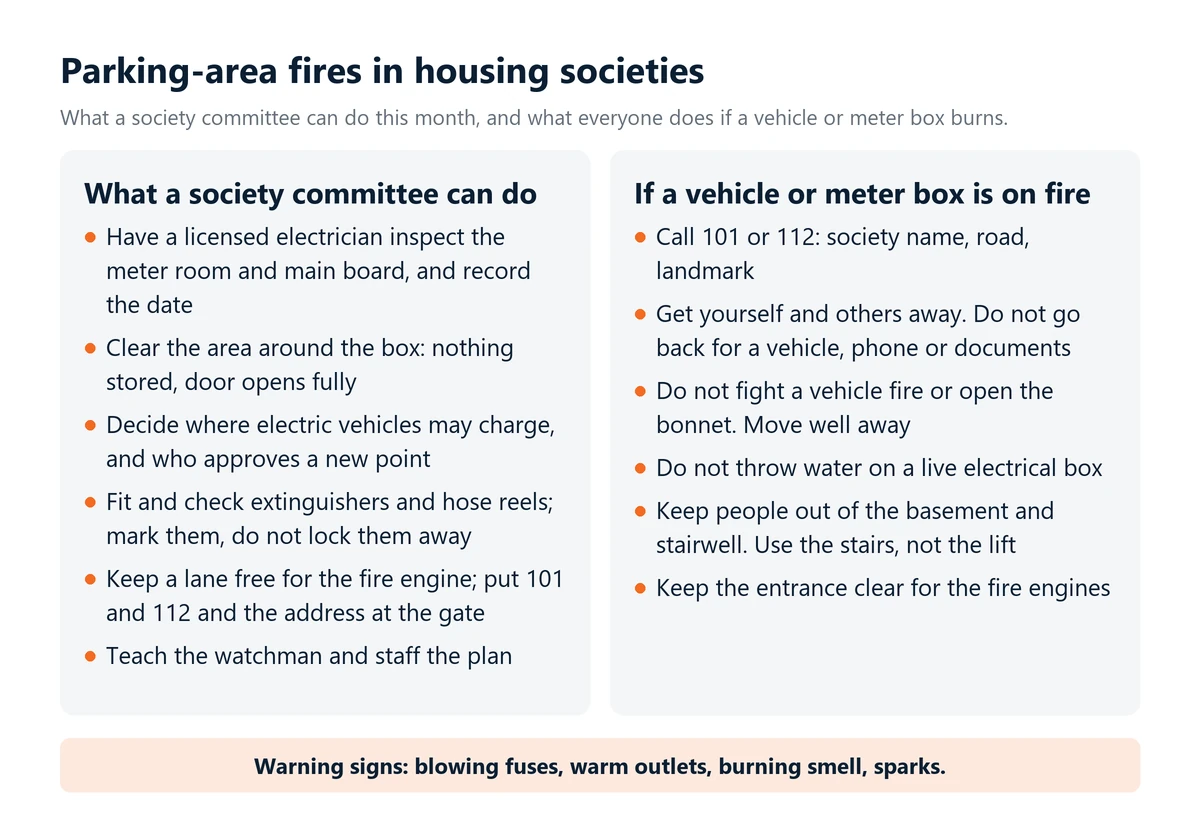
- Have a licensed electrician inspect the meter room and main distribution board. Ask for tight terminals, no burnt or discoloured wiring, working protective devices, and a record of the date. The NFPA says to use a qualified electrician for all electrical work. Our guide to electrical safety at home, including MCB and RCCB explains what each device does.
- Clear the area around the box. Nothing stored within arm’s reach, and the door must open fully. Never use the meter room as a store.
- Decide where electric vehicles may charge, and who approves a new charging point. Ask the electrician about the load first.
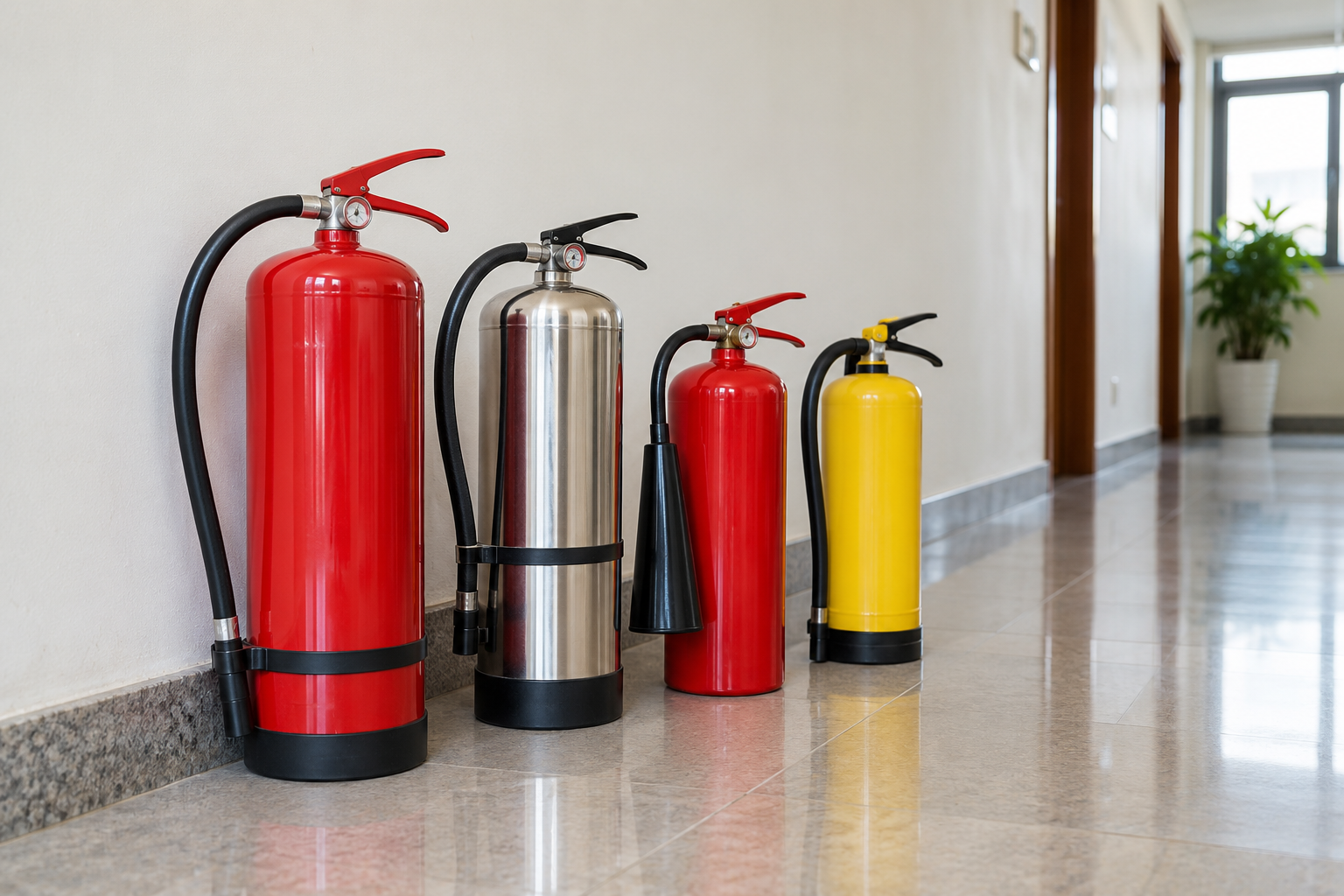
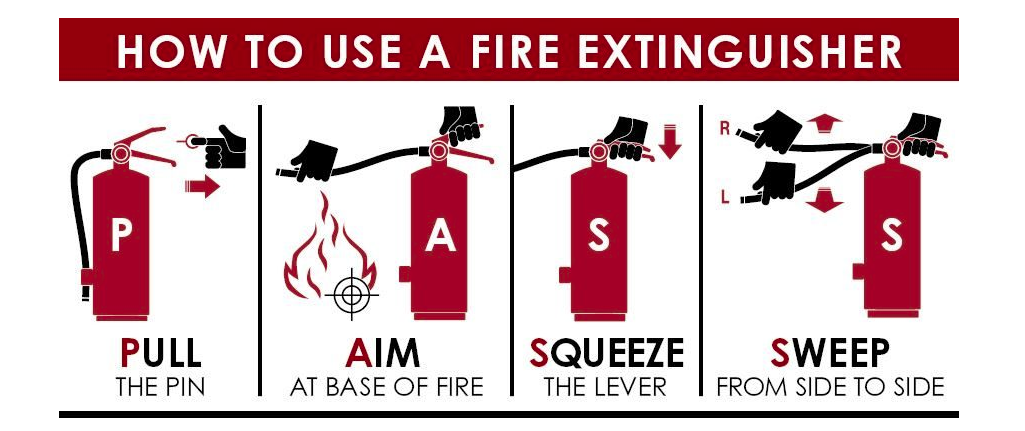
- Fit and check fire extinguishers and, where the society has them, hose reels in the parking and basement. Mark them, and do not lock them away. Our pages on which extinguisher works on which fire and the PASS method are a good start for the committee and the watchmen.
- Keep a lane free for the fire engine, and do not let double-parking block the gate. Put the 101 and 112 numbers and the society’s address on a board at the gate.
- Teach the watchman and the staff the plan. Who calls, who opens the gate, who switches off the main supply if it is safe to do so.
The legal duty in Gujarat
The Gujarat Fire Prevention and Life Safety Measures Act, 2013, as read on a legal database that hosts the text, defines a housing society to include registered residential societies and flat-owner associations. Section 18 places the duty on the society or owner, for buildings classified under the rules, to keep fire prevention and life-safety measures in operational condition at all times. A licensed agency is to give a maintenance certificate (section 19) and the Act makes failure to maintain the equipment an offence (section 39). We could not confirm from the page which buildings the rules cover, or whether a given society’s parking falls under them, so ask your local fire office or a licensed fire-safety agency what applies to your building.
If a vehicle or the meter box is on fire
- Call 101 for the fire brigade, or 112 for any emergency, and say the society’s name, the road and the nearest landmark. Our guide on how to call 112, 101 or 108 has what to say.
- Get yourself and others away. Do not go back for a vehicle, a phone or documents.
- USFA says not to fight a vehicle fire yourself, and not to open the bonnet or boot if the fire seems to be there, because that can make it grow. It advises moving at least 100 feet, about 30 metres, away.
- Do not try to drive or push a burning vehicle out. It is our advice that you leave that to the fire brigade. If neighbouring vehicles are not yet burning and it is safe to do so, move your own and stay clear.
- Do not throw water on a live electrical box. If the fire is small, the supply can be switched off at the main switch by someone who knows where it is and can reach it safely. If in doubt, stay away.
- Keep people out of the basement and the stairwell, where smoke collects. Use the stairs, not the lift.
- Keep the entrance clear for the fire engines.
What is still not known
- What caused the Mota Varachha fire: an EV, a meter box, or something else.
- The exact number of vehicles burnt (six or seven in the two accounts) and the name of the society as it appears in official records.
- The time of the fire, how many fire tenders came and from which station, and how long the fire took to control.
- Whether any FIR, inquiry or insurance claim has been filed. We found no report on any of these.
More on Surat: see our Surat fire and emergency safety guide for fire brigade numbers, every fire station and the local risks to know. Surat’s recent fires include the Hotfix plastic waste fires at Limbayat and Punagam and the Adinath Textile Market fire. For a parking fire elsewhere, read our Bangalore Gangondanahalli parking lot fire case study.
Who to call
112 for any emergency, 101 for the fire brigade and 108 for an ambulance. These are the national numbers and can vary by state, so check yours. Say the name of the society, the road and what is burning, and stay on the line.
Last checked: 21 October 2026. We will update this page if a fuller report or an official statement appears.
What needs attention
- Two accounts of the same fire gave different causes and different vehicle counts on the first day, which is why this page does not name a cause.
- Electrical boxes in parking areas fail through loose connections, overload and damage, and the warning signs (frequent tripping, warm or discoloured fittings, burning smell, sparks) are known and easy to check.
- Parked vehicles close together mean a fire in one can spread to the next, and every vehicle adds fuel or a battery.
- Home charging adds electrical load and heat to the same area; USFA advice is a dedicated circuit, certified equipment, no extension cords and a residual current device.
- In Gujarat the housing society itself carries the legal duty to keep fire-safety equipment in working order, but we could not confirm which buildings the rules cover.
Controls that reduce risk
- Committee: have a licensed electrician inspect the meter room and main board, record the date, and fix any loose, burnt or overloaded fitting.
- Committee: keep the meter room clear, do not store anything in it, and fit and check extinguishers in the parking and basement.
- Committee: agree a rule for EV charging points, with an electrician’s load check before any new point.
- Resident: report a warm, humming, sparking or burnt-smelling box to the committee at once.
- Resident: call 101 or 112 early, give the society name, road and landmark, and move away from the burning vehicle.
- Watchman and staff: know the plan, keep the gate and lane clear for the fire engine, and do not fight a vehicle fire.
Common unsafe practices
- Storing cartons, furniture, petrol cans or cylinders in or beside the meter room.
- Ignoring a box that is warm, humming, smells of burning or keeps tripping.
- Running a charger from an extension cord or multi-plug adapter in the parking.
- Parking so close or so badly that a fire engine cannot enter the compound.
- Locking extinguishers and hose-reel cabinets, or leaving them unchecked for years.
- Opening the bonnet of a burning vehicle, or trying to drive or push it out.
- Throwing water on a live electrical box.

Leave a comment