
Quick answers
What should I do if an electric bus or car smells of burning?
Stop at the first safe place, switch off, get everyone out and move well away, upwind. Then call 112 or 101 and say it is an electric vehicle. Do not open the bonnet, boot or battery cover and do not go back in for belongings.
What caused the Pune electric bus fire?
It is not yet known. The Times of India quoted a divisional controller of the transport corporation saying a short circuit may have triggered the fire and that further investigation will establish the exact cause.
Can an electric vehicle fire restart after it is put out?
Yes. A demonstration by UL Research Institutes with Maharashtra Fire Services in Mumbai in August 2023 showed a lithium-ion battery fire restarting after it was extinguished. Stay away and tell the fire brigade it is an electric vehicle.
Should I use a fire extinguisher on an electric bus fire?
Not on a battery fire. A small extinguisher will not stop it. If everyone is out and the fire is tiny and away from the battery, only trained staff should try. Otherwise move away and call 112 or 101.
What should passengers do if an electric bus is on fire?
Leave by the nearest door without waiting for a second instruction, leave bags, help children and the elderly, use the emergency exit or window hammer if doors jam, then walk well away and do not return.
What safety standards cover electric bus batteries in India?
AIS-038 Rev 2 covers the electric power train of M and N category vehicles, which includes buses and trucks, and AIS-156 covers L category vehicles. Both were amended in 2022. A standard does not guarantee that a particular bus is safe.
Which number should I call for a vehicle fire, 112 or 101?
Either. 112 is the all-emergency number and 101 is the fire brigade. Give the road, a landmark, the direction you were travelling, the type of vehicle and that it is electric.
On the morning of Monday 26 October 2026, an electric MSRTC E-Shivai bus that had come into Pune from Solapur caught fire near Swargate. The Times of India reported that about 17 passengers got out and nobody was hurt. The driver noticed smoke coming from the bus and pulled over to the side of the road, then told everyone to get off, and the report credits that quick response for the safe escape. A divisional controller of the transport corporation said a short circuit may have triggered the fire, and a further inquiry will look for the exact cause. We are not drawing any conclusion about this bus. What the report does show is the pattern that saves lives: smoke, a quick stop, everyone out. This page is about those first thirty seconds in an electric bus or an electric car, and about what changes when the vehicle runs on a large battery.
In short
- Stop. Smoke or a burning smell is enough. Pull over where it is safe and switch off.
- Out. Everyone leaves by the nearest door. Leave the bags.
- Away. Move well away, upwind, and behind a barrier if you can.
- Call. 112 for any emergency or 101 for the fire brigade. Say it is an electric vehicle.
- Do not open the bonnet, boot or any battery cover, and do not go back in.
Warning signs you should not ignore
- A smell of burning plastic, rubber or wire, in the cabin or from the vents.
- Smoke or steam from the dashboard, the floor, the roof, the rear or from under the vehicle.
- Hissing, popping or crackling sounds, especially from the battery area.
- A battery or high-voltage warning on the dashboard, sudden loss of power or lights and displays flickering for no reason.
Do not try to reach the next stop or the depot. Our guide to car fire safety in the first 30 seconds has the same advice for cars. This page adds what drivers, conductors and passengers of a bus should do.
If you are the driver
- Indicate and pull over at the first safe place, away from a petrol pump, a crowd, a stack of parked vehicles or an enclosed space.
- Switch the vehicle off, apply the handbrake and put on the hazard lights.
- Open all the doors and tell passengers loudly to get out. Say it once, clearly: everybody out, leave your bags.
- Check that the doors you opened are not blocked, and use the emergency exit if one is jammed.
- Get out yourself after a quick look down the aisle. Do not run back for anything.
- Call 112 or 101 and give the road, the landmark, the direction you were travelling and that it is an electric bus.
Our suggestion: if your bus has a battery isolation or emergency switch, your operator’s drill should tell you where it is and when to use it. We have not given model-specific steps because they differ between makers.
If you are the conductor or a passenger
- Do not wait to be told twice. If you see smoke or smell burning, say so loudly, and move to the nearest door.
- Help children, older people and anyone with luggage or a disability, but do not block the aisle.
- Leave your bags. Do not stop to film, and do not open the luggage compartment.
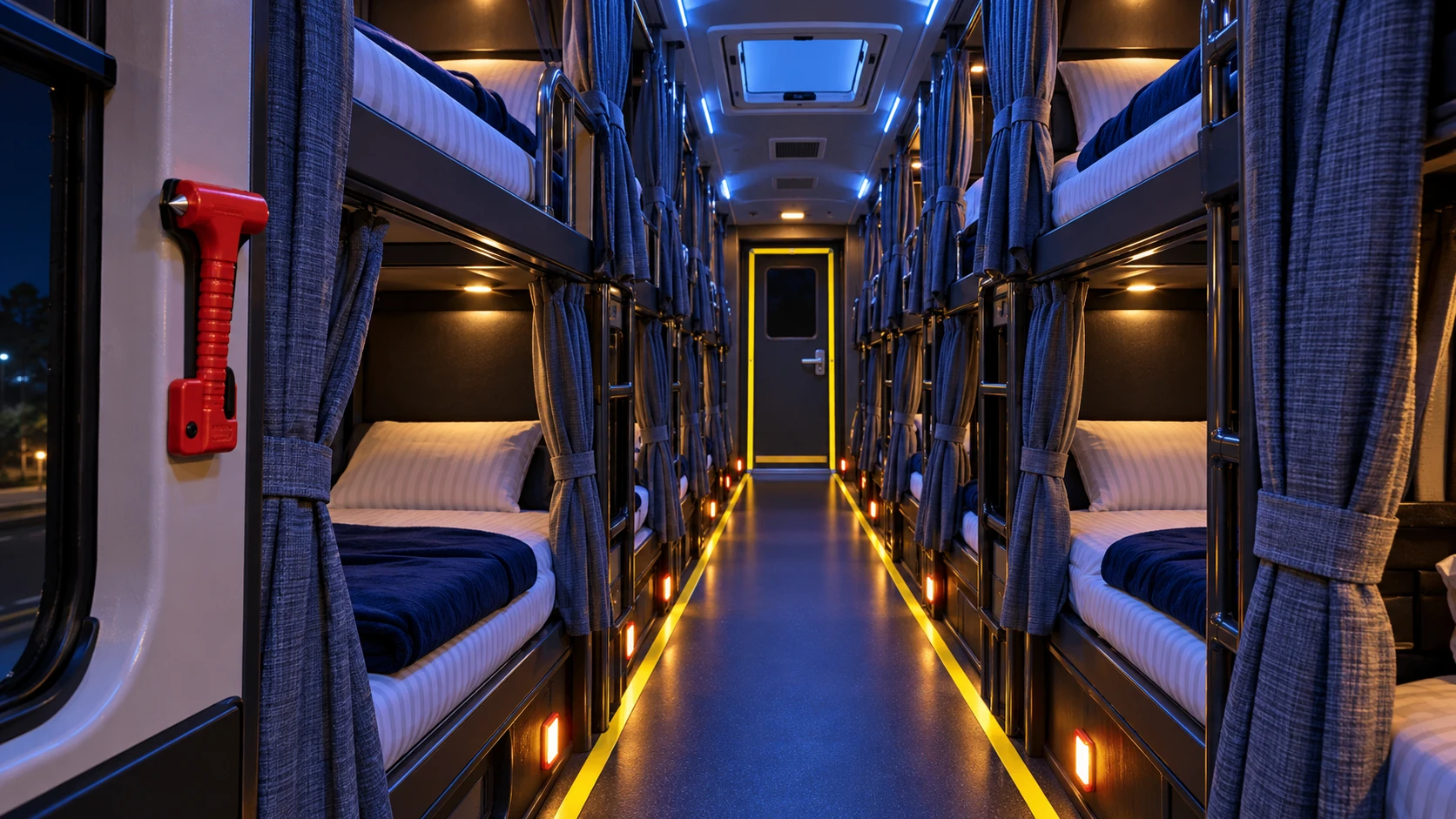
- If the doors do not open, go to the emergency exit or use the window hammer to break the glass. Our guide to getting out of a sleeper bus fast explains how.
- Count your group once you are out, then walk well away from the bus. Do not return.
Why electric vehicle fires are different
An electric bus or car carries a large pack of lithium-ion cells. When one cell overheats, it can set off a chain reaction called thermal runaway that spreads from cell to cell. Such fires give off flammable and toxic gases, can take long to cool and can restart. In August 2023, UL Research Institutes and Maharashtra Fire Services showed at Mumbai how a lithium-ion battery fire can reignite even after being put out. That is why you should not open any cover, not try to fight it with a small extinguisher and not go back in once everyone is out. Our explainer on lithium-ion battery fires goes deeper.
What the rules say about the batteries
India has tested its traction batteries against specific standards since 2022. AIS-038 Rev 2 covers the electric power train of M and N category vehicles, which includes buses and trucks. AIS-156 covers two- and three-wheelers, and quadricycles. Both were amended in 2022, and the road ministry decided to bring the third amendment in two phases, from 1 December 2022 and 31 March 2023, according to a circular hosted by the auto components makers’ association. An ARAI-based compilation says AIS-038 Rev 2 takes a system-level approach and covers protection from thermal runaway. A standard on paper is not a guarantee for one vehicle on one day. We read the circular and the compilation, not the standards themselves.
What operators can do
Our suggestion: brief drivers and conductors on a simple drill, test the window hammers and emergency exits, keep fire extinguishers in date, and treat every smoke or burning smell report as an emergency stop. After a fire or a crash, keep the damaged vehicle away from a depot full of other buses. An India Today ground report in September 2026 found a choked emergency exit and no window hammers on a long-distance bus it checked, which shows the basic items are often the ones missing.
What we could not confirm
- The cause of the Pune fire. A short circuit was mentioned as possible by an official, and the exact cause is yet to be established.
- The passenger count. The Times of India says about 17; a news video title says the bus was full of passengers. We have used the newspaper’s figure.
- The distance to stand from a burning electric vehicle. We found no official Indian figure for buses. Move as far as you safely can, upwind.
- What the amended standards require in detail. We did not read AIS-038 or AIS-156.
- Only one newspaper report of the Pune fire could be opened. The other outlets, including the transport corporation’s own statement, could not be read.
- We found one public Facebook video of an electric bus fire abroad, which we did not use. We found no public Instagram or LinkedIn video of the Pune fire we could open and match.
Do this today
The next time you board a bus, look at where the doors, the emergency exit and the window hammer are, and tell the child beside you. If you drive or run an electric vehicle, write the first thirty seconds on a card and keep it in the cabin. Checked 28 October 2026.
What needs attention
- The Times of India reported that about 17 passengers escaped unhurt when an MSRTC electric bus caught fire near Swargate in Pune on the morning of Monday 26 October 2026.
- It reported that the driver noticed smoke, pulled over and told passengers to get out, and that an official said a short circuit may have triggered the fire.
- UL Research Institutes reported a demonstration with Maharashtra Fire Services in Mumbai in August 2023 in which a lithium-ion battery fire restarted after being put out.
- AIS-038 Rev 2 covers the electric power trains of M and N category vehicles; AIS-156 covers L category vehicles (EV Reporter, ARAI-based).
- A circular hosted by the auto components makers' association says the road ministry brought the third amendment of the two standards in two phases, from 1 December 2022 and 31 March 2023.
- India Today's ground report in September 2026 found a choked emergency exit and no window hammers on a Delhi to Jammu bus it checked.
Controls that reduce risk
- Learn where the doors, emergency exit and window hammer are in every bus you take.
- Stop at the first safe place if you smell burning or see smoke.
- Get everyone out and away, upwind, before you call.
- Call 112 or 101 and say it is an electric vehicle.
- Do not open any cover or go back in.
- Operators: drill drivers and conductors, and test the hammers and exits.
Common unsafe practices
- Driving on to the next stop or depot with smoke or a burning smell.
- Waiting for a second instruction before getting out.
- Opening the bonnet, boot or battery cover to look.
- Going back in for bags, phones or documents.
- Trying to put out a battery fire with a small extinguisher.
- Standing close by to film, or parking a fire-damaged vehicle next to others.


Leave a comment