
Quick answers
How can I cut my risk of dying in a road crash?
Wear a helmet or seat belt on every trip, including in the back seat. Keep your speed down, keep the phone away, never drink and drive, and carry a first-aid kit in every vehicle.
Does a little overspeeding really matter?
Yes. WHO says every 1% rise in average speed raises the risk of a fatal crash by about 4%. Over-speeding accounted for 68.1% of road deaths in India in 2023.
Should I stop and help if I see a road accident?
Yes, if it is safe. Park well away, switch on your hazard lights and call 112 or 108 with the exact place. India's Good Samaritan law protects people who help crash victims in good faith.
Are road accidents just bad luck?
No. Most road deaths come from speed, no helmet or seat belt, drunk or distracted driving and unsafe roads. All of these can be fixed, which is why WHO calls road traffic injuries preventable.
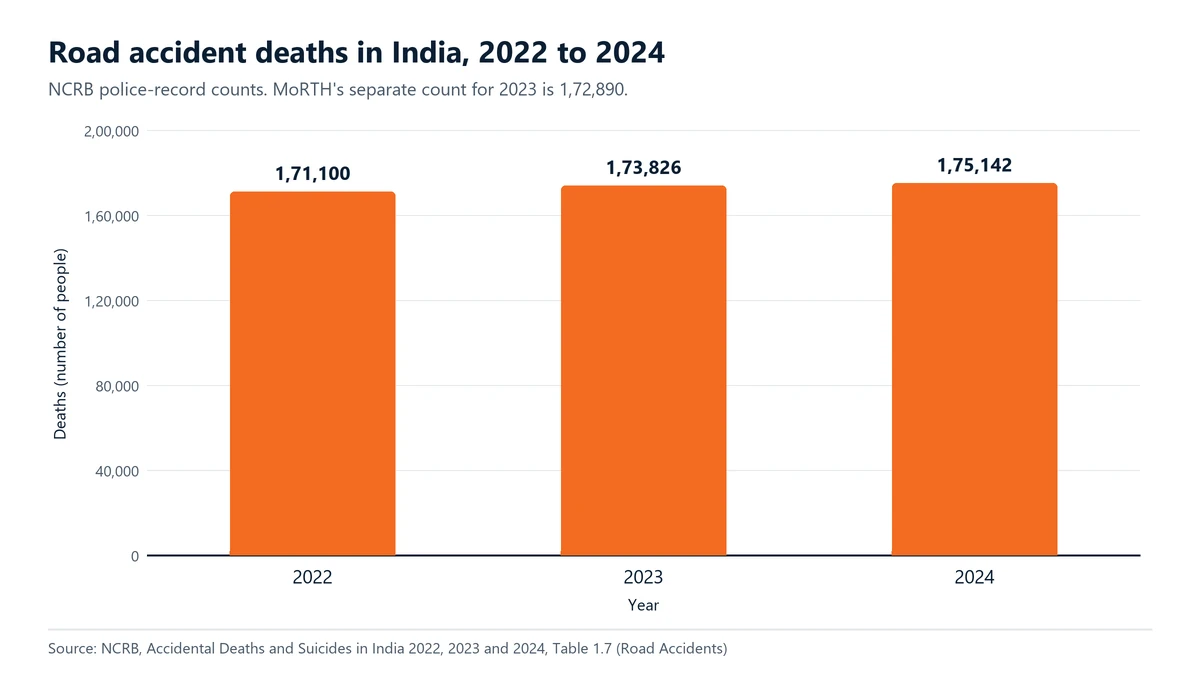
In 2023, 1,72,890 people died on India’s roads. That is about one death every three minutes, or around 474 every day. (Source: Ministry of Road Transport and Highways, Road Accidents in India 2023)
Why this matters
Imagine something that killed nearly 500 Indians every single day. There would be headlines, debates and emergency meetings. On our roads it happens quietly, and we treat it as routine.
A rider without a helmet, an overloaded truck, a drunk driver, a pothole on a dark highway: these are not “accidents” in the sense of bad luck. Most of them are deaths we know how to prevent. Countries that have cut road deaths did it with safer roads, safer vehicles and steady enforcement. In India, getting home safely still depends far too often on luck.
Two myths
“If it is in your destiny, you cannot prevent it.” The World Health Organization says road traffic injuries can be prevented. Wearing a helmet correctly cuts the risk of death by more than six times, and a seat belt cuts deaths among car occupants by up to half.
“A little overspeeding does not matter.” It does. WHO says every 1% rise in average speed raises the risk of a fatal crash by about 4%.
Who is dying, and why
From the Ministry’s report for 2023:
- Over-speeding accounted for 68.1% of the people killed.
- People aged 18 to 45, the earning members of most families, made up 66.4% of the victims.
- Two-wheeler riders were 44.8% of all road deaths.
The National Crime Records Bureau counts road deaths separately, from police records. Its report Accidental Deaths and Suicides in India 2024 recorded 1,75,142 deaths in road accidents in 2024. The two sources use slightly different methods, but they tell the same story.
What you can do today
- Helmet and seat belt, every trip. Strap the helmet properly, and use seat belts in the back seat too. Short trips to the market count.
- Keep your speed down, especially near schools and markets, and on wet roads.
- Put the phone away while driving or riding. No call or message is worth it.
- Never drink and drive, and never get into a vehicle with a driver who has been drinking.
- Keep a first-aid kit in every vehicle.
- If you see a crash, stop and help if it is safe. Call 112 or 108 straight away. India’s Good Samaritan law protects people who help crash victims in good faith from being harassed.
If you reach a crash first
- Park well away, switch on your hazard lights and make sure you are not hit by other traffic.
- Call 112 or 108 and give the exact place, with a landmark.
- Switch off the engines of the crashed vehicles if you can do it safely.
- Do not move an injured person unless there is fire or another immediate danger. Do not pull off a rider’s helmet.
- Press firmly on heavy bleeding with a clean cloth, and keep the person warm and talking until help arrives.
India loses about one life every three minutes to road crashes.
Next time a friend or someone in the family is about to ride off without a helmet, stop them. That one sentence can save a life. Roads should take us home, not to hospital.
What needs attention
- Nearly 500 people a day die on India's roads, far more than most people imagine
- Over-speeding is linked to about two-thirds of road deaths
- Two-wheeler riders make up the largest single group of people killed
- Most victims are young adults aged 18 to 45, often the main earners in their families
- Helmets, seat belts and lower speeds are proven to save lives
- Bystanders are often the first help; the Good Samaritan law protects them
Controls that reduce risk
- Make helmets and seat belts a family rule for every trip
- Set your own speed limit near schools, markets and in the rain
- Keep a first-aid kit and a torch in every vehicle
- Learn basic first aid for road crashes
- Report dangerous potholes, missing signs and black spots to the local authority or NHAI
- Talk to young riders in your family about speed and phones
Common unsafe practices
- Riding without a helmet or with the strap open
- Skipping seat belts, especially in the back seat
- Speeding, even by a little
- Using a phone while driving or riding
- Drinking and driving, or travelling with a drunk driver
- Driving past a crash without calling for help
- Removing an injured rider's helmet or moving a casualty unnecessarily
Leave a comment