

Quick answers
Why do stampedes happen in India?
Panic is a symptom, not the real cause. Stampedes are failures of crowd management, driven by bad planning, closed or blocked exits and overcrowding.
What should I do if a crowd starts to panic?
Move sideways, not forward, and avoid rushing or pushing. Locate emergency exits before entering a crowded place so you know where to go.
How to keep children safe in big crowds?
Teach children to stay close and hold hands, and locate the emergency exits before entering temples, rallies or other public gatherings.
Can stampedes be prevented?
Yes. Strict crowd flow design, barriers, open exits and a crowd management plan can prevent stampedes. Ask your local temple or society whether it has such a plan.
On 2 July 2024, a satsang in Fulari village, Hathras district, Uttar Pradesh, ended in a crush. At least 121 people died, most of them women. They had come to pray. Nobody had planned how a crowd that size would get out.
What the official numbers say
The National Crime Records Bureau (NCRB) has counted stampede deaths every year since 2001 in its report Accidental Deaths & Suicides in India.
- Between 2001 and 2022, 3,074 people died in stampedes in India, according to an analysis of NCRB data by Factly.
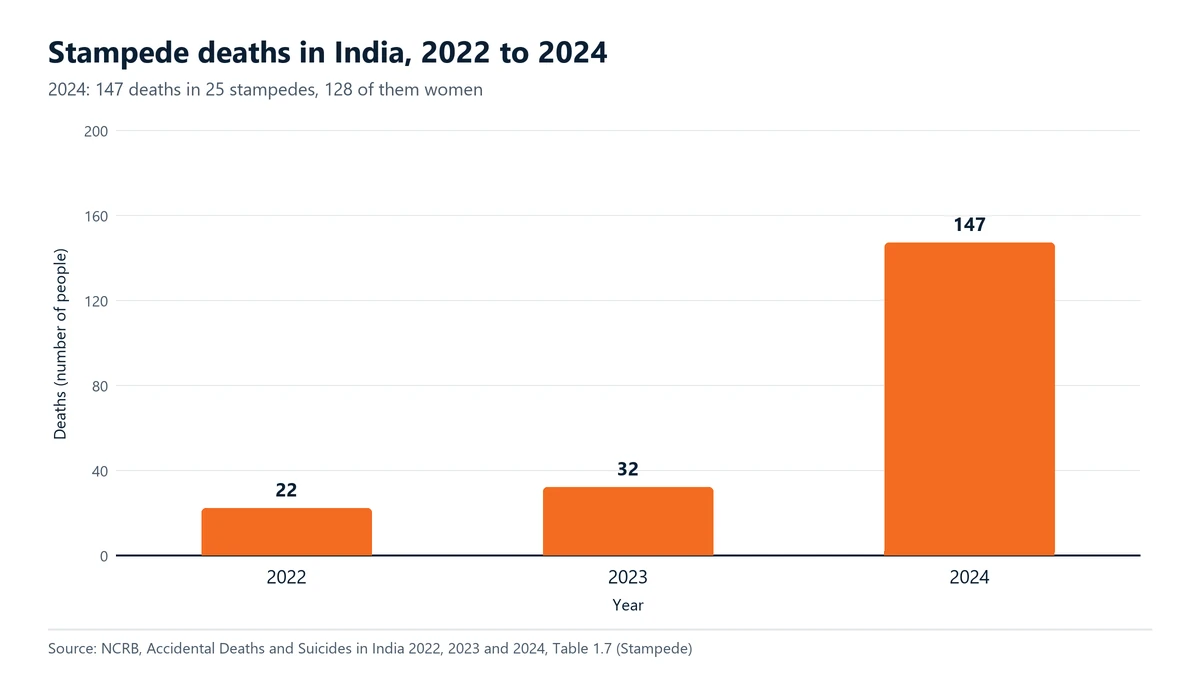
- The toll swings wildly from year to year. The worst year was 2011, with 489 deaths. In 2023 the NCRB recorded 32. In 2024 it jumped to 147, in 25 stampede cases.
- Of the 147 people killed in 2024, 128 were women, largely because of Hathras.
- Four states, Jharkhand, Maharashtra, Andhra Pradesh and Tamil Nadu, account for about half of all stampede deaths since 2001.
So the honest picture is not a steady rise. It is long quiet stretches broken by sudden disasters, and each one shows the same failures.
Why this matters
Stampedes are not “acts of God”. The National Disaster Management Authority (NDMA) says most crowd disasters are man-made and could be prevented with proper planning and execution. It also notes that most crowd disasters in India have happened at religious places, often on hilltops or narrow, winding paths that vendors make narrower still.
The lesson is forgotten after every tragedy, and so it repeats.
Two myths
“Stampedes happen because people panic.” Panic is a symptom. The real causes are too many people in too little space, exits that are closed or blocked, one-way routes that turn into two-way traffic, and sudden surges when something happens at the front, like a VIP arriving or prasad being handed out.
“People die from being trampled.” Some do, but NDMA says compressive asphyxia has historically been the most common cause of death in crowd disasters. People are squeezed so tightly, often while still standing, that they cannot breathe.
How to stay safe in a big crowd
- Plan your way out first. When you arrive, note at least two exits and an open area you can head for.
- Stay at the edges. The middle and the front, near the stage or the darshan point, are where pressure builds.
- Watch the crowd, not just the event. If you are being pushed so you cannot move your arms freely, or the crowd starts to sway, leave at once while you still can.
- Never push, and never try to go against the flow. Move diagonally across and out of it, a little at a time, towards the edge.
- Keep your arms up in front of your chest, like a boxer, to protect space to breathe.
- Stay on your feet. Do not bend to pick up a dropped slipper, bag or phone.
- If you fall, try to get up immediately. If you cannot, curl on your side with your arms protecting your head.
- Children: hold their hands, dress them in something bright, and put your phone number in their pocket. Better still, keep very young children away from huge crowds.
What organisers and authorities must do
- Estimate the crowd honestly, and cap entry when the venue is full.
- Keep separate entry and exit routes, open and unblocked.
- Put barriers and staff where crowds bunch up: gates, stairs, narrow lanes and the stage.
- Have ambulances, a public address system and trained volunteers ready.
- Follow the NDMA guide Managing Crowd at Events and Venues of Mass Gathering (2014).
Ask your temple, society or event committee
Before the next festival, procession or big function, ask one question: do we have a written crowd management plan, with exits, barriers, volunteers and an ambulance? If not, ask for one, and offer to help write it.
Stampedes are man-made disasters. Planning, and a little awareness from each of us, save lives.
What needs attention
- Stampede deaths come in sudden spikes driven by single big disasters, not a steady trend
- Most crowd disasters in India have happened at religious places, often with narrow, crowded access paths
- People in a crush usually die because they cannot breathe, not because they are trampled
- Closed or blocked exits, one-way routes turning two-way and surges at the front are common triggers
- In 2024, nearly nine out of ten stampede victims were women, largely because of the Hathras crush
- NDMA says most crowd disasters are man-made and preventable with planning
Controls that reduce risk
- Write a crowd management plan for every big religious or public event
- Cap entry once the venue is full
- Keep separate, open entry and exit routes
- Place barriers, staff and volunteers at gates, stairs and narrow lanes
- Keep ambulances and a public address system ready
- Train volunteers using the NDMA crowd management guide
Common unsafe practices
- Letting more people in than the venue can hold
- Using the same narrow route for entry and exit
- Locking or blocking exit gates
- Pushing towards the stage, darshan point or a VIP
- Bending down in a dense crowd to pick something up
- Taking very young children into huge crowds
- Blaming 'panic' instead of planning

Leave a comment