
What happened here
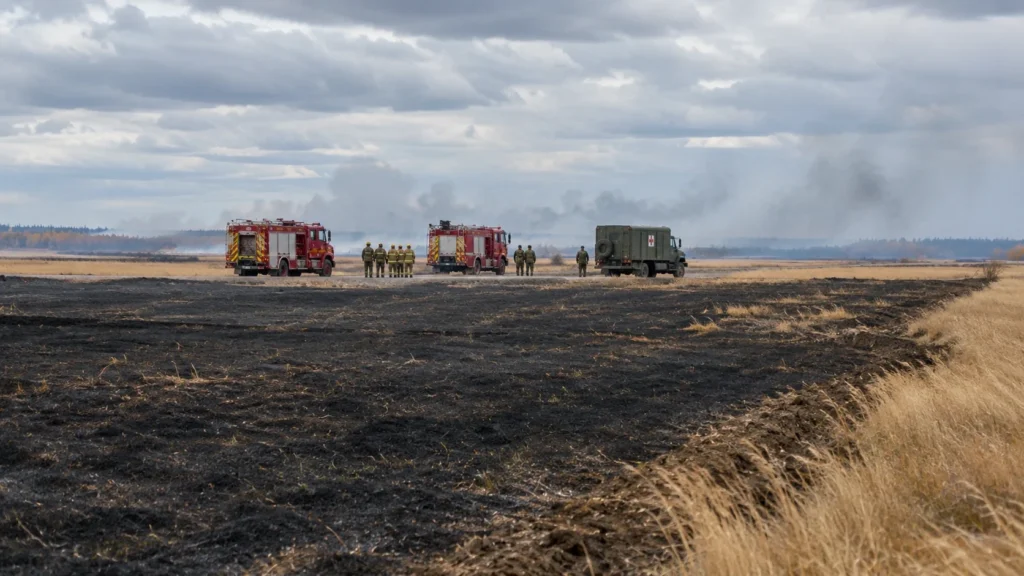
A wind-driven grass fire overtook soldiers during live-fire training at CFB Wainwright, a military site in Alberta, at about 4 p.m. on 17 October 2026. Four were killed and 39 injured; 27 were still in hospital on 21 October, 13 of them in critical condition. The base had known of a grass fire for hours and judged it contained. On 22 October the military police said the fire began on the base's automatic grenade launcher range; what ignited it, including an unofficial report of a munition, is unconfirmed and under investigation.
Quick answers
What happened at CFB Wainwright on 17 October 2026?
A grass fire driven by a wind shift overtook soldiers doing live-fire training at the Canadian Army base in Alberta at about 4 p.m. Four were killed and 39 injured, according to Canada's Department of National Defence.
How many are still in hospital?
On 21 October Alberta Premier Danielle Smith said 27 of the 39 injured were still in hospital and 13 were in critical condition, and officials gave the same figures on 22 October, adding that 12 soldiers are no longer hospitalised. On 20 October the Defence Minister had said 33 were in hospital, and on 18 October the Premier said 19 were critical.
Do we know what started the fire?
Partly. On 22 October the military police said the fire began as a result of a training event on the base's automatic grenade launcher range. What ignited it is not determined: unnamed military sources told Global News a munition may have sparked it, which is unofficial, and Maj.-Gen. Wade Rutland said on 18 October it could have been any of the ordnance in use or none. Three investigations are under way.
Did the soldiers hit a gas line?
Not confirmed. Military sources told Global News a gas line or well was believed to have been struck. Maj.-Gen. Wade Rutland said there was no indication that oil and gas infrastructure was hit, and the army does not believe it was involved; on 22 October the provost marshal said there is no indication natural gas was a factor.
Why was training still going on with a fire on the base?
Rutland said range control knew of the fire for hours and judged it contained, about a kilometre away, until the wind shifted. On 22 October Rutland said the fire had not been assessed as a threat at first, and that the decision to train later in the day, and how the fire was assessed, are part of the investigation.
How fast was the wind?
Reports differ: gusts of up to 100 km/h were forecast, Reuters gave 96 km/h without a source, and the Globe and Mail reported observed gusts of 69 km/h for the hour and 82 km/h for the day.
What can people near firing ranges in India learn from this?
Learn the range's warning signals, stay out of marked areas, never touch old ordnance, do not burn grass or waste on a windy day, and keep an escape route and meeting point.
Were nearby residents evacuated?
Reports differ. AP reported that no evacuation order was issued for residents; an internal military memo seen by Global News said one family home was evacuated. The municipal district said the fire was being held by about 11 p.m. that night.
Where did the Wainwright fire start?
On 22 October the Canadian Forces provost marshal said the military police investigation confirmed it began as a result of a training event on the base's automatic grenade launcher range. The fire first stayed inside a permanent danger area, which can hold unexploded munitions, so base firefighters could not attack it directly; high winds then drove it to another range where soldiers were training.
Updated 23 October 2026, about 10.00 a.m. IST. New on 22 October: at a military briefing in Edmonton, the provost marshal said the fire began as a result of a training event on the base’s automatic grenade launcher range, inside a permanent danger area that base firefighters could not enter, and that there is no indication natural gas was a factor. Officials said 27 injured soldiers are still in hospital, 13 of them in critical condition, and 12 are no longer hospitalised. The soldiers were at a pairs range, not a section-attack range as first said. The death toll is still four. What ignited the grass, and why training went on, are still being investigated.
What happened
The investigation is ongoing and this is a military site. Canadian Forces Base Wainwright is a Canadian Army training base. Nothing below is an official finding on the cause; where reports disagree, we say so.
At about 4 p.m. on Saturday, 17 October 2026, a fire in the training area of Canadian Forces Base (CFB) Wainwright in east-central Alberta, Canada, swept over soldiers who were in the middle of a live-fire exercise. Four soldiers died and 39 were injured, according to Canada’s Department of National Defence (DND). The base lies next to the town of Wainwright, about 200 km south-east of Edmonton.
Soldiers of the 3rd Battalion, Princess Patricia’s Canadian Light Infantry (3 PPCLI), were doing live-fire training under Exercise APOLLO SHOOTER, DND said. Maj.-Gen. Wade Rutland, commander of the 1st Canadian Division, told reporters on Sunday that the affected company had 84 members. Most were throwing hand grenades on a range, while about 10 soldiers, he said then, were carrying out a section attack on a simulated enemy. On 22 October he corrected that: the soldiers were setting up for a pairs range, where two soldiers take turns covering and firing at a target (Edmonton Journal).
Range control had known about a grass fire on the base for several hours, Rutland said. It was about a kilometre away and was judged to be under enough control for training to go on. Then the wind shifted. Environment Canada had warned of gusts of up to 100 km/h that afternoon, while Rutland said winds were below 50 km/h for most of the day before the shift (Global News). “It is not normal for a fire to move a kilometre in 30 to 60 seconds,” Rutland said. That speed is the military’s own estimate; wildfire scientist Mike Flannigan told the Globe and Mail it is highly unlikely. He said the fire reached the section-attack area and the unit’s administrative area and that the grenade range was not affected; on 22 October officials said it overran a pairs range instead (see the 22 October briefing below).
The fire crossed fire guards and the base fence and moved into the surrounding rural area, according to the Government of Canada and the Municipal District of Wainwright. By 11 p.m. on Saturday the municipal district said the fire was being held and that property and critical infrastructure were protected, CBS News and AP reported. AP reported that no evacuation order was issued for residents, but an internal military memo seen by Global News said one family home was evacuated. We have not seen those two accounts reconciled.
The wind and the weather
Reports give different wind figures, and none is a confirmed measurement from the training area. Environment Canada warned of gusts of up to 100 km/h in parts of Alberta. Reuters reported gusts of up to 60 mph (96 km/h) without naming who measured it. The Globe and Mail reported observed gusts peaking around 4 p.m. at 69 km/h for the hour and 82 km/h for the day. The Globe and Mail also quoted Flannigan on relative humidity below 17 per cent, a temperature of 23 C and a cold front that changed the fire’s direction. Canada’s wildland fire information system rated fire danger in southern Alberta as extreme that day, Global News reported, though that is not necessarily the military’s own rating, and an internal memo called the base fire index low for the exercise. A Global News satellite analysis published on 20 October found possible fire hotspots on the base at 12.17 p.m. and 2.49 p.m. on 17 October, at least four hours before the deadly fire. The passes show hotspots, not the size or ignition time of any one fire, or whether it was the fire that reached the soldiers. The same report says the Edmonton airport reportedly recorded a 117 km/h gust at about 1 p.m., the base recorded gusts of 48 km/h at 4 p.m. and an 82 km/h gust at an unknown time that day, and only 3.5 mm of rain had fallen at Wainwright in October.
What officials said on 22 October
At a news conference in Edmonton on 22 October, Brig.-Gen. Vanessa Hanrahan, the Canadian Forces provost marshal, said the military police investigation has confirmed that the fire originated as a result of a training event on the base’s automatic grenade launcher range (Canadian Press, The Globe and Mail). She did not say whether live firing of explosive rounds ignited the grass (The Globe and Mail), and said everything after that, from the start of the fire on that range to what happened on a different range, is still under investigation. The fire first stayed inside a permanent danger area, which can hold unexploded munitions, so base firefighters could not attack it directly; range control and the base fire hall monitored it through the day. Then high winds from a cold front changed its direction and speed, and it spread to another range and overran soldiers’ positions. Rutland said the fire had not been assessed as a threat at first, and that how that judgement was reached, and whether different decisions should have been made, are central questions for the investigation. Hanrahan said there is no indication natural gas was a factor or was damaged (Edmonton Journal). Rutland said eight firefighters from the base fire platoon responded, later joined by a second platoon and by firefighters from the town and the municipal district (The Globe and Mail).
The explosions and the gas line report
Some witnesses said they heard explosions, and early reports called it an explosion and fire. On Saturday night Global News, citing military sources, reported that the live-fire exercise was believed to have hit a natural gas line or well. The military does not support that account, and on 22 October the provost marshal said there is no indication that natural gas infrastructure was a factor. Rutland said there was no indication that oil and gas infrastructure was hit; the “initial impression” was that it was not damaged, but it would be checked. Officials also said the explosions were not believed to be from outside interference, and DND said there was no indication of any terrorist activity.
Global News later reported, again citing military sources, that a preliminary investigation suggests a munition from the exercise started the grass fire. Rutland said grenade launchers, grenades and small arms were in use that afternoon and that “it could have been any of that or none of it.” Those accounts came from unnamed sources. The first official statement on where the fire began came on 22 October (see above); which round or device ignited the grass is still undetermined. Reports of Rutland’s remarks on where the fire began are not consistent: one Global News summary says he said it did not start inside the training area, while other coverage quoted him saying it ignited there; the 22 October briefing put the origin on the automatic grenade launcher range. Gen. Jennie Carignan, the Chief of the Defence Staff, said it is not uncommon for exercises to continue during a grass fire and that it was too soon to judge the base commanders’ decisions. Separately, Global News reported that, according to the Government of Canada, there are more than 200 active gas wells and related pipelines in the CFB Wainwright area.
The soldiers who died and the injured
Four soldiers of 3 PPCLI died. DND named them on 18 October 2026 and their families have spoken publicly; we are not repeating their names here. Prime Minister Mark Carney called it “one of the worst tragedies for the Forces on Canadian soil in peacetime.”
The official death toll is four. On Saturday night Global News, citing separate military sources, reported at least seven dead, and CBC News said its sources had first given the same figure. Defence officials then confirmed four deaths, and CBC News updated its report. We found no official statement of more than four deaths up to the morning of 23 October 2026, and no later death among the injured.
DND gave the injured as 39 Canadian Armed Forces members. Alberta Premier Danielle Smith said 39 patients were in hospital, at least 19 of them in critical condition, and that all patients were accounted for. Many have severe burns that will need months of care, the Globe and Mail reported. Acute Care Alberta’s chief executive gave a split on Sunday, reported by CTV News and The Canadian Press: 19 critical, eight stable and 12 treated without being admitted, so the figure of 39 counts people in hospital and people not admitted, depending on who is speaking. The Globe and Mail reported that internal communications put 31 as seriously or very seriously injured. On Tuesday 20 October Defence Minister David McGuinty said 33 members were still in hospital and called the situation of the patients delicate and evolving (CP24); on 21 October Alberta Premier Danielle Smith said 27 of the 39 are still being treated and 13 remain in critical condition (CTV News), down from 33 in hospital on Tuesday and 19 critical on 18 October. She said some patients have burns over 30 to 80 per cent of the body, that changing the dressings can take up to two hours per patient, and that three of the injured soldiers from Ontario are in dire condition. Smith said Ontario is sending 19 burn nurses and five operating-room nurses to help Alberta’s staff, and Ontario Premier Doug Ford said 27 health-care workers, including surgeons and nurses, are being deployed. Patients went from the Wainwright health centre to the University of Alberta Hospital and Royal Alexandra Hospital in Edmonton, Foothills Medical Centre in Calgary, and Red Deer Regional Hospital. On 22 October Maj.-Gen. Rutland repeated that 27 remain in hospital in serious condition and said 12 soldiers are no longer hospitalised, though they will keep receiving follow-up care; Dr Sayeh Zielke of Acute Care Alberta put the number in critical condition at 13 (CBC News, The Globe and Mail).
Response and investigation
Emergency Health Services Alberta sent 22 ground ambulances, six fixed-wing aircraft and two helicopters, with a medevac plane from Saskatchewan. Several hospitals declared a Code Orange, the mass-casualty alert, which was lifted on Sunday afternoon after more than 10 hours. Military personnel, including Royal Canadian Air Force search and rescue technicians, parachuted into Wainwright late on Saturday night to add help quickly, Global News reported.
Three inquiries are under way, McGuinty said on 20 October: an RCMP investigation with military police, a fire marshal’s investigation and a Canadian Armed Forces board of inquiry. At the 22 October briefing officials described the three as a military police investigation, an investigation by Alberta’s chief medical examiner and the army board of inquiry (CBC News, The Globe and Mail); we have not seen the two lists reconciled. Prime Minister Carney said 50 investigators are on the ground, and the Globe and Mail reports that Alberta’s chief medical examiner is also involved. Rutland said the board would look at topography, field conditions and vegetation, and whether the fire moved so fast because of the wind, moved unseen through the grass, or both. Carignan said it could take up to a year and that it is her intention to release the findings publicly. On 22 October Rutland said he had underestimated the scope of the work and that the board will take as long as it takes; it will look at whether training policies were appropriate and why a grass fire was not assessed as a threat in strong wind. The earlier estimate of at least a month is superseded. Hanrahan said about 30 military police are on the ground and that their involvement should not be read as a sign that an offence has taken place (Edmonton Journal, Canadian Press). Global News also reports that Defence Minister McGuinty, asked about reports that the Forces had been advised not to hold fire training at the base, declined to speculate and said the investigation must take its course; the report we opened does not say who gave that advice or when. As of the morning of 23 October 2026 the only official finding is where the fire began. There is still no official finding on which round or device ignited the grass, what caused the explosions people heard, or why training continued with a grass fire on the base.
What the base’s own rules say
Global News obtained the 139-page Range Standing Orders for CFB Wainwright, dated 2024, and the Globe and Mail reported the army confirmed the document is current. They name October as a high-risk month for grass fires and tell units firing live between August and October to plan to shoot early in the morning, before about 10 a.m., when fire danger is usually lower. A grass or brush fire must be reported to Range Control at once, and the orders set a four-step fire danger scale in which pyrotechnics, tracer rounds and white phosphorus are barred at the extreme level unless a waiver applies. Decisions to stop or change training in bad weather sit with the chain of command, and the base commander has the final say in extreme cases. Rutland said on 22 October that the early-morning guidance is a guideline, not an order, and that officers running a shoot weigh the weather, dryness, type of munition and number of trainees; the decision to train later in the day is part of the investigation (The Globe and Mail, Canadian Press). Which rating applied on 17 October, whether the orders were followed and whether any waiver was used have not been made public, and DND has declined to answer while the investigation continues.
Why this matters
A grass fire a kilometre away can look safe, and a fire that is held is not the same as one that is out. Strong wind changes how a fire spreads, and dry grass burns fast. When the wind turned at Wainwright, soldiers had well under a minute. The same thing can happen to farm workers burning stubble, to a crew at a well site, or to villagers near a scrub fire on a windy afternoon.
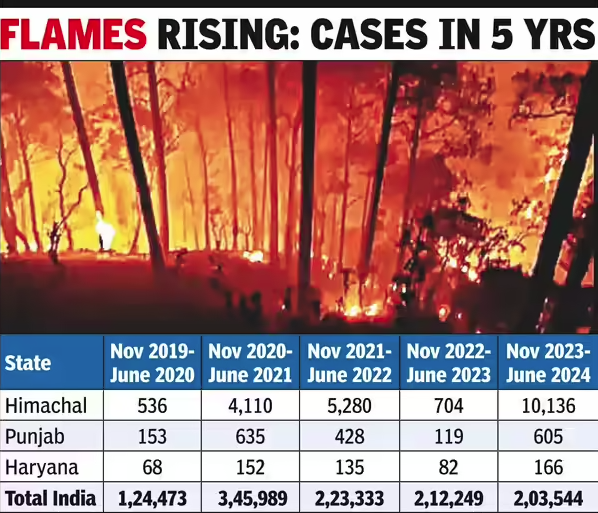
India has its own mix of risks here. Gas pipelines run under fields and along roads, oil and gas wells sit close to farms in Assam, Gujarat and Rajasthan, and dry-season fires burn through grassland and forest. NCRB recorded 5,888 deaths from accidental fire in India in 2024 (it has no separate grass-fire category) and 360 deaths from accidental explosions, eight of them in ammunition explosions in the armed forces, police and central armed police forces. Our case study of the Myla warehouse detonation shows what happens when explosives and people sit too close together.
Lessons for India
- Know where the pipeline runs. Pipeline routes are marked with posts that usually carry the operator’s emergency number. Never dig, drill, drive heavy machines or light a fire near those markers without the operator’s permission.
- Report a gas smell or hiss at once. Move away upwind, keep phones and engines off near the spot, and call the number on the marker or 112.
- Stop work when the wind picks up. On a windy, dry day any fire in sight is a threat, even a small one far away. Hot work, burning of waste and stubble, and blasting should wait.
- Plan the way out before you start. Every site and village near grassland or forest needs an evacuation plan with two routes, a meeting point and a head count.
- Move across the wind, not ahead of it. A wind-driven fire runs faster than you can. Go sideways to it, towards a road, a ploughed field or ground that has already burnt.
- Contained is not out. “Held”, “contained” and “out” mean different things. Agree a written stop rule, such as a wind warning plus dry grass, and name the person who can say stop.
- Cool a burn for 20 minutes. Use cool running water; even 10 minutes helps. Take off rings and loose clothing near it, but not anything stuck to the skin, and cover it loosely with clean cling film or a clean, non-fluffy cloth. No ice, toothpaste, oil or butter. Call 108 or 112 for any large, deep or facial burn; see our basic first aid guide.
- Near a firing range or ordnance depot? Learn its warning flags and siren signals, never enter a marked range, and never touch an object that looks like old ordnance. Move away, warn others and call 112.
In India, call 112 for any emergency, 101 for the fire brigade and 108 for an ambulance. In Canada, call 911.
What is still not known
What ignited the grass and whether a munition was involved, what the explosions were, whether any gas line or well was hit, which fire-danger rating applied, whether the standing orders were followed, how fast the fire really moved, the exact wind at the range, whether anyone was evacuated from a home, how many are still in critical condition after the 13 reported on 21 and 22 October, who advised against the training and what the advice said, and how much land burnt have not been officially confirmed. The inquiries have not reported. We last checked on the morning of 23 October 2026 and will update this page when official findings are published.
- Environment Canada high-wind warning in force; a grass fire is known on the base and judged contained; live-fire training continues
- The wind shifts; the fire reaches soldiers within about 30 to 60 seconds and overtakes the unit's administrative area
- Ambulances and aircraft sent; hospitals declare Code Orange; the Defence Minister announces deaths and injuries about 7.30 p.m.
- The Municipal District of Wainwright says the fire is being held
- Prime Minister Carney confirms four deaths and dozens of injuries; DND says no indication of terrorism
- Code Orange lifted; Rutland briefs the media; Premier Smith gives 39 in hospital, 19 critical; DND issues its release
- Carney says 50 investigators are on the ground; Carignan says the board of inquiry could take up to a year
- Defence Minister McGuinty says 33 members remain in hospital and that three investigations are under way
- Premier Smith says 27 remain in hospital and 13 are critical; Ontario sends burn nurses; Global News reports the Defence Minister declining to speculate on reports that the Forces were advised against fire training
- Military police say the fire began on the automatic grenade launcher range, inside a permanent danger area firefighters could not enter; officials say 27 remain in hospital, 13 critical and 12 out of hospital, and that there is no indication natural gas was involved
- No finding on what ignited the fire and no revised death toll found
Why consequences escalated
- A grass fire was known on the base for hours and judged contained, and training went on nearby.
- A sudden wind change moved the fire onto the soldiers in about a minute, according to the military; the speed is the military's estimate.
- Four soldiers died and 39 were injured; 27 were still in hospital and 13 critical on 21 October, down from 33 in hospital on 20 October. Many have severe burns, some over 30 to 80 per cent of the body.
- The cause is not known. A munition is an unofficial, unconfirmed report; a gas well or pipeline link was not supported.
- The base's 2024 standing orders name October as high risk and advise early-morning live firing; whether they were followed is not yet public.
Failures and risk multipliers
- Treating a fire that looks far away and contained as safe on a day with a strong wind warning.
- Continuing work that can start or feed a fire when dry grass and a wind warning were both present.
- No reported trigger to stop or pull back when the wind changed; this is an open question for the inquiry, not a finding.
- Sharing unconfirmed numbers (seven dead) and an unconfirmed cause (gas line) before the official count.
Actions that reduce risk
- Stop live firing, blasting, hot work and stubble burning when strong winds are forecast and grass is dry.
- Treat any fire in sight on a windy day as a threat and keep a clear escape route open.
- Mark pipeline and well locations on site maps and keep work and fires away from them.
- Keep a written evacuation plan with two routes, a meeting point and a head count.
- Wait for the official toll and cause before sharing figures.

Leave a comment