

Quick answers
Why does fire brigade response time matter so much?
When a fire breaks out, response time is everything. Shortages of firefighters, outdated vehicles and lack of backup can delay help and cost lives.
What can citizens do to support fire safety in their area?
Volunteer with local fire and emergency groups, keep basic fire safety tools like extinguishers and fire blankets at home, report non-functional hydrants and push your society to hold fire drills.
Do villages need fire brigades too?
Yes. Rural areas also suffer fire deaths, so fire response cannot be limited to cities and community responders can help fill the gap.
What should I do first if there is a fire before firefighters arrive?
Raise the alarm and warn others, move away from smoke and fire, use the safest exit and not lifts, and call 112 from a safe place with the full address and hazard details.

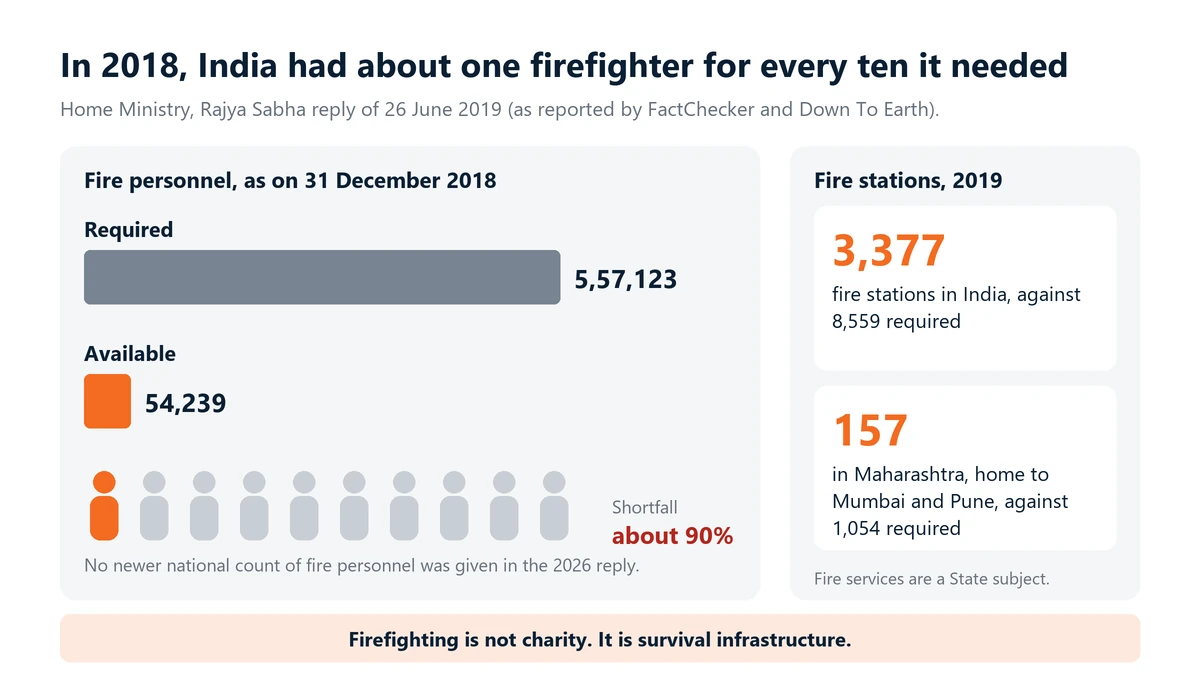
In June 2019, the Home Ministry told the Rajya Sabha that India had 54,239 fire personnel against 5,57,123 required, as on 31 December 2018. That is a shortfall of about 90%, or roughly one firefighter for every ten the country needed. India also had 3,377 fire stations against 8,559 required.
(Source: Rajya Sabha replies of 26 June 2019, as reported by FactChecker and Down To Earth)
Why this matters
When a fire breaks out, the first few minutes decide how big it gets. The farther the nearest fire station and the fewer the crew, the longer people wait for help. With a gap this large, many towns and districts are covered by stations that are far away and short of staff.
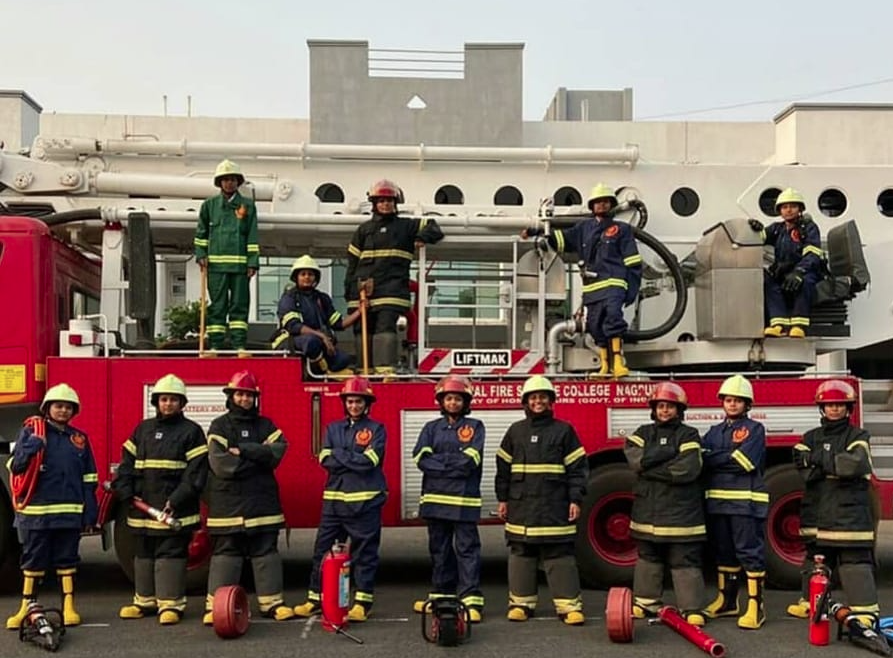
Fire services are a State subject. The Constitution lists them as a municipal function, and it is mainly the State governments’ job to staff and equip them. The Centre advises and supports. In July 2023 it launched a ₹5,000 crore Scheme for Expansion and Modernisation of Fire Services in the States, for new fire stations, training and modern equipment. The Home Ministry told the Lok Sabha in February 2026 that the National Fire Service College in Nagpur had trained 4,049 fire officers in the previous five years.
These are welcome steps. But the official requirement figures date from 2018, and no newer national count of fire personnel was given in the 2026 reply. Until updated numbers are published, nobody can say how much of the gap has closed.
Two myths
“Big cities have enough fire stations.” The 2019 figures showed big gaps even in industrialised States. Maharashtra, home to Mumbai and Pune, had 157 fire stations against 1,054 required.
“Villages don’t need fire brigades.” Fire kills everywhere. The NCRB does not split fire deaths into urban and rural, but 3,555 of the 5,888 fire-accident deaths it recorded in 2024 were in homes. A village house fire far from any station is exactly where a late fire engine costs lives.
What you can do today
- Volunteer with local fire and emergency groups such as VFF India, and learn basic firefighting and first aid.
- Keep basic tools at home: a serviced ABC extinguisher and a fire blanket in the kitchen, and know how to use them on a small fire.
- Report hydrants that don’t work in your area to the municipal corporation or fire service.
- Push your society or RWA to hold a fire drill, so residents can manage the first few minutes safely.
- Know where your nearest fire station is, and keep the society gate and driveway clear so a fire engine can get in.
Would you accept a hospital with one doctor for every ten it needs? That is roughly what India’s fire-personnel figures looked like in 2018. Firefighting is not charity. It is survival infrastructure, and it is worth asking your MLA and municipal councillor what your State is doing about it.
What needs attention
- In 2018 India had only about one in ten of the fire personnel it needed
- The country had fewer than half the fire stations it needed
- Even industrialised Maharashtra had about one in seven of the stations it needed
- Fire services are a State subject, so the gap is mainly for States to fill, with central support
- No national update on staffing has been published since the 2018 figures
- Most fire deaths happen in homes, including villages far from any fire station
Controls that reduce risk
- Ask your State and municipal body for current fire-station and staffing numbers
- Train volunteers in your society or village as first responders
- Keep a serviced extinguisher and a fire blanket in every home and shop
- Report and follow up on non-working hydrants
- Keep fire-engine access clear at all times
- Hold a fire drill in your society at least once a year
Common unsafe practices
- Assuming a fire engine will always arrive within minutes
- Blocking society gates and driveways so fire engines cannot get in
- Ignoring broken hydrants in the neighbourhood
- Having no extinguisher or fire blanket at home
- Never practising what to do before the fire brigade arrives
- Quoting old or untraceable shortage figures

Leave a comment