
Quick answers
When should I start CPR?
Start CPR immediately if the person is unconscious and not breathing normally or is only gasping. Even if unsure, start CPR, because doing nothing is the only wrong decision.
How do I do hands-only CPR?
Place the heel of your hand in the centre of the chest, interlock both hands with elbows straight, and push hard and fast, letting the chest rise fully each time. Continue until the person breathes or help arrives.
Who should I call before starting CPR?
Call 108 or 112 and ask someone to bring an AED if available. If you are alone, put the call on speaker while you start CPR.
How do I use an AED?
Turn it on and follow the voice instructions, attach the pads to the bare chest, keep everyone clear while it analyses or shocks, and resume CPR after the shock until the next prompt.
How long should I keep doing CPR?
Keep going until the person starts breathing normally or moving, an AED is ready to use, or the ambulance crew takes over. Do not stop after a few seconds to check. If someone else can help, swap every couple of minutes.
How can I learn CPR properly?
Watch a short demonstration from a recognised first-aid body, practise the rhythm on a firm pillow, then do a hands-on course with a manikin. Ask your school, office or society to arrange a class every year.
Someone collapses at a wedding, in a gym, on a railway platform or at home in front of the TV. They do not answer when you call their name, and their breathing has stopped or turned into odd gasps. Their heart has most likely stopped pumping. What the people around them do in the next few minutes, before any ambulance can arrive, decides whether they have a chance.
That is what CPR is for. You do not need to be a doctor. You need two hands and the willingness to start.
Why bystanders matter
India has no national count of cardiac arrests. Police records alone show 38,599 sudden deaths from heart attacks in 2024 (NCRB, ADSI 2024), and many more cardiac arrests never reach those records.
Survival after a cardiac arrest outside hospital is low everywhere. In the US in 2024, 10.5% of these patients survived to go home (CARES registry). In one South Indian hospital study, only 1.4% did. In the US, survival was higher when a bystander started CPR: 13.0% against 7.6% without it. The difference is people who acted before the ambulance came.
What CPR does
CPR (cardiopulmonary resuscitation) means pushing hard and fast on the chest to keep blood moving to the brain and heart while the heart cannot do it. It does not usually restart the heart. A defibrillator (AED) can do that in some cases, and CPR keeps the person alive until one arrives. Every minute without CPR lowers the chance of survival, so start at once.
When to start
Start CPR if the person:
- does not respond when you tap their shoulders and shout, and
- is not breathing normally, or is only gasping.
Do not waste time feeling for a pulse. Gasping is not normal breathing. If you are unsure, start CPR. Doing nothing is the only wrong choice.
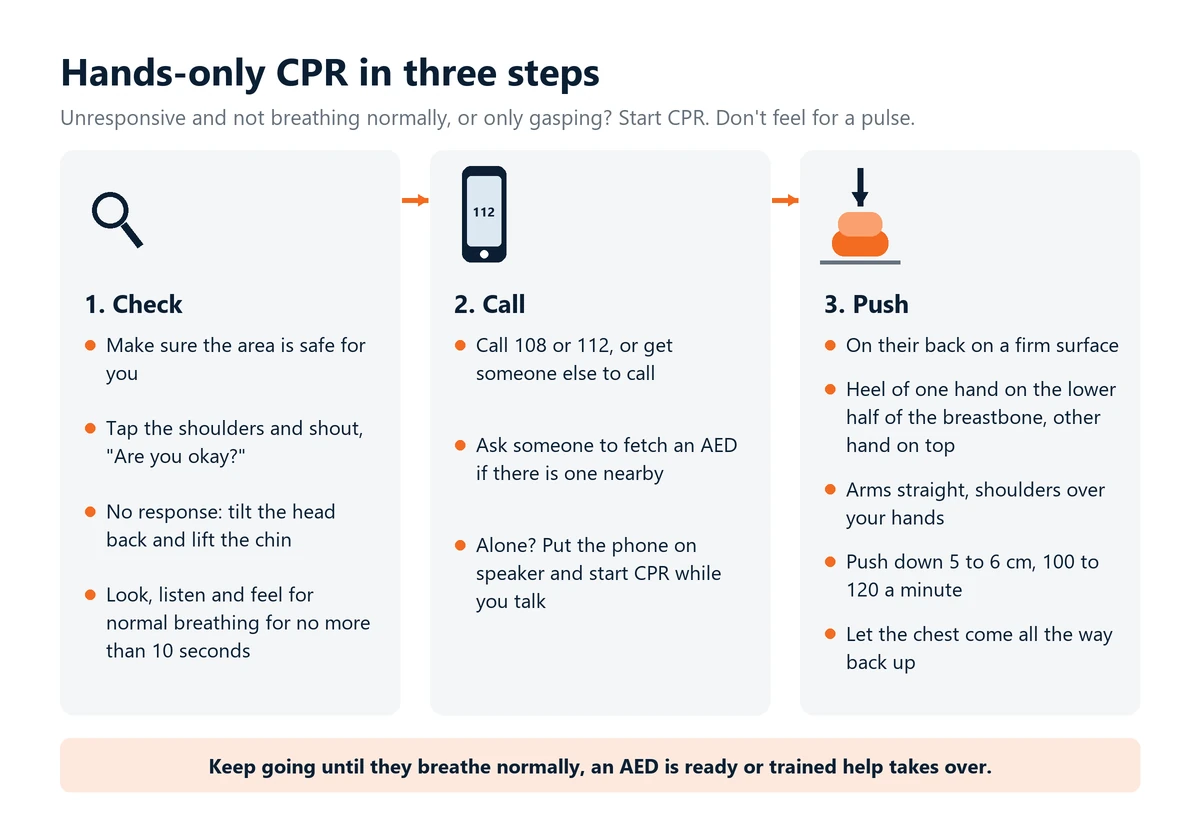
Hands-only CPR in three steps
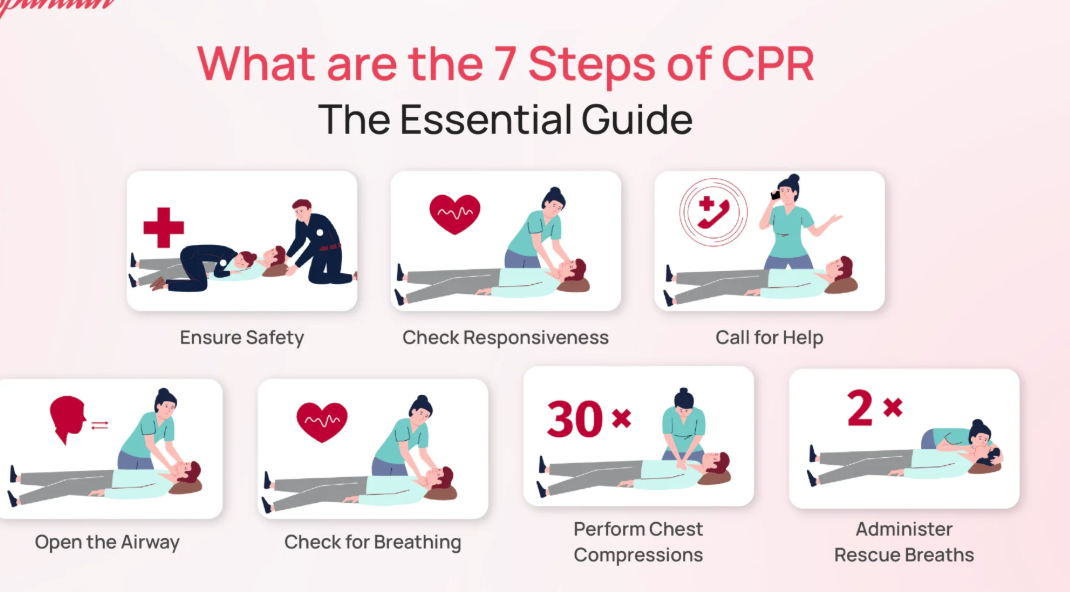
1. Check
Make sure the area is safe for you. Tap the person’s shoulders and shout, “Are you okay?” If there is no response, tilt the head back, lift the chin and look, listen and feel for normal breathing for no more than 10 seconds.
2. Call
Call 108 or 112, or get someone else to call. Ask someone to fetch an AED if there is one nearby, at a mall, airport, metro station, office or gym. If you are alone, put the phone on speaker and start CPR while you talk.
3. Push
- Lay the person on their back on a firm surface. Move them from a bed or sofa to the floor.
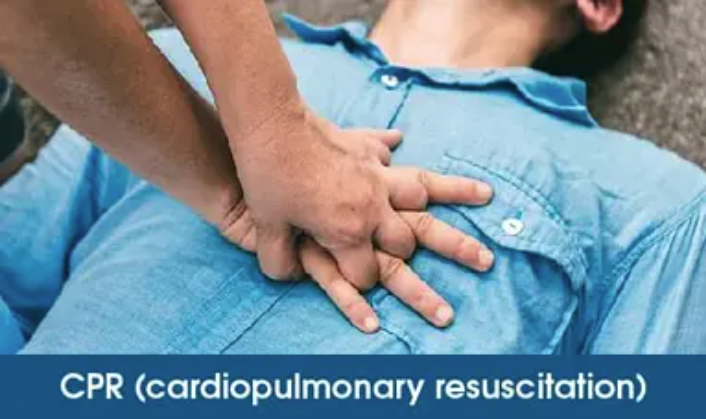
- Kneel beside them. Put the heel of one hand in the centre of the chest, on the lower half of the breastbone, and the other hand on top. Lock your fingers.
- Keep your arms straight and your shoulders over your hands.
- Push down 5 to 6 cm, at 100 to 120 pushes a minute. The beat of “Stayin’ Alive” is about the right speed.
- Let the chest come all the way back up after each push.
Keep going until the person starts breathing normally or moving, an AED is ready to use, or trained help takes over. If another person is there, swap every couple of minutes so the pushing stays strong.
Rescue breaths, if you are trained
If you have been trained and are willing, give 30 compressions and then 2 rescue breaths. Tilt the head back, lift the chin, pinch the nose, seal your mouth over theirs and breathe in gently for about one second each time, watching the chest rise. Then go straight back to compressions.
If you are not trained, or do not want to give breaths, keep doing hands-only CPR without stopping.
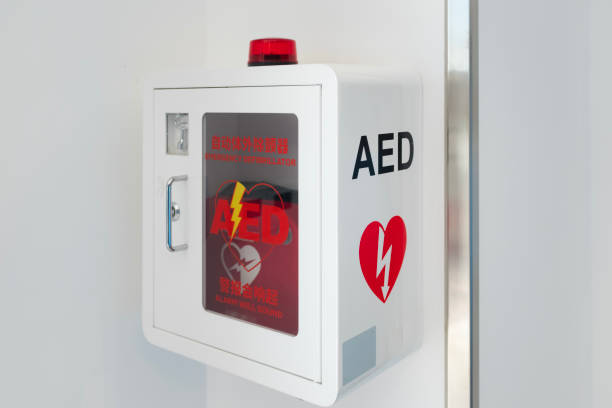
Using an AED
- Switch it on and follow the voice instructions.
- Bare the chest. Stick one pad below the right collarbone and the other on the left side of the chest, below the armpit, as shown on the pads.
- Make sure nobody touches the person while it analyses the heart rhythm or gives a shock.
- After a shock, or if no shock is advised, go straight back to CPR until the machine tells you to stop.
Special situations
| Situation | What to do |
|---|---|
| Child (1 year to puberty) | Use one or two hands on the lower half of the breastbone and push about one-third of the chest depth, about 5 cm. If trained, give 30 compressions and 2 breaths. |
| Infant (under 1 year) | Use the heel of one hand, or both thumbs with your hands circling the chest, on the lower half of the breastbone, about 4 cm deep. The old two-finger method is no longer recommended. |
| Drowning | Give 5 rescue breaths first if you are trained, then 30 compressions and 2 breaths. |
| Pregnant woman | Use the normal hand position in the centre of the chest. Tell the 112 operator she is pregnant; trained responders will gently move the bump to her left side during CPR. |
| Electric shock | Make sure the power is off before you touch the person. |
Do and don’t
| Do | Don’t |
|---|---|
| Start compressions straight away | Wait for the ambulance to arrive |
| Work on a firm surface | Push on a soft bed or sofa |
| Push on the centre of the chest | Push on the stomach or the ribs at the side |
| Keep a steady rhythm | Rush or pause for long |
| Swap with someone when you tire | Stop because you are tired, if no one can take over |
Myths and facts
| Myth | Fact |
|---|---|
| “CPR is only for doctors.” | Anyone can do it, and bystander CPR improves survival. |
| “I might hurt them.” | Ribs can crack during good CPR. That heals; a heart left stopped does not restart on its own. |
| “Breathing into the mouth is the main thing.” | Chest compressions come first. Hands-only CPR is fine if you are not trained in breaths. |
| “CPR restarts the heart.” | CPR keeps blood moving. A defibrillator shock is what can restart some stopped hearts. |
| “It’s too complicated.” | Push hard and fast in the centre of the chest. That is most of it. |
What every building should have
- At least one AED, kept unlocked in a clearly signed place and registered with local emergency services where possible.
- Staff trained in CPR and first aid on every shift, including security guards and housekeeping.
- Clear signs pointing to the AED and first-aid kit.
- A CPR chart near reception or the lift lobby.
- Regular hands-on refresher sessions.
Learn it together
Do a CPR course as a family, a workplace or a school group. Practise on a manikin, or on a firm pillow at home, until the rhythm feels natural. Skills fade if you never use them, so go back for a refresher when your certificate runs out.
What needs to change
- CPR training in schools, colleges and driving licence programmes.
- Visible, unlocked AEDs in malls, airports, railway and metro stations.
- CPR training built into CSR and disaster preparedness programmes.
- Public recognition for people who step in and save a life.
Do this today
Save 108 and 112 in your phone. Find out where the nearest AED is at your office, gym or society. Then put on “Stayin’ Alive”, kneel by a firm pillow, and push along to the beat for one minute. You will remember it when it matters.
References
- American Heart Association: Highlights of the 2025 AHA Guidelines for CPR and ECC
- European Resuscitation Council: The ERC Guidelines 2025 on Resuscitation for Everyone
- Resuscitation Council UK: Adult Basic Life Support Guidelines 2025
- CARES (Cardiac Arrest Registry to Enhance Survival): 2024 Annual Report
- Bhat R et al., Pre-hospital care of out of hospital cardiac arrest victims and their outcome in a tertiary care hospital in India, Indian Heart Journal, 2021
- NCRB, Accidental Deaths and Suicides in India 2024, Table 1.7
What needs attention
- India has no national cardiac arrest registry; NCRB recorded 38,599 heart-attack sudden deaths in 2024
- In the US in 2024, 10.5% of out-of-hospital cardiac arrest patients survived to discharge
- US survival was 13.0% with bystander CPR against 7.6% without
- A South Indian hospital study found 1.4% survival to discharge
- Lay rescuers should start CPR without checking for a pulse
- The two-finger method for infants is no longer recommended (AHA 2025)
Controls that reduce risk
- Put an unlocked, signed AED in every office, mall, gym and society
- Register AEDs with local emergency services where possible
- Train staff on every shift, including guards and housekeeping
- Put a CPR chart near reception or the lift lobby
- Hold regular hands-on refresher sessions
- Teach CPR in schools, colleges and driving licence courses
Common unsafe practices
- Freezing and waiting for someone else to start
- Waiting for the ambulance before starting CPR
- Wasting time feeling for a pulse
- Mistaking gasping for normal breathing
- Doing CPR on a soft bed or sofa
- Pushing too gently or too slowly
- Stopping CPR for long to check the person
- Crowding round or splashing water on the person instead of starting compressions



Leave a comment