
Quick answers
Why do NCRB and MoRTH give different road accident numbers?
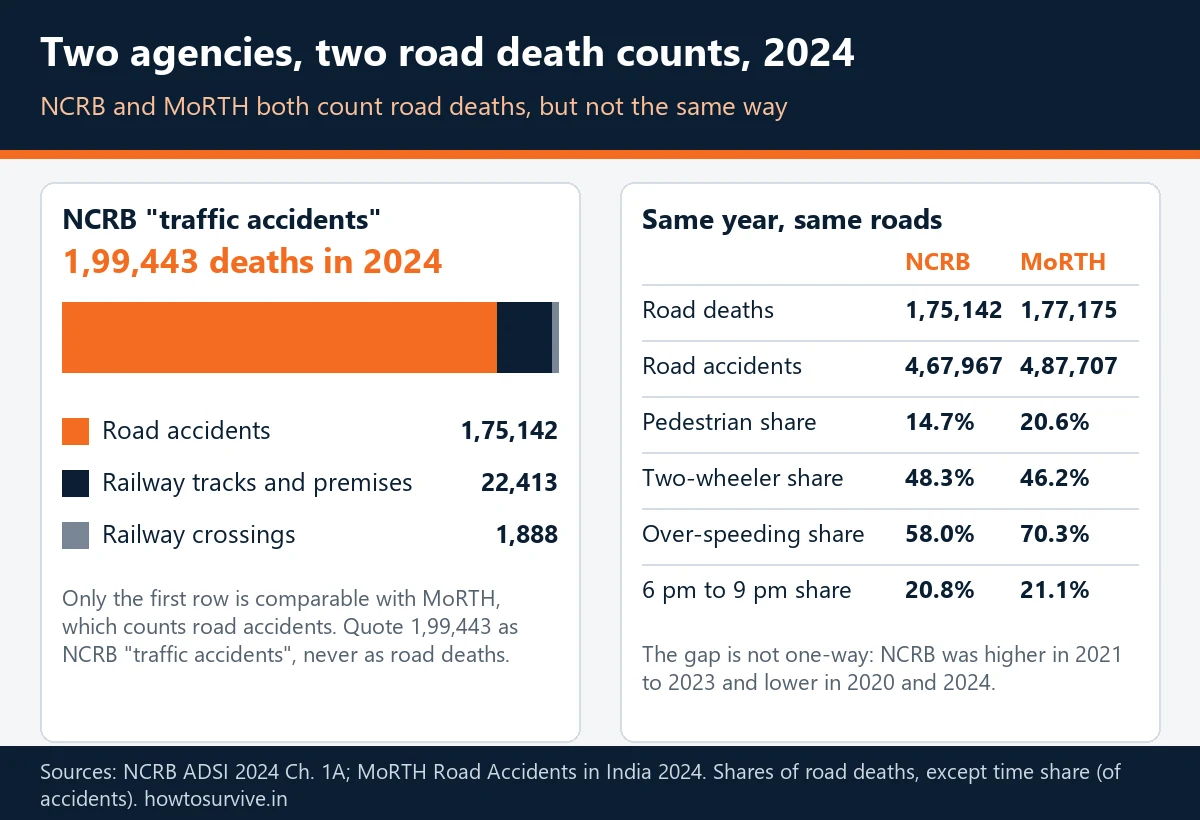
Both say their figures come from State and Union Territory data, but the counts differ: for 2024, 4,67,967 road accidents (NCRB) against 4,87,707 (MoRTH), and 1,75,142 road deaths against 1,77,175. In 14 of 36 States and Union Territories the accident counts are identical; four States hold most of the gap. Neither report explains the differences, so we do not.
What is the correct number of road deaths in India in 2024?
MoRTH's report gives 1,77,175 and NCRB's gives 1,75,142. Both are official, police-reported figures. Always name the source. Both are likely to miss some deaths, for example those that happen in hospital after 30 days, according to MoRTH's own note.
Is 1,99,443 the number of road deaths in India?
No. It is NCRB's total for traffic accidents: 1,75,142 on roads, 22,413 on railway tracks and premises, and 1,888 at railway crossings. The road figure is 1,75,142.
Which agency should I trust more?
Both report State data and both have limits. MoRTH publishes its collection method and the 21 formats it uses, and it is the source most of our road safety pages use. NCRB covers more kinds of accident, including railways. Use the one that counts what you are writing about, and say which.
Is NCRB's road death figure usually higher or lower than MoRTH's?
It varies. NCRB was lower in 2020 (by 5,182) and 2024 (by 2,033) and higher in 2021, 2022 and 2023 (by 1,650, 2,609 and 936).
How does MoRTH collect road accident data?
Its Transport Research Wing receives it from the police departments of the States and Union Territories in 21 standard formats based on a UNESCAP model. The 2024 report says data for West Bengal came as aggregates from the new e-DAR system and was recast.
Do these numbers include all road deaths?
Probably not. MoRTH's own note says deaths in hospital after 30 days may not be captured, and that an accident with no identifiable responsible person may go unreported. An independent analysis cites a Sample Registration System estimate of about 2,71,300 deaths in 2022; we did not open that survey.
NCRB vs MoRTH road accident data is a question every reader of Indian road safety news runs into sooner or later. For 2024 one agency says 1,75,142 people died in road accidents and the other says 1,77,175. A third number, 1,99,443, is quoted as “road deaths” in many places and is neither. This page lays the figures side by side, says what each agency says about how it collects them, shows where the gap sits, and ends with a plain rule for which number to quote. We do not guess at reasons that neither agency states. Checked 12 November 2026.
In short
- Road deaths in 2024: 1,75,142 (NCRB, Accidental Deaths and Suicides in India 2024) against 1,77,175 (MoRTH, Road Accidents in India 2024). A difference of 2,033, or about 1.1 per cent of MoRTH’s figure (our division).
- Road accidents in 2024: 4,67,967 (NCRB) against 4,87,707 (MoRTH), a difference of 19,740.
- 1,99,443 is not road deaths. It is NCRB’s “traffic accidents” total: road 1,75,142, plus 22,413 on railway tracks and premises, plus 1,888 at railway crossings.
- The gap is not one-way. NCRB’s road death count was higher than MoRTH’s in 2021, 2022 and 2023 and lower in 2020 and 2024.
- In 2024 the accident gap sits in a few States. The two counts are identical in 14 of 36 States and Union Territories, and four States (Uttar Pradesh, Maharashtra, West Bengal and Kerala) account for 18,420 of the 19,740 difference (our sums).
- Quote the source, the year and the definition every time. Never add or mix the two.
Same year, two counts
All figures are for calendar 2024 and are the agencies’ own, from their 2024 reports:
- Road accidents: NCRB 4,67,967; MoRTH 4,87,707.
- Road deaths: NCRB 1,75,142; MoRTH 1,77,175.
- Pedestrians killed: NCRB 25,769 (14.7 per cent); MoRTH 36,526 (20.6 per cent).
- Two-wheeler riders and pillions killed: NCRB 84,599 (48.3 per cent); MoRTH 81,780 (46.2 per cent).
- Over-speeding: NCRB 1,01,649 deaths (58.0 per cent); MoRTH 1,24,522 killed (70.3 per cent).
- Drink or drug driving: NCRB 3,375 deaths (1.9 per cent); MoRTH 3,204 (1.8 per cent).
- National Highways: NCRB 60,894 deaths (34.8 per cent); MoRTH 64,772 (36.6 per cent).
- Accidents between 6 pm and 9 pm: NCRB 97,349 (20.8 per cent); MoRTH 1,02,897 (21.1 per cent).
Most are close. Pedestrians are not: NCRB’s count is 10,757 lower than MoRTH’s, much more than the gap of 2,033 in the total. So the two agencies do not split the same total among road users in the same way. We cannot tell you why; neither report explains it in the pages we opened. Two of the other rows go the other way: NCRB’s two-wheeler and drink-driving counts are higher. Our guide to walking on Indian roads and our guide to over-speeding and drunk driving deaths show how we label each source.
Five years of both series
Road deaths, NCRB against MoRTH: 2020, 1,33,201 and 1,38,383; 2021, 1,55,622 and 1,53,972; 2022, 1,71,100 and 1,68,491; 2023, 1,73,826 and 1,72,890; 2024, 1,75,142 and 1,77,175. NCRB is lower by 5,182 in 2020, higher by 1,650, 2,609 and 936 in 2021 to 2023, and lower by 2,033 in 2024 (our subtraction). Road accidents are different: NCRB’s count is lower than MoRTH’s in every one of the five years (about 3,54,800 against 3,72,181 in 2020, about 4,03,100 against 4,12,432 in 2021 and about 4,46,800 against 4,61,312 in 2022, with NCRB’s first three years given in thousands only). The MoRTH figures are from its report and from the reply it gave Parliament on 11 March 2026.
Where the 2024 gap in accidents sits
We lined up NCRB’s State-wise road accident counts (Figure 1A.3) with MoRTH’s (Table 5.1). Both add up to the totals above, so the comparison is sound. In 14 of the 36 States and Union Territories the two counts are exactly the same, including Tamil Nadu (67,526), Karnataka (43,062), Telangana (25,986), Gujarat (15,588) and Odisha (12,375). The differences are concentrated: MoRTH is higher by 7,635 in Uttar Pradesh (46,052 against 38,417), 5,483 in Maharashtra (36,118 against 30,635), 3,059 in West Bengal (13,702 against 10,643) and 2,243 in Kerala (48,834 against 46,591). NCRB is higher in Haryana, by 763. Those four States hold 18,420 of the 19,740 net difference. Because the numbers match so closely in many States, both agencies clearly draw on State data, and the differences are in particular States.
One fact from MoRTH’s own methodology note belongs here, with no conclusion drawn from it. MoRTH says West Bengal and the Durgapur-Asansol city did not send 2024 data in its prescribed formats, only aggregate figures from the new e-DAR system, so MoRTH recast the State’s data using the 2023 reporting pattern and checked totals against e-DAR. NCRB’s chapter says nothing about how its West Bengal figure was produced, and neither source says that this explains the gap, which is larger in Uttar Pradesh and Maharashtra.
How each one says it collects the data
- MoRTH. Its Transport Research Wing gets the data from the police departments of the States and Union Territories, in standard formats from the United Nations regional commission for Asia and the Pacific (UNESCAP), reviewed by an expert committee in 2017. There are 21 formats. The report says data for the previous year is asked for at the start of the calendar year and generally arrives by April or May, and that the 2024 report was delayed because of the move to the e-DAR system.
- NCRB. Its chapter says the Bureau collects detailed data on traffic accidents, in three parts: road accidents, railway accidents and incidents on railway tracks or premises, and railway crossing accidents. It says it captured road accident information using revised proformae from its first report for 2014, and that its figures are “as per data provided by States/UTs”. The chapter does not say whether the source is police first information reports or give a time limit for counting a death. A data journalism site, Data for India, says NCRB compiles from police FIRs; we could not confirm that in NCRB’s own text.
- The two are linked in one place. NCRB’s rate of 0.54 deaths per thousand vehicles uses MoRTH’s vehicle numbers, and because MoRTH’s 2024 number was not available it used the 2023 figure.
What the two agencies count
MoRTH reports road accidents only. NCRB reports “traffic accidents”, which it defines as road accidents, railway accidents, incidents on railway tracks or in railway premises, and railway crossing accidents. In 2024 that came to 4,95,256 accidents, 4,51,597 injured and 1,99,443 deaths, of which 1,75,142 were road deaths. So when a news report says NCRB counted 1,99,443 road deaths, it has taken the wider category for the narrower one. Only the road row of NCRB is comparable with MoRTH. Our guide to India’s road deaths in 2024 uses MoRTH’s figure and mentions NCRB’s wider one.
Why neither number is the whole truth
MoRTH’s own methodology note lists weaknesses of police-reported data: deaths that happen in hospital after 30 days may not be captured because police and hospital records are not linked, an accident where the person responsible cannot be identified may go unreported, police may write details from memory after leaving the spot, and the data is limited to the questions on the formats. Both agencies rely on State reports, so the same weaknesses plausibly apply to NCRB, but its chapter does not say so. Data for India cites an estimate from the Sample Registration System of about 2,71,300 road accident deaths in 2022, nearly double the official figure; we did not open the SRS report, so treat that as a pointer, not a settled count.
Which number should I quote?
Our rules of thumb, not an official standard:
- Name the source, the year and the category, for example “MoRTH, road deaths, 2024” or “NCRB, traffic accident deaths, 2024”.
- For India’s road deaths, MoRTH’s figure is the one given to Parliament and the one our road safety pages lead with. NCRB’s road figure, 1,75,142, is a fair second source, and the gap is about one per cent.
- For anything involving trains, use NCRB, which counts them; see our guides to buses, trains and metros and level crossings.
- Never add the two, and never compare a share from one agency with a share from the other without saying so. Pedestrians show why.
- For a State, say which agency. Our guide to road deaths by State uses MoRTH, and our guide to accident and disaster deaths by State uses NCRB.
What we could not confirm
We do not know why the two agencies differ in any State or category; neither report says, and we have not asked either agency. We read NCRB’s Chapters 1 and 1A and MoRTH’s 2024 report, not the NCRB appendix tables, so NCRB’s State-wise road deaths are not compared. The MoRTH report was read from a public mirror of its PDF. Data for India is a secondary source. This page explains numbers; it is not a legal or statistical opinion.
Do this today
- When you read a road death number, look for the agency, the year and whether it is road or all traffic.
- If you write or share it, put the source next to the number.
- Do not call 1,99,443 road deaths.
What needs attention
- NCRB and MoRTH road death counts for 2024 differ by 2,033 and accident counts by 19,740, with MoRTH higher in both.
- NCRB's 1,99,443 is traffic accident deaths including railways, not road deaths.
- The death gap changes direction from year to year; NCRB's accident count is lower than MoRTH's in all five years from 2020 to 2024.
- In 14 of 36 States and Union Territories the 2024 accident counts are identical; Uttar Pradesh, Maharashtra, West Bengal and Kerala hold 18,420 of the 19,740 gap.
- Neither report explains the differences, and neither claims to count every death.
Controls that reduce risk
- Name the source, year and category with every road death number.
- Use MoRTH for India's road deaths and NCRB for railway-inclusive figures.
- Do not add or mix the two series.
Common unsafe practices
- Calling 1,99,443 the number of road deaths.
- Adding NCRB and MoRTH figures together.
- Comparing a pedestrian share from one agency with a share from the other.
- Quoting a number without the agency, year or category.
- Assuming the gap is always the same direction.





Leave a comment