

Quick answers
How close can an electric wire be to my house?
For a line up to 650 volts, the CEA Safety Regulations 2023 (regulation 62) ask for 1.2 metres horizontally and 2.5 metres above a roof, open balcony or verandah. For lines above 650 volts up to 11 kV (regulation 63) it is 1.2 metres horizontally and 3.7 metres above the highest part of a building directly below. These are minimums for the structure, not distances at which a person is safe.
Can I build a floor near an overhead line?
Regulation 65 asks for written notice with a drawing, including scaffolding, to the line owner and the electrical inspector. Work is not to start until the inspector certifies that regulations 60, 62, 63, 66 and 79 will not be broken, and the person building may have to pay for shifting the line.
Who do I tell about a low or sagging wire?
Your electricity company. Helplines printed on their pages include 1912 and 1800 233 1912 (MP Madhya Kshetra), 19122 (PGVCL), 1912 and 1800-233-3435 (MSEDCL), 1912 (BESCOM) and 19124 (Tata Power-DDL). Ask for a complaint number and follow up in writing. Call 112 if the wire is down.
What do I do if someone is stuck to a wire?
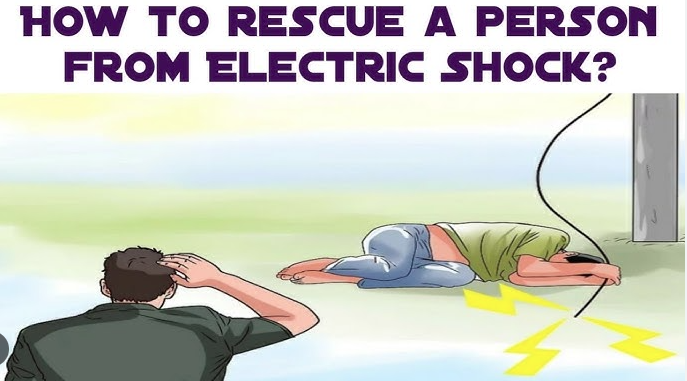
Do not touch the person or the wire. Call 112 and the electricity company so that the supply is cut, and call 108 for an ambulance. For home wiring, switch off at the source first. Start CPR once it is safe if the person is not responding and not breathing normally.
Is it safe to fly a kite near wires?
No. Tata Power-DDL advises flying in open areas away from overhead lines, avoiding metal-coated string, and not retrieving a kite stuck on a line.
What should we do about a fallen wire in the monsoon?
Treat it as live even if it is still, keep people back, and call the electricity company and 112. Better Health Channel advises staying more than 8 to 10 metres away.
How many people die of electrocution in India?
NCRB recorded 15,861 electrocution deaths in 2024 (Table 1.10), up from 13,835 in 2023. The figures do not say how many were caused by overhead lines.
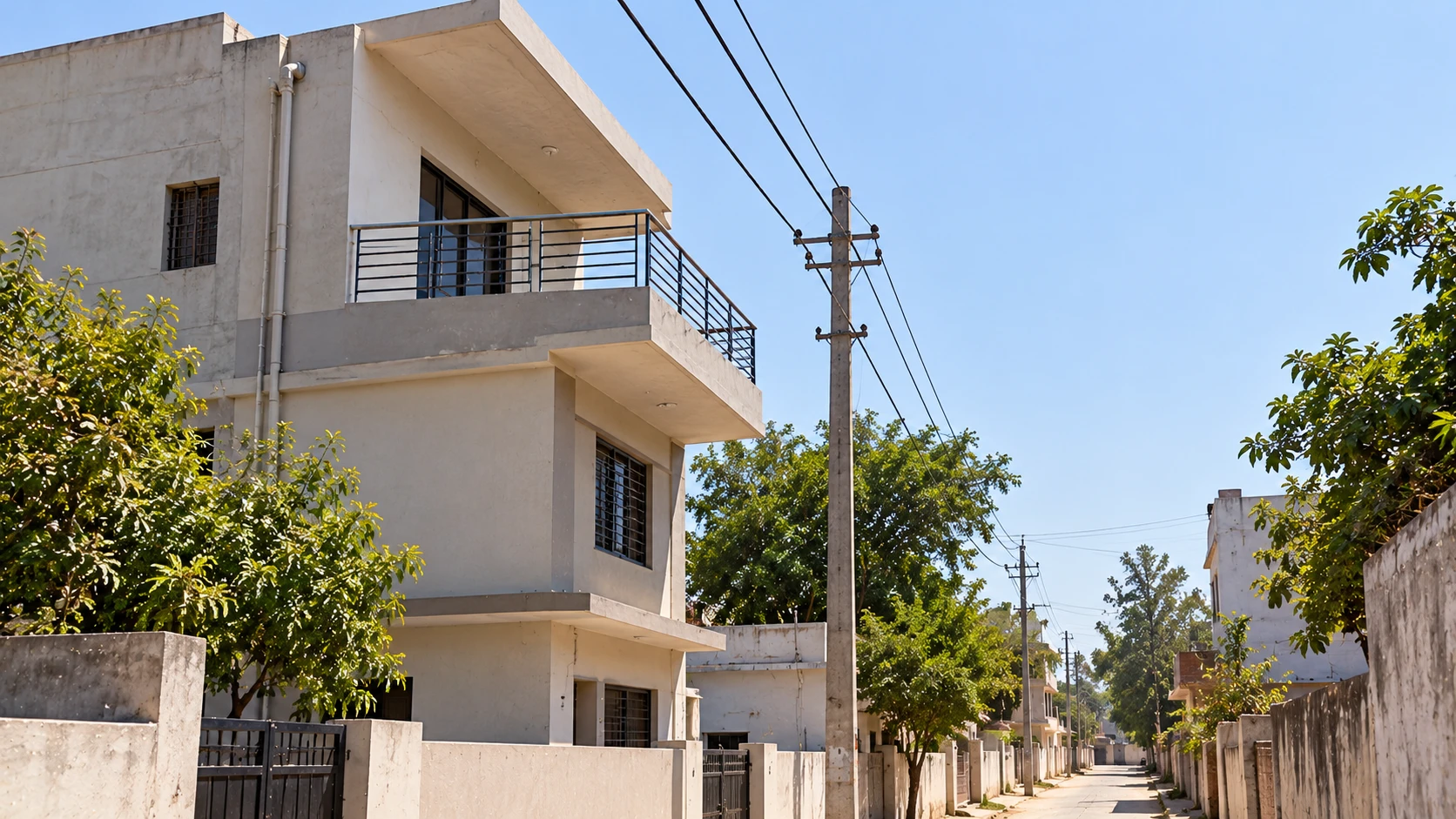
Most houses in India are older than the wires that now pass them. A lane gets built up, a floor goes on, a balcony is added, and one day the electric line that used to run past a blank wall is an arm’s length from a window. People get used to it. The family hangs washing near it, a boy flies a kite from the terrace, a mason carries an iron rod up a staircase. On 23 October 2026 a man died in Ganj Basoda, in Vidisha district of Madhya Pradesh, after reports say he came in contact with an 11 kV line passing very close to the third-floor balcony of the house where he lived. The police inquiry is on and how the current reached him is not settled. This guide is about the ordinary version of that hazard: what to look for, what the rules say about distance, who to call, and what a family, a landlord or a panchayat can do before anyone is hurt.
In short
- Never touch, reach for or move a wire. Never lean out towards one either. High-voltage current can jump a gap, so a wire does not have to be touched to be dangerous.
- Keep anything long and metal away. Iron rods, pipes, antenna poles, ladders, scaffolding poles, kite strings and wet bamboo are the usual way a person is connected to a line.
- The rules give minimum distances for buildings. For a line up to 650 volts it is 1.2 metres sideways and 2.5 metres above a roof, balcony or verandah. For lines above 650 volts, up to 11 kV, it is 1.2 metres sideways and 3.7 metres above the highest part of a building directly below.
- A low, bare or sagging wire is a complaint, not a chore. Photograph it from a safe spot, note the pole, and report it to your electricity company in writing.
- If someone is shocked, switch off at the source or call 112 and the electricity company. Do not touch the person or the wire.
How big is the problem
Electrocution killed 15,861 people in India in 2024, in 15,805 cases, according to figures that the States and Union Territories gave the National Crime Records Bureau (NCRB, Accidental Deaths & Suicides in India 2024, Table 1.10). That is about 3.4% of all accidental deaths that year, up from 13,835 in 2023. Madhya Pradesh (2,597), Rajasthan (1,803) and Maharashtra (1,651) had the most. Our state-wise NCRB breakdown has the full table. The figures we use do not split these deaths by cause, so we cannot say how many were caused by overhead lines near buildings. Treat the number as the size of the wider problem, not as a count for this hazard.
Where the danger comes from
- Leaning, reaching and climbing. A balcony, terrace edge or window grille close to a line turns an ordinary movement into a risk. This includes hanging out washing, cleaning a window, or reaching for a kite.
- Long metal objects. An iron rod carried up to a terrace, a pipe, an antenna or dish pole, a metal ladder, a flag pole and a metal-framed washing line can all touch or come close to a conductor. The Gorakhpur immersion case and the Jabalpur Majholi case this month both involve a pole or rod meeting an 11 kV line.
- Building work. Scaffolding, shuttering and bar-bending on a new floor often happen with a live line a short distance away.
- Kites and manja. Strings that fall on lines, especially metal-coated ones, can carry current, and children climb to retrieve kites.
- Trees and roofs. A branch resting on a line, or a line resting on a tin sheet or a roof edge, can make the whole branch, sheet or railing live.
- Rain and wet surfaces. Wet bamboo, wooden poles, ropes and railings are not reliable insulators. A wire that sagged in summer heat is also easier to reach.
What the rules say about distance
The Central Electricity Authority (Measures relating to Safety and Electric Supply) Regulations, 2023, published in the Gazette of India on 12 June 2023, set the distances below. We read the gazette text itself (its Hindi section) and give the numbers as printed. Your State may have its own rules or practice on top, and the electricity company decides how it applies them, so use these as a yardstick when you ask questions, not as a promise that a line is acceptable.
- Lines and service lines not above 650 volts, regulation 62. Where such a line passes over or near a building, measured with the line swung out to its maximum by wind, the minimum is 2.5 metres vertically from the highest point when the line is above the building, and 1.2 metres horizontally from the nearest point when it passes alongside. The regulation lists a flat roof, open balcony, verandah roof and lean-to roof in one group, and a sloping roof in another, with the same figures. Where a conductor is closer than this, the regulation says it is to be replaced with aerial bunched cable with a bare earthed messenger wire of at least 350 kgf breaking strength.
- Lines above 650 volts, regulation 63. As far as possible such a line is not to pass over an existing building, and no building is to be put up under an existing line. Where one passes over or near a building, the vertical distance above the highest part of a building directly beneath, at maximum sag, is at least 3.7 metres for lines up to and including 33 kV, with 0.30 metre more for each extra 33 kV or part of it. The horizontal distance to the nearest conductor, at maximum swing, is at least 1.2 metres for lines up to and including 11 kV, 2.0 metres for lines above 11 kV up to 33 kV, and 2.0 metres plus 0.30 metre for each extra 33 kV or part of it above that.
- What counts as a building. Both regulations say any structure, permanent or temporary.
- Height above the ground, regulation 60 and its Schedule VIII A. For the lowest conductor, the schedule gives, for lines up to 650 volts, 5.80 metres across a road, 5.50 metres along a road and 4.60 metres elsewhere. For an 11 kV line the figures are 6.50 metres across a road, 5.80 metres along a road and 4.60 metres elsewhere.
Notice what these numbers are. They are the legal minimum between a wire and a structure, worked out for a fixed building, not for a person leaning out of it or holding a pipe. The regulations give no distance at which a person can safely stand next to a live wire, and we did not find one in any official Indian source we opened. If a wire is closer to your balcony or window than the figures above, or you cannot tell, treat it as a fault to report.
Before you build a floor, a balcony or a scaffold
Regulation 65 covers anyone who plans a new building, an extra floor or an alteration near an existing line. The person must give written notice to the line owner and the electrical inspector, with a drawing that shows the scaffolding as well. The line owner checks it, and the work is not to start until the electrical inspector certifies that regulations 60, 62, 63, 66 and 79 will not be broken. The regulation also says the person who builds can be made to pay for any shifting of the line. A contractor who says “it is fine, I have done this before” is not a substitute for that notice.
Regulation 66 is the one for rods and pipes. It says no rods, pipes or similar material are to be carried under or near bare overhead conductors, and that such material must not be brought so near live bare conductors that a flashover could happen. If you are casting a slab, fixing a water tank pipe or raising an antenna near a line, that is the rule that applies.
If a wire is low, bare, sagging or touching a tree or roof
- Keep away and keep others away. Do not touch it, do not push a branch off it, do not throw anything over it and do not try to tie it up.
- Photograph it from a safe spot, and note the location, a landmark, and the number on the pole or the transformer if there is one. This is our suggestion; it helps the lineman find the right place.
- Report it to your electricity company by its helpline, and again in writing at the nearest office. Ask for a complaint number and keep it. Helplines as printed on the companies’ own pages, opened on 27 October 2026: MP Madhya Kshetra Vidyut Vitaran 1912 or 1800 233 1912; PGVCL (Gujarat) 19122 or 1800 233 155333, with WhatsApp complaints on +91 95120 19122; MSEDCL (Maharashtra) 1912 or 19120, and 1800-212-3435 or 1800-233-3435; BESCOM (Bengaluru) 1912; Tata Power-DDL (north and north-west Delhi) 19124. In other States, look up your own company’s printed number.
- Call 112 if the wire is down, sparking, or on a roof, road or tree where people are passing. Ask for the supply to be cut. Stay back and stop people from going near.
- If nothing happens, write again with the complaint number, then go to the company’s consumer grievance forum or the state’s electrical inspector. MP Madhya Kshetra’s contact page lists a grievance forum portal.
- Do not trim a tree or move a pole yourself. Our advice is to leave that to the company’s crew, with the supply off.
If someone is shocked
These steps follow the first-aid page of the Better Health Channel, run by the Victoria State Government in Australia, which we opened on 27 October 2026. We did not find an Indian official page with the same detail, and they match what our first aid guide says.
- Check for danger first. Do not touch the person until you are sure the power is off.
- Switch off at the source if it is a home appliance or wiring, at the plug, switch or main switch. If it cannot be switched off, the page says to move the person away using something dry that does not conduct, such as a wooden broom handle.
- If the person is on or against an overhead or fallen line, do not go near. The same page says to stay more than 8 to 10 metres away from fallen lines, to treat them as live even if they are not moving, and to keep others back. Call 112 and ask the electricity company to cut the supply. Our reading is that the dry-stick advice is for home wiring, not for a high-voltage line.
- Call 108 or 112 for an ambulance (see our emergency numbers guide). If the person is not responding and not breathing normally, start CPR if you are trained.
- Cool burns under cool running water for 20 minutes once it is safe and breathing is fine, and cover them loosely. Everyone who has had a shock should see a doctor, even if they seem all right.
Kite season and children
Tata Power-DDL’s advisory of 11 August 2025 says to fly kites in open areas away from overhead lines and electrical installations, and to avoid flying them from rooftops or terraces near power lines. It says metal-coated string can conduct electricity and trip lines, and that if a kite gets stuck on a line, do not try to retrieve it. It also asks adults to supervise children. In a lane where wires run past the terrace, the simplest rule is that the kite flies from a park or a ground. Tell children that a kite is never worth a climb onto a parapet.
Monsoon and storm-fallen wires
Rain brings down branches and, sometimes, the wire along with them. Treat any wire on the ground, on a fence or in water as live, even if it is still. Keep people and animals back, warn neighbours, and call the company and 112. Do not wade through water near a pole, and do not touch a metal gate, grille or railing that a wire may be leaning on. Wait for the company to confirm the supply is off.
What a family, landlord, RWA or panchayat can do
- Families. Keep metal frames, pipes and washing lines away from the side where a wire runs. Close or grill the balcony door that faces a close wire. Tell everyone in the house, including tenants and domestic workers, not to lean out there.
- Landlords and builders. Check where the wire is before you design the floor or the balcony. Ask the company for its written view, and give the notice regulation 65 asks for. If a tenant reports a close wire, pass the complaint on in writing and keep a copy.
- RWAs, mohalla committees and panchayats. Walk the lane together, list the low or close wires with photographs and pole numbers, and send one letter to the company’s divisional office, copied to the electrical inspector. Our suggestion is to ask, in that letter, for the line to be raised or shifted, or for a covered or insulated line where the company thinks it suitable. For a line up to 650 volts, regulation 62 itself provides for aerial bunched cable where the clearance is short. Whether it happens is the company’s decision, but a dated letter with a list is hard to ignore.
- Schools and anganwadis. Check the playground and terrace for wires, and keep kite flying off the roof.
What we could not confirm
- We did not find an official Indian figure for how close a person can safely be to a live wire, and do not give one. The 8 to 10 metre figure for fallen lines is from a state government health page in Australia.
- NCRB’s electrocution figures do not tell us how many deaths came from overhead lines near buildings.
- The clearance numbers come from the gazette text of the 2023 regulations. We did not check State amendments or any later notification that changes them, and individual companies may apply stricter rules.
- For the Ganj Basoda death, no report we read gave the distance of the wire from the balcony, or the company that owns the line. We have not used it to draw conclusions here.
- We found no official helpline for Tamil Nadu on a page we could open, so it is not listed. We did not find a public Instagram, Facebook or LinkedIn video on this topic that we could verify, so the videos below are from YouTube.
Do this today
Walk around your home and look up. Check every window, balcony and terrace edge for a wire within arm’s reach, or within the distances above. Photograph the nearest low or close wire from a safe place, note the pole number, and send it to your electricity company’s helpline tonight. Checked 27 October 2026.
What needs attention
- The CEA Safety Regulations 2023 set minimum distances between overhead lines and buildings, and different figures apply up to 650 V and above 650 V.
- Those distances are for structures; the regulations give no distance at which a person can safely stand near a live wire.
- Regulation 65 asks for written notice and an inspector's certificate before building near a line, and regulation 66 restricts carrying rods and pipes near bare conductors.
- For lines up to 650 V closer than the regulation 62 distances, the regulation says to replace the conductor with aerial bunched cable.
- NCRB recorded 15,861 electrocution deaths in India in 2024, up from 13,835 in 2023; the figures do not split by cause.
- A Ganj Basoda man died on 23 October 2026 after reported contact with an 11 kV line close to a balcony; the inquiry is on and the mechanism is not settled.
Controls that reduce risk
- Walk around your home and look for wires near windows, balconies and terraces.
- Keep metal objects, kite string and wet bamboo away from any wire.
- Report a low, bare or sagging wire to your electricity company and keep the complaint number.
- Before building near a line, give the notice regulation 65 asks for.
- Save 112, 108 and your electricity company's helpline on every phone in the house.
- Raise the list of close wires with the panchayat or RWA and send one letter to the company (our suggestion).
Common unsafe practices
- Leaning out of a balcony or terrace edge towards a close wire.
- Carrying iron rods, pipes, ladders or antenna poles near overhead lines.
- Building a floor or putting up scaffolding without giving notice to the line owner and the electrical inspector.
- Flying kites from a terrace near wires, or climbing to retrieve a kite from a line.
- Pushing a branch off a wire with a stick, or trying to tie up a sagging wire.
- Touching a person who is stuck to a wire or railing.
- Treating a low wire as the electricity company's problem alone and not reporting it in writing.



Leave a comment